
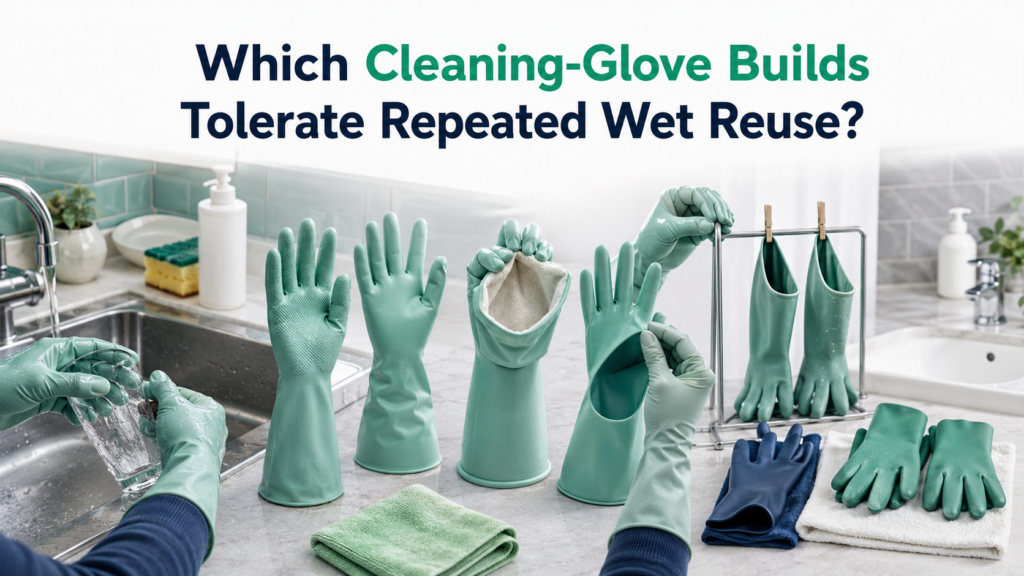
Which cleaning-glove builds tolerate repeated wet reuse?
Cleaning-glove builds tolerate repeated wet reuse when the exact product is designed for reuse and remains suitable for the task, cleaner, and next use.
Reuse readiness depends on complete construction, exposure history, care, household-zone assignment, structural condition, hygiene, function, dryness, and wearer comfort—not on material name, thickness, lining, or prior-use count alone.
This article provides general Cleaning-glove build guidance. Follow the household-cleaner label and exact glove manufacturer instructions. Stop use when reusable status or cleaner compatibility is unclear, the interior remains damp, water enters unexpectedly, grip or fit becomes unsafe, material changes occur, residue cannot be removed, or persistent skin irritation develops.
Why Does Construction Matter for Cleaning-glove builds Under Repeated Wet Reuse?
Construction matters because Cleaning-glove builds perform as complete products, and repeated wet reuse stresses their shell, cuff, lining, texture, fit, and current condition together.
Build durability remains one part of the broader need to Cleaning Gloves overview. HSE guidance similarly emphasizes the substance, contact type and duration, wearer, fit, comfort, and task rather than a material name alone. [HSE]
Why does reusable designation come first?
An exact product should be explicitly designed and labeled for repeated use. Disposable or single-use gloves should not be washed, dried, stored, or redonned as substitutes for reusable Cleaning-glove builds.
Why can no individual feature prove durability?
Thickness, lining, texture, cuff length, reinforcement, manufacturing method, and material may influence performance, but none independently proves cleaner compatibility, wet grip, drying speed, hygienic suitability, or service life.
What Does a Complete Construction Include in Cleaning-glove builds?
A Cleaning-glove build includes the exact shell and formulation where disclosed, documented thickness, cuff, lining, texture, reinforcement, size, fit, overall shape, reusable status, and intended household use.
How does thickness affect Cleaning-glove builds?
Greater documented thickness may support some forms of wear resistance, but it may also reduce dexterity, tactile feedback, comfort, and fine-object control. Wet grip, cleaner compatibility, drying time, and service life must be assessed separately.
How do cuff, lining, texture, and reinforcement affect Cleaning-glove builds?
Cuffs influence splash coverage and runoff control; lining may support comfort but retain moisture; texture may support wet handling but wear smooth; reinforcement matters only where it is documented and matches the actual wear point.
Table 1. Compare each feature by benefit, trade-off, verification, and rejection trigger.
| Construction Feature | Potential Benefit | Trade-Off | User Verification | Rejection Trigger |
|---|---|---|---|---|
| Greater documented thickness | May support some wear resistance | May reduce dexterity | Can wet objects still be handled safely? | Handling becomes unsafe |
| Flock lining | May improve comfort and donning | May dry slowly or retain odor | Is the lining fully dry and intact? | Persistent dampness or damage |
| Unlined interior | May be easier to inspect | Perspiration may be more noticeable | Is comfort acceptable? | Intolerable moisture or difficult donning |
| Longer cuff | Adds splash coverage | May still admit runoff | Does the cuff suit the task? | Repeated cuff entry |
| Textured palm or fingers | May improve wet handling | Texture may wear smooth | Is grip controlled? | Slipping or grip loss |
| Documented reinforcement | May support stressed areas | May add stiffness | Does it match the wear point? | Reinforced area fails |
| Seamless shell where documented | Removes conventional stitched seams | Does not prevent puncture or degradation | Is water exclusion maintained? | Localized water entry |
| Correct size and shape | Supports grip and cuff stability | Sizes vary by brand | Does the build remain secure? | Twisting, bunching, or harmful pressure |
Thickness, lining, texture, and reinforcement must never be treated as independent proof of service life.
Which Task Conditions Determine Reuse Stress for Cleaning-glove builds?
Reuse stress for Cleaning-glove builds depends on the cleaner, immersion, water temperature, flexing, abrasion, frequency, household zone, and available drying window.
How do immersion and water temperature affect Cleaning-glove builds?
Assess continuous immersion, repeated splashing, warm water, extended wear, cuff entry, and temperature changes through the full wet-use guide. Ordinary Cleaning-glove builds should not be treated as thermal-protection gloves.
How do scrubbing, abrasion, flexing, and frequency affect Cleaning-glove builds?
Mechanical stress may concentrate at fingertips, palms, cuffs, and high-flex areas. Frequency is only one input; a short severe task may create more stress than several mild tasks.
Table 2. Define the real exposure before selecting or reusing a build.
| Household Task | Cleaner and Exposure | Wet or Mechanical Stress | Reuse Frequency | Drying Window | Evidence Needed | Possible Outcome |
|---|---|---|---|---|---|---|
| Daily dishwashing | Detergent and warm immersion | Grip, flexing, glassware | Frequent | Short | Exact product and cleaner instructions | Reuse, rotate, or reassess |
| Weekly bathroom scrubbing | Bathroom cleaner and splash | Abrasion and cuff exposure | Weekly | Usually adequate | Compatibility and care guidance | Reuse in assigned zone |
| Toilet or drain cleaning | Potentially stronger cleaner | Splash, scrubbing, hygiene stress | Variable | Separate drying area | Exact compatibility and zone history | Restrict or replace |
| Frequent mopping | Floor cleaner and bucket contact | Wringing and handle grip | Frequent | Variable | Cleaner label and wet-grip check | Reuse or rotate pairs |
| Unknown cleaner | Unknown | Unknown | Any | Any | Identify cleaner and exact product | Stop and reassess |
| Cleaner causing material changes | Known or suspected incompatibility | Swelling, tackiness, hardening | Any | Not corrective | Manufacturer guidance | Replace |
No row creates a guaranteed cycle count or universal build ranking.
How Should Exact Cleaning-glove builds Be Selected for Repeated Reuse?
Select Cleaning-glove builds by exact product evidence, intended use, cleaner, task stress, wearer, fit, wet grip, and available care and drying time.
What evidence should be checked for Cleaning-glove builds?
Check the manufacturer, product name and code, reusable designation, intended use, construction, size, cuff, lining, texture, cleaner compatibility, and care instructions. Exact compatibility requires a product-specific review of cleaner-matching guide. HSE notes that glove performance can vary between manufacturers and should be assessed from the correct manufacturer’s data. [SEL]
How should fit and grip be assessed for Cleaning-glove builds?
The build should remain secure without bunching, twisting, harmful pressure, or repeated adjustment. Wet objects should be handled under representative conditions, balancing grip with dexterity. HSE recommends considering textured surfaces for wet handling while preserving task control. [HSE]
How Do Lined and Unlined Cleaning-glove builds Differ During Reuse?
Lined and unlined Cleaning-glove builds create different comfort, perspiration, inspection, and drying trade-offs, but neither type is automatically stronger or longer-lasting.
What may lined Cleaning-glove builds offer?
Flock lining or a compatible removable liner may support comfort, donning, and perspiration management. Potential limitations include slow drying, retained moisture, persistent odor, residue retention, and more difficult inspection.
What may unlined Cleaning-glove builds offer?
An unlined interior may be easier to inspect and may suit some drying routines, but perspiration can be more noticeable and donning may be less comfortable for some wearers. Unlined does not mean weaker.
Can removable cotton liners be used?
Compatible cotton liners may help with hot, sweaty hands during prolonged use, but they must fit correctly, remain dry, and not interfere with glove performance. HSE presents liners and glove breaks as conditional controls rather than universal requirements. [CLN] [PPE]
Table 3. Compare comfort and care trade-offs without declaring a durability winner.
| Build Type | Potential Advantage | Potential Limitation | Before-Reuse Check | Do Not Assume |
|---|---|---|---|---|
| Flock-lined build | Comfort and easier donning | Retained moisture, odor, slow drying | Lining is fully dry, clean, and intact | Lining strengthens the shell |
| Removable cotton liner | May reduce sweaty-hand discomfort | Must remain compatible and dry | Liner is clean, dry, and correctly fitted | Every task allows a liner |
| Unlined build | Interior may be easier to inspect | Perspiration may be more noticeable | Interior is dry and fit remains controlled | Unlined means weaker |
| Any lined or unlined build | Performance depends on full construction | Exact care requirements vary | Follow manufacturer instructions | One type always lasts longer |
Choose between lined and unlined builds by task, wearer, care, and drying conditions—not a universal durability claim.
How Should Cleaning-glove builds Be Cleaned, Dried, and Stored Between Uses?
Cleaning-glove builds should be removed, cleaned where supported, drained, dried, inspected, and stored according to the exact cleaner label and manufacturer instructions.
Every reusable build needs a supported drying guide.
When may Cleaning-glove builds be rinsed?
Rinsing may remove exterior residue where the cleaner and glove instructions permit it. It cannot reverse permeation, swelling, tackiness, hardening, softening, brittleness, loss of elasticity, or chemical degradation.
How should Cleaning-glove builds be dried?
Open cuffs, drain the exterior, ventilate the interior, allow enough time, and use approved racks where available. Invert only when the design and manufacturer permit it. Avoid high heat unless expressly approved.
How should Cleaning-glove builds be stored?
Store them fully dry, open, shaded, away from heat and sharp objects, and separated by household zone. Do not ball them up or trap damp pairs in sealed containers.
When Should Cleaning-glove builds Not Be Reused Across Household Tasks?
Cleaning-glove builds should not cross household zones when prior contamination, cleaner exposure, or unknown use history makes hygienic reuse inappropriate.
Why should kitchen Cleaning-glove builds remain separate?
Pairs used for dishwashing or food-related surfaces should remain separated from bathroom, toilet, drain, and floor pairs. Structural integrity alone does not prove hygienic suitability.
Does rinsing make Cleaning-glove builds suitable for another household zone?
No. Rinsing cannot establish that residue, contamination, odor, or unknown prior use has been resolved. Zone history remains part of the reuse decision.
Table 4. Keep pairs separated where contamination or cleaner history makes cross-zone reuse inappropriate.
| Assigned Zone | Typical Prior Exposure | May Move to Kitchen? | Required Control | Reject or Restrict When |
|---|---|---|---|---|
| Dishwashing | Food-contact items and detergent | Only if assigned and suitable | Keep as a dedicated pair | Prior use is uncertain |
| Kitchen cleaning | Counters and kitchen cleaner | Only within approved kitchen tasks | Separate from bathroom and floor pairs | Unknown cleaner or contamination |
| Bathroom cleaning | Bathroom surfaces and cleaner | No automatic return | Keep bathroom-only | Residue, odor, or zone mixing |
| Toilet or drain | High-hygiene-risk surfaces | No | Dedicated restricted pair | Any cross-zone proposal |
| Floor cleaning | Floor soil and cleaner | No | Store separately | Mixed with food-related pairs |
| Unknown zone | Unknown | No | Stop and identify history | History cannot be confirmed |
Rinsing alone does not prove that a build is hygienically suitable for another household zone.
When Are Cleaning-glove builds No Longer Fit for Reuse?
Cleaning-glove builds are no longer fit for reuse when intended-use, structural, hygienic, functional, or wearer-readiness checks fail and cannot be corrected safely.
Use condition-based replacement guide rather than a fixed date or cycle count.
Which structural and material signs reject Cleaning-glove builds?
Reject tears, cracks, cuff damage, worn texture, deformation, swelling, tackiness, hardening, softening, brittleness, loss of elasticity, or repeated localized water entry. Visual inspection cannot prove that a build is pinhole-free.
Which hygienic and functional conditions reject Cleaning-glove builds?
Persistent odor, damp lining, unremovable residue, unknown zone history, unsafe wet grip, changed fit, poor cuff control, or loss of water exclusion require restriction, reassessment, or replacement.
How should skin symptoms affect Cleaning-glove builds?
Persistent redness, itching, cracking, burning, soreness, swelling, or rash requires stopping use and reassessing moisture, fit, lining, cleaner, latex, rubber additives, and skin condition. Latex proteins may cause allergy, while sweating, occlusion, additives, and contamination may also contribute. [LAT] [LAT-2]
Table 5. Match the observed condition to a specific next action.
| Observed Condition | Readiness Dimension | Immediate Action | Reuse Outcome | Replacement Trigger |
|---|---|---|---|---|
| Fully dry, intact, correct task and cleaner | All five pass | Complete final check | Reuse | Any failed dimension |
| Interior or lining remains damp | Hygienic / wearer | Ventilate and dry further | Dry further | Persistent dampness or odor |
| Removable residue remains | Hygienic | Clean again if instructions allow | Clean again | Residue cannot be removed |
| Wrong household zone | Hygienic / intended use | Return to assigned zone | Restrict | Zone history unknown |
| Compatibility or prior use is unclear | Intended use | Stop and verify evidence | Reassess | Uncertainty remains |
| Crack, tackiness, swelling, leakage, unsafe grip | Structural / functional | Remove from use | Replace | Confirmed or repeated failure |
| Persistent irritation | Wearer | Stop use and reassess | Reassess or replace | Symptoms continue |
A visually intact build may still fail hygienic, functional, intended-use, or wearer-readiness checks.
Which Mistakes Cause Cleaning-glove builds to Fail or Become Unsuitable Early?
Early failure often follows selection, care, hygiene, or inspection mistakes rather than one universally inferior material or build.
Which selection mistakes affect Cleaning-glove builds?
Common mistakes include choosing by material name, thickness, marketing labels, or prior-use count; ignoring cleaner compatibility; accepting poor fit; and treating water resistance as chemical compatibility.
Which care and hygiene mistakes affect Cleaning-glove builds?
High heat, incomplete drying, sealed damp storage, universal inside-out drying, mixed household zones, and assuming rinsing restores damaged material can make reuse unsuitable.
Which inspection mistakes affect Cleaning-glove builds?
Looking only for large tears misses grip loss, localized water entry, cuff stretching, damp lining, residue, odor, fit changes, and wearer discomfort.
What Should Households Verify Before Reusing Cleaning-glove builds?
Before every reuse, households should verify the exact product, next task, cleaner, zone, exposure, construction, care history, current condition, performance, and wearer response.
- Exact product is identified.
- Reusable designation is confirmed.
- The next household task matches intended use.
- The household-zone assignment is appropriate.
- The exact cleaner and dilution are known.
- Cleaner compatibility is supported.
- Immersion, splashing, and temperature are acceptable.
- Scrubbing, abrasion, flexing, and sharp-object exposure are acceptable.
- The available drying window is adequate.
- Shell, fingertips, palm, high-flex areas, and cuff are intact.
- Texture and documented reinforcement remain functional.
- No localized water entry suggests a hidden leak.
- No swelling, tackiness, hardening, softening, brittleness, or elasticity loss is present.
- Interior and exterior are fully dry.
- No unacceptable residue, persistent odor, or contaminated lining remains.
- Wet grip, fit, dexterity, cuff control, and safe removal remain acceptable.
- The wearer has no persistent discomfort, redness, itching, cracking, burning, or swelling.
- Care and storage history are acceptable.
- Prior cleaner and household-zone history are known.
- The final outcome is reuse, dry further, clean again, restrict, reassess, or replace.
Selected Sources
What Should Households Remember About Cleaning-glove builds and Repeated Wet Reuse?
Cleaning-glove builds tolerate repeated wet reuse only when the exact product is designed for reuse and continues to match the task, cleaner, household zone, care history, structural condition, hygienic condition, functional requirements, and wearer comfort.
Construction features create trade-offs rather than durability rankings. No universal cycle count applies; disposable gloves must not be reused; rinsing does not reverse chemical deterioration; the interior must be fully dry; and final approval applies only to the next defined task.
Frequently Asked Questions About Cleaning-glove builds and Repeated Wet Reuse
Does greater thickness mean Cleaning-glove builds will last longer?
Not automatically. Greater thickness may support some forms of wear resistance but may reduce dexterity and tactile control. Cleaner compatibility, abrasion, care, fit, and current condition remain essential.
Are lined Cleaning-glove builds more durable than unlined builds?
Not necessarily. Lining mainly affects comfort, donning, perspiration management, inspection, and drying. It does not automatically strengthen the shell.
How many wet-use cycles can Cleaning-glove builds tolerate?
There is no universal cycle count. Reuse remains acceptable only while the exact build remains compatible, intact, fully dry, hygienically suitable, functional, correctly assigned, and comfortable.
Can disposable gloves be cleaned and reused as Cleaning-glove builds?
No. Gloves labeled disposable or single-use should not be washed, dried, stored, or redonned for repeated household cleaning.
Can toilet-cleaning Cleaning-glove builds be reused for dishwashing if they look intact?
No. Structural readiness does not establish hygienic readiness. Toilet and drain builds should remain restricted to their assigned household zone.
What should happen when Cleaning-glove builds cause skin irritation?
Stop using the build and reassess fit, trapped moisture, cleaner exposure, lining, latex, rubber additives, and skin condition. Do not automatically replace it with the same product.