
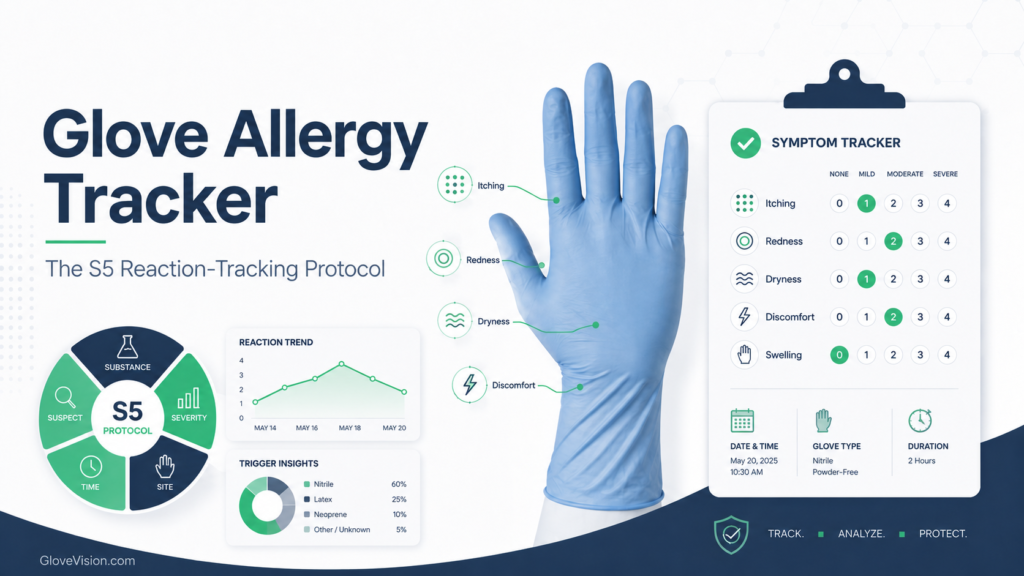
Glove Allergy Tracker: The S5 Reaction-Tracking Protocol
A structured symptom-tracking system that helps frequent glove users compare reaction patterns across glove materials, rubber accelerators, moisture, occlusion, friction, hand hygiene products, and external irritants.
The Glove Allergy Tracker is a structured 7-day reaction log that helps frequent glove users document glove-related symptoms across material, rubber accelerator exposure, sweat, friction, hand hygiene products, and wear duration without self-diagnosing a medical allergy.
This page explains how to control tracking variables, compare common glove-related triggers, record symptoms in a matrix, interpret repeated patterns, build a safer glove-use plan, and validate whether the new system keeps both skin reaction scores and job protection under control.
Critical Safety Boundary
Why Can a Glove Allergy Tracker Reduce Repeated Irritation?
A Glove Allergy Tracker can reduce repeated glove-related skin irritation by replacing random glove switching with controlled symptom documentation across material, wear duration, sweat level, hand hygiene exposure, and reaction timing.
Occupational exposure history matters significantly. NIOSH reported that between 8% and 12% of 7 million healthcare workers showed evidence of latex sensitization, and over 22 billion pairs of medical gloves were sold in 1997. [NIOSH]
Tracking improves professional review because presenting a clinician with a structured record of confounders and variables is far more useful than guessing after symptoms appear.
Why Does Random Glove Switching Fail?
Random glove switching fails because changing brand, material, thickness, fit, accelerator chemistry, powder status, and wear duration at the same time makes the reaction pattern impossible to isolate.
This creates variable overload, where it is impossible to know which specific change triggered or resolved the skin issue.
When a user switches from a powdered latex glove to a powder-free nitrile glove and simultaneously changes their hand sanitizer, the true cause of the reaction becomes completely obscured.
What Glove-Related Triggers Can the Tracker Compare?
Figure 1: Multiple occupational variables converge into identical symptoms. Tracking isolates the pattern to differentiate chemical, mechanical, and moisture-based triggers.
The Glove Allergy Tracker can compare reaction patterns linked to latex exposure, rubber accelerators, sweat and occlusion, hand hygiene irritation, friction, pressure, and poor glove fit, but it cannot diagnose the medical cause.
Rubber accelerator allergy is diagnosed through clinical history and patch testing. Thiuram mix tests four thiuram chemicals with one test, and one of these four accounts for about 9 out of 10 allergy cases to thiuram mix. Mercapto mix tests 3 chemicals in one test. [DermNet]
How Can Latex Protein Sensitivity Appear in Glove Users?
Latex protein sensitivity may appear quickly after natural rubber latex exposure, with symptoms such as itching, redness, hives, swelling, or respiratory symptoms in sensitized users.
Natural rubber latex is a material derived from rubber tree fluid and used in some gloves and medical products.
Latex proteins are specific proteins within this natural fluid that can trigger allergic reactions in sensitized people.
Do not deliberately retest natural rubber latex if immediate symptoms have occurred in the past.
How Do You Control External Factors Before Starting?
Figure 2: Biochemical impact of hand hygiene. Uncontrolled sanitizer and soap spikes disrupt the skin’s lipid barrier, creating false tracking spikes that mimic glove-induced reactions.
You control external factors before starting the Glove Allergy Tracker by keeping skin-contact products, hand hygiene routines, glove duration, drying time, and workplace conditions as consistent as practical during the tracking period.
The AAD recommends washing hands for at least 20 seconds, and the CDC states that hand sanitizers with 60–95% alcohol are more effective at killing many germs than lower-alcohol or non-alcohol-based sanitizers. [AAD] [CDC]
A confounder is any outside variable that affects skin condition and distorts the tracking results.
Hand hygiene control involves tracking, rather than changing, the soaps and sanitizers required by workplace rules.
How Do You Set Up the 7-Day Tracker Sequence?
Figure 3: The S5 Reaction-Tracking Sequence Protocol. A controlled 7-day timeline isolating a single safer variable against a confirmed baseline to ensure accurate pattern recognition.
You set up the 7-day Glove Allergy Tracker sequence by recording baseline skin condition first, repeating the current glove exposure, comparing safer variables only when appropriate, and confirming the lowest-reaction option without unsafe re-exposure.
Required Disclaimer: The 7-day sequence is a practical tracking framework, not a validated diagnostic protocol.
The baseline establishes your starting skin health before any new variable is introduced.
Current-glove repeat tracking ensures the current problem is consistently documented.
How Do You Record Symptoms in the Matrix?
You record symptoms in the 7-day Glove Allergy Tracker matrix by logging exposure details, hand hygiene counts, moisture level, symptom location, symptom timing, and a consistent 0–4 score for each major symptom category.
Required Disclaimer: The 0–4 score and 20-point total are tracking templates only. They are not validated clinical severity scores.
Which Symptoms Should the Glove Allergy Tracker Score?
The Glove Allergy Tracker should score redness, itching, swelling, dryness or cracking, and blistering or burning because these categories capture the most practical day-to-day skin changes.
How Is the Inflammatory Pattern Score Calculated?
The Inflammatory Pattern Score is calculated by adding redness, itching, swelling, dryness or cracking, and blistering or burning scores for a maximum daily score of 20.
Inflammatory Pattern Score Formula
Score = Redness + Itching + Swelling + Dryness/Cracking + Blistering/Burning
Maximum Score: 20
7-Day Glove Reaction Log Matrix
Automated Pattern Analysis
Template Boundary: This automated analysis scans your inputs against common trigger patterns for educational documentation. It strictly does not diagnose medical allergies, allergic contact dermatitis, or irritant dermatitis. Always present this data to a professional.
Which Tracker Patterns Suggest the Most Likely Trigger?
Figure 4: Differentiating immediate systemic hazards from localized, trackable irritation. Immediate hypersensitivity requires stopping the tracker, whereas delayed irritation allows for variable isolation.
Glove Allergy Tracker patterns can suggest possible trigger categories when symptoms repeatedly align with latex exposure, accelerator-containing gloves, sweat, occlusion, friction, fit pressure, or hand hygiene spikes, but only a qualified professional can diagnose the cause.
Professional patch testing investigates and confirms substances that produce allergic contact dermatitis. Allergens are usually applied for 48 hours and read at 96 hours, because delayed reactions usually take 48–96 hours to develop. Baseline series usually pick up about 70% of contact dermatitis. [DermNet]
How Do You Build a Safer Glove-Use Plan?
You build a safer glove-use plan after completing the Glove Allergy Tracker by selecting the lowest-reaction repeatable glove condition, matching the change to the likely pattern, preserving hazard protection, and validating improvement over 5 workdays.
No single glove type resists all chemicals indefinitely, and choosing the right glove design and construction gives the best protection only when it also fits well. [DermNet]
Users should choose the lowest-reaction glove condition only when the lower score repeats and the glove still provides the required protection for the actual work hazard.
What Checklist Confirms Whether the New System Is Working?
Figure 5: Work-Safety Validation Integrity. A successful glove system must simultaneously maintain symptom-free skin conditions while effectively deflecting biological, chemical, and mechanical workplace hazards.
The new glove system is working only if symptoms stay consistently low, no severe reaction appears, work performance remains safe, and the glove still protects against the actual job hazard.
Required Disclaimer: The 5-day validation checklist is a practical consistency check, not a clinical clearance test.
What Is the Final Rule for Accepting a New Glove System?
A new glove system should be accepted only when it reduces symptoms consistently and still protects against the actual work hazard.
Comfort is not success unless protection is still intact.
Frequently Asked Questions
What is the Glove Allergy Tracker?
Can the Glove Allergy Tracker diagnose a latex allergy or glove allergy?
When should someone stop using the Glove Allergy Tracker?
What glove-related triggers can the tracker compare?
When should the tracker be shared with a professional?
Conclusion
The Glove Allergy Tracker gives frequent glove users a structured way to document reaction patterns across glove materials, accelerator exposure, sweat, friction, hygiene, and wear duration without self-diagnosing a medical condition.
This guide covered safety stop conditions, variable control, symptom scoring, pattern interpretation, safer glove-use planning, and validation that the selected glove system still protects against the actual work hazard while keeping skin reactions consistently low.