
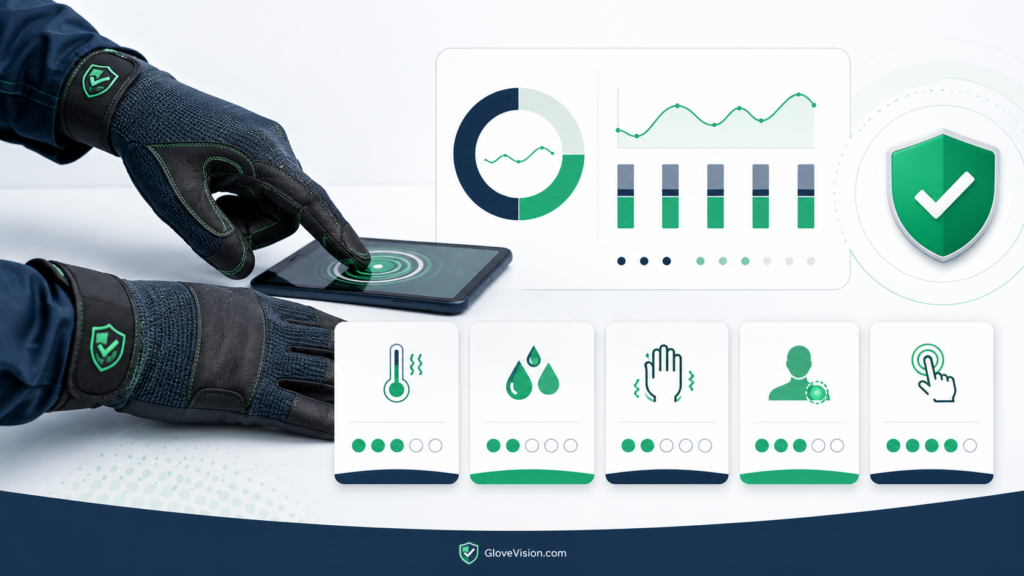
Glove Comfort Assessment: S5 Comfort Evaluation Protocol
The Glove Comfort Assessment is an S5 comfort evaluation protocol that helps high-frequency glove users identify whether heat, sweat, stiffness, chafing, tactile loss, or safety limits are causing comfort breakdown during real work.
The S5 framework means Sweat, Skin Friction, Stiffness, Sensation, and Safety; this article covers safety-stop rules, protection rejection rules, comfort drivers, pre-test controls, comfort scoring, DCI, Comfort Decay, targeted action planning, and 5-day validation. It is not a medical test, diagnosis tool, PPE certification, or replacement for workplace hazard assessment, and comfort improvement cannot override required protection.
How Does a Glove Comfort Assessment Reveal Comfort Breakdown That First-Wear Impressions Miss?
A Glove Comfort Assessment reveals comfort breakdown that first-wear impressions miss by measuring how heat, sweat, stiffness, chafing, and touch control change during planned wear intervals.
First-wear comfort is useful, but it mainly captures donning feel, initial softness, and the first impression of flexibility.
Wear-time comfort adds the missing evidence layer by recording how the glove behaves after movement, gripping, sweating, tool handling, and task repetition.
| First-Wear Comfort Checks | Wear-Time Comfort Checks |
|---|---|
| Feels comfortable at donning | Comfort after 30, 60, and 120 minutes |
| Initial softness | Heat buildup during repeated use |
| Initial fit feel | Sweat pooling and skin friction |
| Initial flexibility | Fatigue during gripping and pinching |
| Initial tactile impression | Touch control during actual task performance |
Why Should Glove Comfort Not Be Judged in the First 60 Seconds?
Glove comfort should not be judged in the first 60 seconds because heat, sweat, friction, stiffness, and tactile loss often appear only after repeated movement or prolonged wear.
The first minute checks donning feel, but it does not show how the glove responds to repeated gripping, task pace, moisture buildup, or touch-control loss.
How Does Glove Comfort Break Down During Prolonged Wear?
Glove comfort can break down during prolonged wear when heat accumulates, sweat pools, stiff material increases grip effort, seams rub the skin, or reduced sensation causes over-gripping.
Each pathway should be interpreted as a comfort pattern, not a diagnosis of allergy, dermatitis, nerve injury, or circulation disease.
Which Comfort Warning Signs Should the Glove Comfort Assessment Track?
The Glove Comfort Assessment should track heat buildup, sweat trapping, hand fatigue, chafing, finger soreness, grip slippage, loss of touch control, skin pinching, cuff rubbing, and reduced task focus.
When Should a Glove Comfort Assessment Stop and Professional Review Begin?
A Glove Comfort Assessment should stop and professional review should begin when testing causes numbness, tingling, burning, rapid swelling, restricted circulation, open rash, bleeding, raw blisters, hand weakness, chemical burn signs, infection signs, or symptoms that continue after glove removal.
These safety-stop signals should not be treated as ordinary comfort data because they may require medical, ergonomic, occupational health, or workplace safety review.
NIOSH describes pain, tingling, or numbness in the hand, wrist, or arm in ergonomic injury contexts, so these signals should stop the test rather than be converted into comfort scores. NIOSH
Which Symptoms Mean the Glove Comfort Assessment Should Stop Immediately?
The Glove Comfort Assessment should stop immediately when numbness, tingling, burning, rapid swelling, restricted circulation, severe itching, open rash, bleeding, raw blisters, chemical burn signs, infection signs, hand weakness, or persistent symptoms appear.
The user should remove the glove safely and record the glove model, task, symptom, location, timing, and whether the symptom continued after removal.
Why Should Severe Skin or Circulation Symptoms Not Be Treated as Normal Discomfort?
Severe skin or circulation symptoms should not be treated as normal discomfort because they may involve more than glove comfort and can make continued testing unsafe.
The assessment cannot diagnose allergies, infections, burns, nerve problems, or circulation problems, so severe or persistent symptoms need review outside the scoring matrix.
What Should Users Do When Safety-Stop Symptoms Appear?
When safety-stop symptoms appear, users should stop the test, remove the glove safely, record the glove model, task, symptom, location, and timing, and seek review if symptoms are severe, persistent, repeated, or work-limiting.
Users should not retest the same glove when severe symptoms repeat because the next step is review, not more comfort scoring.
| Stop-Test Signal | Continue Testing? | Action |
|---|---|---|
| Mild warmth | Possibly | Record and continue if safe |
| Mild sweat | Possibly | Record and continue if safe |
| Numbness or tingling | No | Stop and seek review if repeated |
| Burning sensation | No | Stop and remove glove safely |
| Rapid swelling | No | Stop and seek professional review |
| Open rash or bleeding | No | Stop testing |
| Chemical burn signs | No | Stop and follow workplace safety procedure |
| Symptoms continue after glove removal | No | Seek medical or occupational health review |
When Should a Glove Comfort Assessment Reject a More Comfortable Glove?
A Glove Comfort Assessment should reject a more comfortable glove when comfort gains reduce chemical, biological, cut, puncture, heat, cold, electrical, contamination, grip, or workplace-specific protection.
OSHA requires appropriate hand protection when hands face hazards such as harmful substance absorption, severe cuts, abrasions, punctures, chemical burns, thermal burns, and harmful temperature extremes. OSHA
OSHA also requires workplace hazard assessment and PPE selection that protects employees from identified hazards, so comfort cannot override the hazard baseline. OSHA
When Should a More Comfortable Glove Be Rejected?
A more comfortable glove should be rejected when it lowers required chemical resistance, biological protection, cut protection, puncture protection, heat or cold protection, electrical safety, contamination control, grip safety, durability, compliance, or task safety.
A glove that tears early, slips during handling, leaks, or encourages unsafe shortcuts is not a successful comfort upgrade.
Why Can Comfort Never Override Hazard Protection?
Comfort can never override hazard protection because a glove is only successful when it improves wear tolerance while still protecting the user against the actual job hazard.
Comfort matters inside the protection boundary; outside that boundary, the glove fails the task even if it feels better.
What Is the Final Protection Rule?
The final protection rule is that a glove passes the Glove Comfort Assessment only when it improves comfort and still meets the required hazard protection level for the task.
Comfort is not a win if protection fails.
| Rejection Question | Pass/Fail |
|---|---|
| Does the glove meet required chemical protection? | |
| Does the glove meet required biological protection? | |
| Does the glove meet required cut protection? | |
| Does the glove meet required puncture protection? | |
| Does the glove meet required heat/cold protection? | |
| Does grip remain safe? | |
| Does touch control improve without reducing protection? | |
| Does the glove comply with workplace PPE rules? | |
| Does the glove avoid unsafe tearing, slipping, or leaking? |
What Comfort Drivers Are Evaluated During a Glove Comfort Assessment?
A Glove Comfort Assessment evaluates five comfort drivers: heat, sweat, fatigue, chafing, and touch control.
These drivers are practical wearability factors used to isolate the main reason a glove becomes harder to tolerate during real work.
Trapped warmth inside the glove.
Moisture pooling or clammy skin feel.
High effort during grip or pinch movement.
Localized rubbing, pressure, or irritation.
Reduced fingertip feedback and precision.
How Does Heat Affect Glove Comfort?
Heat affects glove comfort by creating a warm, trapped feeling inside the glove that can reduce wear tolerance during longer use.
Heat problems often appear after continuous use because the glove environment changes as movement, task pace, and enclosed warmth accumulate.
How Does Sweat Affect Glove Comfort?
Sweat affects glove comfort by pooling around the palm, fingertips, and finger spaces, which can make grip feel unstable and skin feel damp.
Sweat tracking helps separate moisture problems from fit, friction, and material-stiffness problems without treating sweat as a medical diagnosis.
How Does Material Stiffness Affect Glove Fatigue?
Material stiffness affects glove fatigue by making finger movement, grip, and pinch actions require more effort during repeated tasks.
Stiffness should be interpreted as a functional comfort problem, not as proof that the glove caused an injury.
How Does Chafing Affect Glove Comfort?
Chafing affects glove comfort when seams, cuffs, rough inner surfaces, tight areas, or repeated rubbing create localized soreness or friction marks.
Location patterns can point toward construction or fit issues, but they should not be used to diagnose dermatitis.
How Does Touch Control Affect Glove Comfort and Performance?
Touch control affects glove comfort and performance because poor fingertip sensitivity can make users over-grip tools or handle small items less precisely.
Task-performance comparison should stay task-specific: ASTM F2010/F2010M supports comparing glove effects on dexterity by timing simple tasks with and without gloves, but this page does not treat DCI as an ASTM score. ASTM
Higher dexterity or thinner tactile zones can be considered only when material strength, coating, and required hazard protection still match the task.
| Comfort Driver | Physical Sign | Work Impact |
|---|---|---|
| Heat | Warm, trapped feeling inside glove | Reduces wear tolerance |
| Sweat | Moisture pooling or clammy skin | Reduces grip and comfort |
| Fatigue | Finger stiffness or high grip effort | Slows repetitive tasks |
| Chafing | Rubbing, pressure, raw spots | Causes localized discomfort |
| Touch Control | Reduced fingertip sensation | Weakens precision and grip calibration |
How Do You Control Test Variables Before Starting a Glove Comfort Assessment?
You control test variables before starting a Glove Comfort Assessment by keeping glove model, glove size, task conditions, wear-time intervals, environment, and starting hand condition as consistent as practical.
A control variable is a factor kept stable so the comparison is fair.
Test controls cannot override required replacement, hygiene, contamination, or safety rules because PPE still has to protect against identified hazards. OSHA
How Should Glove Model and Size Be Controlled?
Glove model and size should be controlled by using the same model and size during baseline testing while recording material, coating, thickness, cuff type, liner style, and fit condition.
Changing size or model during baseline testing weakens the result because the comparison no longer isolates wear-time comfort.
How Should Task Conditions Be Controlled?
Task conditions should be controlled by using the same work task, tool, workstation, work speed, and task difficulty as consistently as practical.
Comparing unrelated tasks can make one glove look better or worse because the work changed instead of the comfort variable.
How Should Wear-Time Intervals Be Controlled?
Wear-time intervals should be controlled by recording planned checkpoints such as 30, 60, and 120 minutes where safe.
Planned intervals make comfort decay visible, but testing should stop earlier if safety-stop symptoms, hygiene rules, contamination rules, or workplace policy require removal.
How Should Environment Conditions Be Controlled?
Environment conditions should be controlled or recorded by tracking room temperature, humidity, wet or dry work, heat exposure, cold exposure, handwashing frequency, sanitizer use, and break timing.
Environment variables can confound comfort scores because moisture, temperature, and exposure conditions can change how the same glove feels.
How Should Starting Hand Condition Be Recorded?
Starting hand condition should be recorded by noting whether hands are dry, damp, sweaty, recently washed, recently sanitized, moisturized, irritated, sore, cut, or cracked.
Open cuts, burns, infection signs, or severe skin damage should stay outside the normal comfort-testing workflow.
| Control Item | Pass/Fail |
|---|---|
| Same glove model used for baseline | |
| Same glove size used for baseline | |
| Same task used during each log | |
| Same planned wear intervals used where safe | |
| Room temperature and humidity recorded | |
| Handwashing and sanitizer use recorded | |
| Starting hand condition recorded | |
| No open cuts, burns, or severe irritation before testing | |
| Required protection level confirmed before testing |
How Can You Log Comfort Scores During a Glove Comfort Assessment?
You can log comfort scores during a Glove Comfort Assessment by rating Heat, Sweat, Fatigue, Chafing, and Touch Control on a consistent 0–4 scale at planned wear intervals.
Consistent scoring matters more than perfect measurement because the goal is to compare patterns across the same task conditions.
The 0–4 comfort score and DCI are practical tracking tools only, not medical scores, safety certifications, regulatory approvals, or manufacturer performance ratings.
How Should the 0 to 4 Comfort Scale Work?
The 0 to 4 comfort scale should rate each comfort driver from 4 for no issue to 0 for intolerable or unsafe-to-continue discomfort.
| Score | Meaning |
|---|---|
| 4 | Excellent / no issue |
| 3 | Minor issue but comfortable |
| 2 | Noticeable discomfort or performance effect |
| 1 | Serious discomfort or strong task interference |
| 0 | Intolerable or unsafe to continue |
Which Comfort Categories Should Be Scored?
The assessment should score Heat, Sweat, Fatigue, Chafing, and Touch Control because these five categories capture the main comfort bottlenecks during extended glove wear.
Numbness, tingling, burning, open rash, and swelling should stay outside the comfort score because they are safety-stop signals.
When Should Comfort Scores Be Recorded?
Comfort scores should be recorded at planned checkpoints such as 30 minutes, 60 minutes, and 120 minutes when those intervals are safe and task-appropriate.
Users should stop earlier if safety-stop symptoms appear or if workplace rules require glove removal.
What Is the Dynamic Comfort Index Formula?
The Dynamic Comfort Index is calculated by adding Heat, Sweat, Fatigue, Chafing, and Touch Control scores and dividing the total by five.
DCI compares comfort across intervals and glove conditions, but it is not a medical score, safety certification, or manufacturer rating.
Enter five internal comfort scores from 0 to 4. The result updates automatically and remains a practical tracking score only.
Use the quick score helper for a single snapshot, then reset the fields if you want to start a new rating.
| Time Interval | Heat 0–4 | Sweat 0–4 | Fatigue 0–4 | Chafing 0–4 | Touch Control 0–4 | DCI Score | Notes |
|---|---|---|---|---|---|---|---|
| 30 Minutes | |||||||
| 60 Minutes | |||||||
| 120 Minutes |
Which Glove Comfort Assessment Metrics Suggest the Main Thermal or Mechanical Comfort Bottleneck?
Glove Comfort Assessment metrics suggest the main comfort bottleneck by comparing the lowest individual comfort score with how much the DCI declines between early and later wear intervals.
Comfort Decay bands are internal interpretation ranges for this assessment, not universal clinical, ergonomic, certification, or safety thresholds.
How Is Comfort Decay Calculated?
Comfort Decay is calculated by subtracting the 120-minute DCI from the 30-minute DCI.
The formula shows how much comfort drops during prolonged wear, but it should not be used when the test stopped early for safety symptoms.
How Should Comfort Decay Bands Be Interpreted?
Comfort Decay bands should be interpreted as internal comfort-tracking ranges, not universal thresholds.
| Comfort Decay Range | Internal Meaning |
|---|---|
| 0–0.4 | Stable comfort |
| 0.5–0.9 | Mild comfort decline |
| 1.0–1.4 | Clear comfort breakdown |
| 1.5+ | Severe comfort breakdown or poor task fit |
How Does the Lowest Score Reveal the Main Comfort Bottleneck?
The lowest individual comfort score may reveal the main comfort bottleneck because the weakest driver often explains why the glove becomes less tolerable over time.
Heat points toward thermal buildup, Sweat points toward moisture trapping, Fatigue points toward stiffness or grip effort, Chafing points toward seam or cuff friction, and Touch Control points toward thickness or poor fingertip feel.
When Should Comfort Interpretation Stop and Safety Review Begin?
Comfort interpretation should stop and safety review should begin when burning, open rash, swelling, numbness, tingling, bleeding, chemical exposure signs, infection signs, or symptoms continuing after glove removal appear.
Those signals should not be interpreted as ordinary Comfort Decay because they belong to the safety-stop workflow.
| Comfort Decay Score | Internal Meaning | Lowest Individual Score | Likely Comfort Bottleneck |
|---|---|---|---|
| 0–0.4 | Stable comfort | Heat | Thermal buildup |
| 0.5–0.9 | Mild comfort decline | Sweat | Moisture trapping |
| 1.0–1.4 | Clear comfort breakdown | Fatigue | Material stiffness or grip effort |
| 1.5+ | Severe comfort breakdown | Chafing | Friction, seam, or cuff irritation |
| 1.5+ | Severe comfort breakdown | Touch Control | Excessive thickness or poor fingertip feel |
How Do You Build a Targeted Action Plan Using Glove Comfort Assessment Results?
You build a targeted action plan by matching the lowest comfort driver to one testable glove change, then checking that the change does not reduce required protection.
A more comfortable glove must still match the task, conditions, duration, and hazards before the change can count as an improvement. OSHA e-CFR
How Should Users Create a Comfort Improvement Hypothesis?
Users should create a comfort improvement hypothesis by naming the glove feature they want to change, the comfort bottleneck they expect to improve, and the protection level that must remain intact.
Use this format: “By changing [glove feature], I expect to improve [comfort bottleneck] while maintaining [required protection level].”
Which Action Should Be Tested for Heat Problems?
For heat problems, users may test a lighter backing, more breathable construction, or heat-release glove style only if required task protection remains suitable.
Breathability should not be chosen when it weakens barrier protection, thermal protection, or any required job hazard protection.
Which Action Should Be Tested for Sweat Problems?
For sweat problems, users may test a moisture-management liner, breathable coating, shorter wear cycles, or approved glove rotation when those changes do not weaken barrier protection.
Liquid, chemical, biological, or contamination-control tasks need a stricter barrier check before any moisture-management change is accepted.
Which Action Should Be Tested for Fatigue Problems?
For fatigue problems, users may test softer material, more flexible coating, lighter construction, or improved fit when durability, grip, and task protection remain acceptable.
The goal is lower grip effort during repeated movement, not an unsupported claim that the glove prevents injury.
Which Action Should Be Tested for Chafing Problems?
For chafing problems, users may test a seamless liner, smoother interior, different cuff, better size, or alternative construction while checking that no new pressure points appear.
Localized friction should be recorded by location so the next test targets the seam, cuff, liner, size, or pressure zone that caused the issue.
Which Action Should Be Tested for Touch-Control Problems?
For touch-control problems, users may test better fingertip fit, thinner tactile zones, high-dexterity coating, or a different glove shape only when thickness, coating, and material strength still match the hazard.
Thinner or more tactile gloves should be rejected when they reduce cut, puncture, chemical, thermal, contamination, or workplace-specific protection.
| Identified Bottleneck | Baseline Glove Problem | Proposed Action Step | Required Safety Check |
|---|---|---|---|
| Heat | Trapped warmth | Try breathable backing or lighter construction | Confirm required protection remains suitable |
| Sweat | Moisture pooling | Try moisture-management liner or approved glove rotation | Confirm barrier protection is not reduced |
| Fatigue | Stiff material | Try softer or more flexible construction | Confirm durability and grip remain safe |
| Chafing | Seam, cuff, or friction pressure | Try seamless liner, smoother interior, or better sizing | Confirm no new pressure points appear |
| Touch Control | Low fingertip sensitivity | Try better fingertip fit or higher-dexterity coating | Confirm thickness/protection still matches the task |
How Does a Glove Comfort Assessment Validate Improved Comfort Without Weakening Task Safety?
A Glove Comfort Assessment validates improved comfort by retesting the replacement glove under similar task conditions and confirming that DCI improves, Comfort Decay decreases, safety-stop symptoms do not appear, and required protection remains suitable.
The 5-day validation checklist is a practical consistency check, not a clinical clearance test, regulatory approval, or manufacturer certification.
How Should the Replacement Glove Be Tested?
The replacement glove should be tested against the baseline glove under the same task, similar work conditions, and the same planned wear intervals where safe.
The replacement test should record Heat, Sweat, Fatigue, Chafing, Touch Control, and the new 120-minute DCI against the baseline result.
What Comfort Result Counts as Improvement?
Comfort improvement is present when DCI improves, the weakest comfort driver improves, Comfort Decay decreases, task discomfort decreases, and no safety-stop symptoms appear.
One better score is not enough by itself if the improvement does not repeat under similar task conditions.
What Task-Safety Result Must Also Pass?
Task safety also passes only when required protection remains suitable, grip remains safe, dexterity remains acceptable, task performance does not decline, and the glove does not tear, slip, leak, or fail early.
Comfort validation and protection validation are separate gates, and both must pass.
When Should the Replacement Glove Be Rejected or Retested?
The replacement glove should be rejected or retested if protection is reduced, comfort improves while grip becomes unsafe, barrier protection drops, symptoms worsen, workers cannot complete the task safely, or the improvement does not repeat.
Retesting is quality control, not a way to ignore protection failure.
| Validation Item | Pass/Fail |
|---|---|
| Baseline 120-minute DCI was recorded | |
| Replacement glove was tested under similar task conditions | |
| New DCI improved compared with baseline | |
| Weakest comfort driver improved | |
| Comfort Decay decreased | |
| No safety-stop symptoms appeared | |
| Grip remained safe | |
| Dexterity remained acceptable | |
| Required hazard protection remained suitable | |
| Workplace PPE rules remained satisfied |
Frequently Asked Questions
What does the Glove Comfort Assessment measure?
The Glove Comfort Assessment measures heat buildup, sweat trapping, fatigue, chafing, touch control, and safety protection during planned wear intervals. It helps users identify which comfort factor breaks down first instead of relying only on first-wear impressions.
Can the Glove Comfort Assessment diagnose allergies or dermatitis?
No, the Glove Comfort Assessment cannot diagnose allergies, dermatitis, infections, burns, nerve problems, circulation issues, or medical conditions. It records comfort and symptom patterns that may support medical, ergonomic, or occupational health review when symptoms are severe or repeated.
When should someone stop the comfort test?
Someone should stop the comfort test if numbness, tingling, burning, rapid swelling, restricted circulation, open rash, bleeding, raw blisters, chemical burn signs, infection signs, hand weakness, or symptoms lasting after glove removal appear.
What is the Dynamic Comfort Index?
The Dynamic Comfort Index is an internal score calculated by averaging Heat, Sweat, Fatigue, Chafing, and Touch Control scores. It helps compare comfort across wear intervals and glove conditions, but it is not a medical score, safety certification, or manufacturer rating.
When should a more comfortable glove be rejected?
A more comfortable glove should be rejected when it reduces required chemical, biological, cut, puncture, heat, cold, electrical, contamination, grip, or workplace-specific protection. Comfort improvement matters only when the glove still protects against the real task hazard.
Conclusion
The Glove Comfort Assessment gives high-frequency glove users a structured way to compare comfort over time instead of guessing from first-wear impressions. It does this by separating safety-stop symptoms, protection rejection rules, comfort drivers, test controls, comfort scoring, DCI, Comfort Decay, targeted action planning, and 5-day validation into one controlled workflow.
The best comfort improvement is the one that makes glove wear more tolerable without weakening the protection required for the task.