
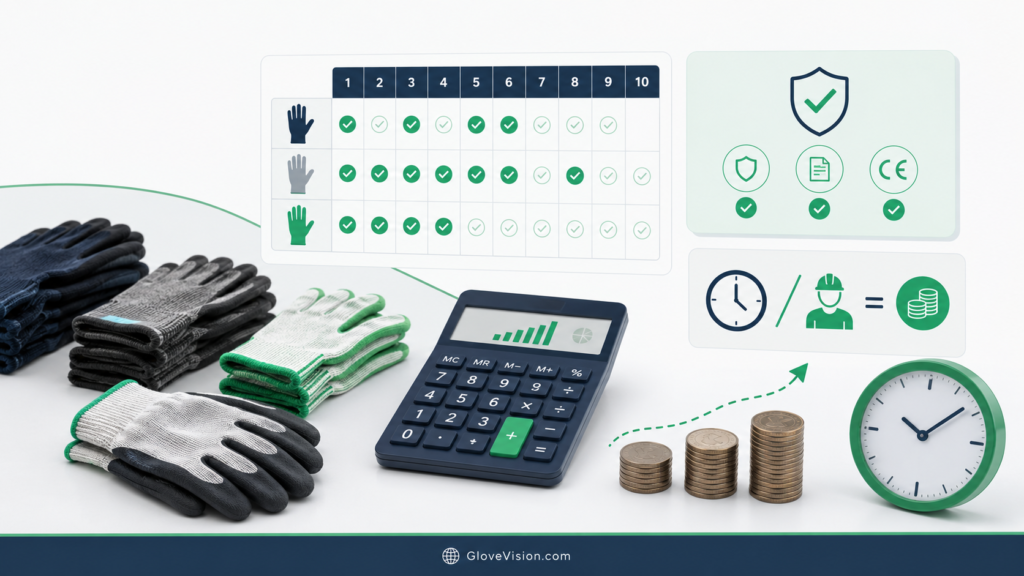
Glove-Cost Calculator: The S5 Financial Efficiency Protocol
The Glove-Cost Calculator is a 10-day financial efficiency protocol that calculates Cost Per Productive Hour by combining glove unit price, pairs used, change-out labor cost, productive work hours, and safety rejection flags.
This page explains how to reveal hidden glove spending, control audit conditions, run the 10-day financial log matrix, calculate CPPH, reject unsafe savings, and validate procurement decisions without treating unit price as the only cost signal.
Which Financial Drivers Should the Glove-Cost Calculator Measure Before Comparing Glove Models?
The Glove-Cost Calculator should measure unit price, pairs used, productive wear time, change-out frequency, change-out labor cost, failure threshold, waste, and optional TCO variables before comparing glove models.
Use internal company data for cost variables because no reliable universal source gives one correct glove wear life, change-out time, or replacement frequency for all tasks.
How Does Unit Purchase Price Affect Glove Cost?
Unit purchase price affects glove cost by setting the direct acquisition cost, but it becomes meaningful only when compared with wear life, replacement frequency, and productive work time.
How Does Productive Wear Time Affect Real Glove Value?
Productive wear time affects real glove value by showing how long the glove performs acceptably before a predefined replacement condition occurs.
How Does Change-Out Frequency Affect Labor Cost?
Change-out frequency affects labor cost because every glove replacement consumes paid work time that can reduce productive output.
How Does Failure Threshold Define When a Glove Should Be Replaced?
A failure threshold defines when a glove has reached the end of useful life because grip, barrier protection, dexterity, integrity, cleanliness, or task performance is no longer acceptable.
Which Optional TCO Variables Can Be Added for Advanced Audits?
Optional TCO variables can be added when reliable data exists for disposal cost, rework cost, defect cost, incident-related cost, inventory carrying cost, emergency purchases, training, or supplier minimum-order impact.
| Variable | Definition | How To Measure |
|---|---|---|
| Unit Price | Cost per glove pair. | Supplier invoice. |
| Pairs Used | Total pairs consumed. | Daily log. |
| Productive Work Hours | Useful hours worked. | Shift record. |
| Change-Out Count | Number of replacements. | Worker log. |
| Change-Out Time | Time spent replacing gloves. | Timed sample. |
| Labor Rate | Hourly worker cost. | Payroll or finance estimate. |
| Failure Threshold | Condition requiring replacement. | Predefined audit rule. |
| Waste Volume | Gloves discarded. | Waste count or bag estimate. |
| Safety Rejection Flag | Safety condition that disqualifies savings. | PPE review checklist. |
When Should Cost Savings Be Rejected by the Glove-Cost Calculator?
Cost savings should be rejected by the Glove-Cost Calculator when a lower-cost glove weakens required protection, compliance, grip, dexterity, replacement discipline, contamination control, or task safety.
OSHA requires employers to assess workplace hazards that require PPE and select PPE that protects affected employees from the hazards identified in the assessment. [OSHA] [eCFR]
When Should a Cheaper Glove Be Rejected?
A cheaper glove should be rejected when the lower cost comes from weaker protection, poor durability, unsafe grip, reduced dexterity, higher failure risk, or lower worker compliance.
Why Should Safety and Compliance Override Cost Savings?
Safety and compliance should override cost savings because PPE cost reduction is valid only when the glove still protects the worker against the identified job hazard.
What Is the Final Rejection Rule?
The final rejection rule is that a glove is not financially efficient if it saves money by lowering protection, increasing risk, or reducing task performance.
False Savings Rejection Checklist
How Do You Control Test Conditions Before Using the Glove-Cost Calculator?
You control test conditions before using the Glove-Cost Calculator by comparing glove models under similar tasks, shift lengths, worker groups, replacement rules, and environmental exposures.
If different hazards exist across tasks, the comparison must be separated by task category instead of blended into one cost result. [OSHA]
How Should Task Consistency Be Controlled?
Task consistency should be controlled by comparing glove models within the same task type, department, role, or exposure category whenever practical.
How Should Shift Length and Work Duration Be Controlled?
Shift length and work duration should be controlled by recording total work hours for each glove model and avoiding comparisons between short test blocks and full-shift exposure.
How Should Worker Variation Be Controlled?
Worker variation should be controlled by using the same worker group where practical and recording role, task type, glove size, and work method.
How Should Replacement Rules Be Controlled?
Replacement rules should be controlled by defining the same failure threshold before the audit begins and recording every replacement reason.
How Should Environmental Exposure Be Controlled?
Environmental exposure should be controlled by recording temperature, moisture, chemicals, abrasive surfaces, oil, grease, sharp edges, cleanroom rules, or hygiene requirements that may affect glove life.
Audit Environment Checklist
How Do You Perform a 10-Day Audit With the Glove-Cost Calculator?
You perform a 10-day audit with the Glove-Cost Calculator by recording current-glove performance for five days, alternative-glove performance for five days, and comparing both using the same cost, labor, failure, and safety rules.
The 10-day audit is a practical cost-documentation framework, not a regulatory standard or universal procurement protocol.
What Should Happen Before Day 1 of the Audit?
Before Day 1, the team should define the glove models, unit price, labor rate, task type, failure threshold, change-out time method, work hours, logging owner, and safety rejection rules.
How Should Days 1–5 Measure the Current or Economy Glove?
Days 1–5 should measure the current or economy glove under normal work conditions by recording pairs used, change-outs, replacement reasons, productive work hours, downtime, and safety flags.
How Should Days 6–10 Measure the Alternative Glove?
Days 6–10 should measure the alternative glove under the same task conditions, using the same failure threshold, logging method, and safety rejection rules.
When Should Parallel Testing Be Used Instead of Sequential Testing?
Parallel testing should be used when comparable worker groups can perform the same task at the same time under stable conditions.
What Should Be Recorded Every Day?
Every day should record glove model, unit cost, pairs used, work hours, change-outs, average change-out time, replacement reason, performance issues, waste, worker feedback, and safety rejection flags.
Functional 10-Day Financial Log Matrix
Enter audit values, then click Calculate Result. Daily CPPH, downtime cost, total cost, and the final comparison will show below.
| Day | Glove Model | Unit Cost | Pairs Used | Work Hours | Change-Outs | Avg Change-Out Time | Failure Reason | Downtime Cost | CPPH | Safety Flag | Notes |
|---|
Current CPPH
0.00
Alternative CPPH
0.00
Which Glove-Cost Calculator Formula Shows Cost Per Productive Hour?
The Glove-Cost Calculator formula for Cost Per Productive Hour divides direct material spend plus change-out labor cost by productive work hours.
Use internal audit values for formula inputs. Do not use external average glove costs, labor costs, or change-out times unless the company verifies them for the audited task.
What Is the Baseline CPPH Formula?
CPPH = [(Pairs Used × Unit Price) + Change-Out Labor Cost] ÷ Productive Work Hours
How Do You Calculate Change-Out Labor Cost?
Change-Out Labor Cost = Total Change-Out Time × Hourly Labor Rate
How Do You Calculate Direct Material Spend?
Direct Material Spend = Pairs Used × Unit Price
How Do You Calculate Total Baseline Glove Cost?
Total Baseline Glove Cost = Direct Material Spend + Change-Out Labor Cost
Which Advanced TCO Costs Can Be Added When Data Is Available?
Expanded TCO = Direct Material Spend + Change-Out Labor Cost + Disposal Cost + Rework Cost + Defect Cost + Incident Cost + Inventory Cost
Quick CPPH Calculator
Calculated CPPH
0.00
How Do You Interpret Economy vs Higher-Priced Glove Results From the Audit?
You interpret economy vs higher-priced glove results by comparing CPPH, productive wear time, change-out frequency, downtime, waste, worker performance, and safety rejection flags together.
Cut resistance levels A1–A9 show why cost comparisons must not ignore required protection levels when cut resistance is part of the job hazard. [ANSI]
When Does a Higher-Priced Glove Reduce Total Cost?
A higher-priced glove may reduce total cost when it lasts longer, requires fewer change-outs, reduces downtime, improves task performance, reduces waste, and maintains required protection.
When Does an Economy Glove Remain the Better Financial Choice?
An economy glove remains the better financial choice when it meets protection requirements, performs for the full task duration, avoids extra change-outs, and produces a lower CPPH after all measured costs are included.
How Should Material Cost Per Hour Be Compared?
Material cost per hour should be compared by dividing unit price by productive wear time for each glove model.
| Glove Type | Unit Cost | Wear Time | Material Cost Per Hour |
|---|---|---|---|
| Economy Glove | $0.20 | 1 hour | $0.20/hour |
| Higher-Priced Glove | $0.50 | 5 hours | $0.10/hour |
This example shows calculation logic only. Real decisions must use actual unit price and wear-time data from the audit.
How Should Change-Out Labor Change the Decision?
Change-out labor should change the decision when frequent replacement consumes enough paid time to erase the savings from a lower unit price.
What Result Shows a Positive ROI?
A glove change shows positive ROI when CPPH decreases, productive wear time increases, change-outs decrease, protection remains suitable, worker performance holds, and waste or rework does not increase.
| Metric | Current Glove | Alternative Glove | Winner |
|---|---|---|---|
| Unit Price | |||
| Average Wear Time | |||
| Pairs Used | |||
| Change-Outs Per Shift | |||
| Change-Out Labor Cost | |||
| CPPH | |||
| Waste Volume | |||
| Safety Rejection Flags | |||
| Worker Feedback | |||
| Rework / Defect Notes |
How Do You Build a Procurement Plan From Glove-Cost Calculator Results?
You build a procurement plan from Glove-Cost Calculator results by selecting the glove that lowers CPPH while maintaining hazard protection, task performance, worker compliance, and supply reliability.
A cost-saving glove must still match the task hazard and exposure condition. [OSHA] [CDC Archive]
How Should the Best-Performing Glove Be Selected?
The best-performing glove should be selected by balancing low CPPH, required hazard protection, comfort, durability, change-out frequency, waste, task performance, and worker compliance.
How Should Procurement Avoid Overreacting to One Audit Result?
Procurement should avoid overreacting to one audit result by checking whether the audit period, workers, tasks, and conditions represent normal operations.
How Should the Procurement Plan Be Documented?
The procurement plan should document the current glove baseline, alternative glove tested, unit price difference, CPPH difference, change-out reduction, safety flags, worker feedback, rollout scope, and review date.
How Should the Rollout Be Staged?
The rollout should be staged by piloting the selected glove in one task group, monitoring cost and performance for 30 days, and expanding only if protection, cost, and worker performance remain acceptable.
| Audit Finding | Procurement Decision | Validation Step |
|---|---|---|
| Lower CPPH + same protection | Pilot alternative glove. | Validate for 30 days. |
| Lower unit price + higher CPPH | Reject false savings. | Keep or retest current option. |
| Better durability + worker acceptance | Expand controlled rollout. | Monitor monthly KPIs. |
| Lower cost but safety concerns | Reject option. | Review safer alternatives. |
| Inconclusive result | Extend audit. | Repeat with tighter controls. |
| Cost savings but supplier inconsistency | Delay rollout. | Verify supply reliability. |
How Do You Validate Whether the New Glove Model Actually Saves Money?
You validate whether the new glove model actually saves money by comparing 30-day post-rollout KPIs against the original CPPH baseline, safety flags, waste levels, worker feedback, and supplier consistency.
The 30-day validation period is a practical procurement follow-up window, not an official safety, finance, or compliance standard.
Which KPIs Should Be Reviewed After Implementation?
After implementation, teams should review monthly glove spend, pairs used per worker, pairs used per task, average wear time, change-outs per shift, CPPH, waste, rework, worker feedback, safety flags, and supplier consistency.
How Long Should the Validation Period Last?
The validation period should last 30 days in this calculator framework because the 10-day audit identifies a likely winner while the 30-day review checks whether savings continue under normal operations.
What Result Confirms a Successful Procurement Change?
A procurement change is successful when CPPH is lower than the previous baseline, required protection is maintained, change-outs decrease or stabilize, performance stays acceptable, waste does not increase, and no new safety issues appear.
When Should the Procurement Decision Be Reversed or Retested?
The procurement decision should be reversed or retested if CPPH increases, workers reject the glove, protection concerns appear, change-outs rise, supplier quality becomes inconsistent, task performance declines, or waste increases.
30-Day Validation Checklist
Advanced TCO Add-On Table
Advanced TCO add-ons should be included only when reliable internal records make the cost measurable.
| Add-On Cost | When To Include It |
|---|---|
| Disposal Cost | When glove waste volume is measurable. |
| Rework Cost | When glove performance affects product quality. |
| Defect Cost | When failures create damaged goods. |
| Incident Cost | When glove failures create documented disruptions. |
| Inventory Cost | When storage or carrying costs are significant. |
| Emergency Purchase Cost | When stockouts force expensive substitutions. |
| Training Cost | When a new glove requires process adjustment. |
Terminology Bank
These terms define the calculator language so procurement, safety, and operations teams measure the same variables.
Frequently Asked Questions About the Glove-Cost Calculator
Conclusion
The Glove-Cost Calculator helps procurement and safety teams compare glove options by real operating cost instead of unit price alone.
By combining direct material spend, change-out labor, productive work hours, waste, and safety rejection flags, the template shows whether a glove choice lowers cost without lowering worker protection or task performance.