
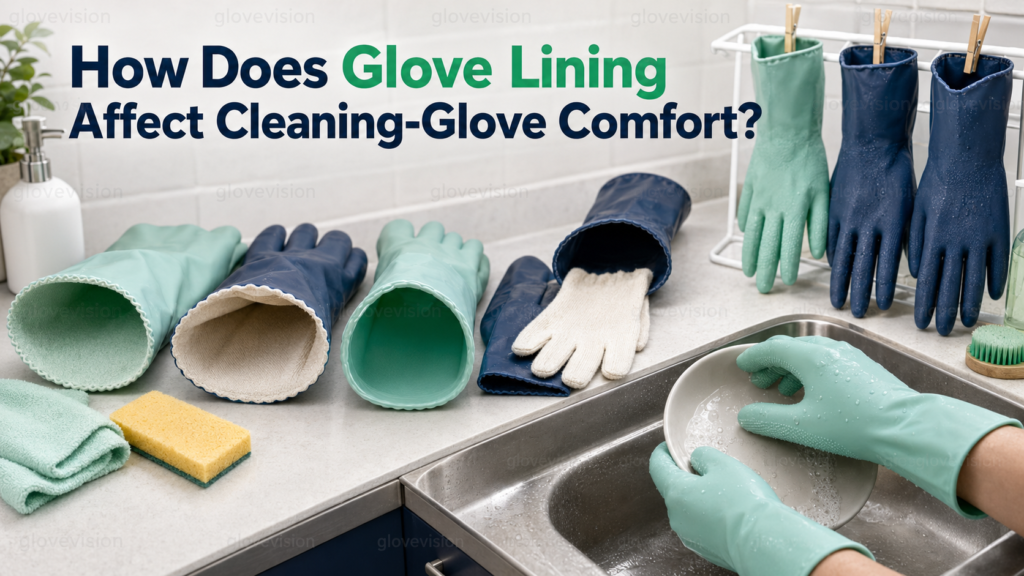
How Does Glove Lining Affect Cleaning-Glove Comfort?
Glove lining can affect cleaning-glove comfort by changing how the interior manages perspiration, feels against the skin, retains warmth, and supports donning and removal.
Its effect depends on the complete glove product, fit, household task, cleaner, water temperature, wear duration, wet grip, care history, and the individual wearer’s response.
This article provides general cleaning-glove comfort information. It does not diagnose eczema, contact dermatitis, latex allergy, or other skin conditions. Use water at a safe temperature, follow the cleaner and exact glove instructions, and stop using the gloves if persistent irritation, burning, swelling, blistering, breathing difficulty, or other concerning symptoms develop.
Why Does Glove lining Affect Cleaning-Glove Comfort?
Glove lining affects cleaning-glove comfort because it changes how the interior handles moisture, contacts the skin, feels during movement, and dries after use.
Interior comfort is only one part of the need to match Cleaning Gloves to the task. HSE advises considering the substance, task, contact conditions, wearer, fit, comfort, grip, and dexterity rather than selecting from one feature alone. [HSE]
Which Types of Glove lining Are Used in Cleaning Gloves?
Common interiors include flock-lined, integrated textile-lined, unlined, and removable-liner systems, but their exact fibers, thicknesses, and care needs remain product-specific.
What is a flock-lined interior?
It is a thin attached fiber layer that may support donning and absorb some perspiration. It is not automatically cotton, stronger, drier, or more comfortable for every wearer.
How does integrated textile Glove lining differ?
An integrated textile layer is more substantial and permanently incorporated. Its warmth, absorbency, flexibility, and drying behavior depend on the exact product.
What does an unlined interior change?
An unlined interior may be easier to inspect and may retain less textile moisture, but it can also make perspiration more noticeable or stick to damp hands.
When may a removable cotton liner help?
A clean, dry, compatible liner may absorb perspiration and reduce direct rubbing, but it must preserve fit, finger movement, dexterity, and wet grip. HSE identifies cotton liners as one possible comfort measure during prolonged glove wear. [PPE]
Table 1. Compare lining types through possible benefits, limitations, verification, and action.
| Interior Type | Possible Comfort Benefit | Potential Limitation | User Verification | Adjustment or Replacement Trigger |
|---|---|---|---|---|
| Flock-lined interior | May aid donning and absorb some perspiration | May remain damp, retain odor, or become rough | Confirm exact fiber where disclosed; inspect dryness and texture | Dry further; replace if clumped, separated, or persistently damp |
| Integrated textile-lined interior | May feel softer or warmer | May retain moisture and require longer drying | Check exact construction, fit, and manufacturer care | Stop if lining cannot be dried, cleaned, or inspected |
| Unlined interior | May be easier to inspect in some products | May stick to damp hands and make sweat more noticeable | Assess donning, fit, drying, and handling | Adjust size or product if sticking or control remains unsafe |
| Removable cotton liner | May absorb perspiration and reduce direct rubbing | Can tighten the glove, bunch, or become saturated | Confirm compatible fit, dexterity, and wet grip | Change when damp; stop if fit or handling becomes unsafe |
No lining type is universally most comfortable or protective.
How Do Glove lining, Fit, and Wear Duration Interact?
Glove lining supports comfort only when the complete glove fits without pressure, bunching, twisting, unstable cuffs, or difficult removal.
Which fit signs matter most?
Check fingertip reach, palm width, cuff stability, finger movement, internal folds, liner position, and whether the glove can be removed without excessive pulling.
Is there a universal continuous-wear time?
No. Use condition-based breaks when hands become hot, excessively sweaty, numb, uncomfortable, or irritated, or when lining saturation or grip loss develops. HSE advises airing hands before they become excessively hot and sweaty. [FIT]
Table 2. Fit controls how Glove lining contacts the hand and affects movement.
| Fit Condition | Likely Comfort Effect | What to Verify | Required Action | Stop or Replacement Trigger |
|---|---|---|---|---|
| Too tight | Pressure, heat, perspiration, difficult removal | Finger, palm, and cuff pressure | Try a suitable size or remove incompatible liner | Numbness, pain, burning, or restricted movement |
| Too loose | Folds, twisting, liner movement, weak handling | Finger excess, palm movement, cuff stability | Select a more stable fit | Grip or tool control remains unsafe |
| Correct fit | Stable contact with free movement | Finger reach, palm shape, cuff, wet grip | Continue while conditions remain acceptable | Any new pressure, slippage, or irritation |
| Removable liner makes glove tight | Compression and reduced dexterity | Full glove fit with liner in place | Use a compatible size or different system | Persistent pressure or grip loss |
| Liner bunches | Rubbing, pinching, restricted movement | Position and liner condition | Reposition or replace liner | Repeated bunching or unsafe control |
| Finger length is incorrect | Tip pressure or excess material | Finger reach and object handling | Choose correct size or shape | Pain, folding, or poor dexterity |
| Cuff is unstable | Movement, runoff entry, rubbing | Cuff fit and arm movement | Correct fit or product design | Repeated water entry or instability |
Softness cannot correct an incorrectly fitted complete glove.
How Does Glove lining Affect Perspiration and Perceived Warmth?
Glove lining may absorb or retain some perspiration and may make the hands feel warmer, but it cannot eliminate sweating or prove protection from heat.
Evaluate moisture and temperature within the complete wet-use profile. Water should remain at a safe, comfortable temperature, and burning or numbness should stop the task.
How may Glove lining manage perspiration?
Flock or compatible removable liners may absorb some moisture, while wear duration, room temperature, water temperature, activity, fit, and the complete glove also influence sweating. Persistent moisture may require the broader hand-sweating assessment.
Does perceived warmth equal thermal protection?
No. A warm-feeling lining does not establish protection against scalding water, steam, hot objects, or hot surfaces.
Table 3. Internal heat and moisture require condition-based responses rather than a universal wear time.
| Condition | Possible Cause | Immediate Response | Longer-Term Adjustment | Stop Trigger |
|---|---|---|---|---|
| Even internal dampness | Perspiration or incomplete drying | Pause, remove safely, and air hands | Improve drying, fit, lining choice, or break opportunities | Saturation, unsafe grip, or recurring irritation |
| Hands become hot quickly | Water temperature, room heat, fit, activity | Use safer water temperature and pause | Review complete glove thickness and fit | Burning, numbness, or excessive warmth |
| Removable liner becomes damp | Perspiration absorption | Change to a clean, dry liner | Rotate clean liners and improve drying | Damp liner cannot be replaced |
| Grip declines as hands sweat | Internal movement or fit change | Stop and dry hands | Review fit, lining, task, and break timing | Unsafe wet handling |
| Numbness or burning | Pressure, heat, skin response, or another concern | Stop use immediately | Reassess glove, task, and wearer factors | Persistent or severe symptoms |
| Excessive sticking during removal | Damp hands, unlined interior, or fit | Remove gently and dry hands | Review fit and lining system | Skin pinching or difficult safe removal |
Perceived warmth is not evidence of thermal protection.
Which Glove lining Considerations Matter for Sensitive Skin?
Glove lining may improve comfort for some wearers, but no lining prevents eczema, guarantees allergy safety, or replaces assessment of the complete glove, cleaner, moisture, fit, and skin response.
Can cotton liners help eczema-prone hands?
Clean cotton liners beneath compatible waterproof gloves may help some people during wet work, but they must stay dry, fit correctly, and preserve grip and dexterity. AAD includes cotton gloves beneath waterproof gloves as one possible wet-work measure. [AAD]
Are non-latex gloves universally hypoallergenic?
No. Non-latex products avoid natural-rubber-latex proteins, but complete gloves may still contain additives or cause irritation through moisture, occlusion, fit, contamination, or cleaner exposure. NIOSH also notes that “hypoallergenic” latex gloves do not eliminate latex-allergy risk. [NIOSH]
When should symptoms trigger escalation?
Stop use and seek appropriate assessment for persistent, spreading, severe, blistering, significantly swollen, breathing-related, or facial or throat swelling symptoms. The broader sensitive-skin guide owns product-selection detail.
How Should Damp Glove lining Be Troubleshot?
Damp Glove lining should be assessed by its location, timing, and pattern before deciding whether the cause is perspiration, cuff entry, leakage, or incomplete drying.
Table 4. Moisture pattern helps identify what should be checked before reuse.
| Moisture Pattern | Possible Cause | What to Check | Required Action | Replacement Trigger |
|---|---|---|---|---|
| Even dampness in both gloves | Perspiration or incomplete drying | Wear duration, water temperature, interior dryness | Air hands and dry gloves fully | Persistent saturation or discomfort |
| Dampness near the wrist | Cuff entry or arm runoff | Cuff fit, arm angle, immersion depth | Dry and correct technique | Repeated unexplained entry |
| One localized wet spot | Pinhole, tear, or shell failure | Shell and seam or bonded areas where present | Stop use and inspect | Confirmed or unresolved leakage |
| Glove damp before donning | Incomplete drying or storage | Interior and storage conditions | Do not don until fully dry | Interior cannot be dried |
| Lining remains saturated | Moisture retention or damaged lining | Drying time, airflow, lining condition | Extend drying or change removable liner | Integrated lining stays wet |
| Persistent odor | Moisture, residue, contamination, deterioration | Care history and interior condition | Clean only as permitted and dry fully | Odor persists after approved care |
| Dampness after unsupported cleaning | Retained water or residue | Product instructions and cleaning method | Stop improvised cleaning | Condition cannot be restored |
Dampness does not automatically prove sweat or leakage.
How Should Glove lining Be Cleaned, Dried, and Stored?
Glove lining should be cleaned and dried only according to the exact product instructions, with the complete interior fully dry before reuse.
How often should Glove lining be cleaned?
Do not use a universal weekly schedule. Base care on manufacturer instructions, use, perspiration, residue, contamination, odor, interior condition, and whether the lining can dry fully.
Should Glove lining always be turned inside out?
No. Open the cuff and ventilate the interior. Invert only when the product permits it, and dry removable liners separately.
Where should Glove lining be dried?
Use a clean, ventilated, zone-appropriate location away from direct heat, prolonged sunlight, sharp objects, and food-related areas when the gloves belong to a bathroom or toilet zone. Follow the complete drying and storage process.
Table 5. Follow exact product instructions before cleaning, drying, or storing the glove interior.
| Stage | Required Action | Failure Sign | Corrective Action | Replacement Trigger |
|---|---|---|---|---|
| Review instructions | Confirm permitted cleaning, inversion, and drying | Instructions unavailable | Obtain exact product guidance | Safe care cannot be established |
| Remove gloves safely | Limit exterior contact with skin and clean surfaces | Contaminated exterior touches skin | Clean hands and affected surfaces | Significant exposure concern |
| Clean only as permitted | Use approved method | Residue remains | Repeat only approved care | Residue cannot be removed |
| Drain exterior moisture | Direct water away from cuff | Interior becomes wet | Dry and identify entry source | Repeated entry |
| Open cuffs | Allow airflow into glove | Cuff remains compressed | Reposition for ventilation | Interior remains inaccessible |
| Ventilate interior | Provide adequate airflow | Cool or damp lining persists | Extend drying | Interior cannot be dried |
| Dry removable liners | Remove and dry separately | Liner remains damp or soiled | Replace with clean dry liner | Liner damaged or cannot be cleaned |
| Inspect lining and shell | Check roughness, separation, residue, and leakage | Deterioration is present | Stop and reassess | Condition cannot be restored |
| Store in assigned zone | Keep dry and separated | Damp or cross-zone storage | Correct storage | Hygiene history becomes uncertain |
Avoid high heat unless the exact manufacturer expressly permits it.
When Do Glove lining Problems Require Cleaning-Glove Replacement?
Glove lining problems require replacement when the interior cannot be restored to a dry, clean, intact, comfortable, inspectable, and functional condition.
Persistent failure should be evaluated through condition-based replacement criteria.
Table 6. Separate correctable comfort issues from complete-glove replacement triggers.
| Finding | Likely Meaning | Immediate Action | Outcome | Escalation Trigger |
|---|---|---|---|---|
| Dry, smooth, intact, and comfortable lining | Current interior condition appears acceptable | Confirm fit, grip, and task compatibility | Continue for the defined task | Any new discomfort or performance loss |
| Slightly damp but otherwise intact | Temporary moisture or incomplete drying | Dry further | Reuse only when fully dry | Dampness persists |
| Saturated removable liner | Liner absorbed moisture | Change liner | Continue only with clean dry compatible liner | No dry liner or fit becomes unsafe |
| Integrated lining remains damp | Insufficient drying or deterioration | Extend drying and inspect | Reassess before use | Cannot become fully dry |
| Lining separates or clumps | Interior deterioration | Stop use | Replace complete glove | Separation affects comfort or inspection |
| Interior becomes rough | Wear, residue, or lining damage | Stop and inspect | Adjust only if condition is restorable | Persistent roughness or rubbing |
| Persistent odor remains after permitted care | Retained moisture, residue, contamination, or deterioration | Stop use | Reassess or replace | Odor cannot be resolved |
| Interior residue cannot be removed | Unsupported care or contamination | Stop use | Replace complete glove | Skin or cleaner exposure concern |
| Localized water entry occurs | Possible barrier failure | Stop and inspect | Replace if unresolved | Confirmed leak |
| Skin reaction occurs | Moisture, fit, cleaner, latex, additives, or another cause | Stop use and assess | Do not automatically reuse same model | Persistent, severe, or breathing-related symptoms |
Comfort adjustments cannot override unsafe grip, incompatible cleaner exposure, or uncertain barrier integrity.
Which Glove lining Mistakes Reduce Comfort or Safety?
Common mistakes include choosing by softness alone, forcing a liner into a tight glove, treating warmth as heat protection, using loose powder, continuing with saturated lining, assuming all dampness is sweat, using unsupported soap, forcing inversion, using high heat, and storing bathroom or toilet gloves in kitchen areas.
- Do not approve an incompatible glove because the lining feels comfortable.
- Do not ignore declining wet grip or difficult removal.
- Do not use dangerous water temperatures.
- Do not assume odor proves microbial growth.
- Do not wash the interior on a fixed schedule without product support.
- Do not reuse until the complete interior is dry.
How Can Glove lining Comfort Be Verified Before Use?
Verify the exact glove, wearer, task, cleaner, current interior condition, and expected wear conditions before each use.
- Confirm the Complete Glove: Exact product, task, cleaner compatibility, and intended use are known.
- Identify the Glove lining: The interior type and material are verified where documented.
- Check Fit: Finger, palm, cuff, and liner fit remain stable without pressure or bunching.
- Check Handling: Wet grip, dexterity, tactile control, and safe removal remain acceptable.
- Check Water Temperature and Wear Conditions: Water is safe and comfortable; no universal wear interval is assumed.
- Check Perspiration: Hands are dry before donning and breaks are taken when heat or sweat becomes excessive.
- Check Dampness Source: Moisture pattern has been checked for sweat, cuff entry, leakage, or incomplete drying.
- Check the Interior: Lining is dry, smooth, intact, cleanable, inspectable, and free of unresolved residue.
- Check Skin Response: No persistent redness, itching, burning, cracking, swelling, blistering, or rash is developing.
- Check Care and Drying: Manufacturer instructions are followed and the assigned household zone is maintained.
- Make the Final Decision: Continue, adjust, pause, dry further, change the liner, reassess, or replace.
Selected Sources
- HSE — Gloves: Choosing the Right Gloves to Protect Skin
- HSE — Choosing the Right Gloves to Protect Skin
- HSE — Skin at Work: Cleaning FAQs
- HSE — Using the Right Type of PPE
- HSE — Latex Allergies in Health and Social Care
- NIOSH — Latex Allergy: A Prevention Guide
- AAD — Dyshidrotic Eczema Self-Care
- AAD — Nummular Eczema Self-Care
Conclusion
Glove lining is one part of the complete cleaning glove. It may influence moisture, warmth, skin contact, donning, removal, rubbing, and drying, but comfort still depends on fit, task, cleaner, water temperature, wear duration, grip, care, and individual response.
No lining is universally best, no universal wear interval applies, and a comfortable interior cannot override incompatible cleaner exposure, unsafe handling, persistent dampness, lining deterioration, or recurring skin irritation. Final suitability applies only to the exact glove, task, cleaner, wearer, and current condition.
Frequently Asked Questions About Glove lining and Cleaning-Glove Comfort
Is flocked Glove lining always more comfortable?
No. It may support donning and absorb some perspiration, but it may also remain damp, retain odor, or become uncomfortable when saturated or damaged.
Does cotton Glove lining protect against hot water?
Not automatically. Cotton or textile lining may create perceived warmth, but thermal protection must come from a complete glove designed and documented for the heat hazard.
Which Glove lining is best for eczema?
No lining is best for everyone. Clean cotton liners beneath compatible waterproof gloves may help some people during wet work, but fit, moisture, personal triggers, and professional advice remain important.
How long can Glove lining be worn before a break?
There is no universal time. Pause when the hands become excessively hot, sweaty, uncomfortable, numb, or irritated, or when lining saturation or grip loss develops.
Should Glove lining always be turned inside out?
No. Open the cuff and ventilate the interior. Invert the glove only when the exact product design and manufacturer instructions permit it.
When should a glove be replaced because of Glove lining?
Replace or stop using the glove when the lining is separated, persistently damp, rough, contaminated, impossible to clean, strongly odorous after permitted care, repeatedly displaced, or associated with unsafe fit, water entry, or recurring skin irritation.