
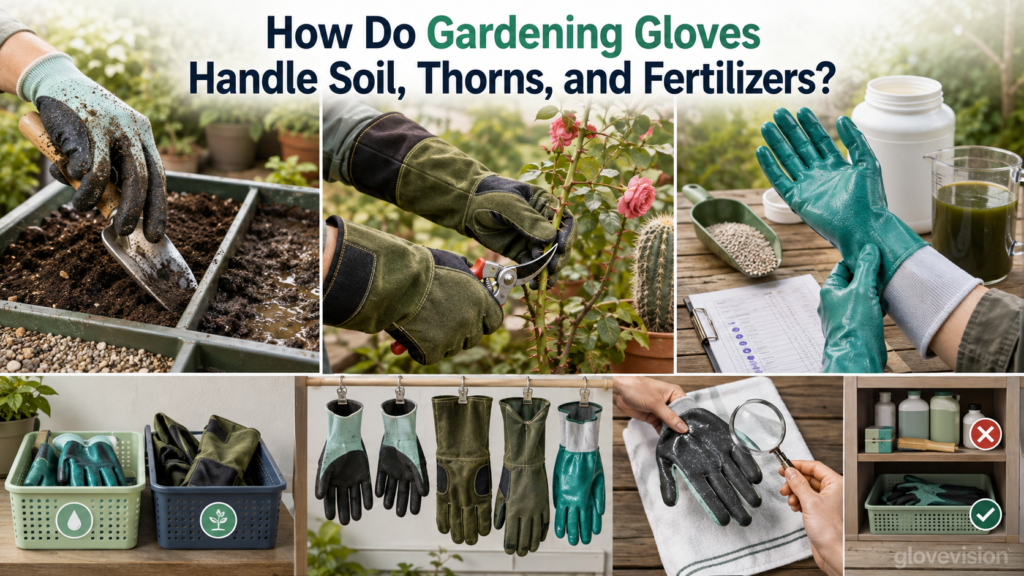
How Do Gardening Gloves Handle Soil, Thorns, and Fertilizers?
Gardening gloves handle soil, thorns, and fertilizers by providing task-specific abrasion control, puncture reduction, moisture management, grip, coverage, and—when required—documented suitability for the exact fertilizer product.
No single pair handles every gardening hazard equally well. The correct pair depends on soil moisture, grit, thorn shape and density, applied pressure, fertilizer form, required coverage, fit, construction, and product instructions.
Educational and gardening-safety notice: This article provides general Gardening gloves guidance. Follow the exact fertilizer label and glove-care instructions. Gardening gloves may reduce soil, thorn, and fertilizer exposure but cannot guarantee prevention of every puncture, skin reaction, or chemical contact. Stop work when the gloves are punctured, contaminated, deteriorated, wet inside for an unknown reason, or unsuitable for the task.
Why Do Gardening gloves Matter for Soil, Thorns, and Fertilizers?
Gardening gloves matter because garden tasks may expose the hands to abrasive soil, sharp plant material, moisture, fertilizer residue, and repeated mechanical stress. Selection should begin with the exact task rather than with one broad material name.
How can soil affect Gardening gloves and hands?
Dry, gritty, damp, or wet soil may increase friction, abrasion, dirt entry, moisture, grip loss, and glove wear. The effect depends on the soil condition, task duration, glove fit, and construction.
How can thorns affect Gardening gloves and hands?
Thorns can puncture a glove, catch seams, damage coatings, or scratch exposed skin. Thorn-resistant construction may reduce exposure, but it cannot guarantee that penetration will never occur.
How can fertilizers affect Gardening gloves and hands?
Granules, dust, diluted liquids, concentrates, and damp treated soil create different contact patterns. The original fertilizer label and exact glove documentation should guide the decision.
Why might more than one pair of Gardening gloves be needed?
A pair suited to light dry weeding may not provide enough puncture reduction for roses, enough moisture coverage for mud, or documented suitability for liquid fertilizer.
How Do Gardening gloves Manage Dry, Gritty, and Wet Soil?
Gardening gloves manage soil effectively only when their construction matches the soil’s moisture, grit, abrasion, grip, and dirt-entry demands.
What should Gardening gloves provide for dry soil?
Dry-soil work often prioritizes dexterity, breathable construction, abrasion control, secure fit, dirt exclusion, and accurate finger movement.
What should Gardening gloves provide for gritty soil and gravel?
Digging and gravel handling increase surface wear and repeated force. Palm durability, fingertip reinforcement, seam integrity, grip, and fit under flexing become more important.
What should Gardening gloves provide for wet soil and mud?
Wet work requires suitable coating coverage, wet grip, cuff control, interior comfort, resistance to dirt entry, and enough drying time before reuse. Prolonged mud exposure should follow the full Gardening gloves for wet-soil tasks decision process.
Why does coating coverage matter for Gardening gloves?
A palm coating may support grip and moisture control at the palm while leaving the back of the hand, fabric panels, seams, or cuff exposed. Palm-coated does not mean fully waterproof.
| Exact Task | Main Hazard | Required Performance | Evidence to Check | Possible Decision |
|---|---|---|---|---|
| Light dry weeding | Grit, friction, dirt entry | Dexterity and abrasion control | Intended use, fit, palm construction | Use a suitable light-duty pair |
| Wet-soil planting | Moisture, mud, grip loss | Wet grip and suitable coverage | Coating extent and care instructions | Use a verified wet-soil pair |
| Digging and gravel | Abrasion and repeated force | Palm durability and finger reinforcement | Construction and intended use | Use a reinforced task-specific pair |
How Should Gardening gloves Be Selected for Thorns and Sharp Plants?
Thorn-resistant Gardening gloves should be matched to the plant, thorn shape, density, rigidity, expected pressure, hand position, and forearm exposure.
Which plant features should be assessed before choosing Gardening gloves?
Consider thorn length, sharpness, density, stem rigidity, cactus spines, splinters, plant height, and whether the forearm will repeatedly contact the plant.
Which construction features may help Gardening gloves reduce thorn exposure?
Task-specific reinforcement, durable palms, fingertip protection, stable seams, secure fit, and an extended cuff may reduce exposure. None guarantees complete puncture prevention.
Are leather Gardening gloves completely thorn-proof?
No. Leather performance varies by type, thickness, construction, wear, moisture history, reinforcement, and applied force.
When should specialized Gardening gloves be considered?
Dense roses, rigid spines, repeated forearm contact, or cactus handling may require a deeper Gardening gloves for thorny plants assessment.
What should happen after a thorn punctures Gardening gloves?
Stop, remove the glove safely, inspect the puncture and interior, and replace the pair where intact protection is required. Do not rely on a punctured glove for protective thorn, wet-soil, or fertilizer work.
How Should Gardening gloves Be Matched to Fertilizer Tasks?
Fertilizer-task Gardening gloves should be selected from the exact fertilizer label, product form, concentration, dilution, expected contact, contact duration, and complete glove construction.
Which fertilizer information should be checked before selecting Gardening gloves?
Identify the exact product, original label, form, concentration, dilution, glove requirement, splash potential, contact duration, cleanup instructions, and whether the task involves granules, dust, liquid, or treated soil.
How should Gardening gloves be selected for granular fertilizer?
Check whether dust or damp granules may contact the hands, whether the glove is intended for the task, whether the cuff and back remain exposed, and whether residue can be removed as instructed.
How should Gardening gloves be selected for liquid fertilizer?
Liquid contact requires documented suitability for the exact fertilizer and expected conditions. Ordinary fabric or partially coated gloves may leave exposed areas. Complex products may need the dedicated Gardening gloves for fertilizer handling assessment.
Why is “nitrile,” “latex,” or “rubber” insufficient for Gardening gloves selection?
A generic material name does not establish coating coverage, thickness, seam performance, fertilizer compatibility, contact duration, or suitability of the complete glove.
When should Gardening gloves not be used with fertilizer?
Do not proceed when the fertilizer identity or label is unavailable, compatibility is uncertain, coverage is incomplete, the glove is punctured or deteriorated, the interior is contaminated, or fit and grip are unsafe.
Fertilizer guidance does not automatically apply to pesticides, herbicides, fungicides, or insecticides. Those products require a separate label-led pesticide-application glove assessment.
Which Features Should Gardening gloves Provide for Different Garden Tasks?
No feature is best in isolation. The exact task determines the balance between abrasion control, puncture reduction, liquid coverage, grip, dexterity, cuff length, fit, and drying.
| Task | Priority Features | Main Limitation to Check | Possible Decision |
|---|---|---|---|
| Light weeding | Dexterity, fit, dirt exclusion | Insufficient thorn or liquid protection | Use for defined light work |
| Digging and rock handling | Palm durability, fingertips, seams, grip | Wear-through and fatigue | Use reinforced task-specific pair |
| Pruning | Thorn-resistant construction and coverage | No puncture-proof guarantee | Add forearm coverage or choose another pair |
| Fertilizer handling | Label-supported suitability and coating coverage | Exposed fabric or undocumented compatibility | Use only within verified conditions |
How Should Damage in Gardening gloves Be Recognized?
Damage should be assessed from observable condition, exposure history, and functional change. Appearance alone may not identify one exact failure mechanism.
What does stiffness in Gardening gloves mean?
Stiffness may relate to repeated wetting and drying, age, heat, soil residue, storage, product construction, or deterioration. Stop if stiffness compromises grip, movement, or safe removal.
What does peeling or cracking mean in Gardening gloves?
Peeling, blistering, cracking, or coating separation indicates wear, deterioration, possible incompatibility, or reduced grip and barrier performance.
What does stickiness or swelling mean in Gardening gloves?
Tackiness or swelling is a stop condition. It may reflect contamination, incompatibility, storage damage, heat damage, or general deterioration.
What do punctures or seam splits mean in Gardening gloves?
A confirmed puncture, tear, or seam split requires replacement where intact protection is needed. It should not be downgraded to protective thorn, fertilizer, or wet-soil work.
What does local wetness inside Gardening gloves mean?
Local wetness may result from puncture, seam failure, coating failure, cuff entry, or perspiration. Stop and identify the source before reuse.
How Should Gardening gloves Be Cleaned, Dried, and Stored?
Gardening gloves should be cleaned, dried, and stored only according to the exact glove construction, fertilizer label where relevant, and manufacturer instructions.
What should be checked before cleaning Gardening gloves?
Identify the glove material and coating, lining, previous exposure, fertilizer residue, cleaning permission, approved cleaning agent, drying method, and whether the item remains structurally intact.
Should Gardening gloves always be rinsed before removal?
No. Rinse only when both the fertilizer and glove instructions permit it, runoff can be controlled, and liquid will not enter the cuff or prolong unsafe exposure.
Should Gardening gloves always be washed with mild soap?
No. Mild soap is not universally approved. Use only a cleaning method and agent permitted for the exact glove.
Should leather Gardening gloves always be conditioned?
No. Do not automatically submerge, oil, condition, or heat leather gloves. Use leather-care products only when the manufacturer permits them.
How should Gardening gloves be dried?
Remove loose soil where appropriate, open cuffs, ventilate the interior, preserve the shape, dry fully, and avoid unapproved heat. Detailed care belongs in the Gardening gloves cleaning and drying process.
How should Gardening gloves be stored?
Store clean, fully dry gloves away from fertilizer, food, sharp tools, direct sunlight, and heat. Separate fertilizer-exposed pairs from food, household, or lower-exposure tasks.
When Should Gardening gloves Be Replaced?
Gardening gloves should be replaced when structural integrity, coating condition, contamination status, fit, grip, coverage, or drying can no longer support the next defined task.
Which physical defects require Gardening gloves replacement?
Punctures, tears, seam splits, worn-through fingertips, cracked cuffs, or permanent stretching require replacement where intact protection is needed.
Which coating changes require Gardening gloves replacement?
Replace the gloves when coating separation, peeling, cracking, tackiness, swelling, or severe stiffness reduces coverage, grip, flexibility, or confidence in performance.
Which contamination conditions require Gardening gloves replacement?
Interior contamination, unremovable fertilizer residue, persistent unexplained odor, or unknown exposure may make reuse unsuitable.
Which functional failures require Gardening gloves replacement?
Unsafe grip, twisting, failed fit, restricted finger movement, incomplete coverage, or inability to dry fully are replacement or reassessment triggers. Use the full Gardening gloves replacement criteria when failure persists.
Which Mistakes Reduce Gardening gloves Protection?
| Mistake Area | Unsafe Assumption | Better Decision |
|---|---|---|
| Selection | One pair handles every soil, thorn, and fertilizer task | Match the exact pair to the exact hazard profile |
| Coating | Palm coating means full-glove waterproof coverage | Inspect every coated and uncoated area |
| Thorns | Leather, thickness, or reinforcement means thorn-proof | Use puncture-reducing language and assess plant severity |
| Fertilizer | A generic polymer name proves suitability | Use the exact label and complete-glove documentation |
| Care | Every glove can be rinsed, washed with soap, conditioned, or heated | Follow product-specific care instructions |
| Inspection | A clean-looking glove is ready for reuse | Check structure, coating, contamination, fit, grip, and dryness |
What Should Gardeners Check Before Using Gardening gloves?
Complete the following pre-work verification for the next specific task. A pass for one task does not approve the same pair for another hazard, fertilizer, user, or exposure condition.
| Check Area | What Must Be Verified | Stop or Reassess When |
|---|---|---|
| Task | Exact soil, thorn, fertilizer, tool, and coverage demands are identified | The task or hazard remains unclear |
| Soil | Moisture, grit, mud, abrasion, grip, and dirt-entry demands are defined | The glove lacks required durability or wet grip |
| Thorns | Thorn shape, density, force, and forearm exposure are assessed | Coverage or puncture reduction is inadequate |
| Fertilizer | Exact product, label, form, concentration, and glove suitability are known | The label or compatibility evidence is missing |
| Construction | Palm, fingers, back, coating, seams, cuff, lining, and reinforcement are intact | A puncture, tear, split, peel, crack, or gap is present |
| Material condition | No tackiness, swelling, severe stiffness, permanent stretching, or retained residue | Material condition has changed or contamination remains |
| Fit and function | Fit, grip, dexterity, cuff stability, forearm coverage, and removal remain safe | The glove twists, slips, restricts movement, or loses grip |
| Dryness | The complete glove and interior are fully dry | Dampness or local wetness has an unknown source |
| Final decision | Use, choose another pair, add coverage, clean as permitted, dry further, restrict, reassess, replace, or do not proceed | Any required condition cannot be verified |
Evidence note: The supplied brief does not provide fixed public source URLs. Before publication, verify 5–7 authoritative primary sources for general claims and use exact fertilizer labels and manufacturer documentation for product-specific statements. Do not invent citations.
Conclusion
Gardening gloves protect effectively only when the exact pair matches the specific soil, thorn, fertilizer, grip, coverage, and care demands of the task. Dry soil, wet soil, gravel, sharp plants, and fertilizer each create different performance requirements, and no single material or feature proves universal suitability.
Thorn-resistant does not mean thorn-proof, a palm coating does not equal full-glove liquid coverage, and fertilizer suitability must follow the exact label. Punctured, contaminated, deteriorated, poorly fitting, or incompletely dried gloves should not be approved for protective reuse. Final approval applies only to the next defined task.
Frequently Asked Questions
01Can one pair of Gardening gloves handle soil, thorns, and fertilizers?
Sometimes, but not automatically. The exact pair must match every hazard present in the specific task. Separate pairs may be needed for light soil work, thorn pruning, and fertilizer handling.
02Are leather Gardening gloves completely thorn-proof?
No. Leather may reduce some thorn exposure, but protection depends on exact construction, reinforcement, glove condition, thorn shape, and applied force.
03Are coated Gardening gloves waterproof?
Not necessarily. Palm-coated gloves may still have exposed fabric on the back or cuff. Verify the exact coating coverage and product instructions.
04Can Gardening gloves be used for liquid fertilizer?
Only when the fertilizer label and exact glove information support the task. Ordinary fabric or partially coated gloves may not provide adequate coverage.
05Can punctured Gardening gloves be kept for light weeding?
They should not be relied on where intact protection is required. Punctures permit soil, moisture, plant material, and residue to enter and normally require replacement.
06When should Gardening gloves be replaced?
Replace them after punctures, tears, seam splits, worn-through fingertips, coating separation, cracking, tackiness, swelling, unremovable fertilizer residue, interior contamination, unsafe grip, or failed fit.