
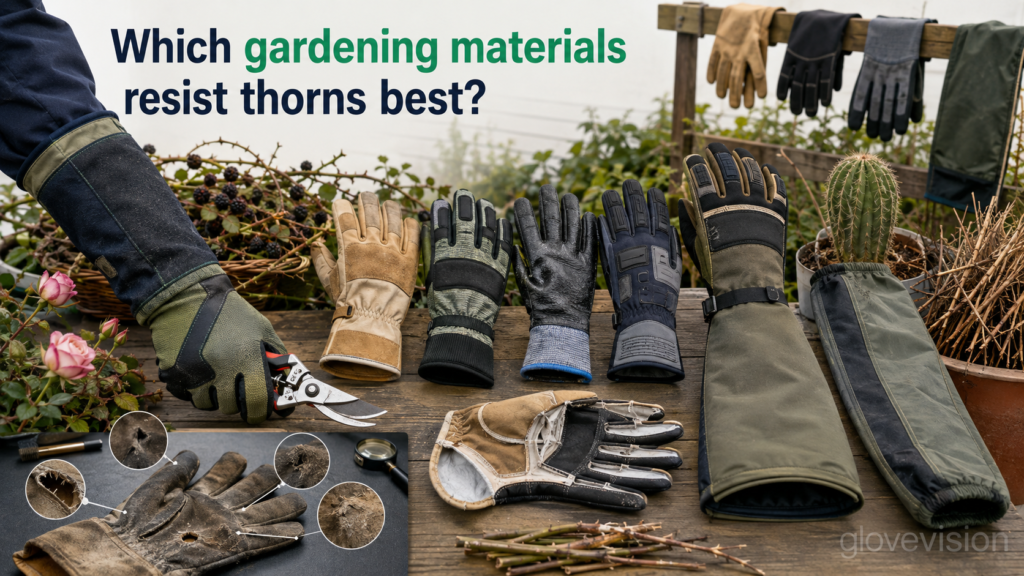
Which gardening materials resist thorns best?
The best Gardening materials for resisting thorns are not defined by one leather, fiber, coating, or thickness. The strongest choice is an exact protective construction whose puncture performance, layering, reinforcement, fit, coverage, and intended use match the thorny plant and gardening task.
Leather, reinforced synthetic fabrics, coated textiles, multilayer gloves, gauntlets, and protective sleeves may all reduce thorn penetration, but no Gardening materials are completely thorn-proof. Performance also depends on thorn rigidity, applied pressure, seams, interfaces, wear, and uncovered areas.
Why Do Gardening materials Matter for Thorn and Bramble Work?
Gardening materials matter because thorny plants create pointed, concentrated contact that may penetrate lightweight, worn, poorly reinforced, incorrectly positioned, or poorly fitted protective areas. Selection must begin with the exact plant and task, not a broad material name. OSHA
How can thorny plants affect the hands and forearms?
Possible effects include scratches, shallow or deeper punctures, splinters, snagging, and plant or soil contamination of broken skin. This article does not diagnose or treat thorn injuries.
Why may lightweight Gardening materials provide limited protection?
Lightweight constructions may improve dexterity, breathability, flexibility, and comfort, but some provide less thickness, layering, reinforcement, or structural stability. Lightweight does not automatically mean unsuitable.
Why must plant hazards be assessed before comparing Gardening materials?
Assess thorn length, sharpness, rigidity, direction, density, applied force, hand pressure, repeated contact, wrist position, and forearm exposure before selecting a product.
| Plant or Task | Thorn Characteristics | Hand Position | Forearm Exposure | Required Protective Features |
|---|---|---|---|---|
| Light rose pruning | Smaller, spaced thorns | Precision grip | Moderate | Dexterity, local reinforcement, cuff coverage |
| Dense blackberry canes | Numerous hooked thorns | Pulling and separating | High | Layering, secure fit, extended coverage |
| Rigid dry brush | Hard woody points | Strong gripping | Variable | Reinforcement, stability, coverage |
| Fine cactus spines | Fine or clustered spines | Minimal direct contact | Variable | Specialized product and tool-assisted handling |
| Woody splinters | Rough broken stems | Carrying and clearing | Moderate | Palm and finger reinforcement |
How Do Gardening materials Reduce Thorn Penetration Risk?
Gardening materials may reduce thorn penetration risk through added thickness, multiple layers, reinforcement, structural stability, and reduced direct contact with skin. These are possible mechanisms, not guarantees. ASTM F1342 ISO 13996
How can thickness support Gardening materials?
Extra thickness may increase travel distance for a thorn, distribute some force, delay penetration, and support abrasion resistance. It may also reduce dexterity, finger control, comfort, and tool feedback.
How can layering support Gardening materials?
Multiple layers may spread some contact force and protect underlying material, but they can increase stiffness, alter fit, and reduce tactile control.
How can reinforcement support Gardening materials?
Reinforcement may support palms, fingertips, thumb webs, finger sides, knuckles, or forearms. Areas outside the reinforced zone remain separate exposure points.
How can coatings support Gardening materials?
Coatings may improve grip, surface durability, moisture control, or abrasion resistance. A coating must not be described as thorn-resistant unless exact product evidence supports that claim.
How should puncture-test results for Gardening materials be interpreted?
Identify the exact test, edition, probe, tested area, and whether a material specimen or finished product was assessed. Laboratory probes do not reproduce every natural thorn, and material results do not automatically cover seams, cuffs, or interfaces.
Which Thorn Hazards Should Gardening materials Be Matched To?
Gardening materials should be matched to the exact thorn length, sharpness, rigidity, density, plant movement, required hand pressure, contact frequency, and forearm exposure.
What should be assessed for rose pruning?
Check thorn spacing, tip sharpness, precision requirements, hand pressure, wrist exposure, and tool control.
What should be assessed for blackberry and bramble clearing?
Dense hooked thorns, pulling, dragging, repeated contact, snagging, and high forearm exposure usually require more coverage and careful tool-assisted handling.
What should be assessed for rigid brush?
Assess hard woody points, broken stems, strong gripping pressure, carrying movements, and repeated high-contact zones.
What should be assessed for cacti and fine spines?
Consider specialized products, tongs, long-handled tools, reduced direct handling, and controlled body position. Protective materials alone may not eliminate exposure.
Which Construction Features Improve Gardening materials for Thorn Resistance?
A material name is not the complete protective product. Evaluate palm, fingertips, thumb web, finger sides, back of hand, seams, cuff, gauntlet, sleeve, lining, closures, and interfaces. Readers needing foundational vocabulary can review the Glove Basics guide. ISO 21420
| Product Area | What to Assess | Possible Failure |
|---|---|---|
| Palm | Thickness, layering, reinforcement, grip | Worn-through high-contact zone |
| Fingertips | Coverage, seams, reinforcement | Pinhole, gouge, reduced control |
| Thumb web | Stretch, seam placement, reinforcement | Opening or concentrated wear |
| Finger sides | Material coverage and seam exposure | Unreinforced puncture zone |
| Back of hand | Material and exposed panels | Lightweight uncovered zone |
| Seams | Placement, opening, snagging | Split or moved protective zone |
| Cuff | Length, closure, stability | Wrist exposure |
| Gauntlet | Forearm length and movement | Sliding, snagging, gap |
| Sleeve | Fit, closure, glove interface | Exposed interface or displaced sleeve |
How Should Gardening materials Be Compared Without Universal Rankings?
Compare exact products, not broad categories. Leather, reinforced textiles, coated textiles, high-performance synthetic fibers, and multilayer constructions each have possible benefits and limitations. EN 388
| Material or Construction Feature | Possible Benefit | Important Limitation | Verification |
|---|---|---|---|
| Dense leather layer | Thickness, abrasion control, structural stability | Varies by hide, finish, seams, and condition | Exact product specification |
| Multilayer construction | May spread force and protect inner layers | May reduce flexibility and feedback | Layer placement and product evidence |
| Reinforced fingertips | Supports a high-contact zone | Other zones remain exposed | Coverage and seam inspection |
| Coated textile | Grip, moisture control, surface durability | Coating alone does not prove puncture resistance | Exact performance documentation |
| High-performance synthetic fiber | May provide documented mechanical performance | Fiber name does not prove whole-product protection | Test method, area, and model |
| Extended gauntlet | More wrist and forearm coverage | Hand section and opening remain separate issues | Length, stability, and interface |
| Protective sleeve | Extends forearm coverage | Gaps or sliding may expose skin | Fit, closure, and movement test |
| Reduced exposed seams | May reduce snag and weak-zone exposure | Does not guarantee puncture performance | Seam layout and condition |
Which evidence should be checked for Gardening materials?
Verify the exact manufacturer, model, intended use, material placement, puncture information, applicable test method, tested area, fit guidance, limitations, and care instructions.
Why is “leather” insufficient to rank Gardening materials?
Leather varies by hide type, grain or split construction, thickness, finish, layering, reinforcement, seams, and condition.
Why are synthetic-fiber or coating names insufficient?
A fiber or coating name does not reveal density, layer count, seam strength, reinforcement coverage, tested area, or complete-product performance.
Why must cut and puncture ratings remain separate?
Cut resistance evaluates slicing by an edge; puncture resistance evaluates pointed penetration. A cut rating does not establish thorn resistance. ISO 13997
How Do Fit and Coverage Affect the Performance of Gardening materials?
Even strong Gardening materials may perform poorly when the product folds, twists, moves seams, leaves gaps, restricts movement, or reduces tool control.
What happens when gardening gloves are too loose?
Loose gloves may bunch, twist, catch on thorns, shift seams, and reduce grip or precision.
What happens when gardening gloves are too tight?
Tight gloves may stretch materials, restrict movement, increase fatigue, reduce dexterity, and make removal difficult.
When is gauntlet or sleeve coverage needed?
Use extended coverage when the task exposes wrists or forearms to dense canes, high plants, dragging, snagging, or repeated contact.
How should gloves, gauntlets, and sleeves interact?
The interface should remain covered during reaching, bending, gripping, and tool use. Check for sliding, cuff movement, snagging, and exposed gaps.
Which Damage Signs Make Gardening materials Unreliable?
Stop and inspect after a sharp sensation, suspected puncture, visible damage, fit change, or loss of grip. Absence of obvious damage does not prove continued protection.
| Finding | Possible Concern | Verification | Required Action |
|---|---|---|---|
| Stiff material | Age, drying, heat, residue, storage, or deterioration | Compare flexibility and instructions | Stop if fit or function is unsafe |
| Cracking | Material breakdown or lost flexibility | Flex under good light | Replace when integrity is uncertain |
| Peeling coating | Lost surface performance or separation | Inspect edge and surrounding area | Do not rely on failed zone |
| Deep gouge | Reduced thickness or structural failure | Inspect both surfaces and layers | Replace in a required protective area |
| Sharp sensation near seam | Puncture, trapped thorn, thin area, or seam opening | Stop and inspect immediately | Do not continue until resolved |
| Worn-through area | Lost protective material | Check high-contact zones | Replace |
| Loose or twisting fit | Moved seams and reduced tool control | Repeat movement and grip test | Choose another size or product |
How Should Protective Products Made from Gardening materials Be Cleaned and Stored?
Cleaning, drying, conditioning, and storage must follow the exact manufacturer instructions. Universal saddle-soap, mild-soap, submersion, inside-out drying, conditioning, or heat advice is unsafe.
| Care Group | What to Check | Do Not Assume |
|---|---|---|
| Review the product | Model, material, lining, care label, prior exposure | All products share one method |
| Remove debris | Thorns, splinters, plant matter, loose soil | Aggressive scraping is safe |
| Clean as permitted | Approved agent, water exposure, handling method | Mild soap or saddle soap is universal |
| Dry completely | Ventilation, shape, interior dryness, approved temperature | Radiators, dryers, flames, or intense sun are safe |
| Inspect after care | Cracks, stiffness, layers, seams, fit, grip | Cleaning restores lost protection |
| Store correctly | Dry, ventilated, away from heat, light, and sharp tools | Compressed damp storage is acceptable |
Should leather Gardening materials always be conditioned?
No. Conditioning may improve flexibility only when the manufacturer permits it. It cannot restore punctured fibers, lost thickness, split seams, deep gouges, detached reinforcement, or original puncture performance.
When Should Protective Products Made from Gardening materials Be Replaced?
Replace a product when structural, material, coverage, fit, or functional failure prevents reliable use for the next defined thorn task.
| Decision Group | Replace or Stop When | Final Rule |
|---|---|---|
| Puncture integrity | Confirmed puncture, pinhole, or sharp-object channel | Do not rely on it for thorn work |
| Structural integrity | Tear, deep gouge, seam opening, worn-through zone, layer separation | Replace in required protective areas |
| Material condition | Severe cracking, brittleness, peeling, detached reinforcement, distortion | Replace when integrity is uncertain |
| Functional condition | Unsafe grip, twisting, failed fit, sliding sleeve, unstable cuff | Choose another product or size |
| Final decision | Evidence, intended use, or coverage cannot be verified | Do not proceed |
Which Mistakes Reduce the Performance of Gardening materials?
- Ranking leather, synthetic fibers, coatings, or thickness universally.
- Calling a product thorn-proof, puncture-proof, impenetrable, or guaranteed.
- Using cut ratings as proof of thorn resistance.
- Assuming palm reinforcement protects fingertips, finger sides, seams, wrists, and forearms.
- Ignoring fit, grip, tool control, or glove-to-sleeve gaps.
- Continuing after a sharp sensation or confirmed puncture.
- Using universal soap, saddle-soap, conditioner, submersion, or heat instructions.
- Assuming cleaning or conditioning restores lost puncture resistance.
What Should Users Check Before Using Protective Products Made from Gardening materials?
Final approval applies only to the next defined thorn task. Complete all seven verification groups before use.
| Inspection Group | What Must Be Verified | Stop or Reassess When |
|---|---|---|
| Define the plant hazard | Plant, thorn length, sharpness, rigidity, density, direction, movement, force, frequency | The hazard remains unclear |
| Confirm the protective product | Exact model, intended use, manufacturer information, test context | The exact product or evidence is unknown |
| Check materials and construction | Thickness, layers, reinforcement, seams, cuffs, gauntlet, sleeve, interfaces | Coverage does not match the task |
| Check for damage | No punctures, pinholes, gouges, cracks, worn areas, separation, or distortion | Integrity is damaged or uncertain |
| Check fit and function | Secure fit, grip, dexterity, cuff stability, sleeve stability, tool control | The product folds, twists, slips, or restricts movement |
| Check care readiness | Clean, fully dry, correctly stored, manufacturer care followed | Debris, dampness, or unverified care remains |
| Make the final decision | Use, add coverage, choose another product, use tools, stop and inspect, replace, or do not proceed | Any required condition cannot be confirmed |
Publication note: Exact product claims must be checked against current manufacturer documentation. Standards and OSHA sources explain selection principles and test limitations; they do not prove that a specific retail product is suitable for natural thorns.
Which Sources Support the Gardening materials Guidance?
- OSHA 29 CFR 1910.138 — Hand Protection
- OSHA Appendix B — PPE Hazard Assessment and Selection
- ASTM F1342/F1342M-05(2022) — Resistance to Puncture
- ISO 13996:1999 — Resistance to Puncture
- ISO 13997:2024 — Resistance to Cutting by Sharp Objects
- BS EN 388:2016+A1:2018 — Mechanical Risks
- ISO 21420:2020 — Protective Gloves: General Requirements
Conclusion
No single Gardening material resists every thorn. The safer choice is an exact glove, gauntlet, sleeve, or combined protective system whose puncture information, thickness, layering, reinforcement, seams, fit, coverage, and intended use match the specific plant and task.
Protective products do not replace careful handling and suitable tools. Cut ratings do not prove thorn resistance, coatings alone do not establish puncture protection, conditioning cannot restore damaged integrity, and confirmed punctures generally require replacement. Final approval applies only to the next defined thorn task.
Frequently Asked Questions
01Which Gardening materials resist thorns best?
No single material is best for every thorny task. Compare exact protective products using puncture information, test context, thickness, layering, reinforcement, seams, fit, coverage, and condition.
02Are leather Gardening materials always best for thorns?
No. Leather products vary in hide type, thickness, grain or split construction, reinforcement, seams, finish, and condition.
03Do coated Gardening materials stop thorns?
Not automatically. A coating may support grip or surface durability, but thorn resistance depends on the complete protective construction and exact product evidence.
04Does greater thickness make Gardening materials better?
Not automatically. Thickness may contribute to protection, but construction, layering, reinforcement, fit, flexibility, and documented performance also matter.
05Does a high cut rating prove Gardening materials resist thorns?
No. Cut resistance and puncture resistance are separate. A cut test does not automatically provide resistance information for pointed hazards such as thorns.
06When should protective products made from Gardening materials be replaced?
Replace them after confirmed punctures, pinholes, tears, deep gouges, seam failure, worn-through areas, layer separation, severe cracking, permanent brittleness, unsafe fit, failed coverage, or loss of grip.