
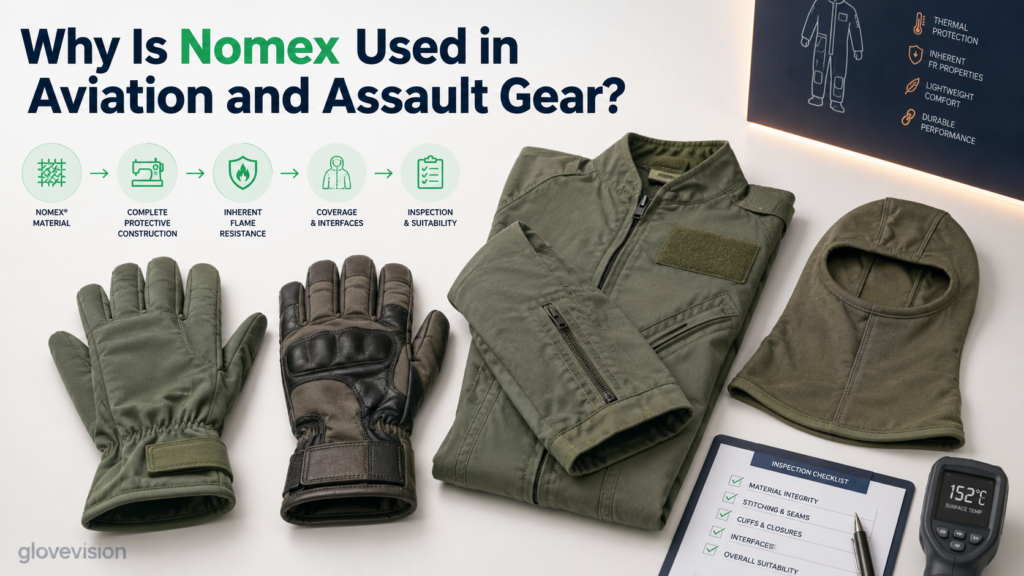
Why Is Nomex Used in Aviation and Assault Gear?
Nomex is used in aviation and some tactical or assault-role protective equipment because it is an inherently flame-resistant meta-aramid that can help limit clothing ignition and continued burning during defined thermal exposures. Its useful role is primarily as a textile component within a documented protective system.
Nomex is not fireproof, and the presence of Nomex alone does not establish the protection level of a finished glove, garment, hood, or protective system. Finished construction, layers, exposure conditions, body coverage, fit, complementary materials, product evidence, and current condition all affect whether a Nomex-containing item is suitable.
This article provides general education about Nomex in wearable aviation and tactical PPE. Follow the exact product specification, issuing-authority requirements, technical manuals, manufacturer instructions, and organizational safety procedures for selection, layering, use, inspection, cleaning, repair, and retirement. Nomex alone does not establish protection against every thermal, mechanical, chemical, environmental, ballistic, or other operational hazard.
What Is Nomex, and Which Material Properties Make It Protective?
Nomex is a branded meta-aramid whose inherent flame-resistant characteristics make it useful as a textile component in certain heat- and flame-protective wearable systems.
DuPont describes Nomex as a meta-aramid fiber with inherent flame-resistant properties and states that Nomex fibers do not show the typical melt-and-drip behavior of many thermoplastic fibers or support combustion. Those fiber properties are relevant, but they do not certify a complete glove or garment. [DuPont Nomex]
How Is Nomex Classified Within the Aramid-Fiber Family?
Nomex is a branded meta-aramid. Kevlar is a distinct DuPont aramid product associated with high-strength applications, so the names should not be treated as interchangeable. “Aramid” by itself is too broad to establish flame, cut, ballistic, or other finished-product performance. [DuPont Kevlar]
Why Is Nomex Described as Inherently Flame-Resistant?
The flame-resistant behavior is associated with the fiber itself rather than depending only on a removable surface FR treatment. “Inherent” does not mean unlimited protection: the finished result still depends on fabric form, blend, weight, weave or knit, layers, seams, closures, coverage, and product-level evidence.
How Does Nomex Respond to Brief Flame and Intense Heat?
Nomex can contribute to limiting ignition and continued burning in an appropriate construction, and sufficient thermal exposure can produce degradation or charring. The absence of typical thermoplastic melting or dripping does not prevent heat transfer or thermal injury.
Which Physical Characteristics Support Wearable Nomex Equipment?
Depending on construction, Nomex textiles can be woven or knitted into flexible wearable systems and combined with other layers. Comfort, breathability, bulk, movement, coverage, snag behavior, and durability are construction-dependent rather than universal fiber constants.
| Nomex Property | Operational Value | What It Does Not Guarantee | Verification |
|---|---|---|---|
| Inherent flame resistance | May help limit ignition and continued burning | Fireproofing or unlimited exposure | Finished-product thermal evidence |
| Thermal degradation / charring | Supports a non-melt/drip response profile | No heat transfer or no injury | Product construction and test |
| Textile flexibility | May support mobility and coverage | Adequate dexterity in every design | Exact fit and task check |
| Lightweight constructions | May reduce wearer burden | One correct weight for every hazard | Specified fabric data |
| Blend compatibility | Allows engineered textile systems | Identical performance across blends | Exact blend and product evidence |
Why Does Nomex Flightwear Address Aviation Fire and Escape Hazards?
Nomex flightwear can be relevant where aviation roles include credible flash, fuel-fire, or emergency thermal exposure and where flame-resistant body coverage must remain compatible with mobility and egress.
DuPont identifies Nomex Essential 450A as a fabric engineered for pilots and air crews, providing a documented aviation example rather than a universal requirement for every flight suit. [DuPont Aviation]
Which Aviation Incidents Can Create a Need for Nomex Protection?
Potential contexts include fuel ignition, flash fire, cockpit or cabin fire, post-crash fire, sparks, heated components, and emergency escape. Exposure conditions vary by aircraft, role, event, and issuing requirement.
How Can Nomex Flight Suits Limit Clothing-Related Burn Escalation?
An appropriately specified finished garment may provide FR torso and limb coverage and help limit clothing ignition and continued burning. It is not sustained-fire PPE, and protection belongs to the tested or specified garment rather than the Nomex name alone.
Why Is a Nomex Flight Suit Only One Part of Aviation Protection?
Hands, wrists, neck, head, face, and feet can sit outside flight-suit coverage. Flight gloves, collars or hoods, helmets, footwear, compatible underlayers, and correct overlap may therefore be part of the full configuration.
How Does Aviation Task Performance Affect Nomex Flightwear Design?
Seated fit, cockpit mobility, harness compatibility, equipment access, dexterity, control interaction, egress, and snag concerns affect the configuration. Hand protection for defined thermal hazards requires a broader evaluation of military gloves for flame exposure.
Why Can Complete-Product Specifications Matter for Aviation Gloves?
MIL-DTL-2874 is an active military detail specification for flame-resistant anti-flash gloves. It shows that military flame-resistant hand protection can have dedicated complete-product requirements; it does not prove that every Nomex-containing glove complies. [MIL-DTL-2874]
| Aviation Hazard | Exposed Area | Possible Nomex Component | Supporting Requirement | Limitation |
|---|---|---|---|---|
| Cockpit flash / fire | Torso, limbs, hands, neck | Flight garment, glove textile, hood/collar | Applicable product requirement | No automatic whole-body coverage |
| Emergency egress | Configured wearer | FR garment + complementary PPE | Coverage, mobility, interface evidence | No guaranteed safe escape |
| Post-crash thermal exposure | Multiple regions | Specified FR clothing system | Role-specific evidence | Not sustained-fire PPE |
| Heated surface | Localized contact area | Glove system where specified | Exact thermal evidence | Nomex name alone is insufficient |
Why Is Nomex Tactical Fabric Incorporated into Assault Gear?
Nomex tactical fabric may be incorporated into selected protective systems where a tactical role includes a credible brief thermal or flame hazard and where flame-resistant coverage must coexist with mobility, grip, dexterity, and other protective requirements.
Which Assault-Role Hazards Can Justify Nomex Equipment?
Potential contexts can include brief flame or flash exposure, vehicle or fuel fire, hot equipment, incidental thermal contact, pyrotechnic flash, or confined-space heat exposure. “Assault gear” is an application context rather than one standardized product class.
Where Can Nomex Be Positioned in Tactical Equipment?
Where documented, Nomex can appear in glove backs or cuffs, hoods, balaclavas, garment panels, and protective clothing layers. Not every tactical product contains Nomex.
Why Does Assault Gear Require Both Protection and Dexterity?
Finger movement, tactile feedback, grip, equipment interaction, range of motion, and layering bulk affect task function. Flexible Nomex coverage does not automatically provide every mechanical or environmental property, so hand protection often requires balancing military glove protection and dexterity.
Why Should Assault Gear Not Be Treated as One Nomex Performance Category?
Gloves, hoods, shirts, suits, layers, and accessories can use different fabrics, weights, blends, reinforcements, seams, coverage patterns, and specifications. Presence of Nomex is a construction fact, not a universal tactical rating.
| Application | Possible Nomex Role | Complementary Construction | Critical Function | Evidence Boundary |
|---|---|---|---|---|
| Aircrew flight suit | FR torso/limb coverage | Seams, closures, layers, interfaces | Mobility, harness, egress | Exact garment requirement |
| Flight glove | FR textile sections | Palm, fingertips, seams, cuff | Grip, tactility, overlap | Exact glove specification |
| Tactical glove | FR back/cuff where documented | Palm, reinforcement, impact elements | Dexterity, equipment interaction | Complete-glove evidence |
| Tactical hood | FR head/neck textile coverage | Helmet and garment interfaces | Fit and coverage | Exact hood/system evidence |
| FR tactical garment | FR panels or shell | Seams, closures, reinforcement | Movement coverage | Exact product evidence |
How Is Nomex-Based Gear Combined with Other Protective Materials?
Nomex-based gear commonly depends on complementary materials and construction features because flame-resistant textile coverage alone does not provide all grip, abrasion, impact, weather, structural, or interface performance required by a finished PPE product.
ISO 21420 addresses general protective-glove design, construction, comfort, efficiency, marking, and manufacturer information, while hazard-specific protective properties require appropriate specific standards. [ISO 21420]
Why Do Some Nomex Gloves Use Leather or Reinforced Palms?
Nomex may provide FR textile coverage, while a leather, synthetic, or reinforced palm can address grip, tactility, wear management, or abrasion performance. Not every Nomex glove uses leather, and no palm material should be assumed to provide maximum grip or abrasion from its name alone.
How Do Nomex Fabric Weight, Weave, Knit, and Blends Change Performance?
Fabric weight, bulk, comfort, wear life, flexibility, stretch, snag behavior, thermal behavior, and blend purpose can vary. Fiber percentage or the word “Nomex” is not a finished-product rating.
Which Garment Details Preserve Nomex Coverage During Movement?
Seam design, thread, zippers, closures, elastic, cuffs, sleeve overlap, collars, reinforcement, and fit can determine whether coverage is maintained during movement.
How Can Non-Nomex Components Become Protection Weak Points?
Melt-prone or incompatible components, non-FR additions, unapproved adhesives or patches, damaged reinforcement, incompatible layers, contamination, or coverage gaps can alter the configured system.
Which Nomex Equipment Best Matches Each Aviation or Assault Role?
Nomex equipment should be chosen by matching the exact role and hazard to a documented finished product, not by selecting equipment solely because a label states that Nomex is present.
How Should the Hazard Be Defined Before Choosing Nomex Equipment?
Identify the thermal source, exposure type, plausible intensity and duration where documented, exposed body region, escape requirement, and additional abrasion, cut, puncture, impact, weather, fuel, or chemical hazards.
Which Evidence Should Support a Nomex Product Claim?
Prefer finished-product testing, applicable military or aviation requirements, exact product specifications, model identity, material construction, intended use, limitations, care, inspection, repair, and retirement criteria. ASSIST is identified by the Defense Standardization Program as the official source for the most current DSP documents. [ASSIST]
Understanding military glove standards and specifications helps separate a generic Nomex statement from documented complete-product performance.
Why Is a Nomex Label Insufficient for Selecting Protective Gear?
A label does not establish fabric weight, architecture, layers, seam performance, palm performance, reinforcement, ballistic or cut performance, impact capability, chemical protection, weather resistance, fit, or maintenance status.
How Should Nomex Gear Be Evaluated for Fit and Task Function?
Verify coverage through movement, grip, tactility, control access, sleeve or footwear interfaces, helmet compatibility, harness compatibility, armor compatibility where relevant, and layer integration.
| Question | Verify | Pass | Stop / Reassess |
|---|---|---|---|
| Thermal-hazard match | Defined exposure + product evidence | Documented role match | Requirement unclear |
| Coverage | Body area and movement overlap | Required areas stay covered | Gap during movement |
| Mechanical protection | Separate abrasion/cut/puncture/impact evidence | Required data exists | Nomex name used as proof |
| PPE integration | Helmet, hood, harness, armor, footwear, layers | Interfaces compatible | Bulk or restriction |
| Exact model evidence | Manufacturer, spec, tests, intended use | Evidence applies | Identity uncertain |
| Maintenance | Cleaning, repair, retirement guidance | Exact procedures available | Care history uncertain |
What Are the Protection Limits of Nomex Material?
Nomex material provides an important flame-resistant textile function, but it does not automatically provide complete protection against sustained fire, cuts, punctures, ballistic threats, chemical exposure, weather, extreme cold, or blunt impact.
Why Does Nomex Flame Resistance Not Make It Fireproof?
Sufficient heat can damage or degrade a Nomex-containing system, heat can pass through the layers, and thermal injury remains possible. Ordinary flight or tactical clothing should not be treated as firefighter turnout PPE.
ISO 11612 establishes defined performance requirements for protective clothing against heat and flame, reinforcing the distinction between a fiber property and finished protective-clothing performance. [ISO 11612]
Does Nomex Automatically Provide Ballistic or Stab Protection?
No. Ballistic and stab-resistant products are separate engineered systems. The generic word “aramid” does not create one universal ballistic, stab, or cut rating.
Which Additional Hazards Require Protection Beyond Nomex?
Severe abrasion, cuts, punctures, heavy impact, chemical permeation, water penetration, extreme cold, sustained hot contact, and other hazards require their own evidence. ISO 23388 separates abrasion, blade cut, tear, puncture, and impact where applicable as distinct mechanical categories. [ISO 23388]
Why Does Nomex Alone Not Establish Cold or Wet Protection?
An FR textile is not automatically a waterproof membrane, insulation system, or wet-grip surface. Military gloves for cold and wet environments require separate environmental evidence.
How Can Clothing Layers Undermine Nomex Protection?
Incompatible melt-prone layers, combustible contamination, rolled sleeves, open closures, coverage gaps, incompatible accessories, unauthorized modifications, or damaged fabric can change the configured protective system.
| Hazard | Nomex May Contribute | Nomex Alone Does Not Establish | Next Check |
|---|---|---|---|
| Brief flame / flash | FR textile function | Unlimited exposure or no burn risk | Thermal product evidence |
| Sustained fire | No automatic suitability | Firefighter-level protection | Dedicated PPE requirements |
| Abrasion | May be part of durable textile | Abrasion rating | Mechanical evidence |
| Cut / puncture | No automatic rating | Cut or puncture protection | Separate test data |
| Ballistic threat | No automatic protection | Ballistic or stab protection | Dedicated tested system |
| Chemical exposure | FR is a different domain | Chemical compatibility | Exact product/chemical evidence |
| Cold / wet | May coexist with environmental layers | Waterproofing or insulation | Environmental product data |
| Impact | No automatic impact rating | Blunt-impact performance | Separate impact evidence |
How Should Nomex Protective Clothing Be Worn and Maintained?
Nomex protective clothing should be worn, inspected, cleaned, repaired, and retired according to the exact finished-product requirements because a Nomex-containing PPE item may also depend on leather, reinforcement, seams, closures, elastic, other fibers, coatings, or membranes.
What Should Be Inspected Before Wearing Nomex Gear?
Confirm product identity, fabric condition, high-wear areas, holes, tears, thermal damage, thinning, seams, thread, cuffs, closures, elastic, glove palms, fingertips, reinforcement, contamination, previous repairs, fit, coverage, and interfaces. For gloves, use a complete military glove pre-use inspection.
How Should Nomex Clothing Be Worn as a Complete System?
Follow exact instructions for zippers, collars, cuffs, closures, glove-to-sleeve overlap, trouser and footwear interfaces, underlayers, and movement coverage. Avoid unapproved configuration changes.
How Should Nomex Equipment Be Cleaned and Dried?
Use the exact finished-product care instructions for cleaning method, approved agent, water conditions, drying method and temperature where specified, leather, elastic, closures, membranes, reinforcement, and blends. Broader military glove cleaning and maintenance must account for all components, not only Nomex textile.
How Should Contaminated Nomex Equipment Be Managed?
Identify the contaminant, location, extent, exact product, and applicable guidance. Do not assume routine laundering restores a contaminated product.
Which Repairs Are Appropriate for Nomex Gear?
Use only authorized repair processes, approved materials, approved thread and patch construction, and applicable technical criteria. Avoid household adhesives, generic patches, decorative modifications, or unapproved sewing.
When Should Nomex Gear Be Removed from Service?
Remove or reassess when coverage is interrupted, a hole or tear violates criteria, thermal damage is unacceptable, seams or closures fail, reinforcement fails, contamination remains unresolved, or identity/condition cannot be verified. For hand protection, follow exact military glove replacement criteria rather than invented damage sizes or service-life counts.
- Exact model identified
- Intended role confirmed
- Product documentation available
- Applicable test/specification known
- Correct size
- Movement coverage maintained
- Closures functional
- PPE overlap appropriate
- No unacceptable hole or tear
- No unresolved thermal damage
- No unacceptable thinning
- Seams and reinforcement acceptable
- No unresolved fuel/oil/chemical contamination
- Approved process followed
- Approved cleaning used
- Drying followed exact instructions
- Non-Nomex components maintained correctly
- Previous repair approved
- Compliant repair materials
- No unauthorized adhesive or patch
- Use: all requirements pass.
- Clean/maintain: approved care is required.
- Reassess: technical evaluation is required.
- Repair: authorized process only.
- Replace: protection or function cannot be restored.
- Do not use: suitability cannot be verified.
Why Should Nomex Selection Follow a Complete-System Decision?
Nomex selection should follow a complete-system decision because the relevant question is not simply whether Nomex is present, but whether the exact finished PPE system matches the hazard, covers the exposed body area, integrates with complementary protection, supports the task, and remains serviceable.
What Final Questions Determine Whether Nomex Is Suitable?
Confirm that a credible thermal hazard exists, identify required FR coverage, define Nomex’s role, identify complementary materials for other hazards, verify the exact finished product and its evidence, and confirm fit, coverage, interfaces, task function, inspection, care, repair, and retirement criteria.
Which Decision Rule Should Readers Retain?
Start with role and hazard; identify Nomex function; identify the exact product; evaluate complete construction; verify documented performance and limitations; verify fit, coverage, interfaces, grip and task function; confirm maintenance and repair requirements; inspect condition; then make the final suitability decision.
| Step | Verify | Decision Question |
|---|---|---|
| 1. Role and hazard | Exact role + thermal/secondary hazards | Is Nomex relevant? |
| 2. Nomex function | Fabric location and intended contribution | Where does FR coverage help? |
| 3. Complete product | Fabric, palm, reinforcement, seams, closures, layers | Is construction known? |
| 4. Evidence | Specification, test, product documentation | Does evidence apply? |
| 5. Fit and coverage | Size, movement, overlap | Do areas stay covered? |
| 6. Interfaces | Gloves, sleeves, hood, helmet, harness, footwear | Is the system compatible? |
| 7. Task function | Mobility, grip, tactility, dexterity | Can the task be performed? |
| 8. Care and condition | Cleaning, repair, damage, contamination history | Is protection still verifiable? |
| 9. Final decision | Use, maintain, reassess, repair, replace, do not use | Which action is supported? |
Conclusion
Nomex is selected for some aviation and tactical protective applications because its inherent flame-resistant behavior can contribute to a complete protective system, but the Nomex name alone never establishes the protection level of the finished equipment.
The useful decision is product- and role-specific. Nomex is a branded meta-aramid, not a universal fireproof, ballistic, cut, chemical, waterproof, or cold-protection solution. Finished-product evidence, complementary materials, coverage, fit, movement, grip, dexterity, maintenance, authorized repair, exposure history, and current condition determine whether the complete system remains suitable.
Frequently Asked Questions
Is Nomex fireproof?
No. Nomex is inherently flame-resistant, but sufficient thermal exposure can degrade a Nomex-containing system and heat can still reach the wearer.
Does Nomex melt when exposed to flame?
Nomex is documented as not showing the typical melt-and-drip behavior associated with many thermoplastic fibers, but this does not mean the wearer cannot receive heat or suffer thermal injury.
Does Nomex provide ballistic or stab protection?
Not by itself. Ballistic and stab protection require separately designed and tested protective constructions.
Why do some Nomex aviation and tactical gloves use leather palms?
Some designs combine Nomex textile sections with leather or another palm construction so different components can address different requirements such as flame-resistant coverage, grip, tactility, and abrasion management.
Does every product containing Nomex provide the same protection?
No. Finished performance depends on fabric construction, weight, blends, layers, seams, thread, closures, complementary materials, coverage, fit, condition, care history, and product-level evidence.
When should Nomex equipment be removed from service?
Remove or reassess the exact product when applicable inspection criteria fail because of holes, tears, significant thermal damage, unacceptable thinning, failed seams or closures, damaged reinforcement, unresolved contamination, unauthorized repairs, loss of required coverage, or another condition that makes protection unverifiable.