
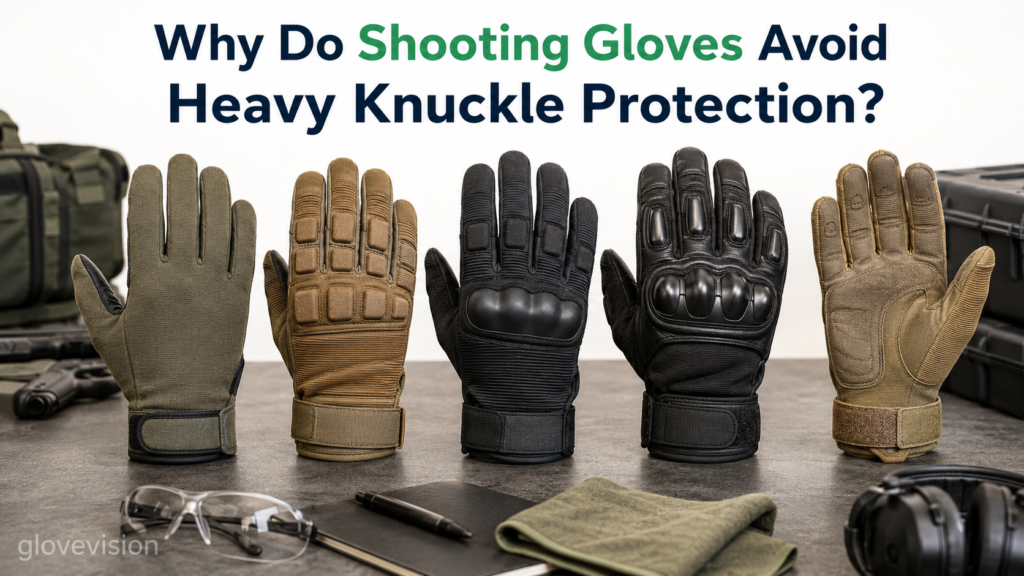
Why Do Shooting Gloves Avoid Heavy Knuckle Protection?
Many Shooting gloves avoid heavy knuckle protection because firearm-handling roles often require flexible hand closure, independent finger movement, stable glove fit, low interface bulk, and prolonged wearability. Extra back-of-hand structure can add flexion resistance, pressure, heat retention, or equipment interference when its protection is not justified by the actual hazard.
Not every Shooting glove should minimize knuckle protection. Credible back-of-hand impact hazards can justify reinforced, segmented, flexible molded, floating, or rigid protection when the exact finished glove has relevant evidence and still preserves acceptable fit, movement, and equipment compatibility.
This article discusses Shooting gloves as personal protective equipment and equipment-interface accessories. It does not provide marksmanship, firing, reloading, tactical manipulation, engagement, or firearm-modification instruction. Select hand protection from the actual hazard, applicable requirements, complete-glove evidence, fit, condition, and manufacturer guidance.
What Does Heavy Knuckle Protection Mean in Shooting Gloves?
Heavy knuckle protection in Shooting gloves describes a comparatively bulky, stiff, layered, or wide-coverage back-of-hand construction; it is not a universal technical protection category.
“Heavy” is therefore a relative construction description. A protector may feel substantial because of thickness, coverage, stiffness, layering, attachment structure, or resistance to bending, yet none of those visual or tactile cues is a stand-alone performance rating. Selection should begin with the task, conditions, duration, and identified hazards rather than with appearance. [OSHA 1910.138]
Which components create knuckle protection?
Back-of-hand construction can use textile or leather overlays, low-profile foam, flexible molded polymers, thermoplastic or composite elements, segmented pads, articulated panels, floating protectors, or continuous rigid shells. The component must be assessed together with its attachment panel, surrounding fabric, finger construction, palm, seams, liner, closure, and cuff.
When should knuckle protection be described as heavy?
Why does visual bulk not prove impact performance?
Large or rigid-looking protection does not by itself establish impact attenuation. Back-of-hand impact protection can be tested and classified, which is why an exact product claim should be supported by product-level evidence rather than shell size or marketing appearance. ANSI/ISEA 138-2019 is an occupational impact-glove standard, not a firearm-specific standard. [ANSI/ISEA 138]
How do common knuckle constructions differ?
| Construction | Intended Role | Possible Advantage | Possible Limitation | Required Evidence |
|---|---|---|---|---|
| Unpadded | Roles without identified dorsal impact need | Lowest added back-of-hand structure | Little added contact cushioning | Role and hazard assessment |
| Textile/leather overlay | Surface-contact or reinforcement need | Low profile; may support wear resistance | Does not prove impact performance | Exact mechanical-property data |
| Low-profile foam | Limited cushioning need | Localized padding with modest profile | Can compress, shift, or retain heat | Exact finished-product evidence |
| Segmented protection | Impact need with articulation priority | Movement between separate elements | Alignment and coverage gaps can matter | Impact evidence + fit assessment |
| Flexible molded protection | Impact role needing conformability | Can flex with the hand | Flexibility does not prove rating | Product-specific test evidence |
| Floating protection | Role needing shell movement over backing | Can separate shell motion from fabric | Attachment and edge behavior matter | Complete-glove evidence |
| Continuous rigid shell | Role-specific impact protection | Broad stiff coverage may be appropriate | Can increase bulk, leverage, or snag profile | Impact evidence + fit/function verification |
Why Do Control-Focused Shooting Gloves Minimize Knuckle Bulk?
Many control-focused Shooting gloves minimize knuckle bulk when substantial dorsal impact exposure is absent because lower-burden constructions can make it easier to preserve natural hand closure, finger movement, stable fit, equipment clearance, and prolonged-wear comfort.
Glove selection involves separate considerations such as dexterity, grip requirements, size, comfort, thermal needs, and the mechanical demands of the task. This supports evaluating protection alongside function rather than assuming that more back-of-hand material is always better. [OSHA Selection Factors]
How can reduced bulk support hand closure?
Depending on the construction, less material on the dorsal side can reduce folding, shell leverage, concentrated pressure, and resistance across flex zones. That may make natural closure easier to preserve, but the result still depends on patterning, material behavior, attachment, and fit.
Why does independent finger movement matter?
Finger flexion, finger independence, thumb movement, and general equipment interaction are glove-function requirements. A protector that bridges several joints or pulls against finger panels can make the complete glove feel less independent even when the protector itself appears articulated.
How can low-profile construction support fit stability?
A lower-profile back may reduce lifting, rigid-edge pressure, and leverage that shifts the palm or fingertips. It can also simplify interaction between the glove back, wrist closure, cuff, and adjacent equipment. The broader shooting glove protection and dexterity balance should be considered whenever reinforcement changes articulation, tactility, bulk, or prolonged-wear comfort.
Why can prolonged wear favor less bulk?
Additional layers may contribute to pressure, sweat accumulation, heat retention, or fatigue during long wear, but the relationship is product- and environment-dependent. A low-profile design is not guaranteed to feel cooler or more comfortable.
| Dimension | Lower-Profile Construction May Favor | More Substantial Construction May Favor | What Must Be Verified |
|---|---|---|---|
| Hand closure | Less dorsal resistance | More localized protection | Natural closure without persistent pressure |
| Finger independence | Lower cross-joint burden | Segmented protection where designed well | Independent movement in correct size |
| Internal stability | Less shell leverage | Stable protector when anatomically aligned | Palm, fingertip, liner, wrist stability |
| Heat management | Potentially less layering | May trade ventilation for protection | Finished-product behavior in environment |
| Impact protection | May be limited or documented | May provide documented higher protection | Exact impact evidence |
| Equipment clearance | Lower profile may reduce interference | More coverage where hazard justifies it | Safe clearance and snag assessment |
How Can Heavy Knuckle Shooting Gloves Interfere with Firearm Control?
Heavy-knuckle Shooting gloves can reduce functional compatibility when protector stiffness, poor articulation, misalignment, excess layering, or incorrect fit resists hand movement or shifts the complete glove.
How can rigid protectors restrict finger flexion?
Possible contributors include continuous shells, insufficient flex zones, stiff attachment panels, tight back patterning, misalignment, and excess layering. The practical signs are glove-function problems such as flexion resistance, concentrated knuckle pressure, reduced finger independence, or whole-glove movement.
Why can protector shells create fit instability?
An oversized or undersized glove can place the protector off-center. A stiff shell may also act as a lever against the glove back, shifting palm material, fingertips, or the liner. Protector pressure is therefore not automatically evidence that the protector is “too protective”; it may be a fit, alignment, or architecture problem.
How can knuckle bulk affect adjacent equipment?
Compatibility checks should stay at the level of sleeves, cuffs, watches, wrist equipment, storage equipment, pouches, vehicle interiors, confined spaces, safe clearance, and snag potential. They should not become firearm-operation instruction.
Why can rigid edges create snag or pressure concerns?
Raised edges, exposed attachment transitions, or misaligned shells can create catch points, concentrated pressure, surface abrasion, or contact with adjacent equipment. Persistent interference is a reason to reassess the complete glove rather than modifying the protector.
How can added protection affect heat and moisture?
Extra layering can change ventilation, sweat accumulation, drying, liner behavior, or cold-weather stiffness. The direction and magnitude of those effects depend on the exact finished glove and environment.
Which Shooting Gloves Still Need Reinforced Knuckle Protection?
Shooting gloves may require reinforced knuckle protection when the exact role includes a credible back-of-hand impact hazard whose protection benefit outweighs the added bulk, heat, fit, and articulation trade-offs.
Which hazards can justify reinforcement?
Potential examples include repeated dorsal knocks, hard-surface contact, confined-space contact, equipment contact, moving-object contact, or another role-specific impact exposure. Firearm use by itself does not establish that an impact protector is required.
How should impact be separated from abrasion?
Impact concerns transmitted force to the back of the hand, while abrasion concerns surface wear. Cut, tear, and puncture are also separate mechanical properties. ISO 23388:2018 treats these properties separately and remains the published edition while a second edition is under development. [ISO 23388] ANSI/ISEA 105-2024 likewise classifies mechanical properties such as abrasion, cut, and puncture separately from the dorsal-impact standard. [ANSI/ISEA 105]
When can segmented protection provide a useful compromise?
Segments can leave movement spaces between protective elements, but their value depends on spacing, connector flexibility, local coverage, attachment, and anatomical alignment. Segmentation alone does not guarantee unrestricted articulation.
When can rigid protection be justified?
A rigid protector can be appropriate when an identified dorsal impact hazard is supported by relevant product evidence and the complete glove still provides stable fit, adequate hand movement, acceptable equipment clearance, and tolerable wearability. A separate back-of-hand impact protection assessment should establish whether that hazard is actually present before extra structure is accepted.
| Hazard Pattern | Possible Design Direction | Main Selection Question | Evidence Needed |
|---|---|---|---|
| Minimal impact | Unpadded or low-profile may be sufficient | Is added impact structure necessary? | Role/hazard assessment |
| Repeated light contact | Overlay or localized padding may be considered | Is the issue contact, abrasion, or impact? | Relevant product property |
| Abrasion | Abrasion-focused reinforcement | Is surface wear the primary hazard? | Abrasion evidence |
| Localized impact | Segmented or flexible molded protection | Can needed coverage preserve articulation? | Dorsal impact evidence |
| Higher-impact role | More substantial documented protector | Does benefit outweigh fit/interface burden? | Exact impact classification |
| Combined hazards | Multi-property construction | Are all required properties documented? | Property-specific evidence |
How Do Knuckle Designs in Shooting Gloves Balance Protection and Dexterity?
Knuckle designs in Shooting gloves balance protection and movement through protector material, segmentation, flex zones, attachment, coverage, anatomical placement, surrounding fabric, and complete-glove fit.
General glove requirements address design, construction, comfort, efficiency, marking, and manufacturer information, but they do not by themselves establish hazard-specific protection. That reinforces the need to evaluate the complete glove and pair general requirements with the relevant specific performance evidence. [ISO 21420]
How does articulated padding support movement?
Flex grooves, joint breaks, stretch zones, floating elements, and segment spacing can let different areas move relative to one another. Problems can still arise from poor alignment, edge pressure, inadequate coverage, or detachment.
How do flexible protectors differ from rigid shells?
Flexible protectors may conform more readily to movement; rigid shells may provide a different coverage and structural profile. Neither is universally superior. Compare impact evidence, coverage, weight, heat, flexion behavior, snag profile, durability, and exact fit.
Why does protector placement matter?
Hand anatomy varies. A protector that crosses a wearer’s flex zones or sits off the intended knuckle area can create pressure, lifting, migration, or reduced movement even if the protector is well made.
How do palm and knuckle construction interact?
Back-of-hand tension can change palm movement, finger fit, seam rotation, liner movement, and overall glove stability. A knuckle component should therefore never be evaluated as if it were independent of the rest of the glove.
| Construction | Articulation Character | Possible Trade-Off | Key Verification |
|---|---|---|---|
| No protector | No added protector articulation | No added dorsal impact structure | Hazard does not require it |
| Low-profile foam | Usually conformable | Compression, heat, uncertain rating | Exact finished-product evidence |
| Segmented padding | Movement between elements | Coverage/alignment dependence | Segment position through movement |
| Flexible molded guard | Material flexes with glove | Flexibility alone proves nothing | Impact evidence + attachment |
| Floating shell | Shell can move over backing | Edge/attachment behavior | Stability and snag profile |
| Continuous rigid shell | Lowest inherent shell flex | Potential bulk/leverage | Flex zones, fit, documented protection |
Which Knuckle Construction in Shooting Gloves Matches the Role?
The appropriate knuckle construction in Shooting gloves depends on the actual back-of-hand hazard, required movement, wear duration, environment, equipment interfaces, exact product evidence, and complete-glove fit.
What should be defined first?
Define the role, impact and abrasion hazards, wear duration, environment, mobility need, equipment density, and any existing protection. Only then identify the protector type and the evidence that applies to the exact glove.
What fits controlled range use?
Where a substantial dorsal impact hazard is not identified, priorities may include low bulk, stable fit, mobility, prolonged-wear comfort, and only the level of surface reinforcement actually required. This is not a universal rule; the hazard assessment remains decisive.
What fits hunting or outdoor use?
Outdoor selection may also need to account for brush contact, moisture, cold, wear duration, drying, insulation, and movement. Selection of shooting gloves for cold and wet conditions should separately consider protector stiffness, liner stability, wet grip, and environmental performance.
What fits patrol or duty contexts?
Evaluate actual impact exposure, equipment contact, wear duration, environmental conditions, and interface compatibility. Do not infer a rigid-knuckle requirement from the job title alone.
What fits higher-impact roles?
Higher-impact roles require a credible impact hazard, appropriate documented impact performance, suitable coverage, correct anatomical alignment, stable fit, adequate movement, and acceptable equipment clearance.
Which evidence should support protection claims?
Look for the exact model, intended use, relevant impact test, other mechanical-property evidence where needed, construction details, sizing, limitations, care instructions, and retirement criteria. OSHA’s PPE-selection guidance recommends matching PPE to identified hazards and obtaining manufacturer documentation showing compliance with applicable test standards. [OSHA PPE Appendix]
| Role Context | Likely Priority | Knuckle Decision | Do Not Assume |
|---|---|---|---|
| Controlled range | Fit, mobility, low interface bulk | Add protection only for identified hazard | Firearm use requires hard knuckles |
| Sport shooting | Movement, stable fit, wearability | Hazard-led construction | Low profile means unprotective |
| Hunting | Environment, brush/contact, wear duration | Balance exposure and mobility | One design covers every climate |
| Patrol/duty | Impact exposure, equipment interfaces | Use documented protection when justified | Role title determines protector |
| Vehicle/confined environment | Contact hazard + clearance | Assess impact benefit and snag profile | More shell is always better |
| Higher-impact role | Documented dorsal impact protection | More substantial protector may be justified | Visual armor proves performance |
How Should Knuckle Fit and Interference in Shooting Gloves Be Evaluated?
Knuckle protection in Shooting gloves should align with the wearer’s anatomy and remain stable through required hand movement without producing persistent pressure, glove migration, major flexion restriction, or unsafe equipment interference.
No single protective ensemble covers every hazard, and fit and comfort are important PPE-selection considerations. For Shooting gloves, that means checking anatomical alignment, palm and finger fit, wrist security, pressure, migration, and functional movement rather than defining correct fit simply as “tight.” [NIOSH PPE]
What does correct protector alignment look like?
The protector should sit over its intended dorsal area, flex zones should correspond reasonably with the wearer’s joints, the back should not lift or bunch, and the palm and wrist should remain stable.
Which movements reveal interference?
Under controlled safety conditions, assess glove function only: open hand, natural closed hand, individual finger movement, thumb movement, wrist movement, firm gripping of non-operational equipment, and general interface clearance. This is a glove-fit check, not firearm-operation instruction.
How can users distinguish protector bulk from wrong size?
A complete shooting glove fit assessment should also verify palm width, finger length, thumb position, wrist security, internal movement, and seam alignment.
Which findings require another construction?
Reassess when the protector blocks natural closure, moves the glove, creates persistent pressure or numbness, materially reduces independent finger movement, repeatedly snags, or fails required adjacent-equipment compatibility after correct sizing. A complete shooting glove pre-use inspection should extend beyond the protector to the palm, fingers, seams, liner, closures, contamination, and complete interface.
How Should Knuckle-Protected Shooting Gloves Be Inspected and Maintained?
Knuckle-protected Shooting gloves should be inspected and maintained as complete products because protector damage, attachment failure, surrounding-fabric wear, improper cleaning, deformation, or fit changes can alter both protection and hand function.
What should be inspected on the protector?
Look for cracks, splits, deformation, detached edges, loose stitching, delamination, permanently compressed padding, hardening or softening, missing segments, sharp edges, and changed alignment. Do not invent a universal safe crack size, deformation limit, or impact count.
Which surrounding components require inspection?
Inspect back fabric, stretch zones, fingers, fourchettes, palm, thumb crotch, liner, seams, closure, cuff, previous approved repair, and product identification. A protector can appear intact while the attachment or surrounding glove has degraded.
How should gloves be cleaned?
Follow the exact finished-product instructions for washing method, cleaning agent, temperature, drying, leather, textile, foam, molded protectors, liners, coatings, and closures. Detailed shooting glove cleaning and maintenance should not rely on a universal detergent or drying method.
Which modifications should be avoided?
Avoid unauthorized protector removal, cutting, heating, bending, reshaping, drilling, grinding, adhesive repair, stitching, substitute padding, or finger removal. If the protector interferes after correct sizing and assessment, select another approved construction instead of reshaping the protection.
When should the glove be removed from service?
Remove or reassess when a protector cracks, separates, deforms, develops sharp edges, loses attachment, stays permanently compressed, changes alignment, restricts required movement, causes new glove migration, or when required protection can no longer be verified. The wider shooting glove replacement decision should also consider palm wear, seam failure, liner instability, closure failure, contamination, and fit changes.
| Problem | Possible Cause | Required Check | Decision |
|---|---|---|---|
| Knuckle pressure | Wrong size or alignment | Fit + flexion | Resize or change design |
| Restricted closure | Stiff or poorly articulated construction | Movement | Select another construction |
| Protector shifts | Attachment or fit problem | Stitching + stability | Approved repair or change glove |
| Protector snags | Excess profile or edge | Interface | Change design |
| Protector cracks | Impact, age, or care damage | Product rejection criteria | Remove and reassess |
| Padding stays flattened | Material deterioration | Protection evidence | Replace when required function is uncertain |
Why Should Selection of Shooting Gloves Balance Knuckle Protection with Control?
Shooting gloves should use only the level of knuckle protection justified by the identified back-of-hand hazard while preserving acceptable complete-glove fit, articulation, prolonged wearability, and equipment compatibility.
What final questions determine required protection?
- What role is being supported?
- Is a credible dorsal impact hazard present?
- Is the primary hazard impact, abrasion, or another property?
- Which hand area requires coverage?
- How much movement is required?
- Does protector alignment match the wearer?
- Does complete-glove fit remain stable?
- Is equipment clearance acceptable?
- Is product-level protection documented?
- Can the glove be maintained as specified?
- Is its current condition acceptable?
Which decision rule should readers retain?
Do not select by visual armor. Begin with the hazard, verify the required property, identify the exact protector architecture, confirm anatomical alignment and complete-glove movement, verify adjacent-equipment compatibility and product-level evidence, reject unresolved pressure or migration, and keep inspecting the glove throughout its service life.
Conclusion
Many Shooting gloves avoid heavy knuckle protection when substantial back-of-hand impact protection is not required because unnecessary bulk, stiffness, or poor alignment can work against natural hand movement, stable fit, prolonged wearability, and equipment compatibility. Reinforced protection remains appropriate when the actual role presents a credible dorsal impact hazard and the exact glove provides relevant documented performance.
Final suitability should therefore be hazard-led rather than appearance-led. Low-profile, flexible, segmented, floating, and rigid constructions should be judged by the protection actually required, anatomical alignment, complete-glove fit, movement, equipment clearance, environment, product evidence, and current condition.
Which Questions Clarify Knuckle Protection in Shooting Gloves?
Do all Shooting gloves avoid hard knuckle protection?
No. Some Shooting gloves use rigid, flexible, or reinforced protectors when a documented back-of-hand impact hazard justifies the added construction.
Does heavier knuckle protection make Shooting gloves safer?
Not automatically. Useful protection depends on the relevant hazard, documented performance, fit, movement, compatibility, and condition.
Can rigid knuckles reduce Shooting-glove dexterity?
They can when the protector is excessively stiff, bulky, continuous, misaligned, or poorly fitted. A properly articulated role-specific design may preserve acceptable movement.
Are segmented knuckles always better for Shooting gloves?
No. Segmentation may support articulation, but effectiveness still depends on protector placement, attachment, coverage, material behavior, complete-glove construction, and fit.
How much knuckle protection should Shooting gloves have?
Only the level justified by the exact back-of-hand hazard, role, required movement, complete-glove compatibility, documented performance, and current condition.
When should knuckle-protected Shooting gloves be replaced?
Replace or remove them from service when protector cracking, separation, permanent deformation, attachment failure, sharp edges, unresolved misalignment, major fit changes, or another condition makes required protection or safe hand function uncertain.