
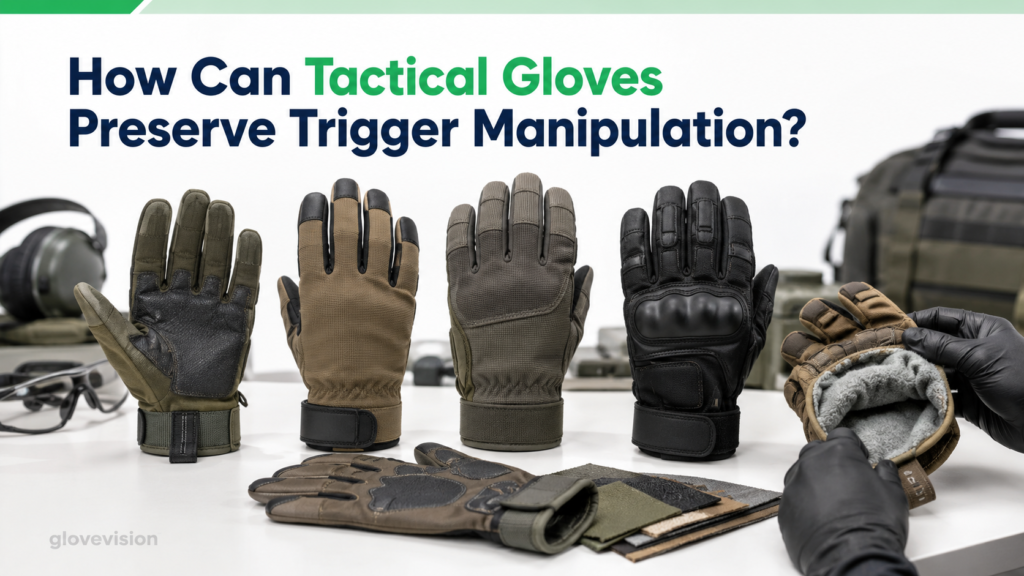
How Can Tactical Gloves Preserve Trigger Manipulation?
Tactical Gloves can preserve trigger manipulation when their fit, finger geometry, fingertip construction, seams, and materials allow safe indexing, independent trigger-finger movement, sufficient tactile awareness, and compatible equipment-interface clearance. Fingertip length, seam placement, complete-glove stability, required protection, and environmental conditions all affect whether that interface remains functional.
Tactical Gloves cannot guarantee safe firearm handling or improve skill. Poor fit can create excess material, bulk or stiffness may restrict movement, liner movement can destabilize the glove, and an otherwise protective product may still be unsuitable when it crowds or snags the exact equipment interface.
Safety and scope notice: This article discusses Tactical Gloves as personal protective equipment and equipment-interface accessories. It does not provide firing, trigger-use, marksmanship, reloading, tactical manipulation, target-engagement, or firearm-modification instruction. Follow established firearm-safety procedures, firearm-manufacturer guidance, applicable organizational requirements, and exact glove-product instructions.
What Must Tactical Gloves Preserve During Trigger Manipulation?
Tactical Gloves must preserve safe finger indexing, independent trigger-finger movement, tactile awareness, stable glove position, and sufficient interface clearance without interfering with established firearm-safety procedures.
Hand protection should be selected from the exact task, conditions, duration, and identified hazards rather than from tactical appearance alone. [OSHA]
How should Tactical Gloves support safe trigger-finger indexing?
The glove should allow independent finger extension while the fingertip remains stable inside its stall. Excess material, bunching, a shifting liner, palm rotation, or poor wrist retention can disturb the finger’s position even when the nominal glove size appears correct.
Which movements must Tactical Gloves preserve?
Evaluate glove function only: independent finger extension and flexion, thumb opposition, natural hand closure, wrist movement, and transition to non-firearm equipment handling. The purpose is to confirm that the glove does not bind or move unexpectedly—not to teach firearm technique.
Why does tactile feedback matter?
Tactile feedback helps the wearer perceive contact, pressure, surface position, seam pressure, and equipment-interface contact. Material thickness, reinforcement, seams, and liner construction can all change that awareness. Tactility does not replace firearm-safety procedures, training, or visual awareness.
Why must Tactical Gloves preserve both separation and access?
A suitable glove should support safe indexing outside the trigger guard while maintaining sufficient interface clearance and stable positioning when access to required external interfaces is permitted under established procedures. Snagging, excess material, or glove rotation should not be accepted as normal fit.
| Required Function | Glove Contribution | Possible Failure | Verification |
|---|---|---|---|
| Safe indexing | Stable finger geometry and low excess material | Bunching, seam shift, glove rotation | Controlled fit and interface check |
| Independent movement | Correct stall length/width and flexible construction | Pressure, stiffness, linked movement | Independent extension/flexion |
| Tactile awareness | Appropriate fingertip layers and stable liner | Excess bulk, seam pressure, contamination | Contact awareness without interference |
| Interface clearance | Compatible fingertip profile | Crowding, snagging, folded material | Exact-interface compatibility assessment |
| Stable glove position | Palm fit, liner stability, wrist retention | Rotation or forward migration | Movement check across complete glove |
| Environmental protection | Role-appropriate insulation/membrane/material | Cold stiffness, wet shift, sweat migration | Environment-specific product evidence |
How Does the Fit of Tactical Gloves Affect Trigger-Finger Function?
Tactical Gloves should fit the trigger finger securely enough to prevent excess material and seam movement while preserving circulation, full required finger extension and flexion, tactile awareness, and stable complete-glove fit.
Dexterity, grip conditions, size, comfort, thermal needs, and mechanical protection are distinct glove-selection factors. That supports assessing trigger-finger geometry separately rather than defining correct fit by tightness alone. [OSHA Fit]
Why does fingertip length matter?
Excess length may fold, reduce feedback, snag, shift the fingertip, or crowd a confined interface. Insufficient length may create end pressure, restrict flexion, compress seams, pull the glove forward, or accelerate wear.
How does finger-stall width matter?
An overly wide stall may permit side movement, seam rotation, bunching, or inconsistent contact. An overly narrow stall may create pressure, reduced circulation, limited movement, or fatigue.
Why do palm and wrist fit matter?
A loose palm can let the glove rotate; a loose wrist can allow forward migration; a mobile liner can displace the fingertip internally; and excessive palm tightness can reduce natural finger separation.
How do hand proportions affect Tactical Gloves?
Palm width, hand length, finger proportions, finger circumference, thumb position, and wrist dimensions all influence fit. Nominal size alone is not enough. A dedicated tactical glove trigger-finger fit assessment should compare those dimensions with seam position, palm stability, wrist retention, and independent movement.
| Finding | Likely Fit/Construction Cause | What to Recheck | Decision |
|---|---|---|---|
| Folded fingertip | Excess finger-stall length or liner migration | Finger length, liner stability | Resize or select another pattern |
| Fingertip pressure | Short stall or narrow geometry | Length, width, seam position | Resize/reassess |
| Finger-stall rotation | Excess width or unstable palm | Finger circumference, palm fit | Change size/pattern |
| Glove forward migration | Loose wrist or palm fit | Retention, palm volume | Reassess fit |
| Trigger-finger restriction | Tight stall, stiff reinforcement, seam bulk | Geometry and construction | Select another construction |
| Numbness/pressure | Excess tightness or concentrated seam pressure | Size and anatomy match | Stop use and reassess |
How Does Fingertip Construction in Tactical Gloves Preserve Tactile Feedback?
Tactical Gloves preserve tactile feedback through a complete fingertip construction that balances material thickness, fit, seams, reinforcement, liner stability, durability, and environmental protection without unnecessary interference.
General protective-glove requirements treat design, construction, comfort, efficiency, marking, and manufacturer information as part of the complete glove. They do not make one material or component a stand-alone proof of hazard-specific performance. [ISO 21420]
How does fingertip thickness affect function?
Lower bulk can support surface awareness and easier flexion in some designs, but thinner construction may also reduce abrasion life, thermal protection, environmental protection, or durability. Thin is therefore not the same as suitable.
Why does seam placement matter?
Fingertip-pad seams, sidewall seams, wrapped tips, internal seams, and external seams create different pressure and bulk patterns. A seam that rotates or sits in an incompatible contact zone may produce pressure, a raised tactile cue, premature wear, or unwanted interface contact.
How do reinforcements affect trigger-finger function?
Reinforcement may support abrasion resistance or local durability, but added layers can also increase stiffness, bulk, raised edges, or flexion resistance. The exact finished glove—not the reinforcement material alone—must be evaluated.
Does touchscreen compatibility establish tactility?
No. Touchscreen capability is a separate product function. A deeper assessment of tactical-glove fingertip tactile feedback should compare material thickness, wrapped or seamed fingertips, sidewalls, reinforcement, liner construction, wear, and contamination rather than relying on “high-dexterity” or touchscreen marketing.
| Construction | Possible Benefit | Possible Limitation | Verify |
|---|---|---|---|
| Thin single layer | Low bulk, direct surface awareness | May wear faster or protect less | Hazard suitability and durability |
| Wrapped fingertip | Moves seam away from contact face | Pattern can still bunch | Length, wrap tension, fit |
| Sidewall seam | Moves seam to side surface | Side pressure or rotation | Seam position through movement |
| Reinforced fingertip | Local durability/protection | Added stiffness or bulk | Exact property evidence |
| Conductive panel | Touchscreen function | Does not prove tactility/compatibility | Fit and interface behavior separately |
| Insulated fingertip | Cold protection where required | Added diameter and reduced awareness | Cold performance + movement |
Which Protection Features in Tactical Gloves Can Obstruct Trigger Manipulation?
Protection features in Tactical Gloves can become incompatible with trigger-finger requirements when insulation, reinforcement, padding, membranes, multiple layers, or stiff protective materials create excessive bulk, movement resistance, liner instability, or interface crowding.
How can insulation affect Tactical Gloves?
Insulation can increase finger diameter, reduce tactile feedback, contribute to liner movement, and increase flex resistance, yet it may be necessary for cold exposure. Thermal or flame claims should be supported by the exact finished product and applicable hazard-specific evidence rather than inferred from thickness, leather, aramid, or an insulation label alone. [ISO 23407]
How can impact protection affect hand function?
Protector stiffness, back-of-hand tension, finger padding, articulation, and attachment can influence hand closure and equipment clearance. Impact protection should be evaluated separately from trigger-finger fit and only where the role presents a relevant impact hazard.
How can abrasion or cut protection change dexterity?
Dense fibers, overlays, multiple layers, reinforcement, and seam accumulation can change flexion and bulk. Abrasion, blade cut, tear, puncture, and impact are distinct mechanical properties, so evidence for one should not be transferred to another. [ISO 23388]
How can weather barriers affect function?
Membranes and barriers can alter stiffness, liner movement, moisture retention, drying behavior, bulk, and cold response. Waterproof or weather-resistant construction does not automatically preserve tactile feedback or interface compatibility.
Why must protection claims remain separate?
Abrasion, cut, puncture, impact, flame, weather, cold, dexterity, and trigger-interface compatibility are different properties. The broader tactical glove protection and dexterity balance becomes important whenever protection adds useful coverage but also changes fingertip bulk, flexion, tactility, or prolonged-wear function.
| Feature | Protection Role | Possible Function Cost | Required Check |
|---|---|---|---|
| Insulation | Cold exposure | Finger diameter, tactility, liner movement | Cold mobility and interface fit |
| Impact padding | Back/finger impact | Stiffness, flexion resistance, snag profile | Impact evidence + movement |
| Cut-resistant layer | Blade-cut hazard | Layer stiffness or seam bulk | Cut evidence + finger fit |
| Palm reinforcement | Abrasion/durability | Can alter palm flex or internal stability | Palm fit and grip separately |
| Weather membrane | Moisture/weather barrier | Liner shift, moisture retention, stiffness | Wet/cold finished-product behavior |
| Flame-resistant construction | Thermal/flame hazard | Material/layer trade-offs | Exact thermal evidence + fit |
Which Tactical Gloves Match the Firearm Interface and Environment?
Tactical Gloves should be matched to the exact lawful role, hand dimensions, firearm interface, expected environment, adjacent equipment, required hand protection, and trigger-finger function rather than selected from tactical appearance or one material alone.
What should be defined first?
Define the lawful role, exact equipment interface, organizational requirements, wear duration, environment, hand hazards, required protection, and required finger mobility before comparing glove models.
How should the firearm interface affect Tactical Gloves selection?
Stay at compatibility level: assess available interface space, trigger-guard geometry, required external-control clearance, grip dimensions, adjacent equipment, and whether safe indexing remains possible. Do not convert that assessment into weapon-operation instruction.
How should hot or humid conditions affect selection?
Sweat, liner attachment, internal stability, breathability, drying, and wrist retention can change how the glove remains positioned during prolonged wear. Dry-room fit should not automatically be extrapolated to a hot or saturated environment.
How should wet conditions affect selection?
Water absorption, wet grip, material swelling, liner movement, seam behavior, drying, and post-saturation fit all matter. Palm grip and trigger-finger geometry should be assessed separately.
How should cold conditions affect selection?
Balance insulation with fingertip bulk, tactile feedback, finger movement, moisture, duration, and material stiffness. Selecting tactical gloves for cold and wet conditions requires a separate environmental assessment rather than assuming an insulated or membrane glove is automatically compatible.
Which product evidence should guide Tactical-Glove selection?
Use the exact model, intended use, manufacturer sizing, construction details, relevant mechanical or thermal evidence, environmental documentation, care instructions, inspection criteria, and replacement guidance. PPE-selection guidance supports matching protection to identified hazards, considering fit and comfort, and using appropriate test procedures and manufacturer documentation. [OSHA PPE]
What if a role includes chemical contact?
Chemical protection is separate from tactical-glove material, grip, weather resistance, dexterity, or mechanical protection. Claims should be chemical- and product-specific, and other protective properties require their own applicable evidence. [ISO 374-1]
| Context | Primary Priorities | Common Trade-Off | Verification |
|---|---|---|---|
| Controlled range | Fit, finger geometry, low unnecessary bulk | Overprotection can add interference | Exact interface + role hazards |
| Hot/humid | Stability, sweat management, drying | Moisture can change fit | Wet/sweaty condition check |
| Wet | Wet fit, grip, liner stability | Absorption/swelling or liner movement | Finished-product wet behavior |
| Cold | Warmth plus finger movement | Insulation adds bulk/stiffness | Cold mobility and clearance |
| Patrol/duty | Role hazards + equipment compatibility | More protection can crowd interfaces | Hazard-led complete-glove check |
| Documented tactical role | Exact required protection and interfaces | Multiple hazards increase layering | Product-level evidence + fit |
What Problems in Tactical Gloves Disrupt Trigger Manipulation?
Tactical Gloves can disrupt trigger manipulation when excess fingertip material, restrictive finger stalls, seam bulk, liner movement, complete-glove migration, protective-layer stiffness, moisture, or wear changes the trigger-finger interface.
Why does material bunch near the fingertip?
Possible causes include excess length or width, liner migration, material stretching, seam distortion, pattern mismatch, and wear. The correction should address the source rather than compressing or modifying the fingertip.
Why can the finger feel restricted?
A narrow stall, stiff reinforcement, thick seam, heavy insulation, cold-stiffened material, or excessive back-of-hand tension can reduce required movement. Persistent pressure or numbness is a reason to stop and reassess size or design.
Why can Tactical Gloves contact confined interfaces unexpectedly?
Fingertip excess, thick seams, an enlarged profile, glove rotation, liner movement, wet material changes, or exact-interface mismatch can create unwanted contact. Palm friction alone cannot correct those geometry problems.
Why can feedback change after repeated use?
Surface wear, stretching, seam deformation, liner separation, reinforcement wear, contamination, repeated wetting and drying, or unapproved cleaning can change the glove’s tactile cues and fit.
Which problems require another glove or replacement?
Reassess when correct fit cannot be achieved, excess material persists, finger mobility remains restricted, seams interfere, liner instability continues, protective features create unresolved interference, or wear changes compatibility.
| Problem | Possible Cause | Check | Decision |
|---|---|---|---|
| Fingertip folding | Excess length or liner shift | Finger length + liner | Resize/change pattern |
| Finger restriction | Narrow stall, stiff seam/reinforcement | Width + construction | Select another construction |
| Glove rotation | Loose palm/wrist | Complete fit | Resize/reassess |
| Uneven feedback | Seam rotation, wear, contamination | Fingertip construction | Clean/reassess/replace |
| Wet-condition change | Absorption, swelling, liner movement | Wet behavior | Select environment-suitable glove |
| Wear-related interference | Permanent folds, seam shift, liner separation | Condition + fit | Repair if approved or replace |
How Should Tactical Gloves Be Evaluated for Trigger Compatibility?
Tactical Gloves should be evaluated for trigger compatibility only after glove fit and condition are established and under controlled firearm-safety procedures that allow interface clearance, safe indexing, finger mobility, and glove stability to be assessed without turning the evaluation into firing instruction.
How should glove fit be checked first?
Check palm width, hand length, finger length and width, thumb alignment, fingertip seams, wrist retention, liner stability, independent finger extension, and natural hand closure before assessing any equipment interface.
How should interface compatibility be assessed?
Where authorized, use an unloaded, verified-safe firearm or an approved inert training device under established safety procedures and applicable manufacturer or organizational guidance. Assess only safe indexing, interface clearance, independent movement, glove stability, absence of excess material, and absence of snagging. Do not use the compatibility check to teach firing or trigger-use technique.
How should adjacent equipment be considered?
Holsters, slings, sleeves, wrist equipment, body armor, pouches, communication equipment, and environmental layers can move or compress a glove. The assessment should verify that those interfaces do not destabilize fit or create snagging.
Which findings should disqualify the glove?
Reject or reassess when safe indexing cannot be maintained, excess material enters a critical interface, finger movement is restricted, seam bulk creates interference, the glove rotates, the liner shifts, adjacent equipment displaces the glove, environmental conditions cause unacceptable function loss, or compatibility cannot be verified safely. A complete tactical glove pre-use inspection should also cover the palm, seams, fourchettes, reinforcement, knuckle components, closures, contamination, and complete fit.
- Exact Tactical Gloves model identified.
- Correct size identified.
- Palm remains stable.
- Trigger-finger stall fits correctly.
- No fingertip excess or persistent pressure.
- Fingertip seam stays appropriately positioned.
- Exact equipment interface identified.
- Controlled safety conditions established.
- Independent finger movement remains available.
- Safe indexing remains possible.
- Required interface clearance remains available.
- No snagging or glove rotation occurs.
- Liner remains stable.
- Wrist retention remains secure.
- Adjacent equipment does not displace glove.
- Expected wet, cold, or hot conditions considered.
- Product limitations are understood.
- Unresolved interference leads to reassessment.
- No unauthorized glove modification is used.
How Should Tactical Gloves Be Inspected and Maintained?
Tactical Gloves should be inspected and maintained according to exact finished-product guidance because fingertip wear, seam movement, liner instability, contamination, reinforcement damage, or improper care can change fit, protection, and equipment-interface compatibility.
Effective PPE programs include inspection and replacement of damaged or worn protective equipment, so Tactical Gloves should be reassessed when wear or damage changes required fit, protection, or interface compatibility. [NIOSH]
What should be inspected on the trigger finger?
Inspect fingertip material, seam position, sidewalls, fourchettes, reinforcement, grip surface, liner, stretching, holes, tears, hardening, permanent folds, and contamination.
Which complete-glove components require inspection?
Check the palm, thumb crotch, remaining fingers, back-of-hand material, knuckle protection, membrane, insulation, padding, wrist closure, cuff, previous approved repairs, and product label.
How should Tactical Gloves be cleaned and dried?
Follow exact manufacturer guidance for washing, cleaning agent, water temperature, drying, leather, membranes, reinforcement, liners, grip prints, and closures. Detailed tactical glove cleaning and maintenance should not rely on one universal detergent, washing temperature, or drying method.
Which modifications should be avoided?
Do not recommend unauthorized fingertip removal, cutting, seam alteration, adhesive repair, homemade grip coating, padding removal, heat reshaping, patching, or stitching. An incompatible glove should be resized, replaced, or changed to another approved construction.
When should Tactical Gloves be removed from service?
Remove or reassess when finger geometry changes, permanent bunching develops, seams move or open, liners detach, reinforcement fails, grip surfaces deteriorate substantially, closures fail, contamination remains unresolved, or required compatibility can no longer be verified. The broader tactical glove replacement decision should consider all changes in fit, protection, and interface function.
- Exact model known.
- Intended role confirmed.
- Documentation available.
- Care guidance matches exact glove.
- Finger length remains correct.
- Stall width remains correct.
- No excess material or excessive pressure.
- Seam and reinforcement remain positioned correctly.
- Palm and liner remain stable.
- Wrist closure remains secure.
- No glove rotation.
- No seam opening or liner separation.
- No permanent deformation or unresolved contamination.
- Approved cleaning and drying used.
- No unauthorized modification.
- Use, clean, reassess, resize, repair, replace, or do not use according to verified condition.
Why Should Selection of Tactical Gloves Follow a Complete-Interface Decision?
Tactical Gloves should be selected through a complete-interface decision that begins with the lawful role, hand dimensions, equipment interface, environment, and protection needs before evaluating trigger-finger fit, fingertip construction, tactile feedback, glove stability, product evidence, and current condition.
What final questions determine suitability?
Confirm the lawful role, exact equipment interface, environment, hand hazards, hand and finger dimensions, trigger-finger stall fit, fingertip excess, seam position, independent movement, safe indexing, tactile awareness, complete-glove stability, required protection, adjacent-equipment compatibility, applicable product evidence, and current condition.
Which decision rule should readers retain?
Begin with role, hand, interface, and environment. Define trigger-finger requirements separately from protection, evaluate the complete glove construction, verify finger geometry and seams, verify palm and liner stability, confirm independent movement and safe indexing, check interface clearance, verify protection evidence, inspect condition, and reject unresolved interference.
Conclusion
Tactical Gloves preserve trigger manipulation only when their fit, finger geometry, fingertip construction, seams, materials, and condition support safe indexing, independent movement, tactile awareness, and compatible interface clearance. They do not create firearm skill, and nominal size, thinness, tightness, palm grip, touchscreen capability, or tactical appearance cannot substitute for complete-glove compatibility.
Final suitability should be based on the wearer’s hand dimensions, exact glove pattern, lawful role, equipment interface, environment, required protection, product-level evidence, and current condition. A glove that retains unresolved excess material, pressure, seam interference, liner instability, restriction, or crowding should be reassessed rather than modified.
Which Questions Clarify Trigger Manipulation in Tactical Gloves?
Should Tactical Gloves fit tightly around the trigger finger?
Not simply tight. They should fit securely without excess material, persistent pressure, numbness, restricted circulation, seam distortion, or reduced independent finger movement.
Are thinner Tactical Gloves always better for trigger manipulation?
No. Lower bulk may improve tactile awareness in some designs, but suitability also depends on fit, seams, durability, environment, protection needs, and exact equipment-interface compatibility.
Can insulated Tactical Gloves preserve trigger manipulation?
They can when the exact finished glove preserves sufficient finger movement, tactile awareness, fit stability, and interface clearance under the intended cold conditions.
Does touchscreen compatibility mean Tactical Gloves provide good trigger-finger tactility?
No. Touchscreen capability is a separate feature and does not establish fingertip fit, tactile feedback, dexterity, or firearm-interface compatibility.
Should a finger be cut off Tactical Gloves to improve access?
No universal glove modification should be recommended. Cutting a glove finger can alter seams, fit, coverage, durability, protection, and the integrity of the finished glove.
Can one pair of Tactical Gloves fit every firearm interface?
Not reliably. Hand dimensions, glove geometry, firearm-interface dimensions, environmental conditions, adjacent equipment, and protection requirements can all change compatibility.