
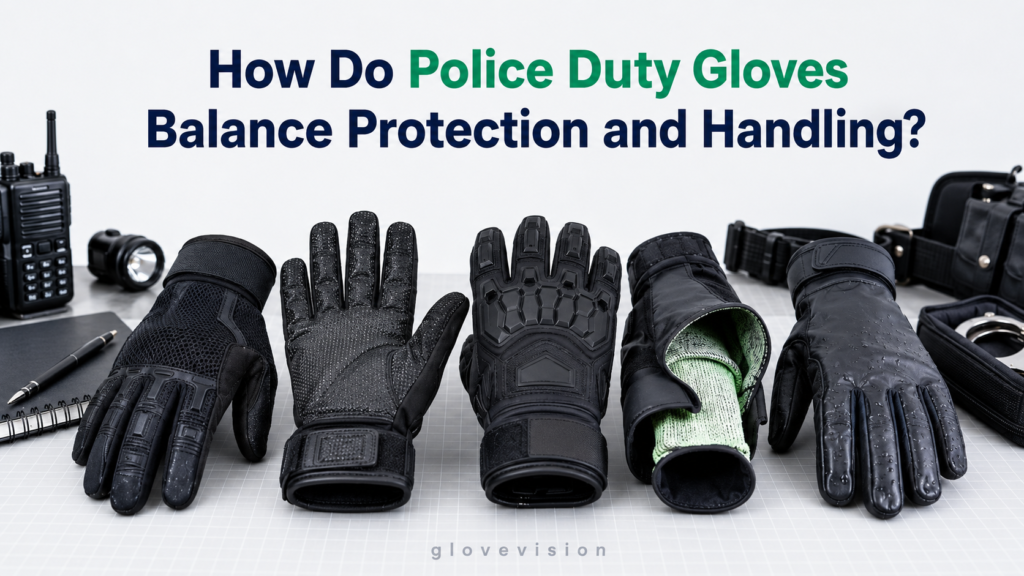
How Do Police Duty Gloves Balance Protection and Handling?
Police duty gloves balance protection and handling by combining task-appropriate protective construction with a stable fit, usable palm grip, flexible finger movement, and sufficient tactile feedback for the exact duty task. The credible hazard, complete-hand fit, grip, dexterity, environment, and required equipment interfaces should all shape selection.
No single Police duty gloves product is optimal for every police hazard. Routine handling differs from sharps risk; biological exposure may require specified disposable barrier PPE; chemicals require substance-specific protection; and higher-impact, cold, or wet roles may require different glove constructions or an approved glove system.
Occupational safety and scope notice: This article provides general education about Police duty gloves as occupational hand protection. It does not provide search, arrest, restraint, use-of-force, firearm-operation, or tactical instruction. Follow agency hazard assessments, exposure-control plans, applicable PPE requirements, chemical SDS information, and the exact glove manufacturer’s selection, use, care, decontamination, disposal, and replacement guidance.
What Must Police Duty Gloves Balance During Routine Work?
Police Duty Gloves should provide only the protective capabilities required for the identified duty hazards while preserving the finger movement, grip, tactile feedback, fit stability, and equipment compatibility required for routine work.
Hand protection should be selected from performance relative to the task, conditions, duration, and identified hazards rather than from police branding, tactical appearance, thickness, or knuckle styling alone. [OSHA]
Which handling functions must Police duty gloves preserve?
Routine handling can require secure object contact, finger independence, thumb opposition, tactile feedback, radio or device access, writing-tool use, vehicle-control compatibility, and access to authorized duty equipment. Any firearm-related consideration remains limited to agency-approved fit and safe-clearance compatibility rather than firearm operation.
Which protective functions can Police duty gloves provide?
Depending on exact product evidence, a glove may address abrasion, cut, puncture, needle puncture, impact, cold, weather, or thermal hazards. One capability does not establish another, and a role label does not establish a protection level.
Why is handling part of glove safety?
A glove should not obstruct the duty task. Poor fit can reduce stability, excess material can catch on equipment, stiffness can limit fine movement, and unstable liners can make contact inconsistent even when the outer palm has a high-friction surface.
Why can one Police duty gloves model rarely cover every task?
Police duties can differ by hazard, wear duration, required dexterity, contamination potential, weather, and equipment. The correct outcome may therefore be a different reusable glove, a specified disposable barrier glove, approved layering, or another hazard-specific glove system.
| Duty Requirement | Glove Contribution | Possible Failure | Verification |
|---|---|---|---|
| Secure handling | Stable palm fit and task-appropriate surface | Internal slide, bunching, poor wet contact | Dry/wet task-relevant handling check |
| Fine control | Finger mobility, suitable seams and thickness | Excess bulk, pressure, seam interference | Independent finger/thumb movement |
| Extended wear | Comfort, retention, moisture management | Heat, pressure, liner migration | Wear-duration and environment assessment |
| Mechanical protection | Documented hazard-specific construction | Wrong rating or unprotected zone | Exact test evidence and coverage |
| Biological barrier | Specified barrier PPE where required | Reusable glove assumed to be a barrier | Exposure-control requirements |
| Equipment compatibility | Stable complete-hand fit and suitable profile | Snagging, blocked access, glove displacement | Controlled compatibility assessment |
How Do Police Duty Gloves Preserve Grip, Dexterity, and Tactile Handling?
Police Duty Gloves preserve handling when their palm, fingers, thumb, seams, liner, wrist retention, and overall fit remain stable enough to support grip and movement without unnecessary pressure, bunching, or interference.
General protective-glove requirements treat design, construction, comfort, efficiency, marking, and manufacturer information as complete-product considerations; they do not make one material a stand-alone proof of hazard-specific protection. [ISO 21420]
How does fit affect Police duty gloves?
Check palm width, hand length, finger length and width, thumb position, wrist retention, full hand closure, and finger independence. Poor fit may cause fingertip folding, palm bunching, seam rotation, internal slippage, pressure, or restricted movement. A dedicated police duty glove fit assessment should compare complete hand geometry rather than treating nominal size or tightness as sufficient.
How does palm construction affect grip?
Assess palm material, texture, thickness, reinforcement, grip printing, dry and wet conditions, debris, contamination, and internal glove stability. External grip cannot compensate for the hand moving inside the glove.
How do finger and thumb patterns affect handling?
Finger length, fourchettes, fingertip seams, pre-curved patterning, thumb-crotch shape, thumb rotation, and reinforcement can influence mobility and pressure. Each should be judged as part of the complete pattern rather than from appearance alone.
Why does tactile feedback depend on complete construction?
Thickness, seam placement, liners, membranes, reinforcement, moisture, cold stiffness, and wear can all change tactile awareness. Touchscreen compatibility is a separate device function and does not establish general dexterity or tactile handling.
How do cuffs and closures affect handling?
Wrist retention, sleeve overlap, watches or other wrist equipment, cuff migration, pressure, and adjacent equipment can all affect glove position. A secure closure should stabilize the glove without creating avoidable pressure or equipment interference.
| Symptom | Possible Cause | Handling Effect | Decision |
|---|---|---|---|
| Fingertip excess | Finger stalls too long | Reduced tactility | Resize or select another pattern |
| Palm bunching | Excess palm volume | Unstable contact | Reject fit |
| Restricted finger | Tight or stiff construction | Reduced dexterity | Change size/design |
| Glove rotation | Loose palm or wrist | Inconsistent handling | Reassess fit |
| Pressure or numbness | Excess tightness | Reduced hand function | Stop and resize |
| Liner movement | Moisture or unstable attachment | Internal slippage | Change construction |
Which Hazards Should Protective Police Duty Gloves Address?
Protective Police Duty Gloves should be selected from the exact hazard rather than a general “protective glove” label because abrasion, cut, puncture, needles, impact, biological contact, chemicals, and environmental exposure require different evidence.
How should abrasion and cut hazards be distinguished?
Abrasion concerns surface wear, while cut resistance concerns cutting under an applicable test. Current ANSI/ISEA and ISO systems classify these mechanical properties separately, so one rating should not be transferred to another hazard. [ANSI 105 + ISO 23388]
Why are puncture and needlestick hazards different?
Generic puncture testing and hypodermic-needle testing are different. Needle-specific methods use specified hypodermic needles as puncture probes, so generic puncture or cut evidence should not be presented as verified needlestick resistance. [ASTM F2878] A deeper comparison of cut, puncture, and needlestick protection should keep the applicable test, protected hand area, and exact glove evidence separate.
When is impact protection relevant to Police duty gloves?
Where a credible back-of-hand impact hazard exists, evaluate the exact product’s dorsal impact evidence, protected zones, bulk, heat, flexion, and compatibility. Visual knuckle size alone is not a rating; ANSI/ISEA 138 addresses testing, classification, and labeling for impact-resistant hand protection. [ANSI 138]
How should blood and body-fluid exposure be handled?
When occupational hand contact with blood or other potentially infectious material can reasonably be anticipated, the applicable exposure-control requirements govern glove use. OSHA distinguishes disposable single-use gloves from reusable utility gloves and prohibits washing disposable gloves for reuse. [OSHA Blood] Tasks with anticipated exposure may therefore require disposable blood-barrier gloves rather than assuming a reusable patrol glove is the required biological barrier.
Why do chemicals and unknown substances require separate gloves?
Chemical selection requires the exact substance, relevant exposure conditions, the SDS, manufacturer compatibility information, and agency procedures. OSHA’s mandatory SDS structure places exposure controls and individual protection measures such as PPE in Section 8. [OSHA SDS] Water resistance, leather, a membrane, or a coated palm does not by itself establish chemical compatibility.
How do weather and thermal hazards affect selection?
Cold, wetness, heat, flame, moisture, grip, and dexterity should be assessed separately. Added insulation or weather layers may be necessary, but they can also change finger profile, liner stability, drying behavior, stiffness, and tactile handling.
| Hazard | Required Evidence | Common False Assumption | Decision |
|---|---|---|---|
| Abrasion | Applicable abrasion performance for exposed zone | Cut rating proves abrasion | Verify exact abrasion claim |
| Cut | Applicable cut test/classification | Thicker material is automatically cut resistant | Verify cut level and coverage |
| Puncture | Applicable generic puncture evidence | Cut rating proves puncture | Verify puncture method |
| Needlestick | Needle-specific evidence and protected zone | Generic puncture means needle resistant | Require needle-specific documentation |
| Impact | Dorsal/back-of-hand impact evidence where relevant | Large knuckle protector proves rating | Verify exact impact classification |
| Blood/body fluid | Specified barrier PPE and exposure-control requirements | Reusable patrol glove is automatically a barrier | Use required barrier PPE |
| Chemicals | Exact substance + SDS + glove compatibility data | Water resistance proves chemical resistance | Select substance-specific protection |
| Cold/wet exposure | Environment-specific product data and fit/function | Insulation or membrane guarantees handling | Verify protection plus handling |
How Can Overbuilt Police Duty Gloves Reduce Handling?
Police Duty Gloves can become overbuilt for a task when protective layers, padding, reinforcement, insulation, or stiff components exceed the identified hazard requirement and create avoidable bulk, pressure, restricted movement, or equipment interference.
How can thickness reduce handling?
Additional thickness can lower tactile awareness, increase finger profile, raise flexion resistance, contribute to fine-control difficulty, or increase fatigue in some constructions. Thickness alone, however, does not establish either protection or dexterity.
How can reinforcement create pressure or stiffness?
Overlays across flex zones, raised reinforcement edges, thick thumb-crotch material, knuckle protectors, palm padding, and seam buildup can create localized pressure or resistance. Their value depends on whether the hazard requires them and whether the complete glove still functions.
Why can aggressive grip become a handling problem?
A high-friction surface can catch unexpectedly, produce uneven contact, retain debris, or change behavior when wet. It also cannot correct palm bunching, liner movement, or other internal-fit problems.
How can liners and membranes destabilize Police duty gloves?
Liner migration, bunching, trapped moisture, slow drying, layer separation, or added membrane stiffness can reduce tactility and change where the hand sits inside the glove.
How should the protection/dexterity trade-off be managed?
Use a controlled sequence: exact hazard → minimum sufficient documented protection → required handling → complete glove evaluation. The wider balance between police duty glove protection and dexterity matters when protective layers add useful coverage but also increase stiffness, heat, bulk, or tactile interference.
Which problems require fit correction versus replacement?
Fingertip excess, palm bunching, pressure, rotation, or a pattern that remains too stiff generally point toward another size or design. Failed seams, damaged protection zones, liner detachment, closure failure, unresolved contamination, or lost handling performance can justify repair only where specifically approved; otherwise reassess or replace.
| Construction Feature | Possible Protective Role | Possible Handling Cost | Verification |
|---|---|---|---|
| Cut-resistant layer | Cut hazard | Stiffness, seam/layer bulk | Cut evidence + complete-hand movement |
| Needle-resistant layer | Needle puncture hazard in covered zone | Bulk, reduced flex or tactility | Needle-specific evidence + coverage |
| Impact protector | Dorsal impact | Heat, flex resistance, snag profile | Impact evidence + equipment fit |
| Insulation | Cold exposure | Finger diameter, liner movement, lower tactility | Cold function and fit |
| Weather membrane | Weather/moisture barrier | Stiffness, moisture retention, liner shift | Environment-specific product data |
| Reinforced palm | Abrasion/durability | Reduced palm flex or pressure | Exact need + stable palm fit |
| Disposable underglove where approved | Specified barrier function | Added finger width, moisture, fit change | Agency approval + layered fit |
| Problem | Possible Cause | Recheck | Decision |
|---|---|---|---|
| Weak tactility | Layers, seams, liner, moisture | Complete fingertip construction | Change design if persistent |
| Internal slippage | Loose fit, liner instability, sweat | Palm and liner fit | Resize/change construction |
| Restricted fingers | Tight geometry, stiffness, reinforcement | Finger width/length and flex zones | Reject fit/design |
| Equipment snag | Excess material or protector profile | Exact equipment interface | Select compatible construction |
| Poor wet grip | Surface/material change when wet | Wet-condition behavior | Select wet-suitable glove |
| Pressure point | Seam, reinforcement, excessive tightness | Size and anatomy alignment | Stop and reassess |
| Liner migration | Moisture, separation, weak attachment | Internal construction/condition | Change construction or replace |
Which Police Duty Gloves Match Each Task and Environment?
Police Duty Gloves should be selected after the duty task, exposure conditions, hazards, handling requirements, agency rules, and equipment interfaces are defined rather than through a one-glove-fits-all patrol recommendation.
What should be defined first?
Identify the task, likely hand contact, credible hazards, duration, required grip, dexterity, tactility, environment, equipment, and agency requirements before comparing glove products.
Which gloves fit routine patrol handling?
Possible priorities include stable fit, finger mobility, tactility, moderate abrasion durability, long-wear comfort, and routine equipment compatibility. Do not extend those priorities into unverified sharps, biological, chemical, or substantial impact protection.
Which gloves fit cut, puncture, or sharps risk?
Verify cut, generic puncture, and needle-specific evidence separately, including the protected zone and the handling cost of the protective construction. Do not treat one rating as a substitute for another.
Which gloves fit blood or body-fluid exposure?
Use the barrier PPE, single-use requirements, exposure-control plan, and disposal procedure specified for the task. A reusable duty glove should not automatically replace a required disposable barrier glove.
Which gloves fit cold and wet environments?
Assess insulation, wet grip, water uptake, liner stability, drying, material stiffness, tactility, and wear duration. Selecting police duty gloves for cold and wet conditions requires balancing environmental protection with the hand movement needed for the duty task.
Which gloves fit chemical exposure?
Require the exact chemical identity, SDS, relevant concentration and contact information, chemical-specific glove data, and agency procedure. Do not select chemical PPE by a generic material name alone.
Which evidence should support final selection?
Prefer the exact model, intended use, applicable test and level, protected zone, sizing instructions, handling evidence where available, environmental limitations, care guidance, and retirement criteria. Marketing descriptions should not replace product-level documentation.
| Task / Environment | Primary Requirement | Handling Consideration | Decision Basis |
|---|---|---|---|
| Routine patrol | Role-specific routine protection | Fit, tactility, mobility, extended wear | Exact routine hazards + equipment |
| Wet duty | Wet-environment suitability | Wet grip, liner stability, drying | Finished-product wet behavior |
| Cold duty | Thermal protection appropriate to exposure | Insulation vs finger mobility/tactility | Cold evidence + complete fit |
| Sharps risk | Cut/puncture/needle evidence as relevant | Protective layers may add bulk | Exact hazard-specific testing |
| Biological exposure | Specified barrier PPE | Layering can change fit | Exposure-control requirements |
| Higher-impact role | Documented dorsal impact protection where needed | Protector bulk and articulation | Impact evidence + compatibility |
| Chemical exposure | Substance-specific chemical protection | Material/system may differ from patrol glove | SDS + manufacturer compatibility |
How Should Police Duty Gloves Be Assessed for Fit and Equipment Compatibility?
Police Duty Gloves should be assessed for complete-hand fit and compatibility with the equipment actually required for the duty role before they are relied upon for routine work.
How should Police duty gloves fit?
Check palm width, hand length, finger length and width, thumb position, knuckle alignment, wrist retention, cuff position, full hand closure, independent finger movement, pressure, numbness, and internal sliding. Correct fit is functional and anatomy-specific rather than simply tight.
Which equipment interfaces should be checked?
Under controlled, authorized conditions, assess glove interference with radios, communication devices, writing tools, electronic devices, vehicle controls, duty-belt equipment, restraint equipment only at the fit/compatibility level, agency-approved firearm interfaces only at a safe-clearance level, and weather layers. Do not convert the assessment into operational instruction.
Which findings should cause rejection?
Reject or reassess when required controls cannot be accessed, the glove rotates, the liner shifts, excess material snags, protective components restrict movement, pressure or numbness develops, equipment displaces the glove, or compatibility cannot be verified safely.
- Exact model and size identified.
- Protection requirements verified.
- Product limitations understood.
- Palm fits securely.
- Finger lengths and widths fit.
- Thumb aligns.
- No significant bunching or liner migration.
- Wrist closure secures the glove.
- Full hand closure remains available.
- Independent finger movement remains available.
- No persistent pressure or numbness.
- Required equipment controls remain accessible.
- No avoidable snag points.
- Weather layers remain compatible.
- Controlled assessment stays non-operational.
How Should Police Duty Gloves Be Inspected, Cleaned, and Maintained?
Police Duty Gloves should be inspected and maintained according to exact product and agency guidance because wear, contamination, liner movement, seam failure, improper cleaning, or damaged protective zones can change both protection and handling.
NIOSH PPE-program guidance includes hazard assessment, PPE selection and use, and inspection and replacement of damaged or worn PPE, so current condition should remain part of the final glove decision. [NIOSH]
What should be inspected before use?
Inspect the palm, fingertips, thumb crotch, fourchettes, seams, grip pattern, reinforcement, impact components, liner, membrane, closure, cuff, contamination, label, and any previous approved repair.
How should reusable Police duty gloves be cleaned?
Follow the exact manufacturer instructions, agency policy, exposure-control requirements, and contaminant-specific procedure. Detailed police duty glove cleaning and maintenance should not be reduced to one universal detergent, washing temperature, disinfectant, or drying method.
How should contaminated Police duty gloves be managed?
Identify whether the issue is ordinary dirt, biological contamination, or chemical contamination; then apply the correct product lifecycle, agency procedure, exposure-control or chemical-specific guidance, and determine whether glove integrity remains verifiable. Ordinary washing should not be assumed to equal validated decontamination.
When should disposable gloves be discarded?
Follow applicable single-use PPE rules and the exposure-control procedure. Disposable examination or similar single-use gloves should not be washed for routine reuse.
When should Police duty gloves be disposed of or retired?
Remove or reassess a reusable glove when a hole or tear develops, a seam or protective zone fails, grip becomes unreliable, the liner detaches, a closure fails, fit changes, contamination cannot be appropriately resolved, product identity or evidence cannot be verified, or an approved repair cannot restore required function. The broader police duty glove replacement decision should consider structural damage, protection, contamination history, handling, and fit together.
| Assessment Area | What to Verify | Possible Failure | Decision |
|---|---|---|---|
| Product verification | Exact model, intended role, relevant test evidence, care guidance, and agency requirements are known. | Unknown model, missing documentation, or unverifiable protection claim. | Reassess or do not use until requirements are verified. |
| Fit and stability | Palm, fingers, thumb, liner, wrist closure, and cuff remain correctly positioned without bunching or internal movement. | Rotation, liner migration, pressure, numbness, or altered fit. | Resize, select another construction, or remove from service. |
| Mechanical condition | No holes, tears, failed seams, excessive thinning, damaged reinforcement, or compromised impact elements where present. | Structural damage or uncertain protective coverage. | Approved repair where permitted; otherwise replace. |
| Handling condition | Grip, wet grip where relevant, dexterity, tactile feedback, finger mobility, and equipment compatibility remain acceptable. | Grip loss, restricted movement, snagging, or reduced tactile handling. | Reassess fit or construction; replace if function cannot be restored. |
| Contamination status | Exposure type is identified and biological, chemical, or ordinary contamination is managed under the correct procedure. | Unknown contamination, unresolved residue, or unverifiable glove integrity. | Decontaminate as approved, dispose, or do not use. |
| Care history | Approved cleaning, decontamination, drying, and treatment methods were followed; no unauthorized repair or treatment was used. | Improper washing, unapproved chemical treatment, heat damage, or unauthorized repair. | Reassess integrity; replace if suitability is uncertain. |
| Final service decision | Protection, handling, fit, contamination status, care history, and current condition all remain acceptable for the exact duty task. | Any unresolved protection, fit, handling, or contamination concern. | Use, layer as approved, select another glove, clean/decontaminate, dispose, replace, or do not use. |
Why Should Police Duty Gloves Follow a Complete Task-to-Glove Decision?
Police Duty Gloves should be selected through a complete task-to-glove decision that begins with the duty activity and credible hand hazards before considering protection level, glove construction, handling, fit, equipment compatibility, care requirements, and current condition.
What final questions determine suitability?
Ask what exact duty is being performed, which credible hazards exist, which protection evidence is required, what handling must remain, whether the exact glove provides the required evidence and coverage, whether it fits and remains stable, whether equipment and environment remain compatible, whether layering is required or approved, whether care can be performed correctly, and whether current condition remains acceptable.
Which decision rule should readers retain?
Begin with task and hazard; keep abrasion, cut, puncture, needle, impact, biological, chemical, and environmental properties separate; require the relevant evidence; evaluate complete construction, fit, handling, equipment compatibility, care, and condition; and reject protection or compatibility that cannot be verified.
Conclusion
Police duty gloves balance protection and handling only when their protective performance matches the exact duty hazard while their fit, materials, finger construction, grip, and condition preserve the movements and equipment access required for the task. One glove cannot cover every police hazard, and abrasion, cut, puncture, needlestick, impact, biological, chemical, and environmental requirements should remain separate.
Final suitability depends on task-specific protection evidence, complete-hand fit, liner stability, grip, dexterity, tactility, equipment compatibility, environment, care and contamination history, and current condition. Thickness, thinness, tactical appearance, touchscreen capability, or one material should not substitute for that complete decision.
Which Questions Clarify Protection and Handling in Police Duty Gloves?
Can one pair of Police duty gloves handle every police task?
No. Routine handling, sharps exposure, blood/body-fluid contact, chemical hazards, weather, and substantial impact can require different protective systems.
Are thicker Police duty gloves always more protective?
No. Thickness alone does not establish cut, puncture, needle, impact, biological, chemical, or thermal performance and may add unnecessary handling burden.
Do cut-resistant Police duty gloves prevent needlestick injuries?
Not automatically. Needle resistance requires appropriate needle-specific evidence; general cut or puncture performance should not be treated as equivalent.
Are reusable Police duty gloves sufficient for blood or body-fluid exposure?
Not automatically. Use the barrier PPE required by the applicable exposure-control plan and agency procedure.
Should disposable gloves be worn under Police duty gloves?
Only when required or approved for the task and when the layered system still provides acceptable fit, dexterity, grip, and equipment compatibility.
When should Police duty gloves be replaced?
Replace reusable Police duty gloves when damage, wear, contamination, liner instability, closure failure, altered fit, lost handling performance, or failed protective criteria make their continued suitability uncertain.