
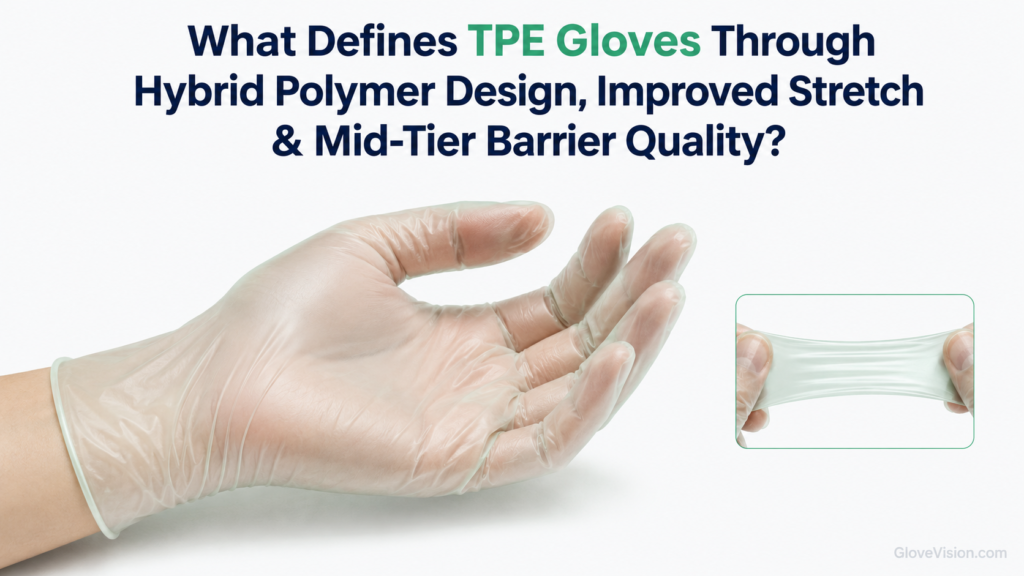
What Defines TPE Gloves Through Hybrid Polymer Design, Improved Stretch & Mid-Tier Barrier Quality?
TPE Gloves are thin-film disposable gloves made from thermoplastic-elastomer formulations that combine economical thermoplastic processing with product-dependent stretch, elastic recovery, and closer hand conformity than many conventional loose polyethylene gloves. Their construction can support rapid glove changes, reduced film bunching, and more controlled handling during suitable short tasks.
TPE is a broad material family rather than one standardized recipe. Improved stretch requires a defined comparison, and “mid-tier barrier quality” is a descriptive page lens—not a certification or universal rank. Finished performance depends on formulation, thickness, seams, freedom from holes, fit, intended use, exposure, duration, manufacturing quality, and product-level testing.
What Are TPE Gloves, and How Does Their Hybrid Polymer Design Shape Performance?
TPE Gloves use thermoplastic-elastomer materials that can be processed like thermoplastics while providing product-dependent flexibility, stretch, and recovery in the finished glove. The material label begins the evaluation; it does not establish one recipe or one predictable protection level.
What Does TPE Mean in TPE Gloves?
TPE means thermoplastic elastomer, a broad family of materials designed to combine thermoplastic processing with selected elastomer-like behavior. TPE does not identify one polymer chemistry, blend ratio, additive package, hardness, or finished-film response. Two gloves carrying the same family label may differ substantially in stretch, recovery, feel, seam behavior, and intended use.
Marketing descriptions may disclose only the family name. Product specifications, regulatory records, technical data, and finished-glove testing are therefore more useful than assuming performance from “TPE” alone.
What Does Hybrid Polymer Design Mean for TPE Gloves?
Hybrid polymer design is a functional description of thermoplastic processability combined with product-dependent flexibility, stretch, and recovery. It can describe documented block-copolymer structures, polymer blends, hard and soft segments, or other engineered formulations, but it does not prove that every TPE glove contains the same components.
The finished film—not the word hybrid—must demonstrate the properties relevant to the task. A flexible formulation can still produce weak recovery, unstable seams, poor grip, or insufficient protection when construction and use conditions are mismatched.
Which Formulation Variables Can Change TPE Gloves?
Base-polymer systems, hard-to-soft segment balance, polymer ratios, additives, fillers, plasticizing components, film thickness, cooling conditions, and surface treatments can change TPE Gloves. Those variables may influence flexibility, elongation, recovery, tack, stiffness, friction, thermal response, aging, and manufacturing consistency.
Only documented formulation information should be discussed for a specific product. An undisclosed recipe cannot be reconstructed from glove color, clarity, softness, price, or category name.
How Are Thin-Film TPE Gloves Constructed?
Thin-film TPE Gloves may use extrusion or cast-film processing followed by cutting, heat sealing, ambidextrous shaping, surface finishing, and packaging. Some products may use formed or contoured construction, and an examination glove may follow a product-specific medical manufacturing pathway. No single process should be assumed across the category.
Heat-sealed edges, finger outlines, thumb junctions, film uniformity, and freedom from holes can determine whether an economical film becomes a functional glove. ASTM D7329-07(2024) lists several thin-film glove materials but does not separately name TPE, and safe use is outside its scope; conformity should not be claimed unless the exact product documents it. [ASTM]
How Do TPE Gloves Differ From PE, Vinyl, and Nitrile Gloves?
TPE Gloves may provide more stretch and conformity than many conventional loose PE films, while vinyl uses plasticized PVC chemistry and nitrile is a cross-linked synthetic rubber. These category differences describe material systems, not a universal performance ladder. Some PE, vinyl, or nitrile products may outperform a selected TPE glove on a relevant property.
Meaningful comparison requires equivalent finished-product data for intended use, freedom from holes, fit, grip, elongation, puncture behavior, chemical compatibility, and task duration. Polymer names alone cannot rank protection.
| TPE Attribute | Possible Glove Effect | Required Qualification |
|---|---|---|
| Thermoplastic processing | Supports efficient thin-film manufacturing | Does not establish finished-glove quality |
| Elastomer-like phase | May improve stretch and conformity | Performance varies by formulation |
| Thin-film construction | May support dexterity and economical use | May provide limited physical protection |
| Heat-sealed construction | Supports economical glove shaping | Seam integrity becomes a barrier factor |
| Surface treatment or texture | May change handling friction | Does not guarantee wet or oily grip |
| Product-specific additives | Can modify feel or processing | Composition must not be assumed |
How Do TPE Gloves Use Stretch, Recovery, and Fit to Improve Handling?
TPE Gloves may improve handling by stretching around the hand and reducing some excess material associated with loose PE gloves, but useful fit still depends on sizing, recovery, finger geometry, seams, and film stability. Stretch is valuable only when it preserves coverage and control.
Why Can TPE Gloves Stretch More Than Conventional PE Gloves?
Elastomer-like response can give a TPE film greater product-dependent elongation and movement conformity than many conventional loose thin-film PE gloves. The film may follow finger flexion more closely, reduce some folds, and support a more stable grip during short tasks.
This is a controlled comparison, not a universal rule. Formulation, thickness, processing, geometry, and the exact PE reference product determine whether a real advantage exists.
How Does Elastic Recovery Affect TPE Gloves?
Useful elastic recovery helps stretched TPE Gloves return toward their original shape and maintain stable fingertip, palm, and wrist positioning. That can reduce bunching, internal slipping, and progressive looseness. Weak recovery may leave permanently stretched fingers, wider cuffs, film folds, or declining control.
Recovery should be function-checked through representative opening, closure, pinching, and release. A glove that stretches once but does not recover may fit worse as the task continues.
How Does TPE Gloves Fit Affect Dexterity?
Functional fit places the fingertips, thumb, palm, and cuff where the task requires without disruptive excess film or damaging overstretch. Check fingertip space, finger alignment, thumb position, palm conformity, full hand opening, full closure, and small-object handling.
Thin film alone does not guarantee dexterity. The broader principles of functional glove fit still apply when hand movement inside the glove or material folds interfere with control.
Can Excessive Stretch Weaken TPE Gloves?
Yes. Excessive stretch can thin the film, load sealed edges, strain finger webs, create permanent deformation, and increase vulnerability to tears or punctures. An undersized glove may appear close-fitting while operating beyond a stable deformation range.
Reject a glove that becomes visibly thinned, whitened, distorted, tacky, permanently loose, or stressed at seams. More stretch is not automatically safer or more protective.
How Do Surface Texture and Fit Affect TPE Gloves Grip?
Texture and fit can influence grip, but neither guarantees control on dry, wet, oily, smooth, heavy, or awkward objects. Surface embossing, film smoothness, object geometry, contact pressure, external friction, and internal hand slipping work together.
Evaluate the exact glove under representative conditions. If the outer film slips or the hand moves inside the glove, resizing or selecting another construction is safer than simply squeezing harder.
| Fit or Stretch Condition | Handling Effect | Barrier Concern | Decision |
|---|---|---|---|
| Functional stretch and recovery | Closer conformity and stable movement | Film must remain intact | Use if task-compatible |
| Excess fingertip material | Reduced precision | Snagging or seam stress | Resize or change product |
| Excessive stretching | Film thinning or restricted movement | Tear and puncture vulnerability | Reject |
| Permanent deformation | Increasing looseness | Unstable coverage | Change glove |
| Internal slipping | Reduced grip and control | Greater handling stress | Reassess size or construction |
| Failed seam | Loss of glove structure | Direct penetration pathway | Replace immediately |
Where Do TPE Gloves Provide Mid-Tier Barrier Quality, and Where Does Protection End?
TPE Gloves may provide useful basic separation during selected short tasks, but mid-tier barrier quality does not establish medical, chemical, puncture, heat, or prolonged-liquid protection. Every protective claim must remain tied to the exact finished product and exposure.
What Does Mid-Tier Barrier Quality Mean for TPE Gloves?
Mid-tier barrier quality is a descriptive way to discuss improved conformity over many loose PE gloves together with product-dependent film integrity and moderate disposable-task demands. It is not an AQL, regulatory class, test classification, certification, or universal rank below vinyl or nitrile.
A TPE glove can be a reasonable candidate only when its documentation, construction, fit, and current condition support the intended task. Price or material family cannot supply missing evidence.
How Do Seams and Pinholes Affect TPE Gloves?
Heat-sealed edges, finger seams, thumb junctions, pinholes, thin spots, and incomplete seals can interrupt the glove’s basic separation function. Hand movement, gripping pressure, snagging, and overstretch can load a weak location differently from a static visual check.
Freedom-from-holes testing is a product-quality characteristic, not proof that every individual glove remains intact through use. Visible damage or uncertain integrity requires immediate replacement.
Are TPE Gloves Suitable for Food Handling?
Only an exact TPE glove documented for the intended food-contact conditions should be used for food handling. Verify formulation status, food type, temperature, duration, local requirements, intended application, and change procedures. The FDA Food Code is a model that jurisdictions may adopt or modify, so local rules still matter. [FDA Code]
Use defined food-handling glove procedures; a TPE material label cannot replace documentation or workflow controls.
Are TPE Gloves Suitable for Medical Examinations?
Some exact TPE products may be cleared for patient examination, but the TPE category is not automatically medical-grade. FDA record K202078 identifies one biodegradable thermoplastic-elastomer examination glove with a substantially equivalent decision; that decision belongs to the named device and cannot transfer to other models, food-service gloves, sterile use, surgery, or chemical protection. [FDA 510(k)]
Under 21 CFR 880.6250, a non-powdered patient examination glove is a disposable medical device intended to help prevent contamination between patient and examiner. Verify the exact device status and labeling before clinical use. [eCFR]
Do TPE Gloves Protect Against Chemicals?
Not automatically. Chemical protection requires evidence for the exact glove, chemical or mixture, concentration, temperature, contact type, duration, and mechanical conditions. Permeation through intact film, degradation of the material, and penetration through seams or defects are different failure routes.
OSHA advises considering chemical identity, contact duration and type, temperature, abrasion, puncture, grip, coverage, fit, and cost when selecting protective gloves. Generic TPE identity, thickness, stretch, or disposable appearance cannot replace those exposure-specific data. [OSHA Dermal]
Which Hazards Commonly Exceed Ordinary TPE Gloves?
Sharp edges, needles, blades, abrasive materials, heavy puncture exposure, hot objects, open flame, electrical hazards, unknown chemicals, prolonged immersion, and moving machinery commonly exceed ordinary thin-film TPE capability. Improved stretch does not establish cut, puncture, thermal, electrical, or chemical performance.
Do not stretch disposable glove safety claims beyond the exact evidence. Select a hazard-rated product or stop the task when required protection cannot be verified.
Which TPE Gloves Match Different Tasks, and When Is Another Glove Required?
TPE Gloves should be selected by exact product grade and task requirements because food-service, general-purpose, and examination-grade TPE products do not automatically provide equivalent performance. One category name cannot approve different exposure systems.
Which Short Tasks May Suit TPE Gloves?
Documented TPE Gloves may suit ready-to-eat food handling, light food preparation, brief handling of clean items, light assembly without sharp edges, and other limited-contact disposable tasks. The work must remain short, controlled, and compatible with the exact product’s intended use.
Do not approve gloves by occupation or facility name. Identify what is touched, for how long, under which wetness, temperature, grip, contamination, and mechanical conditions.
Which Tasks May Benefit From Improved TPE Gloves Stretch?
Repetitive hand opening and closure, moderately small-object handling, rapid glove changes, and tasks disrupted by loose PE film may benefit from better TPE conformity. Stretch can reduce folds and improve hand positioning when the size and recovery remain functional.
The benefit disappears when the film overstretches, seams load, the hand slips internally, or the task needs tactile precision beyond the product’s construction.
Which Tasks Require a Cleared TPE Examination Glove?
Patient examination, clinical contact, and procedures requiring medical-device performance need an exact TPE glove cleared and labeled for that use. A food-service or general-purpose TPE glove cannot inherit examination status from another device.
Sterility, surgical suitability, and protection for a specific clinical exposure require separate evidence. “Medical-grade” should never be inferred from packaging style, color, softness, or disposable construction.
Which Tasks Require Another Disposable Glove Material?
Another verified glove may be necessary when the task requires greater puncture or chemical resistance, closer anatomical fit, higher tactile sensitivity, longer wear, stronger wet or oily grip, higher barrier assurance, heat protection, or cut resistance. The alternative must be selected for the actual hazard, not merely because its material name sounds stronger.
Use the broader disposable glove selection boundary when the TPE product cannot meet a defined functional or protective requirement.
How Should TPE Gloves Be Compared With PE, Vinyl, or Nitrile?
Compare equivalent finished products through intended use, applicable standards, freedom from holes, tensile and elongation data, fit, grip, puncture behavior, chemical data, change frequency, and total task cost. A fair comparison holds the task and evidence level constant.
Do not create a fixed PE-below-TPE-below-vinyl-below-nitrile hierarchy. Formulation and construction variability can reverse a simplified material ranking.
How Should Cost Influence TPE Gloves Selection?
Cost should follow task suitability → glove integrity → change frequency → contamination control → productivity → waste → total task cost. Mid-tier price does not prove mid-tier protection, and a cheaper glove is not economical if fit failures, tearing, or uncontrolled changes interrupt the task.
Food-related cost decisions still require the exact formulation or authorization basis, intended food, temperature, duration, conditions of use, and local requirements. FDA guidance ties status to the components and applicable regulatory pathway, so review relevant food-contact material risks before transferring one product’s documentation to another. [FDA Status]
OSHA requires hand protection selection to consider the task, conditions, duration, hazards, and potential hazards. Price becomes relevant only after required performance is established. [OSHA Hand]
| Task Context | Possible TPE Advantage | Main Limitation | Decision |
|---|---|---|---|
| Short food handling | Improved conformity with rapid changes | Requires exact food-contact suitability | Possible candidate |
| Light general-purpose work | Flexible disposable coverage | Limited mechanical protection | Verify task stress |
| Precision handling | Better fit than some loose PE gloves | May not equal fitted nitrile or latex | Function-check product |
| Medical examination | Some products are separately cleared | TPE name does not establish clearance | Verify exact model |
| Chemical handling | Some products may have specific data | No universal TPE resistance | Require exact evidence |
| Sharp or abrasive work | Lightweight hand coverage | Insufficient cut or puncture protection | Select hazard-rated gloves |
| Prolonged wear | Stretch may improve initial comfort | Sweat, fit loss, and film fatigue may develop | Reassess glove type |
How Should TPE Gloves Be Selected, Inspected, Used, and Changed?
TPE Gloves should be selected for one defined task, checked for the required product status and fit, inspected before use, changed after contamination or damage, and discarded after their intended single use. The safe sequence is verify → inspect → wash and dry hands → don → function-check → use → change → remove → discard.
What Should Be Verified Before Selecting TPE Gloves?
Verify the exact product, disclosed formulation, intended use, food-contact documentation or medical clearance where needed, applicable standard, size, thickness, seam construction, freedom-from-holes specification, grip requirement, task duration, chemical exposure, mechanical hazards, and manufacturer instructions. Do not infer status from color, softness, stretch, price, or packaging.
Define the task narrowly enough to test: identify the contacted material, duration, wetness, temperature, grip demand, contamination transitions, and replacement triggers.
How Should TPE Gloves Be Inspected?
Inspect TPE Gloves for pinholes, tears, open seams, thin spots, distortion, discoloration, tackiness, stiffness, contamination, incomplete fingers, damaged cuffs, and incorrect size. Move the hand through representative opening, closure, pinching, and gripping to reveal stress that a still-hand inspection may miss.
Any visible defect, uncertain integrity, damaged package, or abnormal material condition is sufficient reason to reject the glove.
How Should TPE Gloves Fit?
TPE Gloves should maintain natural finger alignment, stable palm position, comfortable thumb placement, full hand opening, functional closure, limited disruptive fingertip excess, and no overstretched seams. The hand should not slide inside the glove during representative work.
Resize when the product category is suitable but positioning is unstable. Select another construction when no available size preserves control without excessive film stress.
When Should TPE Gloves Be Changed?
Change TPE Gloves between incompatible tasks, after contaminated-surface contact, after tears or punctures, when seams open, when the film stretches permanently, when fit or grip becomes unreliable, after unsupported chemical contact, and at the end of the intended task. No universal time interval applies to every product and workflow.
For food work, CDC advises handwashing before and after glove use to help prevent cross-contamination; gloves are an additional control, not a substitute for soap and water. [CDC]
Why Should Single-Use TPE Gloves Not Be Washed and Reused?
Ordinary single-use TPE Gloves should not be washed or reused because washing does not restore a validated barrier or fit. Hidden film damage, seam weakening, permanent stretching, trapped contamination, incomplete decontamination, and unverified material changes can remain even when the glove looks clean.
Discard after the intended task, contamination, damage, unsupported exposure, or loss of functional fit. Reuse requires a validated product-specific procedure, not appearance-based judgment.
How Should TPE Gloves Be Removed and Discarded?
Remove TPE Gloves without touching the contaminated exterior with bare skin, contain the removed film, prevent transfer to hands or clothing, discard it appropriately, and complete required handwashing. The removal method should match the contamination and workplace procedure.
Do not snap, shake, wash, place on a shared surface, or save a used glove for a later task.
Which Problems Indicate TPE Gloves Product or Task Mismatch?
Repeated tearing, open seams, excessive stretching, fingertip bunching, internal slipping, poor grip, restricted movement, uncontrolled liquid entry, chemical contact without data, prolonged-wear demands, or specialized medical or mechanical requirements indicate mismatch. Issuing the same unsuitable glove more often does not correct the protection gap.
Use, resize, change, replace, select another glove, or stop according to the exact reason the product no longer matches the task.
- Exact product and intended use are identified.
- Required food-contact or medical documentation is available.
- Generic TPE claims are not replacing product evidence.
- Task duration and exposure are defined.
- Fingers, thumb, palm, and cuff align correctly.
- No excessive bunching or internal slipping is present.
- No pinholes, tears, thin spots, or open seams are visible.
- Grip and movement remain functional.
- No unsupported chemical exposure exists.
- No sharp, hot, electrical, or abrasive hazard exists.
- Stretch does not excessively thin the film.
- A defined change procedure is available.
- Hands are washed and dried before donning.
- Gloves change between incompatible tasks.
- Removal prevents hand contamination.
- Hands are washed after removal.
- Single-use gloves are not washed or reused.
- Use: Product, task, fit, evidence, and condition match.
- Resize: The category fits but hand position is unstable.
- Change or replace: Task, contamination status, fit, or integrity changed.
- Select another glove: Required protection exceeds documented capability.
- Do not use: Suitability cannot be verified.
Conclusion
TPE Gloves use thermoplastic-elastomer formulations to provide product-dependent stretch and hand conformity, but the material name alone does not establish barrier quality, medical status, food-contact suitability, or chemical protection. TPE is a broad family, hybrid design is a functional description, and improved stretch is meaningful only against a defined reference such as many conventional loose thin-film PE gloves.
Choose TPE Gloves only when the exact product matches the task, its documentation supports the required barrier function, stretch improves rather than destabilizes fit, and no unsupported chemical, medical, thermal, or mechanical hazard is present. Keep seams, film integrity, exposure, condition, hygiene, and single-use replacement inside the final decision.
Frequently Asked Questions
Are TPE Gloves more stretchable than Polyethylene Gloves?
They can provide more stretch and hand conformity than many conventional loose thin-film PE gloves. The result depends on the exact formulations, thicknesses, constructions, and products being compared.
Are TPE Gloves food-safe?
Only when the exact product is documented as suitable for the intended food-contact conditions and applicable requirements are followed. The TPE material name alone does not prove compliance.
Are TPE Gloves medical-grade?
Not automatically. Some exact TPE examination gloves have medical-device clearance, but that status does not apply to the entire TPE category.
Are TPE Gloves chemical-resistant?
Not universally. Chemical protection requires compatibility, permeation, degradation, penetration, and breakthrough evidence for the exact glove and exposure.
Can TPE Gloves be washed and reused?
Ordinary single-use TPE Gloves should not be washed or reused. Replace them after the intended task, contamination, damage, permanent stretching, unsupported exposure, or loss of functional fit.