
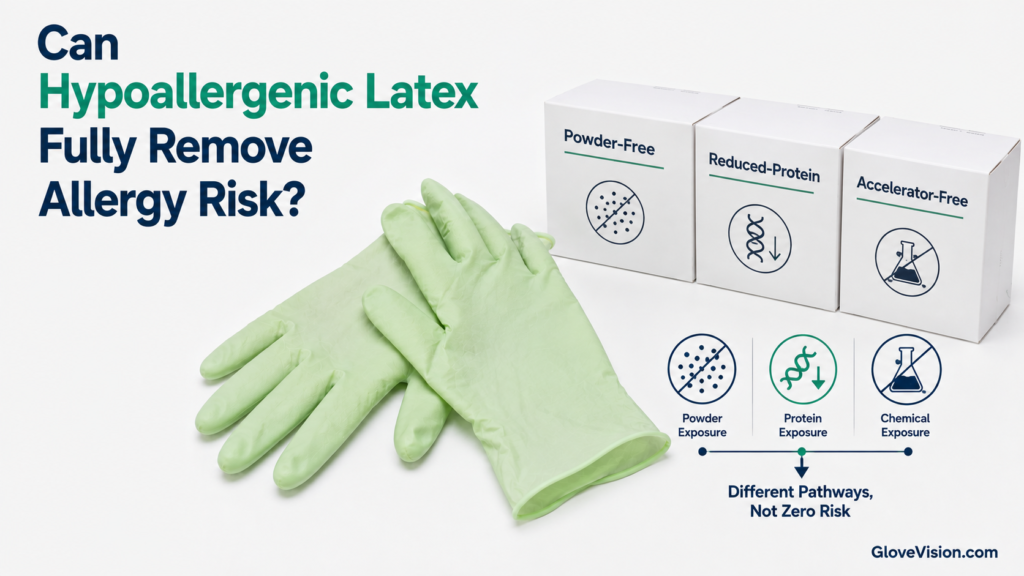
Can Hypoallergenic Latex Fully Remove Allergy Risk?
No. Hypoallergenic Latex Gloves cannot guarantee removal of allergy risk because natural-rubber proteins, processing chemicals, and irritant wear conditions are separate reaction pathways.
Powder-free, reduced-protein, and accelerator-free products may reduce particular exposures, but their value depends on the exact product, documented claim, test method, affected person, and workplace conditions. Known latex allergy generally requires a verified non-latex option.
What Does “Hypoallergenic” Mean for Latex Gloves?
“Hypoallergenic” suggests that a manufacturer has attempted to reduce a particular reaction risk; the word alone does not identify which proteins, accelerators, chemicals, or exposure pathways were reduced. NIOSH specifically warns that so-called hypoallergenic latex gloves do not reduce latex-allergy risk, although they may reduce reactions to some chemical additives. [NIOSH]
Why is “hypoallergenic” incomplete?
It may omit the targeted allergen, reduction method, measured result, remaining hazards, or jurisdiction. A front-label phrase is therefore not enough to establish safe use.
Which evidence should support the claim?
Verify natural-rubber content, exact manufacturer and model, powder status, protein method and result, accelerator formulation, excluded substances, current technical documentation, and claim limitations.
How is hypoallergenic latex different from latex-free?
Hypoallergenic Latex Gloves remain latex products unless documentation states otherwise. The broader Latex Gloves guide explains the underlying material boundary. FDA advises people allergic to natural-rubber latex to choose medical gloves made from another material, while also warning that broad “latex-free” wording can overstate certainty. [FDA] [Label]
Why is front-label wording insufficient?
Packaging and distributor descriptions may omit qualifications, test conditions, or revision details. Interpretation should be controlled by the current manufacturer technical sheet, instructions, formulation statement, and applicable regulatory documentation—not an isolated sales phrase.
| Claim | May address | Does not prove | Verify |
|---|---|---|---|
| Hypoallergenic | A modified reaction pathway | Allergy-free or latex-free | Exact definition and evidence |
| Powder-free | Absence of donning powder | Absence of residual proteins | Product specification |
| Reduced-protein | Lower measured protein | Zero protein or safety for sensitized users | Method, units, result |
| Accelerator-free | Specified accelerators | No proteins or all chemicals | Exact excluded substances |
| Low-allergen | A defined allergen-related measurement | Elimination of sensitization risk | Definition, method, result |
| Latex-free | No intended natural-rubber latex | Freedom from every allergen | Composition documentation |
Why Can Reaction Risks Remain in Hypoallergenic Latex Gloves?
Reaction risks remain because Latex Gloves may expose people to residual proteins, formulation chemicals, moisture, friction, occlusion, or unrelated workplace substances—even after one product feature has changed.
How can latex proteins cause immediate allergy?
Residual natural-rubber proteins can trigger IgE-mediated reactions in sensitized people. Reduced exposure is not the same as zero exposure or guaranteed safety. The separate discussion of latex sensitization risk explains why established use does not remove this concern. [CDC]
How can glove chemicals cause delayed allergy?
Rubber accelerators—including thiurams, dithiocarbamates, thiazoles, guanidines, and thioureas—can contribute to delayed allergic contact dermatitis. Formulations differ, so the excluded chemicals must be named. [Derm]
How can irritation occur without allergy?
Repeated washing, incomplete drying, sweat, occlusion, friction, poor fit, detergents, disinfectants, and existing barrier damage can cause or worsen irritant dermatitis. The latex allergy trade-off should therefore be assessed separately from ordinary irritation. Redness, itching, dryness, and cracking do not identify the pathway by themselves.
Why can symptoms alone be misleading?
Redness, itching, dryness, and cracking are not specific to one mechanism. Immediate hives and systemic symptoms differ from delayed dermatitis, but qualified assessment may still be required; the page must not be used to diagnose the cause.
Who else may be exposed?
Assessment must include patients, dental clients, customers, coworkers, cleaners, waste handlers, and people touching contaminated surfaces—not only the person wearing the glove.
| Pathway | Contributor | Pattern | Relevant control | Limitation |
|---|---|---|---|---|
| Immediate allergy | Latex proteins | May develop rapidly | Verified non-latex product | Lower protein is not zero risk |
| Delayed allergy | Processing chemicals | Usually delayed | Chemical-specific formulation | Other allergens may remain |
| Irritant dermatitis | Friction, sweat, washing | Exposure-related | Fit and workflow controls | Not solved by an allergy label |
| Indirect exposure | Surface transfer | Variable | Exposure controls | Non-wearers may be exposed |
| Unrelated workplace reaction | Detergents, disinfectants, other substances | Variable | Complete exposure assessment | Latex labeling cannot resolve it |
Which Product Modifications Reduce Risks in Latex Gloves?
Each modification has a narrow purpose: powder-free controls powder, reduced-protein concerns a measured protein exposure, and accelerator-free applies only to chemicals covered by the exact formulation claim.
What does powder-free manufacturing change?
It removes donning powder and may reduce powder-associated dispersion. It does not remove every residual latex protein, chemical ingredient, moisture problem, or friction exposure. [NIOSH]
What does reduced-protein processing change?
It may lower a measured extractable-protein result. Verify the glove model, method, units, reporting limit, date, and product or batch applicability; do not convert “lower” into “zero.”
What does accelerator-free mean?
Specified accelerator chemicals may be excluded, but “not intentionally added” is not identical to analytical absence. Accelerator-free products can help when the relevant chemical allergy is established, yet they do not remove latex proteins or every formulation chemical. [Study]
Can surface treatments eliminate allergy risk?
Chlorination, polymer coatings, and other donning treatments may alter friction, residue, or donning behavior. They do not automatically eliminate natural-rubber proteins or chemical allergens, and they do not replace task-specific review of latex chemical limits.
Can several claims together establish zero risk?
No. A glove may be powder-free, reduced-protein, accelerator-free, and surface-treated while still containing residual proteins, other formulation chemicals, or irritant wear conditions.
| Modification | Primary exposure | May help | May remain | Interpretation |
|---|---|---|---|---|
| Powder-free | Donning powder | Less residue and dispersion | Proteins, chemicals, irritation | One pathway reduced |
| Reduced-protein | Measured protein | Lower protein exposure | Residual protein | Lower ≠ zero |
| Accelerator-free | Named accelerators | Chemical-specific avoidance | Proteins and other chemicals | Verify scope |
| Surface-treated | Friction or residue | Different donning behavior | Allergy pathways | Product-specific |
| Combined claims | Several defined exposures | Broader reduction | Uncontrolled residual risk | Zero risk unproven |
| Verified non-latex | Natural-rubber latex exposure | Removes latex as the intended material | Other allergens and irritants | Verify task suitability separately |
How Should Claims About Latex Gloves Be Verified?
Accept a claim only after confirming the exact product, natural-rubber content, claim definition, test method, result, excluded substances, jurisdiction, and manufacturer qualifications.
Which documents should be reviewed?
Use the packaging, current technical data sheet, instructions for use, regulatory labeling, declaration of conformity where applicable, protein-testing information, formulation statements, and workplace approved-product record.
What supports a meaningful protein claim?
The evidence should identify the model, method, measurement, units, reporting limit, date, and whether the result concerns total extractable protein, allergenic protein, or another metric.
What supports an accelerator-free claim?
Verify the excluded accelerator families, whether they were merely not intentionally added or analytically tested, the test method and detection limit, other formulation chemicals, and the continued presence of natural-rubber latex proteins.
How should regulatory claims be handled?
Identify the jurisdiction, product category, current rule or guidance, effective date, authoritative source, and whether the wording is mandatory or voluntary. Medical-glove requirements must not be transferred automatically to industrial gloves or from one country to another.
Which warning signs require rejection?
Reject “100% allergy-free,” “zero allergy risk,” unsupported “protein-free,” undefined “accelerator-free,” missing model identification, or conflicting and outdated documents.
- Exact model identified
- Natural-rubber content stated
- Claim precisely defined
- Method and result supplied
- Excluded chemicals named
- Jurisdiction confirmed
- Revision is current
- Limitations disclosed
How Should Latex Gloves Be Selected When Residual Risk Remains?
Use Latex Gloves only when no person with known latex allergy will be exposed, the exact glove meets the task, its claims address the relevant concern, and a suitable non-latex alternative has been assessed.
Which people must be included?
Include the wearer and everyone who may be exposed indirectly: patients, customers, coworkers, cleaners, waste handlers, and visitors to latex-safe areas.
How should the reaction pathway affect selection?
Known immediate latex allergy calls for latex avoidance and a verified alternative. A suspected immediate reaction requires stopping exposure and obtaining appropriate assessment. Confirmed accelerator allergy requires a formulation verified against the relevant chemical; irritant dermatitis requires review of fit, moisture, hygiene, wear time, and other exposures.
How should alternatives be assessed?
Verify composition, barrier performance, chemical compatibility, fit, dexterity, grip, durability, applicable standards, sterility when required, and other potential contact allergens.
Where handling performance matters, compare the task-specific evidence for latex tactile sensitivity and latex hand conformity. Neither performance characteristic overrides allergy or hazard requirements.
How should a suspected reaction be managed?
Stop exposure, remove the glove safely, follow workplace or emergency procedures, document the exact product and task, protect other exposed people, obtain appropriate assessment, investigate the pathway, and reassess selection before reuse. Do not casually retry latex, rely on liners or double gloving, or wash disposable gloves.
When should hypoallergenic Latex Gloves be rejected?
Reject or discontinue them when a person with known latex allergy may be exposed, the claim is vague or targets the wrong pathway, natural-rubber content or product evidence is unclear, symptoms occur, workplace policy requires avoidance, the glove fails the task hazard, or continued use depends on self-testing or guesswork.
Latex Gloves Label-Verification and Selection Checklist
What Should Readers Remember About Hypoallergenic Latex Gloves?
Hypoallergenic Latex Gloves cannot remove every allergy risk because reducing one exposure does not necessarily address natural-rubber proteins, other processing chemicals, or irritant conditions.
- Hypoallergenic does not mean allergy-free or latex-free.
- Powder-free is not protein-free.
- Reduced-protein is not zero-protein.
- Accelerator-free is not protein-free or chemical-free.
- Surface treatment does not establish allergy elimination.
- Combined claims do not prove zero risk.
- Immediate allergy, delayed allergy, and irritation are separate pathways.
- Symptoms alone cannot reliably identify the cause.
- Known latex allergy generally requires latex avoidance.
- Directly and indirectly exposed people both matter.
- Regulatory conclusions must be jurisdiction-specific.
- Non-latex alternatives still require task and formulation verification.
- Unsupported claims should be rejected.
Conclusion
Hypoallergenic Latex Gloves may reduce a defined exposure, but powder, latex proteins, processing chemicals, and irritant conditions represent separate pathways. No broad marketing claim automatically eliminates all of them.
Identify the exact claim, verify its evidence, match it to the relevant pathway, and consider every exposed person. Use a verified non-latex alternative when latex avoidance is required, and reject products presented as universally allergy-free.
Frequently Asked Questions
Are hypoallergenic Latex Gloves allergy-free?
No. The claim does not establish the absence of natural-rubber proteins, processing chemicals, irritation, or risk to every sensitized person.
Are powder-free Latex Gloves safe for someone with latex allergy?
Not automatically. Powder-free gloves lack donning powder but may still contain residual natural-rubber latex proteins.
Do reduced-protein Latex Gloves eliminate immediate allergy risk?
No. They may lower measured protein exposure, but residual allergenic proteins can remain.
Do accelerator-free Latex Gloves remove every contact-allergy risk?
No. They may exclude specified accelerators while other chemicals, latex proteins, and irritant conditions remain possible.
Is latex-free the same as hypoallergenic latex?
No. Hypoallergenic latex remains a latex-containing product claim; latex-free describes a different material-composition claim.