
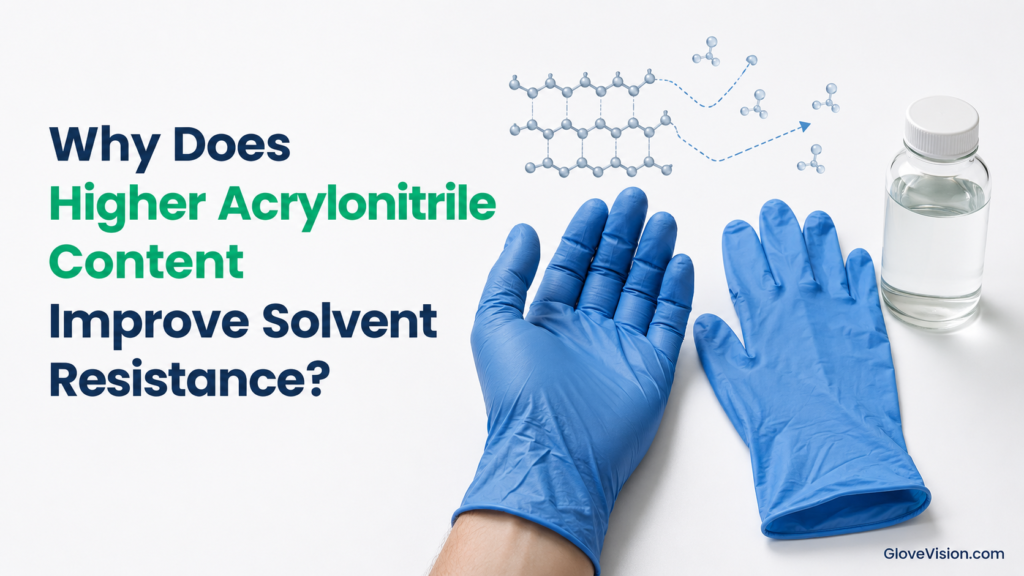
Why Does Higher Acrylonitrile Content Improve Solvent Resistance?
Increasing the acrylonitrile contribution makes NBR more polar and may strengthen cohesive interactions between polymer chains. Selected nonpolar oils, fuels, hydrocarbons, and solvents may enter, swell, or plasticize the film less readily, potentially slowing diffusion and improving stability.
Higher acrylonitrile does not improve resistance to every solvent. Polar liquids, ketones, esters, chlorinated solvents, mixtures, temperature, duration, crosslinking, thickness, formulation, and glove condition may override the general trend.
What Does Higher Acrylonitrile Content Mean in Nitrile Gloves?
Higher acrylonitrile content means that NBR contains a greater proportion of incorporated acrylonitrile-derived units relative to butadiene-derived units, changing polarity, cohesive interactions, chemical affinity, flexibility, and modulus.
How is acrylonitrile incorporated into NBR?
Acrylonitrile-derived units form part of the polymer chain alongside butadiene-derived units. Polar nitrile groups influence chain interactions; incorporated composition is not residual free acrylonitrile. Bulk-NBR evidence supports the directional mechanism but does not approve a thin finished glove. [NBR]
How does the copolymer balance change?
More acrylonitrile generally increases polar character and cohesion while segment mobility and low-temperature flexibility may decline. Modulus may rise; see the nitrile composition and stiffness guide.
Why is high-acrylonitrile nitrile not a complete specification?
The phrase does not disclose architecture, carboxylation, crosslink density, cure, additives, thickness, surface treatment, test results, age, or condition. Undisclosed product percentages must not be assumed.
Why does finished-glove formulation still matter?
Crosslinking, fillers, cure, thickness, surface treatment, and manufacturing consistency can strengthen, weaken, or mask the base tendency. Product testing integrates variables a polymer-family description cannot.
| Composition change | Molecular effect | Possible resistance effect | Important limitation |
|---|---|---|---|
| Greater acrylonitrile | More polar character | Lower affinity for selected nonpolar fluids | Not universal |
| Stronger cohesion | Restricted movement | May reduce sorption or diffusion | Temperature and formulation matter |
| Lower relative butadiene | Less flexible hydrocarbon character | May reduce oil swelling | May increase modulus |
| More crosslinking | Restricted movement | May reduce swelling | Cannot correct incompatibility |
| Greater thickness | Longer travel distance | May delay breakthrough | Does not change affinity |
Directional relationships only; this table does not approve a finished glove.
Why Does Greater Polarity Improve Selected Solvent Resistance in Nitrile Gloves?
Greater NBR polarity can improve resistance to selected nonpolar solvents because a larger difference between the polymer’s cohesive character and the liquid may reduce affinity and sorption.
What does polymer–solvent affinity mean?
A liquid contacts the surface, interacts with NBR, enters when affinity permits, separates chains, and may cause swelling and faster diffusion. Polarity is only one factor; size, shape, hydrogen bonding, concentration, crosslinking, and temperature also matter.
How does the solubility-parameter concept help?
Similar cohesive characteristics can indicate stronger interaction, while larger differences may indicate less swelling. This is screening only; mixtures and strongly interacting liquids defeat simple predictions. [Sw]
Why may selected oils and hydrocarbons cause less swelling?
Higher-acrylonitrile NBR may have less affinity for selected nonpolar liquids, reducing uptake, chain separation, plasticization, dimensional expansion, and strength loss.
Why does greater polarity not guarantee resistance to polar solvents?
Some polar liquids interact favorably with nitrile groups; small ketones, esters, and other polar molecules may sorb or diffuse rapidly. Family labels cannot establish compatibility.
Why do molecular size and shape matter?
Smaller molecules may move through transient free volume more readily. Geometry, branching, concentration, temperature, and mixtures influence sorption and diffusivity.
How Do Reduced Sorption and Swelling Affect Nitrile Gloves?
When Nitrile Gloves absorb less of a particular solvent, the film may swell less, retain tighter chain organization, and slow diffusion, potentially delaying permeation and preserving mechanical integrity.
How does solvent sorption begin?
Molecules contact the exterior, interact with NBR, enter the polymer, create a concentration gradient, and diffuse through the film.
How does swelling change the polymer network?
Swelling increases chain spacing and film dimensions, plasticizes the network, changes modulus and strength, creates transport space, distorts fit, reduces grip, and may increase tearing. It is a degradation warning—not extra protection.
How can higher acrylonitrile restrict diffusion?
Stronger cohesive interactions may restrict segmental movement, while reduced uptake limits plasticization. Actual diffusivity remains chemical-, temperature-, formulation-, and film-specific.
Why does reduced swelling not prove zero permeation?
Molecules may cross without visible expansion. Breakthrough can precede obvious degradation, and odor or skin sensation is unreliable. NIOSH notes physical signs may be absent after permeation. [NIOSH]
How do sorption and diffusion jointly control permeation?
Permeation depends on how readily a chemical enters and how quickly it moves. Low sorption may reduce transport; slow diffusion may delay breakthrough; high sorption may plasticize the film.
Which Solvents May Exceed the Acrylonitrile Advantage in Nitrile Gloves?
Higher acrylonitrile most consistently supports resistance to selected oils, fuels, and hydrocarbons, while ketones, esters, some chlorinated solvents, highly polar solvents, and mixtures may remain challenging.
Which oils, fuels, and hydrocarbons may benefit?
Selected petroleum oils, greases, fuels, aliphatic hydrocarbons, some aromatics, and process fluids may show reduced swelling. Additives, blends, aromaticity, temperature, and duration can change performance. Bulk-NBR oil-swelling evidence supports this direction, not finished-glove approval. [NBR]
Why can ketones challenge Nitrile Gloves?
Acetone, methyl ethyl ketone, and related ketones are polar and often small, enabling interactions and diffusion unlike selected nonpolar oils. No universal breakthrough time applies.
Why can esters and other polar solvents remain problematic?
Acetate esters, some glycol ethers, and other polar liquids may cause sorption, permeation, or degradation depending on interaction, molecular size, concentration, and formulation.
How should chlorinated solvents be evaluated?
Chlorinated solvents can challenge many glove materials. Thin disposable nitrile must never be presumed suitable without exact finished-product evidence.
Why are mixtures harder to predict?
Components have different affinities and diffusion rates; one may swell the polymer and accelerate another. Evaporation changes concentration, so complete-mixture data are preferable. NIOSH cautions that published glove results can vary even for similar materials. [NIOSH]
| Solvent family | Possible benefit | Main limitation | Decision |
|---|---|---|---|
| Petroleum oils | Often reduced swelling | Additives and temperature | Verify exact fluid |
| Aliphatic hydrocarbons | May improve stability | Duration and concentration | Require model data |
| Aromatic hydrocarbons | Some benefit possible | Often more aggressive | Do not generalize |
| Ketones | No dependable advantage | Rapid permeation possible | Exact verification |
| Esters | May remain limited | Polarity and size | Chemical data |
| Alcohols / glycol ethers | Varies widely | Family assumptions weak | Check exact chemical |
| Chlorinated solvents | May be challenging | Thin nitrile may fail | Never presume |
| Mixtures | Unpredictable | Components interact | Mixture data |
Preliminary screening only. This matrix does not approve Nitrile Gloves for any solvent.
How Do Exposure Conditions Modify Solvent Resistance in Nitrile Gloves?
Resistance can increase or decline with crosslink density, carboxylation, additives, cure, thickness, temperature, duration, stress, aging, and integrity.
How does crosslinking change solvent resistance?
Crosslinks restrict movement and may limit swelling, but type and density matter. More crosslinking may increase modulus and cannot make an incompatible polymer suitable.
How does thickness affect permeation?
Greater thickness increases travel distance and may delay breakthrough under comparable conditions. It does not change affinity; data cannot be transferred between thicknesses or constructions.
Why does temperature accelerate solvent passage?
Higher temperature generally increases molecular motion, potentially increasing sorption, diffusion, swelling, softening, degradation, and shortening breakthrough. Workplace conditions such as elevated temperature and flexing can diverge from laboratory data. [NIOSH]
How do duration and repeated contact affect performance?
A droplet, splash, repeated splash, wet wiping, partial immersion, full immersion, and trapped liquid differ. Repeated contact accumulates; splash data do not prove immersion suitability.
How do stretching, flexion, and abrasion affect the barrier?
Tight fit may locally thin film; flexion stresses it; abrasion damages it; solvent-softened material may tear more easily. Static tests may not represent every workplace stress.
How do aging and storage affect resistance?
Heat, light, time, compression, contamination, damaged packaging, and poor storage may cause brittleness, hardening, tackiness, reduced elasticity, pinholes, tearing, or distorted fit.
| Modifier | Likely effect | Solvent consequence | Control |
|---|---|---|---|
| Crosslink density | Changes mobility | Changes swelling and diffusion | Exact product data |
| Thickness | Changes distance | May delay breakthrough | Do not infer compatibility |
| Higher temperature | More molecular motion | Faster permeation | Relevant data |
| Longer contact | More exposure | More uptake | Change schedule |
| Repeated splash | Cumulative contact | May exceed assumptions | Track exposure |
| Stretching | Local thinning | Reduced margin | Correct fit |
| Abrasion | Film damage | Penetration or tearing | Inspect |
| Aging | Changed condition | Reduced integrity | Follow shelf life |
How Should Nitrile Gloves Be Selected for Solvent Exposure?
Select Nitrile Gloves only when manufacturer data support the exact chemical or mixture, concentration, temperature, model, thickness, contact pattern, and duration.
Which solvent information must be collected?
Collect exact product, CAS where available, concentration, mixture, manufacturer, current SDS, physical state, temperature, duration, contact type, cleaning solvents, and contaminated surfaces. An SDS is a starting point, not model-specific proof.
Which Nitrile Gloves information must be verified?
Verify manufacturer, model, disposable or reusable build, material, thickness, cuff, lining, surface, texture, chemical and mechanical data, standards, storage, and shelf life.
How should resistance data be interpreted?
Match chemical, concentration, temperature, model, thickness, breakthrough, rate, degradation, method, mixture applicability, and limitations. ASTM permeation methods test defined contact conditions; their results do not create a workplace safe-wear time. [ASTM]
When should disposable Nitrile Gloves be rejected?
Reject or reassess when immersion lacks evidence, breakthrough is too rapid, degradation is unacceptable, contact exceeds support, mixture identity is incomplete, temperature differs, the glove changes, or no change schedule exists.
When should another construction or material be selected?
Consider a thicker tested nitrile glove, reusable build, longer cuff, greater durability, another material with stronger data, or a validated multilayer system. No alternative is universally correct.
How should contaminated gloves be removed?
Stop → prevent spread → approved doffing → contain or dispose → follow the SDS and exposure procedure → wash as instructed → report suspected exposure → reassess. Never smell-test or wait for damage.
ISO 374-1 defines chemical-risk requirements, while ISO 374-4 addresses degradation testing; penetration, permeation, and degradation must remain separate. [ISO]
Nitrile Gloves Solvent-Selection and Stop-Use Checklist
1. Solvent identity
- Exact chemical or commercial product identified
- Current SDS reviewed
- CAS number recorded where available
- Concentration and mixture status understood
- Carrier, cleaning, and removal solvents included
2. Exposure conditions
- Splash, wiping, repeated contact, and immersion separated
- Duration and temperature defined
- Flexion and abrasion assessed
- Cuff-entry and trapped-liquid risks controlled
- Repeated exposure treated cumulatively
3. Glove evidence
- Exact manufacturer and model known
- Thickness and construction verified
- Data match the chemical or complete mixture
- Breakthrough, permeation rate, and degradation reviewed
- Test conditions represent the task
- Defensible change schedule established
4. Fit and condition
- Fit does not excessively stretch the film
- Grip and movement remain functional
- No holes, tears, pinholes, or weak areas
- No swelling, softening, tackiness, hardening, or distortion
- Storage and shelf-life requirements followed
5. Final decision
- Use only when complete evidence matches
- Restrict to the narrower supported exposure
- Change at the documented replacement point
- Change construction when another nitrile build is verified
- Select another material when nitrile is inadequate
- Stop after contamination, degradation, damage, or uncertainty
- Reject when protection cannot be demonstrated
What Should Readers Remember About Acrylonitrile in Nitrile Gloves?
Higher acrylonitrile can improve resistance to selected nonpolar liquids by increasing polarity and cohesion, reducing affinity and swelling, and potentially slowing diffusion.
- Acrylonitrile content means incorporated composition—not residual monomer.
- Greater polarity does not improve every solvent response.
- Selected oils, fuels, and hydrocarbons may cause less swelling.
- Ketones, esters, chlorinated solvents, and mixtures may remain challenging.
- Sorption and diffusion jointly control permeation.
- Reduced swelling and visible integrity do not prove zero permeation.
- Crosslinking and thickness cannot correct incompatibility.
- Temperature and repeated contact may accelerate transport.
- Disposable and reusable nitrile are not interchangeable.
- Exact finished-product evidence controls selection.
Conclusion
Higher acrylonitrile changes NBR polarity and cohesive interactions. Selected nonpolar liquids may cause less sorption and swelling, helping the film retain structure and potentially slowing permeation.
Never convert that tendency into universal compatibility. Identify the exact solvent, match the task to finished-glove evidence, and reject Nitrile Gloves whenever suitable protection cannot be demonstrated.
Frequently Asked Questions
Does higher acrylonitrile make Nitrile Gloves resistant to every solvent?
No. It may improve resistance to selected oils, fuels, hydrocarbons, and nonpolar solvents, while other liquids may still permeate or degrade the glove rapidly.
Why can ketones still permeate Nitrile Gloves?
Ketones are polar and often relatively small. Their affinity and diffusion behavior may not follow the advantage observed with selected nonpolar liquids.
Does less swelling mean Nitrile Gloves have not permeated?
No. Molecular permeation can occur through intact material without visible swelling, softening, discoloration, or odor.
Do thicker Nitrile Gloves always resist solvents longer?
No. Thickness may extend the diffusion path under comparable conditions, but it cannot correct fundamental incompatibility.
Can breakthrough time be used as a safe wear time?
Not directly. A workplace change schedule must also consider permeation rate, degradation, temperature, movement, repeated contact, fit, and safety margins.