
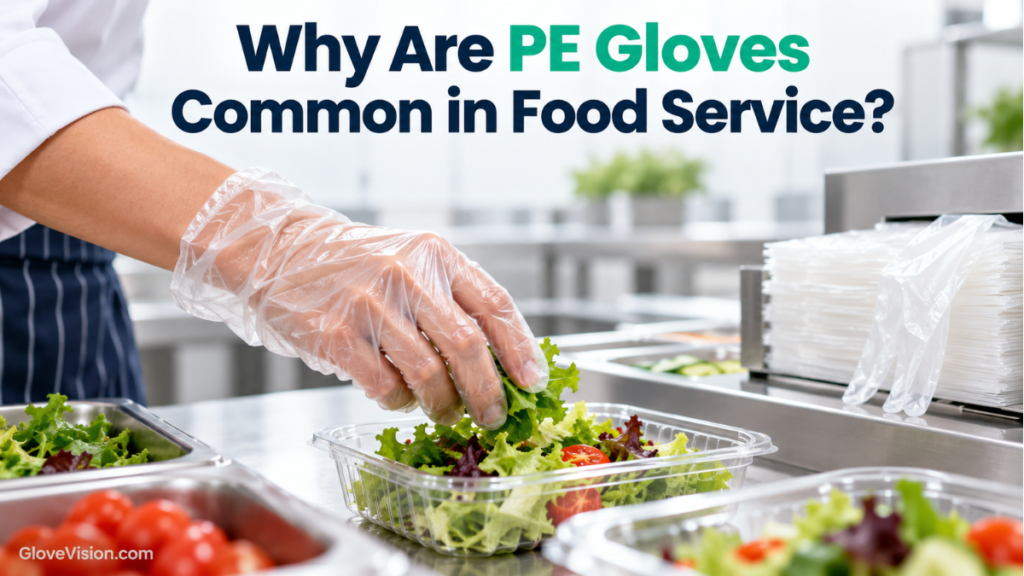
Why Are PE Gloves Common in Food Service?
PE Gloves are common in food service because their low cost, lightweight construction, easy-on/easy-off fit, and suitability for frequent replacement match workflows where workers repeatedly move through short food-handling tasks and need a simple hand-to-food barrier.
Their popularity does not mean polyethylene is legally required or appropriate for every food task. PE works best where contamination separation is the main goal; cutting, puncture, cleaning chemicals, heat, prolonged handling, or high dexterity may require a different glove or protection system. This page moves from workflow fit and contamination control through food-task suitability and hygiene to hazard boundaries, alternatives, and exact-product verification.
What Makes PE Gloves Fit Food-Service Workflows So Well?
PE Gloves fit many food-service workflows because they can provide an inexpensive, lightweight, rapidly donned and discarded barrier for short repetitive tasks where frequent glove changes matter more than prolonged durability or high mechanical performance.
Why Does Quick Donning Matter?
Food-service workers may move rapidly among ingredients, packaging, serving, preparation stages, raw foods, and ready-to-eat foods. A loose lightweight disposable construction can make removal and replacement convenient when the task calls for a fresh barrier.
Why Does Low Cost Matter?
High-change workflows can consume many gloves. When an exact PE glove is appropriate for the task, a low unit cost can make frequent single-use replacement practical rather than encouraging extended wear simply to conserve a more expensive product.
Why Is Lightweight Construction Useful?
Ordinary PE film can provide temporary coverage without the bulk of a heavy mechanical, chemical-duty, or thermal glove. That simplicity is useful only while the task remains inside the protection and usability limits of the exact product.
Why Can Loose Fit Help Short Tasks?
A relatively loose construction can support fast donning and removal during brief tasks when close fingertip precision is not required. This is one reason the practical role of PE differs from more fitted disposable constructions.
Why Does Loose Fit Also Limit PE Gloves?
Loose material can reduce fingertip control, grip, conformity, and suitability for precision work. Fit therefore creates both a workflow advantage and a boundary: rapid changes may be easier, but higher-dexterity tasks may justify comparison with another exact glove.
What Is the Correct Workflow Rule?
Think in terms of short task + frequent glove changes + low mechanical demand → stronger PE workflow fit. As duration, precision, mechanical stress, chemical exposure, or heat increases, the glove decision should move back to the exact task requirements. The broader basic PE protection role helps define that starting point.
| Food-Service Need | PE Advantage | Main Boundary |
|---|---|---|
| Rapid task changes | Easy on/off | Loose fit |
| Frequent replacement | Low-cost disposable workflow | Higher glove consumption |
| Short handling | Lightweight construction | Limited generic durability basis |
| Basic food separation | Simple temporary barrier | Not automatically specialist PPE |
| Packaging | Practical for suitable low-stress tasks | Sharp edges may challenge thin film |
| Precision work | Task dependent | Loose fit may reduce dexterity |
Why Do Contamination Control and Rapid Changing Favor PE Gloves?
PE Gloves can support food-service contamination control by providing a temporary hand-to-food barrier that is discarded and replaced as defined tasks, contamination conditions, or glove integrity change.
Why Does Hand-to-Food Contact Matter?
Hands can transfer contamination to food. For applicable exposed ready-to-eat food, the 2026 FDA Food Code identifies suitable utensils such as deli tissue, spatulas, tongs, single-use gloves, or dispensing equipment as methods for avoiding bare-hand contact. [FDA Food Code]
What Is the Regulatory Objective?
The relevant Food Code provisions focus on contamination control rather than requiring polyethylene as the glove polymer. FDA describes the Food Code as a model that government jurisdictions may adopt or use as a model for their own food-safety rules. [FDA]
Why Can PE Gloves Serve This Barrier Role?
An intact, task-appropriate ordinary PE glove can provide temporary physical separation between the worker’s hand and food. That role should not be expanded into an unsupported claim of cut, chemical, puncture, or thermal protection.
Why Are Gloves Only One Control Method?
The food-safety objective is contamination control. Depending on the applicable requirement and task, suitable utensils can include single-use gloves, tongs, deli tissue, spatulas, or dispensing equipment. Therefore, single-use gloves are one control option—not a PE mandate.
Why Are Single-Use Gloves Frequently Changed?
Food employees may transition among raw foods, ready-to-eat foods, preparation stages, contaminated surfaces, packaging, and serving. Carrying a contaminated barrier across those transitions can undermine the contamination-control purpose of glove use.
Why Is One-Task Use Important?
The single-use model ties the glove to defined work rather than treating it as a permanent second skin. The 2026 FDA Food Code requires single-use gloves to be used for only one task and discarded when damaged or soiled, or when interruptions in the operation result in contamination. [FDA Food Code]
When Should PE Gloves Be Discarded?
Discard the glove when it becomes damaged, soiled, or contaminated as required by the applicable workflow, and replace it when continuing with the same barrier could carry contamination into a new food or work stage.
Why Does PE Fit Frequent Disposal?
Its lightweight, low-cost construction can make repeated replacement practical where the exact ordinary PE product already meets the food-task requirements. Frequent changing is a workflow characteristic; it cannot compensate for inadequate protection or unsuitable food-contact use.
Why Does Reusing PE Defeat the Model?
Ordinary single-use PE food-service gloves should be managed as single-use products rather than washed and treated as reusable gloves. Reuse can carry contamination across tasks and does not establish that a used glove has regained its original integrity.
What Is the Correct Replacement Rule?
Use the sequence: defined task → discard at contamination, damage, soil, or required task transition → perform hand hygiene as required → use a clean appropriate barrier.
This pathway shows the hygiene cycle rather than treating the glove as a permanent barrier worn across unrelated food tasks.
Text equivalent for Figure 1: Food-service hygiene begins with hand hygiene as required, followed by a clean appropriate single-use glove for a defined food task. When a task change, soil, damage, or contamination creates a replacement trigger, the glove is discarded and the hygiene cycle begins again as appropriate.
Which Food Tasks Best Suit PE Gloves?
PE Gloves best suit short, low-stress food tasks where temporary contamination separation matters more than close dexterity, puncture resistance, prolonged durability, chemical protection, or thermal protection.
When Can Ready-to-Eat Food Handling Suit PE Gloves?
Potential examples include sandwich assembly, portioning baked goods, handling prepared food, and simple garnish placement when the exact glove is appropriate for food contact, mechanical stress is low, and the worker has adequate control for the task.
When Can Packaging Tasks Suit PE Gloves?
Placing food in containers, bagging, simple wrapping, and portion transfer can fit PE’s lightweight disposable role when packaging does not introduce sharp edges or other mechanical demands beyond the exact glove’s demonstrated capability.
When Can Bakery or Deli Work Fit PE Gloves?
Brief transfer, simple serving, and low-stress handling can be reasonable PE candidates when food-contact suitability and task fit are established. More demanding cutting, slicing, or prolonged precision work should be evaluated separately.
When Can Produce Handling Fit PE Gloves?
Sorting, bagging, and brief produce handling may fit PE when stems, crate edges, tools, or other pointed surfaces do not create mechanical demand beyond the exact glove’s verified capability.
When Does Simple Serving Fit PE Gloves?
Simple serving can fit when the glove’s main function is temporary contamination separation rather than high precision, prolonged wear, mechanical protection, or specialist worker protection.
Why Are Short Tasks Important?
Short tasks reduce reliance on prolonged comfort and extended service performance. This aligns with the minimal PE barrier role when the exact task truly requires only simple temporary separation.
When Does a Food Task Stop Being a Good PE Gloves Task?
The generic PE fit becomes weaker when knives, bones, shell edges, sharp packaging, heavy repetitive gripping, prolonged wear, cleaning chemicals, hot food, hot water, steam, or high dexterity becomes the controlling requirement. The exact product should then be reassessed against the task.
These are task-fit directions, not universal approvals. The exact glove and actual work conditions still control selection.
Text equivalent for Figure 2: Short sandwich assembly, packaging, bakery or deli serving, sorting, and brief low-stress handling can fall inside PE’s practical food-service zone. Sharp or cutting work, chemical cleaning, heat or steam, and prolonged precision tasks require separate glove evaluation.
| Food Task | PE Fit | Main Qualification |
|---|---|---|
| Sandwich assembly | Potentially practical | Correct hygiene, fit, and glove changes |
| Bakery handling | Potentially practical | Low mechanical stress |
| Packaging | Basic candidate | Sharp-edge demand must remain within product capability |
| Produce sorting | Potential fit | Puncture and snag demand require evaluation |
| Deli serving | Potentially practical | Dexterity must be adequate |
| Simple garnish or portioning | Potential fit | Short low-stress task |
| Knife work | Do not infer cut protection | Cut hazard requires separate control |
| Bone or shell handling | Requires product-specific evaluation | Puncture and tear demand may control selection |
| Chemical cleaning | No generic PE conclusion | Chemical-specific PPE decision |
How Should PE Gloves Fit Into Proper Food-Service Hygiene?
PE Gloves should function as one part of food-service hygiene, not as a replacement for handwashing, correct task separation, contamination control, or timely glove changes.
Why Do PE Gloves Not Replace Handwashing?
The glove is an additional physical barrier, not a substitute for required hand hygiene. The 2026 FDA Food Code separately specifies handwashing requirements for food employees. [FDA Food Code]
When Should Hands Be Washed Before Gloving?
Handwashing should be integrated according to the applicable food-safety workflow. A clean glove placed into an inadequately managed hygiene process does not create a complete contamination-control system.
Why Must Raw and Ready-to-Eat Work Be Separated?
The 2026 FDA Food Code includes cross-contamination controls requiring separation of raw animal foods from specified ready-to-eat foods and other food categories. A practical workflow therefore separates raw-food handling from subsequent ready-to-eat handling and applies the required hygiene and barrier controls at the transition. [FDA Food Code]
Why Must Damaged PE Gloves Be Replaced?
A tear, puncture, or other opening compromises the intended physical separation. The 2026 FDA Food Code requires single-use gloves to be discarded when damaged or soiled, or when interruptions in the operation result in contamination. [FDA Food Code]
Why Should Soiled or Contaminated PE Gloves Be Discarded?
A contaminated glove surface can become a transfer surface. Continuing to handle food, packaging, equipment, or other ingredients with that glove can carry contamination beyond the task in which it was acquired.
Why Should Single-Use PE Gloves Not Be Washed for Reuse?
Single-use PE gloves should remain within their intended disposable workflow rather than being treated as reusable protective gloves. Follow the exact product instructions and applicable food-safety procedures rather than assuming washing restores suitability or integrity.
What Is the Correct PE Gloves Hygiene Sequence?
Wash hands as required → don an appropriate clean glove → perform the defined task → discard at required task change, soil, damage, or contamination → repeat the hygiene process.
How Should PE Gloves Be Upgraded and Verified When Food-Service Tasks Become More Demanding?
PE Gloves should be reassessed when a food-service task requires more fit, mechanical performance, cut protection, chemical resistance, thermal protection, or wear duration than the exact ordinary PE film glove can demonstrate.
Why Are Knives a Separate Hazard?
A food contamination barrier is not automatically a cut-resistant glove. OSHA requires appropriate hand protection when employees’ hands are exposed to hazards such as severe cuts or lacerations, severe abrasions, punctures, chemical burns, thermal burns, and harmful temperature extremes. [OSHA]
Why Can Bones, Shells, or Sharp Packaging Challenge PE Gloves?
Pointed or sharp surfaces introduce puncture, snag, stretching, or tearing demands. Whether an exact glove is adequate for those demands requires product- and task-specific evidence; food-contact use or the polyethylene material name alone does not establish cut or puncture protection.
Why Does Repetitive Handling Matter?
Long or repetitive tasks can change the relevant physical demands and duration of glove use. OSHA requires selection to consider the task, conditions present, duration of use, and identified hazards. [OSHA]
Why Can Loose Fit Matter Near Equipment?
Loose film can reduce precision or leave excess material around the hand. Equipment-specific procedures and machine hazards must control the decision; a disposable food barrier should never be treated as a substitute for required machine-safety controls.
When Should a More Fitted Disposable Glove Be Compared With PE Gloves?
Compare exact products when precision, grip, hand conformity, duration, or mechanical demands exceed what the selected PE glove can demonstrate. Do not assume that nitrile, vinyl/PVC, or another polymer is automatically superior; compare the finished products against the defined task.
Why Is Cleaning Different From Food Handling?
Cleaning can introduce detergents, sanitizers, degreasers, acids, alkalis, wet contact, and other exposure conditions. OSHA identifies factors including chemical type, concentration, duration, contact mode, temperature, abrasion, puncture, dexterity, grip, and thermal protection as relevant considerations in glove selection. [OSHA]
Why Should PE Food Gloves Not Automatically Be Used for Sanitizers?
Food-contact suitability ≠ chemical resistance. The exact cleaning chemical, concentration, contact mode, duration, temperature, and glove construction should be evaluated rather than assuming that a glove suitable for food handling is suitable for chemical cleaning. See the broader PE protection limits when the task extends beyond a simple food-contact barrier.
Why Does Hot Food Require Separate Evaluation?
Food-contact barrier ≠ thermal barrier. Suitability for food contact does not establish protection against hot surfaces, hot liquids, steam, or other thermal hazards.
Why Are Hot Water and Steam Outside Ordinary PE’s Basic Role?
Where thermal burns or harmful temperature extremes are present, the glove decision must address those hazards directly rather than relying on food-contact suitability as evidence of thermal protection.
Why Does Dishwashing Create a Different PPE Problem?
Dishwashing can combine hot water, cleaning chemistry, prolonged wet contact, repetitive handling, and grip requirements. The exact conditions therefore need a separate PPE assessment rather than automatic transfer of a glove selected for brief food handling.
What Is the Correct Task-Separation Rule?
Use food handling → contamination-control glove decision, while cleaning / heat / cutting → chemical, thermal, or mechanical PPE decision. The demanding-exposure limits of PE become relevant when the food-service task crosses into those hazards.
When Should Nitrile Be Compared With PE Gloves?
Compare an exact nitrile product when the task calls for characteristics that the selected PE glove does not adequately provide, such as closer fit, different dexterity, longer intended wear, or documented task-specific barrier or physical performance. The decision should be based on finished-product evidence rather than polymer reputation alone.
When Should Vinyl/PVC Be Compared With PE Gloves?
Compare an exact vinyl/PVC product when its documented intended use, construction, fit, or other verified characteristics may better match the defined food task. Do not infer universal superiority from the material category, and verify food-contact suitability for the actual product.
When Is a Cut-Resistant System Needed Instead of PE Gloves Alone?
When cutting exposure controls the task, evaluate a cut-protection system using evidence specific to that hazard. Do not transfer performance from UHMWPE cut-resistant fiber gloves or other reinforced polyethylene systems to ordinary thin PE food-service film.
When Do PE Gloves Remain a Practical Choice?
PE can remain a practical candidate when the task is short, contamination separation is the primary need, mechanical and dexterity demands are modest, the exact glove is appropriate for food contact, and frequent replacement adds workflow value. This follows the broader PE selection trade-off: economy matters only after adequate task performance is established.
Text equivalent for Figure 3: If basic food contamination separation remains the controlling need, PE may remain a candidate. When fit and precision, cutting, cleaning chemicals, or heat and steam become controlling demands, compare products or protection systems specifically verified for those needs.
| Food-Service Need | PE Direction | Verification Direction |
|---|---|---|
| Short ready-to-eat handling | Potential candidate | Verify exact product and hygiene workflow |
| Frequent changes | Can support PE workflow value | Confirm PE remains task-appropriate |
| Fine food preparation | Conditional | Compare exact fitted products |
| Sharp food, bones, shells | Product-specific evaluation required | Verify puncture, tear, or other mechanical needs |
| Knife work | Do not infer cut protection | Evaluate cut-protection system |
| Chemical cleaning | No generic PE conclusion | Use chemical-specific selection evidence |
| Hot-water or steam handling | No generic thermal conclusion | Evaluate thermal and wet-work protection |
| Extended wear | Conditional | Compare exact products for fit, duration, and task demands |
What Food Task Must Be Defined Before Selecting PE Gloves?
Determine whether the worker is preparing, packaging, serving, handling ready-to-eat food, handling raw food, cleaning, cutting, or handling hot items. Do not combine these into one generic “food-service” exposure.
Is the Exact PE Gloves Product Suitable for Food Contact?
Verify the exact manufacturer, exact product, intended use, and applicable food-contact documentation. Polyethylene identity alone does not establish that every PE glove is intended or documented for the same food-contact use.
Do PE Gloves Provide the Fit and Dexterity the Task Needs?
Assess precision, grip, finger control, fit, and duration using the actual glove. If the worker cannot perform the task safely and consistently, low cost and rapid replacement do not make that product the better choice.
Are Mechanical Hazards Present Around PE Gloves?
Check for knives, bones, shells, sharp packaging, repetitive abrasion, snagging, and other puncture or tear sources. Ordinary PE film must remain separate from UHMWPE cut-resistant fiber systems and other mechanically reinforced polyethylene constructions.
Are Chemical or Heat Hazards Present Around PE Gloves?
Separate cleaning chemicals, sanitizers, degreasers, hot water, steam, hot food, and hot contact surfaces from the basic food-handling decision. Ordinary PE food-service film must also remain separate from specialty PE/EVOH chemical-barrier laminates.
Are PE Gloves Being Used Correctly as Single-Use?
Confirm that the glove is used for the defined task, replacement triggers are understood, damaged or soiled gloves are discarded, contamination transitions are managed, and the product is not being treated as a reusable glove.
Is Hand Hygiene Integrated With PE Gloves?
Gloves should complement the required handwashing and contamination-control workflow. They should never be used to justify carrying contaminated hands or gloves across unrelated food tasks.
Task Gate
- Exact food task identified.
- Ready-to-eat versus raw food distinguished.
- Food handling separated from cleaning.
- Knife and cutting work identified separately.
- Heat exposure identified separately.
Product Gate
- Exact PE product identified.
- Food-contact suitability verified.
- Intended use verified.
- Size and fit acceptable.
- Product confirmed as ordinary PE rather than unrelated specialty PE construction.
Mechanical Gate
- No unsupported cut-protection assumption.
- Puncture demand evaluated against the exact task and product.
- Tear and snag demand evaluated.
- Grip adequate.
- Dexterity adequate.
- Task duration compatible.
Hygiene Gate
- Required handwashing integrated.
- Glove tied to a defined task.
- Raw and ready-to-eat transitions managed correctly.
- Cross-contamination controls in place.
Replacement Gate
- Damaged glove discarded.
- Soiled glove discarded.
- Contaminated glove discarded as required.
- Task changes trigger a clean barrier when required.
- Single-use glove is not treated as a reusable glove.
Hazard Upgrade Gate
- Chemical-cleaning task separated from food handling.
- Heat and steam exposure evaluated separately.
- Knife and cut hazards evaluated separately.
- More fitted disposable products compared when precision requires it.
- Chemical, thermal, or cut PPE selected from task-specific evidence when needed.
Final Decision
What Should Readers Remember About Why PE Gloves Are Common in Food Service?
PE Gloves are common in food service because low cost, lightweight loose construction, quick donning, and easy disposal align with high-turnover workflows that can require frequent short-duration hand-to-food separation. Their popularity is therefore primarily practical and workflow-driven rather than evidence that polyethylene is legally mandated or universally protective.
Their usefulness remains task-specific. Proper handwashing, defined single-use behavior, timely glove changes, and separation of contamination-sensitive tasks remain essential, while cutting, puncture, chemical cleaning, hot water, steam, prolonged wear, or precision work may require another glove or protective system. Choose PE when food service needs an appropriate low-cost, rapidly replaceable barrier for simple short-duration handling; move beyond PE when additional task requirements become controlling.
Which Questions Clarify Why PE Gloves Are Common in Food Service?
Why Are PE Gloves Popular in Restaurants and Food Preparation?
PE Gloves can provide inexpensive, lightweight, rapidly replaceable hand-to-food separation for many simple short-duration tasks, making them practical in high-change food-service workflows when the exact product is appropriate for the task.
Does the FDA Require PE Gloves for Food Handling?
No. The FDA Food Code addresses contamination control and identifies suitable utensils such as deli tissue, spatulas, tongs, single-use gloves, or dispensing equipment for applicable ready-to-eat food handling. It does not require polyethylene as the specific glove polymer.
Do PE Gloves Replace Handwashing?
No. PE Gloves are an additional barrier and should be integrated with required handwashing and contamination-control procedures rather than used as a substitute for hand hygiene.
When Should PE Gloves Be Changed During Food Service?
Single-use gloves should be changed or discarded when required by the task workflow and when they become damaged, soiled, or contaminated. A clean barrier should be used when continuing with the same pair could transfer contamination between foods, surfaces, or work stages.
When Should Another Glove Replace PE Gloves in Food Service?
Compare another exact glove or protection system when the task requires characteristics that the selected ordinary PE glove does not adequately provide, such as closer fit, greater dexterity, verified mechanical protection, chemical resistance, thermal protection, or longer intended service.