
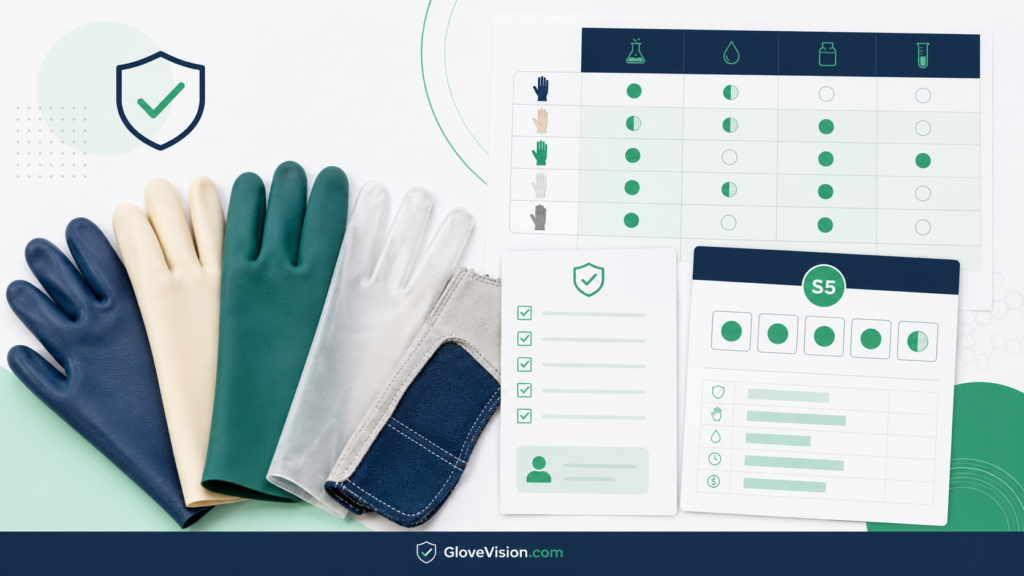
Glove Material Selector: S5 Polymer Compatibility Evaluation Protocol
The Glove Material Selector is an S5 polymer compatibility protocol that screens glove materials against Substance, Strength, Stress, Sensation, and Safety before any material is ranked for a task.
This article covers stop conditions, required chemical and task data, hazard stressor mapping, comparison controls, the Chemical Safety Gate, MAS scoring, failure-risk interpretation, material selection planning, and compatibility validation while keeping the selector as a screening tool, not a chemical PPE approval system.
Why Does a Glove Material Selector Reduce Polymer-Task Mismatch?
A Glove Material Selector reduces polymer-task mismatch by forcing users to compare glove materials against exact chemical identity, concentration, contact duration, contact type, mechanical stress, thermal conditions, dexterity needs, and required protection rules.
OSHA requires appropriate hand protection to be selected according to the task, conditions, duration of use, and hazards, while NIOSH warns that common glove materials are not universal barriers for chemical skin protection. [OSHA] [NIOSH]
Figure 1: Generic glove material claims hide exact exposure compatibility risk. The selector forces the decision back to chemical identity, concentration, glove model, and task conditions.
Why Are Generic All-Purpose Glove Claims Unsafe?
Generic all-purpose glove claims are unsafe because no glove material protects equally against every chemical, temperature, puncture risk, abrasion condition, and dexterity demand.
How Does Polymer-Task Mismatch Happen?
Polymer-task mismatch happens when the glove material does not match the exact chemical identity, concentration, exposure duration, contact type, temperature, mechanical stress, tactile demand, or site PPE rule.
What Mistake Does the Glove Material Selector Prevent?
The Glove Material Selector prevents users from assuming that thickness, price, brand reputation, color, or dry mechanical durability automatically proves chemical protection.
| Unsafe Shortcut | Why It Fails | Safer Selector Rule |
|---|---|---|
| “Chemical-resistant” label only | Does not identify exact chemical or exposure | Check exact chemical and manufacturer data |
| Thickness only | Thicker is not automatically compatible | Compare thickness with permeation and degradation data |
| Brand reputation | Brand does not prove task-specific compatibility | Use exact model and compatibility chart |
| Mechanical durability | Abrasion strength does not equal chemical barrier | Separate chemical gate from mechanical scoring |
| Polymer family name | Polymer performance varies by chemical and model | Confirm exact exposure compatibility |
When Should the Glove Material Selector Stop and Safety Officer Review Begin?
The Glove Material Selector should stop and safety officer review should begin when chemical identity, concentration, contact duration, compatibility data, exposure severity, regulatory requirements, or site PPE rules are unknown or uncertain.
Hard boundary: no MAS scoring, field trial, or material ranking should proceed when the chemical exposure is unknown or the required compatibility data is missing.
OSHA Hazard Communication requires chemical hazards and appropriate protective measures to be communicated through labels, safety data sheets, and training; SDS information helps users review chemical hazards and protective controls before glove selection. [OSHA] [OSHA SDS]
Which Conditions Stop the Glove Material Selector Immediately?
The selector stops immediately when chemical identity, concentration, exposure duration, compatibility data, or site approval requirements are unknown.
Why Does Unknown Chemical Exposure Block Material Approval?
Unknown chemical exposure blocks material approval because a polymer cannot be safely matched without knowing the chemical, concentration, contact type, and expected exposure duration.
What Should Users Do When Safety Review Is Required?
When safety review is required, users should stop the selection process, identify the chemical and concentration, review the SDS, check manufacturer compatibility charts, contact the supplier or manufacturer if needed, and follow site PPE rules.
| Stop Condition | Continue Selector? | Required Action |
|---|---|---|
| Unknown chemical | No | Identify chemical before selection |
| Unknown concentration | No | Confirm concentration before selection |
| Unknown contact duration | No | Define exposure time |
| Mixed solvents with no data | No | Escalate to safety officer or manufacturer |
| No compatibility chart | No | Request manufacturer data |
| Breakthrough time below task duration | No | Reject or change task controls |
| Emergency or spill response | No | Follow site emergency PPE protocol |
| Glove swelling/cracking/softening | No | Remove from use and reassess |
What Chemical and Task Data Must the Glove Material Selector Collect First?
The Glove Material Selector must collect chemical identity, concentration, mixture details, physical form, temperature, contact duration, contact type, task conditions, glove model, thickness, permeation data, breakthrough time, and degradation data before scoring.
Which Chemical Data Must Be Collected Before Glove Comparison?
Chemical data must include the chemical name, CAS number where available, concentration, mixture components, physical form, temperature, contact duration, contact type, and whether the chemical is pure, diluted, heated, or mixed.
Which Task Data Must Be Collected Before Glove Comparison?
Task data must include the work task, wear duration, grip requirement, dexterity requirement, abrasion exposure, puncture or cut risk, thermal exposure, wet/dry condition, reuse requirement, cuff coverage, and change-out rules.
Which Glove Data Must Be Collected Before Scoring?
Glove data must include manufacturer, exact model, polymer type, thickness or gauge, liner or coating, cuff length, permeation data, breakthrough time, degradation rating, and relevant standards or certifications.
| Required Data | Completed? |
|---|---|
| Chemical name identified | |
| CAS number recorded if available | |
| Concentration confirmed | |
| Mixture components reviewed | |
| Contact type defined | |
| Expected contact duration defined | |
| Temperature range recorded | |
| Mechanical hazards recorded | |
| Dexterity requirement recorded | |
| Required protection standard recorded | |
| SDS reviewed | |
| Manufacturer glove chart reviewed |
What Hazard Stressors Are Mapped by the Glove Material Selector?
The Glove Material Selector maps chemical exposure, mechanical wear, thermal stress, and tactile/dexterity demand before any glove material is ranked.
Figure 2: The S5 framework keeps chemical, mechanical, thermal, tactile, and safety requirements separate until the candidate passes the safety gate.
How Does the Glove Material Selector Map Chemical Exposure?
The selector maps chemical exposure by recording exact chemical identity, concentration, contact duration, contact type, permeation data, breakthrough time, and degradation rating.
How Does the Glove Material Selector Map Mechanical Wear?
The selector maps mechanical wear by recording abrasion, puncture, cut risk, grip stress, rough surfaces, tool handling, and repeated flexion.
How Does the Glove Material Selector Map Thermal Stress?
The selector maps thermal stress by recording heat exposure, cold exposure, heated chemical contact, sudden temperature changes, and material stiffening or softening.
How Does the Glove Material Selector Map Tactile and Dexterity Demand?
The selector maps tactile and dexterity demand by recording fine-motor control, grip feel, tool handling, small-part handling, finger sensitivity, and worker removal risk.
| Input Stressor | What It Tests | High-Risk Failure Mode |
|---|---|---|
| Chemical Exposure | Compatibility with exact chemical and concentration | Permeation, breakthrough, degradation |
| Contact Duration | Barrier performance over expected use time | Exposure before task completion |
| Contact Type | Splash, intermittent, immersion, or continuous contact | Underestimated exposure severity |
| Mechanical Wear | Abrasion, puncture, cut, or grip stress | Tearing, thinning, puncture |
| Thermal Stress | Heat, cold, or heated chemical exposure | Cracking, melting, stiffening, softening |
| Dexterity Demand | Grip, tactile control, and fine-motor work | Over-gripping, errors, glove removal |
How Do You Control Comparison Variables Before Using the Glove Material Selector?
You control comparison variables before using the Glove Material Selector by keeping chemical assumptions, contact duration, contact type, task profile, glove condition, temperature, and thickness/gauge records consistent across candidates.
ASTM F739-20 describes permeation testing under defined continuous-contact conditions and warns that test data should not be treated as a universal safe-exposure approval outside its conditions. [ASTM]
How Should Glove Thickness Be Controlled?
Glove thickness should be controlled by recording thickness or gauge for every candidate and treating thickness differences as major decision variables.
How Should Chemical Exposure Be Controlled?
Chemical exposure should be controlled by using the same chemical, concentration, expected contact duration, and contact type for all candidate comparisons.
How Should Work Task Conditions Be Controlled?
Work task conditions should be controlled by keeping task type, tool use, grip force, abrasion rate, puncture exposure, wear duration, temperature, and wet/dry condition consistent where practical.
How Should Material State Be Controlled?
Material state should be controlled by comparing unused gloves from proper storage conditions and excluding expired, damaged, contaminated, stretched, or previously exposed gloves.
| Control Item | Pass / Fail |
|---|---|
| Same chemical and concentration used for comparison | |
| Same expected contact duration used | |
| Same contact type used | |
| Glove thickness/gauge recorded | |
| Material model and manufacturer recorded | |
| Same task profile used | |
| Same temperature range recorded | |
| New, undamaged gloves used for comparison | |
| Storage condition checked | |
| Site PPE rules reviewed |
How Does the Glove Material Selector Enforce the Chemical Safety Gate?
The Glove Material Selector enforces the Chemical Safety Gate by allowing only glove candidates with reliable compatibility data for the exact chemical, concentration, contact duration, contact type, glove model, and thickness to enter MAS scoring.
Figure 3: The Chemical Safety Gate is a non-negotiable pass/fail layer. Unsupported chemical compatibility cannot enter MAS ranking.
What Is the Chemical Safety Gate?
The Chemical Safety Gate is the first approval filter that blocks any glove candidate without reliable compatibility data for the exact chemical and exposure condition.
What Data Is Required to Pass the Chemical Safety Gate?
A candidate passes the Chemical Safety Gate only when acceptable data supports the exact chemical or mixture, concentration, contact duration, contact type, permeation result, breakthrough time, degradation rating, glove model, thickness, and workplace protection level.
Which Candidates Fail the Chemical Safety Gate Immediately?
A candidate fails the Chemical Safety Gate immediately when compatibility data is missing, the chemical or concentration is unknown, breakthrough time is too short, degradation appears, task rating is absent, or site PPE rules fail.
Why Does MAS Scoring Happen Only After the Safety Gate?
MAS scoring happens only after the safety gate because chemical incompatibility cannot be averaged away by abrasion, puncture, comfort, dexterity, or thermal scores.
| Gate Requirement | Pass / Fail |
|---|---|
| Exact chemical identified | |
| Concentration known | |
| Contact duration known | |
| Contact type known | |
| Manufacturer compatibility data available | |
| Breakthrough time suitable for exposure duration | |
| Degradation rating acceptable | |
| Glove model and thickness match the data | |
| Site PPE rule satisfied | |
| No unknown high-risk mixture present |
Functional Gate Check
Use this only as a documentation check. It does not approve chemical PPE.
How Does the Glove Material Selector Calculate MAS After the Safety Gate?
The Glove Material Selector calculates MAS only after the Chemical Safety Gate is passed by averaging Chemical Barrier, Abrasion Resistance, Puncture Shield, Tactile Precision, and Heat/Cold Suitability scores.
MAS is an internal ranking score for already-gated candidates. It is not a regulatory approval, manufacturer rating, chemical certification, OSHA compliance proof, or substitute for manufacturer compatibility data.
What Is the Material Adequacy Score?
The Material Adequacy Score is an internal comparison score used only after a glove candidate has passed the Chemical Safety Gate.
What Is the MAS Formula?
The MAS formula averages Chemical Barrier, Abrasion Resistance, Puncture Shield, Tactile Precision, and Heat/Cold Suitability.
Material Adequacy Score Formula
MAS = (Chemical Barrier + Abrasion Resistance + Puncture Shield + Tactile Precision + Heat/Cold Suitability) ÷ 5
Use only after the Chemical Safety Gate is passed.
What Does MAS Not Prove?
MAS does not prove regulatory approval, universal chemical safety, manufacturer certification, OSHA compliance, safe use for unknown chemicals, safe use beyond breakthrough data, or safe reuse after contamination.
How Should MAS Scores Be Interpreted?
MAS scores should be interpreted as internal ranking bands for candidates that already passed the Chemical Safety Gate.
| MAS Range | Internal Meaning | Decision Use |
|---|---|---|
| 3.5–4.0 | Strong task fit among gated candidates | Strong candidate for controlled trial |
| 3.0–3.4 | Good task fit among gated candidates | Candidate with monitoring |
| 2.5–2.9 | Conditional task fit | Use only with strict limits |
| Below 2.5 | Weak task fit | Reject or seek better candidate |
What Rule Overrides a High MAS Score?
Chemical gate failure, site PPE rule failure, or manufacturer incompatibility warning overrides any high MAS score. A high score cannot rescue an incompatible glove.
Concise Polymer Suitability Log Matrix
Fill only the candidate rows you want to compare. Keep the required fields: model/thickness, Chemical Gate, and the five S5 scores. Key Limitation was removed because it is optional; the result panel now identifies the weakest score automatically after Check Result.
| Material Candidate | Exact Model / Thickness | Chemical Gate | S5 Scores (0–4) | MAS | Decision |
|---|---|---|---|---|---|
| Nitrile |
|
||||
| Latex |
|
||||
| Vinyl / PVC |
|
||||
| Neoprene |
|
||||
| Butyl |
|
||||
| Viton / Fluoroelastomer |
|
||||
| Polyurethane / PU |
|
||||
| Leather |
|
||||
| Hybrid / Coated |
|
Which Glove Material Selector Patterns Suggest Polymer Failure Risk?
Glove Material Selector patterns suggest polymer failure risk when compatibility data is missing, chemical-gate results fail, mechanical strength hides chemical weakness, dexterity is too low, thermal suitability fails, or no standard candidate passes.
Figure 4: Failure patterns do not approve a material. They indicate whether to reject, monitor, compare only approved alternatives, or escalate to specialist review.
What Pattern Suggests Chemical Barrier Failure Risk?
Chemical barrier failure risk is suggested when compatibility data is missing, weak, incomplete, or shorter than the expected exposure duration.
What Pattern Suggests Mechanically Strong but Chemically Unsuitable Material?
A mechanically strong but chemically unsuitable material is suggested when abrasion and puncture scores are high but chemical compatibility is unsupported or fails the gate.
What Pattern Suggests Barrier-Safe but Low-Dexterity Material?
A barrier-safe but low-dexterity material is suggested when the chemical gate passes but tactile precision and grip scores are low.
What Pattern Suggests Thermal Mismatch?
Thermal mismatch is suggested when the chemical gate passes but heat or cold suitability is low for the actual task condition.
What Pattern Suggests No Standard Material Is Suitable?
No standard material may be suitable when no candidate passes the Chemical Safety Gate or all gated candidates fail critical task requirements.
| Pattern Identified | Failure-Risk Signal | Action Step |
|---|---|---|
| Missing compatibility data | Unknown protection level | Reject until data is confirmed |
| Chemical gate failure | Chemical incompatibility risk | Eliminate candidate |
| High mechanical / failed chemical gate | Mechanically strong but chemically unsuitable | Use only for dry mechanical tasks if appropriate |
| Passes chemical gate / low tactile score | Barrier suitable but low task usability | Compare approved higher-dexterity alternatives |
| Passes chemical gate / low heat-cold score | Thermal mismatch | Review manufacturer temperature limits |
| No material passes gate | Task needs specialist review | Escalate to safety officer or supplier technical team |
How Do You Build a Safer Material Selection Plan Using Glove Material Selector Results?
You build a safer material selection plan by selecting only gated candidates, matching the highest viable MAS result to the task, documenting the compatibility basis, and defining conservative change-out and inspection rules.
How Should Users Create a Material Selection Hypothesis?
Users should create a material selection hypothesis by naming the failed material, candidate material/model, bottleneck variable, and confirmed chemical compatibility condition.
Selection hypothesis format:
By switching from [failed material] to [candidate material/model], I expect to improve [bottleneck variable] while maintaining confirmed compatibility with [chemical/concentration/contact duration].
Which Candidate Should Be Selected First?
The first candidate should pass the Chemical Safety Gate, have manufacturer data for the exact exposure, meet breakthrough and degradation expectations, match mechanical and thermal needs, support safe dexterity, satisfy site PPE rules, and allow a practical change-out interval.
How Should Leather Be Handled in the Material Selection Plan?
Leather should be handled as a dry mechanical protection material unless manufacturer data supports the exact chemical exposure.
How Should Conditional Candidates Be Handled?
Conditional candidates should be used only when the chemical gate passes, exposure time remains within conservative limits, change-out rules are documented, inspection rules are clear, users are trained, and workplace safety approval is obtained where required.
| Selector Result | Structural Meaning | Selection Decision |
|---|---|---|
| Gate Pass + MAS 3.5–4.0 | Strong candidate among approved options | Proceed to controlled task trial |
| Gate Pass + MAS 3.0–3.4 | Good candidate with monitoring | Use with documented change-out rules |
| Gate Pass + MAS 2.5–2.9 | Conditional task fit | Use only with strict limits and review |
| Gate Fail | Chemical compatibility not supported | Reject |
| No Gate Pass | No standard candidate suitable | Seek safety officer or specialist review |
How Do You Validate the Chosen Polymer System After the Glove Material Selector Audit?
You validate the chosen polymer system by confirming exact compatibility data, running a controlled task trial, inspecting for degradation, setting conservative change-out rules, and rejecting the glove if exposure, task, or material conditions change.
Permeation-test data is condition-specific, and OSHA’s hand-protection rule keeps the final decision tied to the task, conditions, duration of use, and identified hazards. [ASTM] [OSHA]
Validation confirms that the selected glove system is supported by available compatibility data and controlled task observations. It is not manufacturer certification, regulatory approval, or a substitute for site safety approval.
Figure 5: Validation is a loop: match compatibility data, run a controlled task trial, inspect for degradation, and set conservative change-out rules.
How Should Compatibility Data Be Verified?
Compatibility data should be verified by matching the exact manufacturer, model, polymer, thickness, chemical, concentration, contact type, exposure duration, breakthrough time, permeation data, degradation rating, and site requirement.
How Should a Monitored Task Trial Be Performed?
A monitored task trial should be performed only after compatibility data supports the candidate and should watch for swelling, cracking, softening, discoloration, stickiness, tearing, grip loss, leakage, dexterity problems, or user removal.
How Should Change-Out Rules Be Set?
Change-out rules should be set conservatively below relevant compatibility limits and adjusted for manufacturer data, site policy, chemical severity, contact frequency, degradation signs, abrasion, contamination risk, and reuse limits.
When Should the Selected Glove Be Rejected After Validation?
The selected glove should be rejected or retested when visual degradation appears, breakthrough time is too short, softening or swelling occurs, leakage appears, grip becomes unsafe, dexterity causes removal risk, exposure changes, concentration changes, or required site approval is missing.
| Validation Step | Pass / Fail |
|---|---|
| Exact chemical and concentration confirmed | |
| SDS reviewed | |
| Manufacturer compatibility chart reviewed | |
| Breakthrough time recorded | |
| Degradation rating recorded | |
| Permeation data checked where available | |
| Contact duration compared against data | |
| Conservative change-out interval documented | |
| Controlled field trial completed | |
| No swelling, cracking, softening, discoloration, or leakage observed | |
| Grip and dexterity remain acceptable | |
| Site PPE rules satisfied | |
| Safety officer review completed where required |
Validation progress: 0 of 13 complete
Frequently Asked Questions
Conclusion
The Glove Material Selector gives users a structured way to screen glove polymers by exact chemical and task conditions before ranking material candidates.
It does this by stopping uncertain exposures for safety review, collecting chemical and task data, mapping hazard stressors, controlling comparisons, applying the Chemical Safety Gate, using MAS only for gated candidates, interpreting failure-risk patterns, building a selection plan, and validating the chosen system. The safest material choice is the one that passes exact compatibility review before it is ranked for comfort, dexterity, durability, or task fit.