
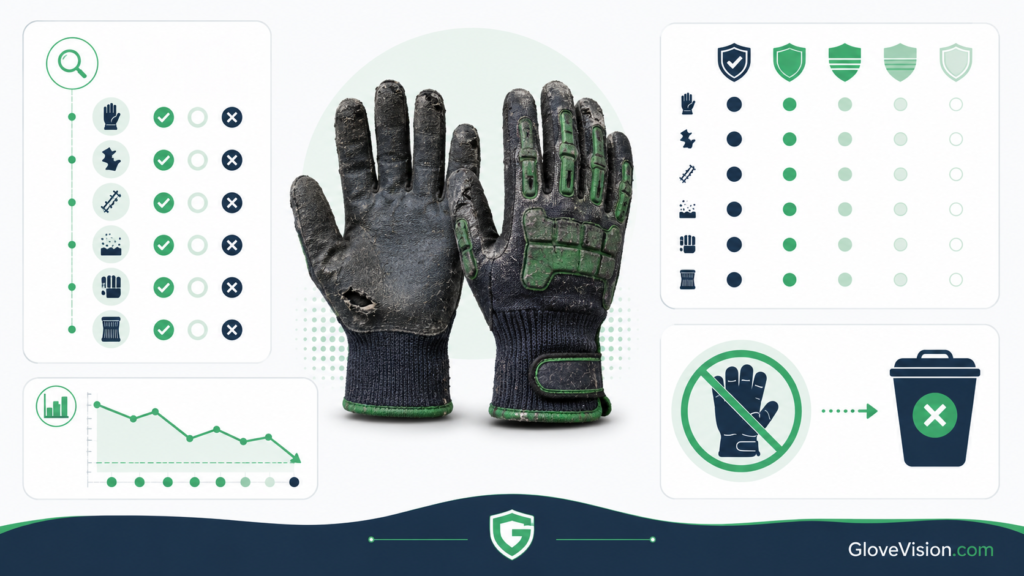
Glove Condition Log: S5 Structural Integrity Tracking Protocol
The Glove Condition Log is an S5 structural integrity tracking protocol that helps users inspect Surface, Seams, Shielding, Sensation, and Stretch Recovery so worn or compromised gloves can be downgraded, replaced, or removed before active protection fails.
This webpage covers immediate retirement gates, S5 structural decay factors, inspection controls, 0–10 condition scoring, QII, single-zone and gate-failure override rules, VoD trend tracking, maintenance/rotation/downgrade planning, and final condition validation. It does not certify PPE safety, and disposable or contaminated gloves must follow workplace and manufacturer rules. [OSHA]
How Does a Glove Condition Log Reduce the Risk of Missed Structural Glove Failure?
A Glove Condition Log reduces the risk of missed structural glove failure by tracking early warning signs such as material thinning, coating wear, seam stress, grip decay, tactile loss, stiffness, and stretch failure before a complete hole or tear appears.
Visible-hole-only inspection is weak because a glove can look intact while its protective surface, grip texture, seams, or fit stability has already declined. The safer workflow is progressive condition tracking.
Figure 1: Progressive structural decay should be logged before a full breach becomes visible.
Why Should Glove Condition Not Be Judged Only by Visible Holes?
Glove condition should not be judged only by visible holes because a glove can lose protection through thinning, coating wear, seam stress, stiffness, or grip loss before the material fully opens.
What Structural Warning Signs Should Be Logged Before Complete Failure?
Structural warning signs should include palm thinning, abrasion marks, seam fraying, cuff separation, coating cracks, brittle material, permanent stretching, grip texture loss, tactile control loss, swelling, and tackiness.
| Warning Sign | What It May Indicate | Logging Action |
|---|---|---|
| Palm thinning | Surface wear or abrasion loss | Score Surface and inspect sooner |
| Seam fraying | Stress at stitched or joined areas | Score Seams and check for separation |
| Coating cracks | Material fatigue or coating breakdown | Score Surface and Shielding |
| Grip texture loss | Reduced tool control | Score Sensation and Surface |
| Chemical swelling/tackiness | Possible chemical degradation | Apply Immediate Retirement Gate review |
When Must a Glove Condition Log Trigger Immediate Glove Retirement or Removal From Service?
A Glove Condition Log must trigger immediate retirement or removal from active service when a glove has a hole, puncture, cut, split seam, chemical breakthrough, swelling, melting, exposed-skin risk, complete grip failure, or damaged protective layer.
Defective or damaged PPE should not be kept in active protective use. QII and VoD cannot rescue a glove that has already failed a safety gate. [OSHA]
Figure 2: Gate failures stop condition scoring and force removal from active protective use.
| Gate Failure | Continue Active Use? | Required Action |
|---|---|---|
| Hole, puncture, or cut | No | Remove from active service |
| Split seam or open stitching | No | Remove, replace, or downgrade only if allowed |
| Chemical swelling or tackiness | No | Follow chemical PPE procedure |
| Known or suspected breakthrough | No | Remove and follow site rules |
| Melting, burn marks, brittle hardening | No | Remove from active service |
| Complete grip failure | No | Remove from tool-handling tasks |
| Liner or cuff detachment | No for protective tasks | Downgrade only if allowed |
What Structural Decay Factors Are Tracked by the Glove Condition Log?
The Glove Condition Log tracks five structural decay factors: Surface, Seams, Shielding, Sensation, and Stretch Recovery.
These S5 categories are practical inspection zones, not regulatory categories. Each zone has a different failure mode and a different impact on operational safety.
Figure 3: The S5 model prevents one average score from hiding separate structural weaknesses.
| S5 Factor | What It Tracks | High-Risk Failure Mode |
|---|---|---|
| Surface | Palm wear, coating wear, abrasion, grip texture | Thinning, puncture, grip loss |
| Seams | Stitching, cuff adhesion, liner attachment | Seam splitting, cuff separation |
| Shielding | Back protection, knuckle zones, overlays | Loss of impact or hazard protection |
| Sensation | Tactile control, stiffness, grip feel | Tool slippage, over-gripping, task errors |
| Stretch Recovery | Return-to-shape, fit stability, elasticity | Sagging, loose fit, unstable handling |
How Do You Establish Inspection Controls Before Updating the Glove Condition Log?
You establish inspection controls before updating the Glove Condition Log by tracking each glove model separately, recording task category, using consistent scoring, checking retirement gates first, and following manufacturer or workplace inspection rules.
Inspection controls prevent false comparisons because chemical, mechanical, thermal, cut, puncture, and general-use gloves can decay differently. PPE must also remain suitable for the hazards present. [OSHA]
Model Control
Track manufacturer, model, material, thickness or gauge, coating, liner, cuff type, task type, and hazard category separately.
Interval Control
Use routine intervals for normal tracking, but inspect sooner after heavy abrasion, chemical contact, heat exposure, or performance loss.
Storage Control
Record storage issues that may accelerate material decay, including heat, harsh sunlight, incompatible chemicals, or aggressive washing.
Scoring Control
Use the same 0–10 scale, score each S5 zone separately, and check immediate retirement gates before calculating QII.
| Control Item | Pass / Fail |
|---|---|
| Same glove model tracked separately | |
| Material, coating, thickness, and cuff type recorded | |
| Task category recorded | |
| Early inspection required after extreme exposure | |
| Immediate Retirement Gate checked first |
Inspection Control Result
Control Check Pending
Reason
Choose Pass or Fail for every control item before updating the condition log.
Required Action
Do not compare condition scores until the inspection setup is complete.
How Do You Record Quantitative Wear Scores Inside the Glove Condition Log?
You record quantitative wear scores inside the Glove Condition Log by checking retirement gates first, scoring each S5 zone with the same 0–10 scale, recording inspection context, and logging the final service decision.
Static S5 Condition Log Example Matrix
This example matrix shows how the S5 worksheet should be filled out. It is intentionally static so it stays reliable on phones, tablets, and desktop screens.
| Interval | Hours Used | Gate Failure? | Surface | Seams | Shielding | Sensation | Stretch | QII | VoD | Example Decision | Notes |
|---|---|---|---|---|---|---|---|---|---|---|---|
| Baseline | 0 | No | 10 | 10 | 10 | 10 | 10 | 10.0 | — | Continue baseline | New or freshly inspected glove. |
| Inspection 1 | 12 | No | 8 | 9 | 9 | 8 | 8 | 8.4 | 1.6 | Monitor | Early palm wear or grip texture loss. |
| Inspection 2 | 18 | No | 6 | 8 | 8 | 6 | 7 | 7.0 | 1.4 | Downgrade review | Surface and tactile control are declining. |
| Inspection 3 | 24 | Yes | — | — | — | — | — | Gate | — | Remove from service | Gate failure overrides QII, VoD, and average scoring. |
How Does a Glove Condition Log Calculate QII Without Hiding Critical Zone Failure?
A Glove Condition Log calculates QII without hiding critical zone failure by averaging the five S5 zone scores only after retirement gates are cleared and then applying single-zone and gate-failure override rules.
QII Formula
QII = (Surface Wear + Seam Integrity + Shielding Protection + Sensation Control + Stretch Recovery) ÷ 5
QII is an internal condition-tracking score. It is not a regulatory certification, manufacturer test result, formal PPE inspection replacement, or proof that a glove remains safe for all assigned hazards.
| QII Range | Internal Meaning | Decision |
|---|---|---|
| 8.0–10 | Strong condition | Continue assigned use if no gate failure exists |
| 6.0–7.9 | Monitor zone | Continue with closer inspection |
| 4.0–5.9 | Downgrade / review zone | Consider light-duty downgrade or replacement |
| Below 4.0 | Remove from active protection | Retire, replace, or follow site procedure |
How Do You Calculate Decay Speed Using Glove Condition Log Tracking Data?
You calculate decay speed using Glove Condition Log tracking data by measuring how much the QII score drops between inspection intervals.
VoD Formula
VoD = QII Drop per Inspection Interval
VoD is an internal trend signal. It does not certify safety, set a universal change-out interval, or override gate failures, workplace rules, manufacturer instructions, or assigned hazard requirements.
| VoD Pattern | Internal Meaning | Action |
|---|---|---|
| 0–0.4 | Slow wear | Continue routine inspection |
| 0.5–1.4 | Moderate wear | Inspect more often |
| 1.5+ | Accelerated decay | Review material, task, storage, and replacement interval |
| Any gate failure | Critical failure | Remove from active service immediately |
How Do You Implement a Maintenance, Rotation, or Downgrade Loop After a Glove Condition Log Audit?
You implement a maintenance, rotation, or downgrade loop after a Glove Condition Log audit by matching the primary failure vector to a corrective strategy and then applying a safety decision.
The loop must follow manufacturer instructions and workplace PPE rules. Downgrade is not allowed when a glove must be replaced, discarded, decontaminated, or removed from all reuse.
Figure 4: Repeated wear patterns should drive a corrective loop, but the final decision must remain safety-gated.
| Primary Failure Vector | Observed Trend | Corrective Strategy | Expected Result |
|---|---|---|---|
| Surface / Palm Wear | Surface scores fall first | Use better abrasion-suited glove or rotate pairs if allowed | Wear distributed more safely |
| Seam Failure | Stitching or cuff separates | Select stronger construction or review fit | Seam stress reduced |
| Shielding Loss | Back protection cracks or compresses | Replace or choose stronger protection | Protection restored |
| Sensation Loss | Grip or tactile control declines | Review coating, soil load, or grip texture | Safer handling |
| Stretch Recovery Loss | Glove becomes loose or baggy | Improve storage, sizing, or replacement interval | Fit stability improved |
| Chemical / Heat Damage | Swelling, hardening, melting, cracking | Remove from service and review material compatibility | Unsafe exposure reduced |
How Does a Glove Condition Log Validate Final Glove Condition Decisions?
A Glove Condition Log validates final glove condition decisions by checking retirement gates, critical zone scores, QII range, VoD trend, grip safety, structural condition, hazard suitability, and workplace PPE rules before continued use.
A glove can stay in active service only when no immediate retirement gate is triggered, no zone score falls below 3, QII remains acceptable for the assigned task, VoD does not show accelerated decay, and workplace PPE rules allow continued use. [OSHA]
Figure 5: Final validation requires a clean gate result, acceptable zone scores, useful trend data, and task protection suitability.
| Validation Item | Pass / Fail | What This Controls |
|---|---|---|
| No immediate retirement gate triggered | Stops active use after holes, punctures, split seams, breakthrough, swelling, melting, exposed-skin risk, or complete grip failure. | |
| No structural zone score below 3 | Prevents a strong average score from hiding one critical S5 zone failure. | |
| QII remains acceptable for assigned task | Confirms the internal condition score still supports the assigned task after gate and zone checks. | |
| VoD does not show accelerated decay | Flags rapid condition decline that requires closer inspection or replacement review. | |
| Glove still matches task hazard | Confirms the glove still protects against the real chemical, cut, puncture, heat, cold, grip, or contamination hazard. | |
| Workplace or manufacturer rules allow continued use | Prevents the webpage score from overriding PPE policy, disposal rules, contamination rules, or manufacturer instructions. |
Final Validation Decision
Decision Pending
Reason
Select Pass or Fail for every validation item to generate a final answer.
Required Action
The glove cannot be approved from an incomplete checklist.
It must pass the Immediate Retirement Gate, avoid critical zone failure, meet task protection requirements, and remain allowed under workplace or manufacturer rules.
Frequently Asked Questions
The Glove Condition Log tracks Surface, Seams, Shielding, Sensation, and Stretch Recovery so users can record structural wear before complete failure appears. It helps organize inspection history, condition scores, decay trends, and downgrade or replacement decisions.
No, QII does not prove a glove is safe. QII is only an internal tracking score calculated after immediate retirement gates are cleared. Workplace rules, manufacturer instructions, hazard suitability, and critical zone failures override the average score.
A glove should be removed immediately when it has a hole, puncture, cut, split seam, chemical breakthrough, swelling, tackiness, melting, burn damage, brittle hardening, complete grip failure, exposed skin risk, or damaged protective layers.
Velocity of Decay measures how quickly QII drops between inspection intervals. It helps show whether glove condition is declining slowly, moderately, or rapidly, but it is only an internal trend signal and does not override gate failures.
A glove may be downgraded only when no immediate retirement gate exists, the glove is no longer suitable for high-risk tasks, lower-risk reuse is allowed, and the glove is clearly labeled for downgraded duty. Unsafe or contaminated gloves should be removed.
Conclusion
The Glove Condition Log gives teams a structured way to track glove wear before visible failure becomes the only replacement trigger. It organizes immediate retirement gates, S5 structural decay factors, inspection controls, 0–10 scoring, QII, override rules, VoD, maintenance/rotation/downgrade planning, and final condition validation into one safer inspection workflow.
The safest condition decision is the one that removes compromised gloves before an average score hides a critical failure.