
What Defines Work Gloves Through Mechanical Hazards, Trade-Specific Builds & Tool-Control Fit?
Work gloves are defined by mechanical hazards, trade-specific builds, material and coating choices, tool-control fit, grip performance, durability limits, and verification requirements.
This page explains what work gloves are, why mechanical hazards shape glove selection, how materials and coatings affect grip and durability, how trade builds differ, how rating labels help verification, how fit and grip should be checked, why work gloves fail, and which checklist helps verify selection before use or purchase.
This article is for educational work glove-selection guidance only and does not replace workplace PPE procedures, safety training, manufacturer instructions, SDS guidance, electrical safety rules, rating verification, or professional hazard assessment. For cut, puncture, abrasion, heat, electrical, chemical, impact, vibration, or regulated workplace tasks, verify glove ratings, materials, labels, fit, manufacturer data, and workplace requirements before relying on a glove for protection.
What are work gloves, and how do they differ from disposable, medical, and household gloves?
Work gloves are protective gloves designed for job tasks where hands may face mechanical stress, rough surfaces, tools, materials, weather, heat, vibration, impact, or grip-control demands.
Work gloves are not the same as disposable gloves, medical gloves, household gloves, fashion gloves, or sports gloves because they are usually built for durability, handling, friction, tool control, and task-specific protection.
A work glove does not automatically protect against every hazard. Cut, heat, impact, chemical, electrical, and puncture protection must be verified by glove design, rating, labeling, intended use, manufacturer instructions, and workplace procedures. [OSHA]
Identify the primary mechanical hazard before choosing leather, coating, rating, cuff, or trade build.
Check whether the glove supports palm stability, finger movement, thumb control, grip, and dexterity.
Use seam wear, coating wear, grip loss, leather damage, padding failure, or unreadable labels as replacement triggers.
| Glove Type | Main Environment | Main Protection Role | Main Limitation | Verification Needed |
|---|---|---|---|---|
| Work gloves | Job sites, trades, industrial handling, tool work | Mechanical hazard support, grip, durability, tool control | Not automatically cut, heat, chemical, electrical, or puncture safe | Hazard, material, rating, fit, manufacturer instructions |
| Disposable gloves | Short-use hygiene, light handling, selected food/medical tasks | Thin short-use barrier | Not reusable or broadly mechanical-protective | Material, labeling, change-out rule |
| Medical gloves | Clinical contact and medical barrier tasks | Medical-use barrier support | Not automatically mechanical or chemical protective | Medical labeling, intended use, facility policy |
| Household gloves | Cleaning, wet work, gardening, domestic tasks | Reuse tolerance, moisture and light chemical splash support | Not always trade-rated or job-site suitable | Material, reuse condition, task exposure |
| Sports gloves | Game or activity-specific grip, impact, or warmth | Sport-specific handling and fit | Not worksite PPE | Sport task, fit, protection need |
Why do mechanical hazards shape work glove selection?
Mechanical hazards shape work glove selection because cuts, abrasion, punctures, impact, heat, vibration, and grip loss each require different glove features and verification steps.
Construction tasks need balanced hazard screening because construction hazard balance depends on abrasion, cut risk, and grip.
OSHA requires appropriate hand protection when hands face hazards such as harmful substances, cuts, abrasions, punctures, burns, and temperature extremes, but the specific glove still needs task-level verification. [OSHA]
| Hazard | Common Task | Glove Feature That May Help | What Must Still Be Verified |
|---|---|---|---|
| Cut | Sheet metal, glass, blades, sharp edges | Cut-resistant yarns, rated protection, reinforced palm | Cut rating, task edge, fit, other hazards |
| Abrasion | Concrete, lumber, masonry, rope, rough tools | Leather, coated palm, reinforced wear zones | Abrasion rating, material durability, moisture exposure |
| Puncture | Wire, splinters, nails, sharp debris | Puncture-resistant construction | Puncture rating, object type, palm/back coverage |
| Impact | Demolition, mechanics, rigging, oilfield, heavy equipment | Back-of-hand padding, impact zones | Impact rating, dexterity, flex zones |
| Heat and sparks | Welding, grinding, hot parts, sparks | Heat-resistant material, longer cuff, reinforced stitching | Thermal rating, process type, manufacturer limits |
| Grip loss | Wet, oily, dusty, greasy, or rough surfaces | Texture, coating, palm pattern, surface-specific material | Surface condition, oil/chemical contact, wear state |
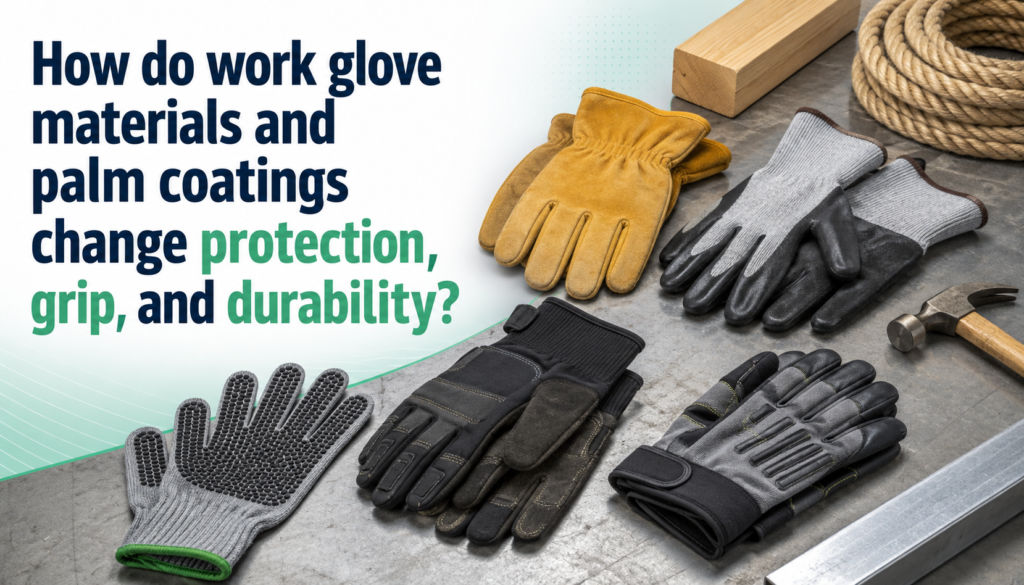
How do work glove materials and palm coatings change protection, grip, and durability?
Work glove materials and palm coatings change protection, grip, and durability by changing abrasion resistance, cut support, tactile feel, surface handling, wear life, and task suitability.
Palm coating should be matched to comfort and handling because coated palm grip affects breathability and handling control.
Coating choice matters in oily tasks because nitrile and polyurethane coatings can support different oily-part and fine-handling needs, but manufacturer data and surface condition still matter.
| Material / Coating | Common Use | Strength | Limitation | Best Verification Question |
|---|---|---|---|---|
| Leather | Construction, rigging, welding-adjacent handling, rugged work | Abrasion support, durability, warmth, rugged handling | Performance depends on leather type, grain, stitching, moisture, and reinforcement | Is the leather type and build suited to the hazard? |
| Synthetic leather | Mechanic, utility, tool handling | Flexibility, repeatable fit, tool feel | May wear, peel, or lose grip under oil, heat, or abrasion | Does the build match the surface and tool-control need? |
| HPPE / engineered fibers | Cut-aware tasks needing dexterity | Lightweight cut-resistance support when rated | Does not prove puncture, heat, chemical, or impact protection | Which rating and hazard does the glove support? |
| Aramid | Heat-aware or cut-aware tasks depending on design | Heat/cut support in selected builds | Suitability depends on construction and rating | Is the glove rated for the actual thermal or cut hazard? |
| Nitrile coating | Oily or industrial handling | Grip and abrasion support | Surface condition, texture, and wear control performance | Is the coating matched to oil, abrasion, and duration? |
| Latex coating | Dry or general grip tasks | Flexible grip and hand movement | May not suit oil-heavy tasks or latex-sensitive users | Is latex appropriate for the user and surface? |
| Polyurethane coating | Fine handling and tactile tasks | Dexterity and touch control | May wear faster in abrasive or oily conditions | Is fine handling more important than heavy abrasion durability? |
How do trade-specific work glove builds differ across construction, mechanics, welding, rigging, and electrical work?
Trade-specific work glove builds differ because construction, mechanics, welding, rigging, electrical work, and assembly place different demands on abrasion, cut awareness, heat, grip, dexterity, cuff coverage, and inspection.
Tool-control decisions become clearer when mechanic glove dexterity is balanced against impact, cut awareness, and oil handling.
Heavy handling needs stronger abrasion screening because rigger abrasion demands shape palm reinforcement and rugged build choices.
Heat and spark exposure require a better-owner route because welding heat and seam stress need trade-specific verification.
Electrical tasks require strict verification because electrician voltage exposure cannot be simplified into ordinary work-glove selection.
| Trade | Main Hand Demand | Common Build Feature | What This Parent Page Covers | Deeper Page |
|---|---|---|---|---|
| Construction | Abrasion, cut awareness, rough materials, grip | Reinforced palms, coated palms, flexible knuckles | Parent-level hazard balance | Construction child page |
| Mechanics | Dexterity, oil grip, knuckle protection, tool control | Synthetic leather, textured palms, impact zones | Parent-level protection/dexterity trade-off | Mechanic child page |
| Welding | Heat, sparks, cuff coverage, seam stress | Leather, heat-resistant stitching, longer cuffs | Parent-level heat/spark route | Welding child page |
| Rigging | Rope handling, load grip, abrasion zones | Reinforced palms, rugged builds | Parent-level heavy handling route | Rigger child page |
| Electrical | Voltage-related systems, protectors, inspection | Rubber insulating systems, leather protectors where required | Parent-level electrical boundary | Electrician child page |
| Assembly | Dexterity, low lint, touch control, repetitive handling | Thin coated palms, low-bulk materials | Parent-level dexterity route | Assembly page if supplied |
How do ANSI/ISEA 105 and EN 388 ratings help verify work glove performance?
ANSI/ISEA 105 and EN 388 ratings help verify work glove performance by giving tested performance signals for selected mechanical hazards, but they do not replace task-specific hazard assessment.
ANSI/ISEA 105 supports U.S. hand and arm protection classification context for selected performance properties. EN 388 supports mechanical-risk glove marking context for selected hazards such as abrasion, cut, tear, puncture, and impact where applicable. [ANSI] [BSI]
Rating labels help verify claims, but they do not prove suitability for every task, chemical, temperature, tool, surface condition, or worksite procedure.
| Label Element | What It Means | What It Helps Compare | What It Does Not Prove |
|---|---|---|---|
| ANSI/ISEA 105 cut context | U.S. classification for selected cut performance where tested | Relative cut-resistance support | Puncture, heat, chemical, electrical, or all-task suitability |
| ANSI/ISEA 105 abrasion/puncture context | Selected performance classification where tested | Relative abrasion or puncture support | Suitability for every surface, sharp object, or duration |
| EN 388 mechanical marking | Mechanical-risk performance marking for selected hazards | Abrasion, cut, tear, puncture, and impact where applicable | Universal glove suitability |
| Impact marking | Back-of-hand impact performance where applicable | Impact-support comparison | Dexterity, grip, or tool-control success |
| Manufacturer label | Product-specific ratings and intended use | Whether the glove supports a claimed hazard | Replacement for hazard assessment or workplace procedure |
How should fit, grip, cuff style, and dexterity be checked for tool-control fit?
Fit, grip, cuff style, and dexterity should be checked for tool-control fit because a glove that protects poorly or controls poorly can create handling problems during work.
Tool-control fit starts with palm stability, finger length, thumb movement, cuff coverage, grip texture, and dexterity against the actual tool, surface, or material being handled.
| Fit Area | Good Sign | Failure Sign | Safer Adjustment |
|---|---|---|---|
| Palm fit | Secure without bunching or circulation restriction | Twisting, folding, pressure points | Re-check size, palm design, or trade build |
| Finger length | Fingertips support control | Excess slack or painful compression | Adjust size or glove pattern |
| Thumb and webbing | Smooth gripping and pinching | Thumb saddle pulls, rubs, or strains seams | Choose better thumb design or fit |
| Cuff style | Matches coverage and mobility need | Debris entry, spark exposure, wrist restriction | Match cuff to task hazard and movement |
| Grip texture | Holds actual work surface reliably | Slipping, slick palm, coating wear | Match texture/coating to surface and replace if worn |
| Dexterity | Allows tool handling and small movements | Bulk, stiffness, or tactile loss | Balance protection with tool-control need |
Why do work gloves fail, and how can tearing, cracking, slick grip, or seam wear be corrected?
Work gloves fail when the glove build, material, coating, rating, fit, care method, task stress, or replacement timing no longer matches the job hazard.
Common failure signals include seam splitting, leather stiffness or cracking, palm coating flaking, slick grip, excessive bulk, restrictive padding, unreadable labels, and visible hazard mismatch.
| Failure Signal | Likely Cause | Safer Correction | Better Owner Page/Tool |
|---|---|---|---|
| Seams split near thumb, palm, or fingertips | Poor fit, high-friction handling, weak stitching, wrong build, excessive task stress | Re-check size, task demand, reinforcement zones, thumb design, seam construction | Fit tool or trade-specific page if supplied |
| Leather becomes stiff, cracked, or shrunken | Moisture, sweat, heat drying, chemical exposure, poor storage, unsuitable care | Follow manufacturer care, dry away from direct heat, replace if structure is compromised | Care page if supplied |
| Palm coating flakes, peels, or turns slick | Abrasion, oil exposure, chemical contact, wrong coating, worn texture | Match coating to surface condition and replace when grip is unreliable | Material/coating page or Hazard Match if supplied |
| Gloves feel protective but reduce control | Excessive bulk, poor finger length, stiff material, wrong trade build | Keep primary hazard protection while improving dexterity and tool feel | Fit tool if supplied |
| Impact padding feels bulky or restrictive | Padding does not match task movement | Re-check impact need, flex zones, articulation, job-specific design | Impact/trade-specific page if supplied |
Which checklist helps verify work glove selection before use or purchase?
A work glove verification checklist helps confirm task, primary hazard, glove category, material, coating, rating, fit, grip, failure triggers, and deeper routing before use or purchase.
- ☐ Identify whether the glove is for construction, mechanics, welding, rigging, assembly, electrical work, landscaping, warehouse handling, or general labor.
- ☐ Identify the primary hazard: cut, abrasion, puncture, impact, heat, cold, vibration, grip loss, wet work, oil, debris, chemical contact, or electrical exposure.
- ☐ Choose the broad work glove category that matches the task environment.
- ☐ Match material and coating to the work surface, hazard, and handling demand.
- ☐ Check rating and label support for cut, abrasion, puncture, impact, heat, or other relevant hazards where applicable.
- ☐ Check palm fit, finger length, thumb movement, cuff style, grip texture, and dexterity against the actual task.
- ☐ Replace gloves when seams split, coatings wear, leather cracks, grip becomes unreliable, padding fails, labels are unreadable, or the glove no longer matches the hazard.
- ☐ Route trade-specific, chemical, electrical, sizing, material, standards, or buying decisions to the correct owner page or tool only when the exact URL is supplied or selected.
Pre-use verification: Work glove selection should be treated as a task-based hazard screening and verification step, not a guarantee of protection. For cut, puncture, abrasion, heat, electrical, chemical, impact, vibration, or regulated workplace tasks, users should verify glove ratings, manufacturer instructions, workplace PPE procedures, and applicable standards before relying on a glove for protection.
Conclusion
Work gloves are best understood as task-based protection tools defined by mechanical hazards, trade-specific builds, material and coating choices, rating support, grip control, tool-control fit, and replacement discipline.
Work glove selection is not a guarantee of protection. Cut, puncture, abrasion, heat, electrical, chemical, impact, vibration, or regulated workplace tasks require ratings, manufacturer instructions, workplace procedures, and applicable standards before a glove is relied on for protection.
Frequently Asked Questions
Do work gloves protect against cuts?
Work gloves protect against cuts only when the glove is designed and rated for the cut hazard being handled.
Are leather work gloves always the most durable option?
Leather work gloves are not always the most durable option because leather performance depends on leather type, grain, thickness, stitching, reinforcement, moisture exposure, heat, and care.
Which palm coating is best for work gloves?
No palm coating is best for every work glove task because nitrile, latex, polyurethane, and other coatings perform differently on dry, wet, oily, rough, or fine-handling surfaces.
Do ANSI/ISEA 105 or EN 388 ratings prove a glove is safe?
ANSI/ISEA 105 and EN 388 ratings do not prove a glove is safe for every task because ratings help compare tested performance properties, not every worksite condition.
When should work gloves be replaced?
Work gloves should be replaced when seams split, coatings wear, leather cracks, grip becomes unreliable, padding fails, labels become unreadable, or the glove no longer matches the hazard.