
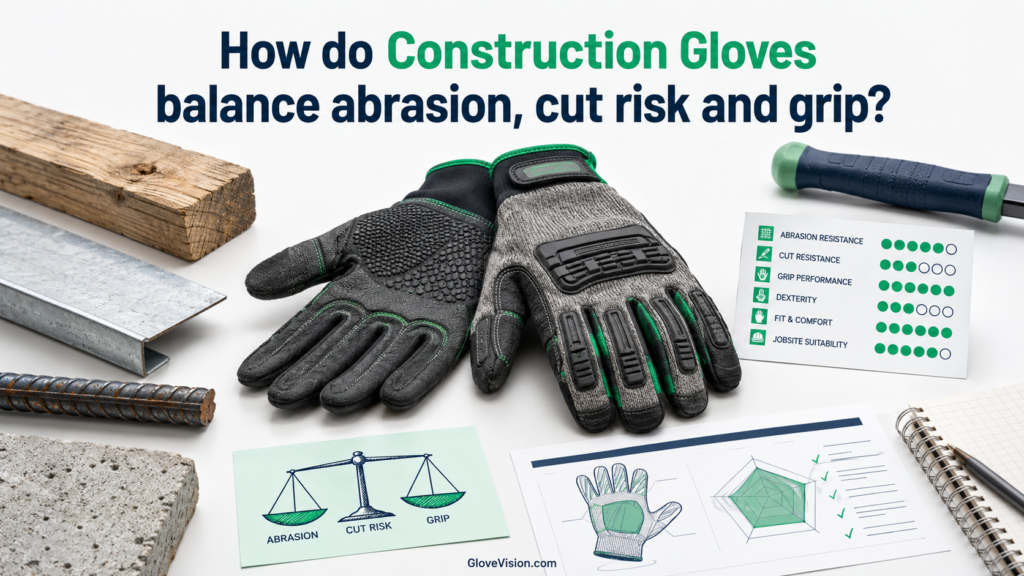
How do construction gloves balance abrasion, cut risk and grip?
Construction Gloves balance abrasion, cut risk, and grip through liners, coatings, leather, reinforcements, fibers, textures, and fit features that support different jobsite tasks. No rating, coating, fiber, palm material, or glove build guarantees protection.
This article covers mechanical design trade-offs, standards and rating interpretation, coating and trade-task matching, fit and fatigue control, failure and saturation response, and a final jobsite performance verification checklist.
This article is educational only. Construction glove suitability must be determined by hazard assessment, manufacturer documentation, current standards, SDS review, site PPE policy, tool risk, fit, exposure, and jobsite procedure.
Why do standard Construction Gloves require balanced mechanics to reduce exposure to diverse jobsite hazards?
Standard Construction Gloves require balanced mechanics because construction tasks often combine abrasion, cut risk, grip needs, dexterity needs, comfort limits, tool handling, and changing jobsite conditions.
Use Work Gloves as the broader category boundary, then narrow the selection to the exact construction task, material handled, and site procedure.
What jobsite hazards can Construction Gloves help address?
Construction Gloves may help reduce exposure to selected hazards such as abrasion, rough lumber, masonry edges, sheet metal, wire, splinters, friction, tool handling, mild impact, grip loss, and some puncture or tear risks. OSHA hand-protection rules require appropriate hand protection when hands are exposed to hazards such as cuts, abrasions, punctures, harmful substances, chemical burns, thermal burns, and harmful temperature extremes. [OSHA]
What materials may appear in Construction Gloves?
Construction Gloves may use leather, cotton, polyester, nylon, HPPE, aramid blends, coated liners, reinforced palms, impact padding, nitrile coatings, polyurethane coatings, latex coatings, and sandy or foam-textured coatings. Do not assume every Construction Glove uses one fiber system.
Why is balance important?
Increasing cut resistance, coating thickness, or reinforcement may improve one performance area while reducing another. Higher cut resistance can reduce dexterity, thicker coatings can reduce tactile feel, stronger grip textures can reduce fine control, and heavier builds can increase fatigue.
What should the article avoid saying?
Avoid saying Construction Gloves ensure hands remain protected. Properly selected Construction Gloves may help reduce exposure to selected abrasion, cut, puncture, grip, and handling hazards when matched to the task, maintained correctly, and used within documented limits. OSHA construction PPE rules also place PPE use within hazardous-condition and regulatory context, not product marketing alone. [OSHA]
Table 1. Design feature, possible benefit, trade-off, jobsite limit, and documentation needed.
| Design Feature | Possible Benefit | Possible Trade-Off | Jobsite Limit | Documentation Needed |
|---|---|---|---|---|
| Cut-resistant liner | May reduce selected cut exposure | May reduce dexterity or comfort | Not powered-blade protection | ANSI/ISEA or EN rating / product data |
| Abrasion-resistant palm | May handle rough materials better | May reduce tactile feel | Not universal tear protection | Manufacturer abrasion data |
| Nitrile coating | May support grip in some oily/wet conditions | Chemical compatibility varies | Not solvent-proof | Product data / SDS review |
| PU coating | May support dry tactile control | May wear faster in rough tasks | Not heavy abrasion proof | Product specification |
| Latex coating | May support grip on coarse surfaces | Latex sensitivity concern | Not chemical/cut proof | Labeling / site policy |
| Leather palm | May support rough handling | Can stiffen or saturate | Not all-weather or chemical proof | Product and task data |
| Reinforced palm/fingers | May improve durability in high-wear zones | May increase fatigue | Not snag-proof | Task hazard review |
| Impact padding | May reduce selected impact exposure | May reduce flexibility | Not crush protection | Impact rating / product info |
Use the feature as a selection clue, not as proof of guaranteed protection.
How do heavy-duty Construction Gloves compare across current abrasion and cut resistance standards?
Heavy-duty Construction Gloves should be compared across current applicable standards by treating ratings as laboratory-derived performance classifications, not jobsite guarantees.
Which standards may appear on Construction Gloves?
Construction Gloves may carry markings or documentation tied to ANSI/ISEA 105-2024 or the current applicable ANSI/ISEA edition, EN 388:2016+A1:2018 or the current applicable EN edition, manufacturer mechanical test data, site-specific PPE requirements, and regional or task-specific standards.
How should ANSI/ISEA ratings be explained?
ANSI/ISEA 105-2024 classifies hand and arm protection performance properties and uses cut-resistance levels such as A1–A9 as selection aids. Treat those levels as laboratory-derived comparison tools, not guaranteed field safety. [ANSI]
How should EN 388 markings be explained?
EN 388:2016+A1:2018 covers protective gloves against mechanical risks including abrasion, blade cut, tear, puncture, and impact where applicable. The marking helps compare tested performance categories, but the result applies to defined test conditions. [EN 388]
Why are ratings not guarantees?
Mechanical ratings do not guarantee protection against powered blades, rotating tools, high-speed cutting, high-vibration equipment, unknown sharp edges, crushing hazards, snagging hazards, chemical exposure, thermal exposure, incorrect glove use, or worn and damaged gloves.
What is the safe ratings rule?
Use ratings to narrow selection, then verify the glove against the exact hazard, tool, material, environment, manufacturer documentation, and site procedure. ISEA describes ANSI/ISEA 105-2024 as a classification system for hand and arm protection against mechanical and chemical hazards, including cut, puncture, abrasion, and chemical-related properties. [ISEA]
Table 2. Standards and ratings compared by what they measure, what they do not prove, and verification needed.
| Standard / Rating | What It Measures | What It Does Not Prove | Jobsite Question | Verification Needed |
|---|---|---|---|---|
| ANSI/ISEA 105-2024 cut level | Cut resistance classification | Powered-blade safety | What sharp material is handled? | Cut rating + task review |
| ANSI/ISEA abrasion rating | Abrasion performance classification | Long-term durability in every surface | What rough surface causes wear? | Abrasion data + field inspection |
| ANSI/ISEA puncture rating | Probe-puncture performance classification | Needle, nail, or all puncture safety | What puncture hazard is present? | Product data + hazard assessment |
| EN 388 abrasion/cut/tear/puncture | Mechanical-risk performance categories | Chemical or thermal protection | Which mechanical hazard dominates? | EN marking + task match |
| EN 388 impact marking where applicable | Impact test context | Crush protection | Is impact risk present? | Impact claim + site PPE rule |
| Manufacturer test data | Product-specific performance | Universal protection | Does the data match the task? | Product spec / test report |
| Site PPE requirement | Local approval rule | Public universal standard | Is this glove approved on this site? | Site PPE policy |
Ratings help compare products under defined conditions; they must still be matched to the jobsite hazard.
Which high-grip Construction Gloves may support tactile control for specific trade applications?
High-grip Construction Gloves may support tactile control when their coating, palm material, texture, fit, and rating match the material handled, surface condition, tool type, and jobsite exposure.
How should polyurethane-coated Construction Gloves be described?
Polyurethane-coated Construction Gloves may support tactile control and dry handling in some precision or assembly tasks. Performance depends on coating thickness, liner material, surface texture, dust, moisture, wear, fit, manufacturer data, and task conditions.
How should nitrile-coated Construction Gloves be described?
Foam nitrile, sandy nitrile, or other nitrile coatings may support grip in some oily, wet, or mixed handling conditions. Compare oily tool-control tasks with Mechanic Gloves when automotive, shop, or tool-control context becomes the better owner page.
How should latex-coated Construction Gloves be described?
Latex-coated or crinkle-latex Construction Gloves may support grip on some dry or coarse materials, but they may be unsuitable for latex-sensitive workers or latex-reduced workplaces. Latex coating also does not prove chemical resistance, cut resistance, heat resistance, or universal jobsite suitability.
How should leather or reinforced Construction Gloves be described?
Leather or reinforced Construction Gloves may support some abrasion, handling, and general jobsite tasks. For rough material handling, compare the design against Rigger Gloves when heavy lifting, rope, rigging, or rugged handling dominates the task.
What is the grip selection rule?
Select palm coating and grip style by material handled, surface condition, wet/dry/oily environment, abrasion risk, cut risk, dexterity need, tool type, manufacturer documentation, and site policy. Welding and hot-work tasks need a separate Welding Gloves heat-and-spatter boundary.
Table 3. Jobsite task-matching workflow for material handled, surface condition, ratings, grip, and added risks.
| Workflow Step | Verification Question | Safe Action | Documentation Needed |
|---|---|---|---|
| Identify Material Handled | Is the material lumber, masonry, metal, wire, rebar, pipe, glass, or tool surface? | Define the handled material first | Job hazard analysis |
| Identify Surface Condition | Is the surface dry, wet, oily, dusty, sharp, rough, hot, or chemically contaminated? | Match grip and material to condition | Site task review |
| Check Cut/Abrasion Risk | Are edges, burrs, splinters, or rough surfaces present? | Select rating and build for hazard | ANSI/ISEA or EN data |
| Check Grip Need | Is lifting, tool control, ladder work, or fine handling involved? | Match coating/texture to task | Manufacturer documentation |
| Check Chemical/Heat/Electrical Risk | Are solvents, oils, sealants, heat, cold, or electrical exposure present? | Do not rely on coating alone | SDS / task-specific glove data |
| Select Documented Glove | Does the glove match hazard, rating, fit, and site policy? | Use only task-approved glove | Site PPE policy / product spec |
Choose the glove only after material, surface, rating, grip, and exposure are all checked.
How should tradespeople don and fit protective Construction Gloves to prevent slippage and hand fatigue?
Tradespeople should don and fit protective Construction Gloves by choosing secure fit, avoiding excess slack near snag hazards, inspecting the glove before use, cleaning hands according to contaminant type, and monitoring fatigue or grip loss.
Step 1: Select the best-fitting approved glove
Choose Construction Gloves that fit securely without excess fingertip slack, palm bunching, restricted thumb movement, severe webbing tension, poor finger flexion, circulation restriction, loose cuff material, or early hand fatigue.
Step 2: Avoid oversized gloves around snag hazards
Oversized Construction Gloves can catch on tool edges, rough hardware, protruding fasteners, wire, rebar, moving parts, rotating equipment, or material corners. OSHA machine-guarding rules address hazards such as point of operation, ingoing nip points, rotating parts, flying chips, and sparks; gloves alone do not make rotating-equipment tasks safe. [OSHA]
Step 3: Don Construction Gloves without damaging them
Before use, inspect for tears, coating wear, seam condition, cuff condition, contamination, and task match. Don gloves without aggressive pulling, twisting, or forcing the material into place.
Step 4: Clean hands according to contaminant type
For construction work, hand cleaning should match the contaminant. Site procedures may differ for soil, concrete dust, oils, grease, solvents, sealants, adhesives, insulation fibers, biological contamination, or general dirt.
Step 5: Monitor fatigue and control
Replace or reassess the glove if the worker notices hand cramping, poor grip control, glove slippage, numbness, bunching, snagging, loss of dexterity, coating wear, saturation, or visible damage. Electrical-risk tasks should be handled under the correct Electrician Gloves boundary rather than by ordinary construction-glove assumptions.
Supporting table. Fit, snag, and fatigue checklist; this is not a sixth proof asset.
| Checklist Item | What to Verify | Safe Action | Safety Outcome |
|---|---|---|---|
| Size | Does glove fit securely without slack or restriction? | Choose best-fitting approved size/model | Better control |
| Cuff Fit | Is cuff loose around snag hazards? | Avoid loose cuff material | Reduced entanglement risk |
| Fingertip Control | Is extra fingertip material interfering? | Select better finger length/fit | Improved tool control |
| Snag Risk | Are protrusions, wire, rebar, or rough edges present? | Inspect glove and task area | Reduced catch risk |
| Tool Risk | Are rotating or powered tools involved? | Follow machinery/safety procedures | Avoid false glove confidence |
| Hand Cleaning | Are hands cleaned according to contaminant? | Follow site procedure | Reduced contamination transfer |
| Fatigue | Are cramping, numbness, or loss of dexterity present? | Stop and reassess glove fit | Reduced handling error |
| Replacement Trigger | Is coating worn, saturated, torn, or slick? | Remove and replace | Maintained task suitability |
Fit control reduces handling problems; it does not replace guarding, lockout, or jobsite procedure.
What immediate steps address failure or structural compromise in active Construction Gloves during high-stress tasks?
Immediate steps for compromised Construction Gloves should stop the task safely, maintain control of tools or materials, remove the damaged glove, check for injury or exposure, and replace it with a glove documented for the task.
What should happen after a tear, cut, or seam failure?
If Construction Gloves tear, split, puncture, lose coating, or expose the hand, stop the task safely, maintain control of tools or materials, move away from the hazard if needed, remove the compromised glove, clean hands or follow exposure response, inspect for injury or contamination, and replace with a glove documented for the task.
What should happen after saturation or coating breakdown?
If Construction Gloves become saturated, slick, swollen, softened, peeling, sticky, or chemically affected, remove the glove to reduce skin exposure risk and prevent continued contact.
For solvents, sealants, cleaners, oils, and site chemicals, compare the task against Chemical-Resistant Lab Gloves boundaries and the exact compatibility data.
What should happen after grip loss?
If Construction Gloves lose grip during lifting, tool use, ladder work, or material handling, stop the task safely, secure the material or tool, inspect the palm coating or surface condition, check for oil, water, dust, wear, or contamination, and replace the glove if grip is compromised. Wet cleaning-chemical tasks may need a separate Cleaning Gloves review.
What should happen near rotating equipment?
If a task involves drills, lathes, rotating shafts, powered spindles, augers, or other entanglement hazards, stop and assess whether gloves are appropriate, follow site machinery procedures, use guarding and safe work controls, avoid loose gloves, and do not rely on glove rating alone.
OSHA lockout/tagout rules cover servicing and maintenance where unexpected energization, startup, or stored energy could injure workers. [OSHA]
What wording should be avoided?
Avoid guaranteed cut protection, immunity from power tools, heavy-duty coating solves chemical exposure, gloves prevent chemical absorption, one rating fits all construction tasks, one coating is best for all wet/oily/dry work, or exact temperature limits without product data. SDS guidance explains that safety data sheets include chemical hazards, protective measures, and handling or safety precautions; SDS information does not prove a coating is compatible by itself. [SDS]
Table 4. Failure, saturation, grip-loss, snag-risk, and task-mismatch response matrix.
| Failure Type | Possible Cause | Immediate Action | Documentation Check | Future Prevention |
|---|---|---|---|---|
| Tear or cut breach | Sharp edge, wrong rating, worn material | Stop, remove, inspect hand, replace | Product rating / task hazard | Select task-matched glove |
| Seam failure | Wear, poor fit, high stress | Stop and replace | Product quality / fit | Reassess size and build |
| Coating wear | Abrasion, rough material, long use | Replace if grip or barrier is compromised | Manufacturer wear guidance | Use higher-wear option if documented |
| Saturation | Water, oil, concrete slurry, chemicals | Remove and clean hands per procedure | SDS / compatibility data | Choose documented coating/material |
| Grip loss | Oil, dust, wear, moisture | Secure material/tool, replace glove | Grip/coating documentation | Match grip to surface condition |
| Snagging | Loose glove, wire, rebar, rotating/moving parts | Stop task and remove hazard if possible | Site machinery procedure | Improve fit and follow guarding controls |
| Task mismatch | Wrong glove for hazard | Stop using glove for task | Site PPE policy / hazard assessment | Update selection and training |
Failure response should protect the worker first, then update glove selection.
Which checklist verifies that alternative Construction Gloves satisfy jobsite safety and performance requirements?
A checklist verifies that alternative Construction Gloves satisfy jobsite safety and performance requirements by checking hazard assessment, ratings, cut and abrasion match, grip environment, latex sensitivity, fit, snag risk, rotating machinery, chemical or heat limits, hand cleaning, and failure response.
Construction Gloves jobsite performance verification checklist
Use a checklist matrix, not a checkbox box. The goal is to keep ratings, coatings, materials, fit, and site procedures connected to the actual jobsite hazard.
Table 5. Jobsite performance verification checklist for Construction Gloves.
| Checklist Category | Core Verification | Tactical Action | Documentation Needed |
|---|---|---|---|
| Hazard Assessment | Are abrasion, cuts, punctures, impact, heat, cold, chemicals, vibration, or harmful substances present? | Select glove based on hazard assessment | Job hazard analysis / OSHA context |
| Standard Rating | Does glove carry applicable ANSI/ISEA, EN 388, or other required rating? | Use ratings as selection aids, not guarantees | Current standard / product marking |
| Cut/Abrasion Match | Are sheet metal, glass, masonry, lumber, wire, or rebar involved? | Match rating and glove build to hazard | Manufacturer data / site PPE policy |
| Grip Match | Is the surface dry, wet, oily, dusty, smooth, or rough? | Select coating or palm material for actual surface | Product documentation |
| Latex Check | Will latex-coated gloves be used? | Verify latex-sensitive users or latex-reduced workplace needs | Product labeling / site policy |
| Fit/Snag Risk | Is there excess slack, loose cuff, or poor finger control? | Choose secure fit and avoid snag-prone use | Fit trial / supervisor review |
| Rotating Machinery | Are drills, lathes, spindles, shafts, augers, or rotating parts involved? | Follow guarding, lockout, and entanglement controls | OSHA/site machinery procedure |
| Chemical/Heat Limit | Are sealants, solvents, fuels, oils, asphalt, heat, cold, or hot surfaces involved? | Verify limits before use; do not invent temperature limits | SDS / manufacturer data |
| Hand Cleaning | Are hands cleaned according to contaminant and site procedure? | Clean and dry hands before/after use as required | Site procedure / SDS |
| Failure Response | Are users trained for tearing, coating loss, saturation, grip loss, or snagging? | Stop, secure tools/materials, remove glove, inspect, replace | Site PPE response procedure |
The checklist ties ratings and glove features to the real jobsite task.
Sources & Evidence Boundaries
This final page uses 8 exact public sources only. Manufacturer product specifications, SDS/compatibility data, and site PPE policies remain verification documents, not public source-count entries.
- ANSI Blog — ANSI/ISEA 105-2024: Hand Protection & Cut Level Ratings — used only for its stated standards, OSHA, SDS, or boundary context.
- ISEA — 5 Facts About ANSI/ISEA 105-2024 — used only for its stated standards, OSHA, SDS, or boundary context.
- ITeh Standards — EN 388:2016+A1:2018 Protective Gloves Against Mechanical Risks — used only for its stated standards, OSHA, SDS, or boundary context.
- OSHA — 29 CFR 1910.138 Hand Protection — used only for its stated standards, OSHA, SDS, or boundary context.
- OSHA — 29 CFR 1926.28 Personal Protective Equipment — used only for its stated standards, OSHA, SDS, or boundary context.
- OSHA — 29 CFR 1910.212 General Requirements for All Machines — used only for its stated standards, OSHA, SDS, or boundary context.
- OSHA — 29 CFR 1910.147 Control of Hazardous Energy Lockout/Tagout — used only for its stated standards, OSHA, SDS, or boundary context.
- OSHA — Hazard Communication Standard: Safety Data Sheets — used only for its stated standards, OSHA, SDS, or boundary context.
Conclusion
Construction Gloves can help reduce exposure to selected abrasion, cut, puncture, grip, and handling hazards when the glove is matched to the task and used within its documented limits. Useful selection starts with the job hazard, material handled, surface condition, tool risk, coating behavior, mechanical rating, and fit.
Ratings, coatings, fibers, leather, reinforcements, and grip textures are selection tools, not guarantees. Construction glove choice must still account for snag risk, rotating machinery, chemical or thermal boundaries, hand cleaning, fatigue, failure response, and site-specific PPE procedures.
Frequently Asked Questions
Do Construction Gloves guarantee cut protection?
No. Construction Gloves may help reduce selected cut exposure when properly rated and task-matched, but ratings do not guarantee protection against every sharp edge, powered blade, rotating tool, or damaged-glove condition.
What does an ANSI/ISEA cut level mean for Construction Gloves?
An ANSI/ISEA cut level is a laboratory-derived cut-resistance classification. It helps compare gloves, but it must be matched to the exact construction task, material, tool, and jobsite hazard.
What does EN 388 mean on Construction Gloves?
EN 388 indicates tested mechanical-risk performance categories such as abrasion, blade cut, tear, puncture, and impact where applicable. It does not prove chemical, thermal, electrical, or real-world jobsite protection by itself.
Are nitrile-coated Construction Gloves best for oily work?
Not always. Some nitrile-coated gloves may support grip in oily or mixed conditions, but chemical and oil-contact performance must be checked against the exact glove, coating, exposure, and manufacturer data.
Should Construction Gloves be worn near rotating equipment?
Not automatically. Loose or unsuitable gloves may create entanglement risk. Workers should follow site machinery procedures, guarding rules, lockout/tagout procedures, and supervisor guidance.
When should damaged Construction Gloves be replaced?
Replace Construction Gloves when they tear, split, lose coating, become saturated, lose grip, snag, expose the hand, become chemically affected, or no longer match the task hazard.