
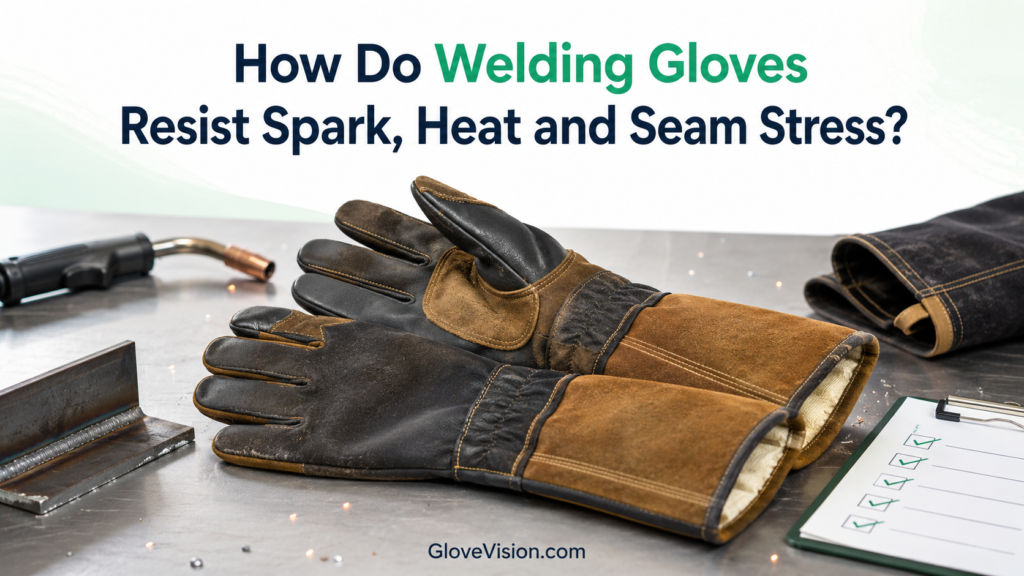
How do welding gloves resist spark, heat and seam stress?
Welding Gloves may resist selected spark, heat, and seam-stress exposure through documented leather or other protective outer materials, heat-resistant stitching, reinforced seams, thermal liners, gauntlet cuffs, and process-matched construction. No material, stitch type, liner, cuff, EN 12477 classification, EN 388 marking, EN 407 marking, Type A/Type B label, or welding-grade wording guarantees protection.
This article covers welding heat and spatter hazards, welding/thermal/mechanical standards, process-specific glove selection, donning and cuff/sleeve alignment, contamination and heat-damage response, and a final thermal, mechanical, fit, and contamination checklist.
This article is educational only. Welding glove suitability must be determined by hazard assessment, manufacturer documentation, current standards, Safety Data Sheets, facility hot-work procedure, welding PPE policy, machine guarding, lockout/tagout, supervisor instruction, exact welding process, amperage, spatter level, heat exposure, dexterity need, glove condition, cuff/sleeve overlap, and facility procedure.
Why do standard Welding Gloves use documented leather, stitching, or liners to reduce spark, heat, and seam-stress exposure?
Standard Welding Gloves use documented leather, stitching, liners, or cuff designs to reduce selected spark, heat, and seam-stress exposure when the construction is matched to the welding process and kept within product limits.
Use Work Gloves as the broader category boundary, then narrow the choice to hot-work exposure, welding process, cuff overlap, and facility welding PPE procedure.
What welding hazards can Welding Gloves help address?
Standard Welding Gloves may help reduce selected exposure to sparks, molten spatter, radiant heat, contact heat, rough metal handling, seam stress, abrasion, minor mechanical contact, wrist exposure where cuff coverage is appropriate, and selected UV-related hand exposure when glove coverage is intact. OSHA PPE rules require hazard assessment, PPE selection, proper fit, and defective or damaged PPE to be kept out of use. [OSHA]
What materials may appear in Welding Gloves?
Welding Gloves may use split cowhide, grain leather, goatskin, pigskin, insulated liners, heat-resistant stitching, reinforced palms, reinforced thumb webbing, gauntlet cuffs, and aluminized or reflective backings where documented. No single material or feature should be treated as mandatory for every welding task.
How should leather and stitching be described?
Leather may help resist selected sparks, spatter, abrasion, and heat exposure when documented for the welding process. Heat-resistant stitching may improve seam durability when the glove is designed and tested for hot-work exposure, but fixed-temperature survival needs product documentation.
What should the article avoid saying?
Avoid saying split leather is non-combustible, Welding Gloves prevent burns, aramid stitching always survives extreme heat, one leather type suits every welding process, Type A always means MIG/Stick only, Type B always means TIG only, gloves can safely contact active arcs or molten puddles, or glove standards guarantee protection during misuse.
What is the safe explanation?
Welding Gloves may help reduce selected spark, spatter, heat, seam-stress, and handling exposures when the glove is matched to the welding process, inspected before use, kept uncontaminated, and used within documented limits. Construction hot-work comparisons may also involve Construction Gloves, but welding heat and spatter require process-specific verification.
Table 1. Welding hazards matched to possible glove features, limits, and verification needs.
| Hazard | Possible Glove Feature | Possible Benefit | What It Does Not Prove | Verification Needed |
|---|---|---|---|---|
| Sparks | Leather or documented protective outer shell | May reduce selected spark exposure | Burn prevention or non-combustibility | Product documentation / hot-work procedure |
| Molten spatter | Welding-rated material and cuff coverage | May reduce selected spatter contact | Safe molten-pool contact | EN 12477 / EN 407 / product data |
| Radiant heat | Thermal liner or reflective feature where documented | May reduce selected heat exposure | Universal heat immunity | EN 407 / product data |
| Contact heat | Documented thermal performance | May help during limited contact tasks where rated | Safe handling of hot metal beyond limits | Product thermal data |
| Rough metal handling | Mechanical-rated leather or reinforcement | May reduce selected abrasion exposure | Heat or chemical resistance | EN 388 / product data |
| Seam stress | Heat-resistant stitching and reinforced seams | May reduce selected seam failure risk | Thread survival at fixed temperature | Product seam/stitch documentation |
| Wrist exposure | Gauntlet cuff and sleeve overlap | May reduce exposed gaps | Spark entry prevention in all positions | Facility PPE procedure |
| Dexterity need | Thinner, process-specific design where documented | May improve torch/filler control | High-spatter suitability | Product documentation / process match |
| Oil/fuel contamination | Clean, uncontaminated glove condition | Lower flammable-contamination risk | Reuse after contamination | Hot-work procedure / SDS |
| Rotating machinery nearby | No glove feature alone solves this | Requires guarding/LOTO/site controls | Safe use near moving parts | OSHA/site machine procedure |
Use this matrix to separate selected exposure reduction from unsupported burn-proof, spark-proof, or heat-proof claims.
How do heavy-duty Welding Gloves compare under welding, thermal, and mechanical glove standards?
Heavy-duty Welding Gloves should be compared under welding, thermal, and mechanical glove standards by treating EN 12477, EN 407, and EN 388 as classification references, not guarantees of field protection.
Which standards may apply to Welding Gloves?
Heavy-duty Welding Gloves may reference EN 12477, EN 388, EN 407, manufacturer thermal, mechanical, seam, and material documentation, and facility hot-work PPE requirements. Use the exact standard edition shown on product documentation and current applicable requirements for the market.
How should Type A and Type B be explained?
Type A and Type B should be treated as selection categories, not rigid process rules. SATRA describes Type B as associated with higher dexterity but lower protective properties, while Type A is for more general welding and cutting operations requiring higher protection. [EN 12477]
How should EN 388 be handled?
EN 388 may help classify mechanical properties such as abrasion, blade cut, tear, puncture, and impact where applicable. SATRA describes EN 388 as including physical tests for abrasion, cutting, tearing, and puncture. [EN 388]
How should EN 407 be handled?
EN 407-related thermal classifications may help compare heat-performance areas such as limited flame spread, contact heat, convective heat, radiant heat, and molten-metal splash categories where applicable. SATRA describes EN 407 as assessing protection against thermal risks such as heat and/or fire. [EN 407]
What do standards not prove?
Standards and classifications do not prove thermal immunity, safe active-arc contact, safe molten-pool contact, safe hot-metal handling beyond documented limits, chemical or oil resistance, defect-free condition, safe use after contamination, safe use near rotating machinery, or continued protection after burns, seam splits, stiffness, cracking, or saturation.
What is the safe standard-use rule?
Use standards to narrow selection, then verify the exact Welding Gloves against the welding process, heat level, spatter exposure, dexterity need, mechanical hazard, cuff coverage, contamination risk, and facility PPE procedure.
Table 2. Welding, thermal, mechanical, and facility classifications interpreted as selection references.
| Standard / Classification | What It Helps Compare | What It Does Not Prove | Welding-Task Question | Verification Needed |
|---|---|---|---|---|
| EN 12477 | Welding-glove performance and Type A/Type B context | Burn immunity or universal process suitability | Does the glove match the welding process and protection/dexterity need? | EN 12477 marking / product documentation |
| Type A | Generally higher protection with lower dexterity | Mandatory MIG/Stick-only rule | Is higher protection needed for spatter/heat? | Product data / facility PPE rule |
| Type B | Generally higher dexterity with lower protection | TIG-only guarantee | Is precision more important than heavier protection? | Product data / process exposure |
| EN 407 | Thermal-risk performance areas | Mechanical protection or chemical resistance | What heat, flame, and molten-splash exposures exist? | EN 407 marking / product data |
| EN 388 abrasion | Abrasion performance under defined test conditions | Heat or spatter protection | Is rough metal handling present? | EN 388 marking / product data |
| EN 388 blade cut | Blade-cut test context | Puncture, heat, or spatter protection | Are sharp edges present? | EN 388 marking / task review |
| EN 388 tear | Tear resistance under test conditions | Seam survival after misuse or heat damage | Will gripping/pulling stress the glove? | Product data / seam inspection |
| EN 388 puncture | Puncture test context | Cut resistance or heat protection | Are wire ends, burrs, or sharp points present? | EN 388 marking / task review |
| ANSI/ISEA 105 | Hand-protection classification context | Welding-specific heat or Type A/Type B meaning | Does a U.S. rating appear in product documentation? | ANSI/ISEA / product data |
| Manufacturer data | Product-specific performance | Universal suitability | Does product data match the exact welding task? | Product specification |
| Facility PPE rule | Local approval | Public universal standard | Is this glove approved for the facility task? | Hot-work procedure / PPE policy |
Standards narrow selection, but process, heat exposure, spatter level, glove condition, and facility procedure decide suitability.
Which specialized Welding Gloves balance thermal protection with tactile precision for different welding processes?
Specialized Welding Gloves balance thermal protection with tactile precision only when the material, liner, cuff, seam construction, heat exposure, spatter level, and dexterity need match the welding process.
How should goatskin, cowhide, pigskin, and other leathers be described?
Goatskin, cowhide, pigskin, split leather, grain leather, and other hide types may differ in flexibility, surface feel, heat response, abrasion behavior, and durability. Do not say one hide type is always superior for a welding process.
How should liners be described?
Thermal liners may help reduce heat transfer during selected welding or handling tasks within documented limits, but they should not be described as allowing safe hot-metal handling unless product documentation supports that use.
How should aluminized or reflective features be described?
Aluminized or reflective backings may support selected radiant-heat exposure tasks when documented by the manufacturer. They do not automatically prove spatter resistance, contact-heat resistance, dexterity, durability, or safe active-arc use.
How should dexterity trade-offs be explained?
Heavier leather, thicker insulation, and reinforced seams may reduce fine finger feedback. Higher-dexterity Welding Gloves may support precision tasks, but they may provide less protection in high-spatter, high-heat, or high-abrasion conditions. Tool-control comparisons may overlap with Mechanic Gloves.
What is the material selection rule?
Select Welding Gloves based on process, amperage, spatter, heat, dexterity, cuff coverage, seam construction, liner design, mechanical hazards, contamination risk, manufacturer data, and facility procedure. Heavy handling boundaries should be compared with Rigger Gloves.
Table 3. Workflow for matching process, heat/spatter exposure, dexterity, cuff coverage, mechanical hazards, and contamination risk.
| Workflow Step | Verification Question | Safe Action | Documentation Needed |
|---|---|---|---|
| Identify Welding Process | Is the task TIG, MIG/MAG, Stick/SMAW, flux-cored, torch work, cutting, or grinding-adjacent work? | Define the process before choosing the glove | Work procedure / process review |
| Check Heat/Spatter Exposure | Is exposure low, moderate, or high based on the actual process and settings? | Match protection level to exposure | EN 12477 / EN 407 / product data |
| Check Dexterity Need | Does the task require filler rod control, torch control, electrode control, or fine part handling? | Balance dexterity against heat/spatter needs | Product fit/dexterity data |
| Check Cuff Coverage | Is wrist/forearm exposure controlled by glove and sleeve overlap? | Match cuff design to site procedure | Facility PPE policy |
| Check Mechanical Hazards | Are rough metal, burrs, edges, abrasion, or puncture hazards present? | Verify mechanical performance separately | EN 388 / ANSI / product data |
| Check Contamination Risk | Are oil, fuel, solvents, anti-spatter spray, or moisture present? | Use clean, suitable gloves and remove contaminated ones | SDS / hot-work procedure |
| Review Product Documentation | Does the glove’s documented use match the task? | Reject unsupported assumptions | Product specification / care instructions |
| Select Approved Glove | Is the glove approved by facility procedure? | Use documented and approved glove only | Facility hot-work PPE policy |
This workflow keeps glove selection tied to the welding process instead of material or Type A/Type B shorthand.
How should operators don, adjust, and wear protective Welding Gloves to reduce wrist exposure and thermal skin risk?
Operators should don, adjust, and wear protective Welding Gloves by verifying size and condition, avoiding seam stress, aligning cuff and sleeve coverage, keeping hands clean, and replacing gloves when heat, grip, or contamination risks appear.
Step 1: Verify size, fit, and glove condition
Select the best-fitting approved size or model. Before use, check palm condition, seams, cuff, thread damage, burn marks, stiff areas, cracking, holes, thin leather zones, contamination, loose lining, poor finger control, and fingertip slack.
Step 2: Don Welding Gloves without stressing seams
After donning, confirm that fingers are seated correctly, thumb webbing is not overstretched, palm material is not twisted, seams are not under unusual tension, cuff is secure but not restrictive, and torch control remains adequate.
Step 3: Align gauntlet cuff and sleeve coverage
Confirm that cuff coverage and jacket-sleeve overlap follow site hot-work PPE procedure. OSHA welding rules include fire-prevention and protective-clothing requirements tied to welding, cutting, and brazing hazards. [OSHA]
Step 4: Keep hand cleaning setting-specific
Welding tasks may involve sweat, grinding dust, metal dust, oil, grease, anti-spatter spray, fuel, solvents, flux residue, and shop contamination. OSHA’s SDS guidance explains that safety data sheets include chemical hazards, protective measures, and safety precautions. [SDS]
Step 5: Monitor heat, fit, and fatigue during use
Pause or replace gloves if the operator notices heat discomfort, spark entry, spatter damage, seam splitting, thread failure, stiffening, cracking, poor grip, reduced torch control, hand fatigue, wrist exposure, or visible contamination.
Supporting workflow table. This is not a sixth proof asset.
| Workflow Step | What to Check | Safe Action | Safety / Control Outcome |
|---|---|---|---|
| Inspect Glove | Are seams, cuffs, liners, palms, or thread damaged? | Remove damaged glove from service | Lower failure risk |
| Confirm Fit | Does glove fit without excess slack or severe tightness? | Choose best-fitting approved model | Better torch/tool control |
| Don Without Stressing Seams | Is material twisted, overstretched, or forced? | Reseat glove gently | Reduced seam stress |
| Check Cuff/Sleeve Overlap | Is wrist coverage aligned with site PPE procedure? | Adjust glove/jacket system | Reduced exposed gaps |
| Check Contamination | Are oil, fuel, solvent, or anti-spatter residues present? | Remove contaminated gloves from hot work | Reduced fire/skin exposure risk |
| Monitor Heat/Grip | Is heat discomfort, slickness, or control loss present? | Pause and reassess | Better process control |
| Replace If Compromised | Is glove burned, stiff, cracked, split, contaminated, or worn? | Remove and replace | Maintained suitability |
Use this supporting workflow to check condition, fit, seam stress, cuff/sleeve overlap, contamination, heat discomfort, and replacement triggers.
What immediate actions address structural failure, heat damage, or contamination in compromised Welding Gloves?
Immediate actions for compromised Welding Gloves should pause hot work safely, secure the torch or workpiece, move away from the heat or spark zone, remove the damaged glove, check for exposure, and replace it with Welding Gloves documented for the task.
What should happen after seam splitting or thread failure?
If compromised Welding Gloves split, tear, expose the hand, or show thread failure during welding, pause hot work safely, secure the torch or workpiece, move away from the active heat or spark zone, remove the glove carefully, inspect the hand, and replace with documented Welding Gloves.
What should happen after spatter damage or heat singeing?
If Welding Gloves show burn-through, localized charring, stiffening, cracking, hard spots, holes, or heat damage, stop the task safely, remove the glove from service, check for exposure or discomfort, inspect other glove areas, replace the glove, and review process suitability.
What should happen after oil, fuel, or anti-spatter contamination?
If hydraulic oil, fuel, solvents, anti-spatter sprays, petroleum-based lubricants, or other chemicals contaminate Welding Gloves, cease hot-work exposure safely and remove the contaminated gloves. Chemical compatibility boundaries should be compared with Chemical-Resistant Lab Gloves rather than inferred from leather, thread, or liner type. OSHA hot-work PPE guidance notes burn hazards from heat, sparks, slag, and light radiation and states that leather or fire-retardant garments should be free of oil, grease, or solvents. [Hot work]
What should happen after grip loss or poor control?
If Welding Gloves lose grip, become slick, stiff, oversized-feeling, or hard to control, pause work safely, secure the torch, inspect for contamination, stiffness, heat damage, or poor fit, and replace gloves if control is compromised. Wet or solvent boundaries may also need comparison with Cleaning Gloves.
What should happen near rotating equipment?
If welding crew members also work near rotating spindles, lathes, drills, conveyors, rollers, shafts, or moving parts, do not assume Welding Gloves are safe near rotating machinery. OSHA machine-guarding requirements address point of operation, ingoing nip points, rotating parts, flying chips, and sparks. [OSHA]
What wording should be avoided?
Avoid thermal immunity, non-combustible leather, guaranteed burn protection, fixed cuff length, fixed safe heat temperature, fixed moisture timing, vapor-saturated leather assumptions, strict universal bans without site procedure, and safe hot-metal handling without documented rating.
Table 4. Response matrix for seam split, thread failure, burn-through, charring, contamination, grip loss, loose lining, and snag risk.
| Problem | Possible Cause | Immediate Action | Documentation Check | Future Prevention |
|---|---|---|---|---|
| Seam split | Poor fit, heat stress, pulling stress, worn construction | Pause hot work, secure torch/workpiece, remove glove | Product seam construction / fit | Reassess size and glove design |
| Thread failure | Heat exposure, spatter, abrasion, wrong glove | Stop, inspect, replace | Stitching documentation | Select documented hot-work glove |
| Burn-through | Spatter, heat, wrong process match, worn glove | Remove from service immediately | EN 12477 / EN 407 / product data | Match glove to process exposure |
| Local charring | Repeated heat or spark exposure | Stop and inspect all glove zones | Product heat limits | Improve glove/process match |
| Stiffness or cracking | Heat damage, age, drying, contamination | Replace if control or structure is affected | Manufacturer care data | Improve storage/change-out |
| Oil/fuel contamination | Hydraulic oil, fuel, lubricant, solvent residue | Cease hot work and remove glove | SDS / hot-work procedure | Keep gloves uncontaminated |
| Anti-spatter residue | Chemical product contact | Remove if residue compromises safety | SDS / facility rule | Follow approved product use |
| Grip loss | Contamination, stiffening, oversize fit, worn palm | Secure tool/torch and replace if needed | Product grip/task data | Improve fit and task match |
| Loose lining | Wear, heat, moisture, product damage | Remove if control is reduced | Product construction data | Replace earlier |
| Rotating-machinery snag risk | Loose cuff, oversized glove, task change | Follow guarding/LOTO/site procedure | Machine procedure | Change PPE/task controls |
Compromised Welding Gloves need pause, secure, remove, inspect, clean, review, and replace actions.
Which pre-task checklist verifies that alternative Welding Gloves meet facility safety, thermal, and mechanical standards?
A pre-task checklist verifies that alternative Welding Gloves meet facility safety, thermal, and mechanical standards by checking process match, Type A/Type B classification, thermal performance, mechanical performance, seam construction, cuff coverage, fit, contamination, hand cleaning, rotating machinery, and replacement triggers.
Electrical or energized-work boundaries should be handled through Electrician Gloves rather than assumed from welding glove heat or seam protection.
Welding Gloves thermal, spatter, fit, contamination, and mechanical safety checklist
Use a checklist matrix, not a checkbox box. The checklist should connect process match, thermal and mechanical ratings, cuff/sleeve overlap, contamination state, hand cleaning, machinery risk, and replacement triggers.
Table 5. Checklist for process match, Type A/Type B, thermal performance, mechanical performance, seams, cuffs, fit, contamination, and replacement.
| Checklist Category | Core Verification | Tactical Action | Documentation Needed |
|---|---|---|---|
| Process Match | Is the task TIG, MIG/MAG, Stick, flux-cored, torch work, cutting, grinding-adjacent work, or another hot-work activity? | Match glove to process, amperage, spatter, heat, dexterity, and facility procedure | Work procedure / product data |
| Type A / Type B | Does the glove carry EN 12477 Type A or Type B where applicable? | Use Type A/Type B as selection categories, not rigid process rules | EN 12477 / product documentation |
| Thermal Performance | Will sparks, spatter, radiant heat, contact heat, or molten-metal splash be present? | Verify EN 407-related thermal areas or manufacturer heat data | EN 407 / product data |
| Mechanical Performance | Will rough metal, edges, abrasive workpieces, or tool friction be handled? | Review abrasion, blade cut, tear, puncture, and impact where applicable | EN 388 / ANSI / product data |
| Seam / Stitching | Are seams intact and stitching appropriate for hot-work exposure? | Verify construction where heat-resistant seam performance is needed | Product specification |
| Cuff / Sleeve Coverage | Is wrist exposure controlled without open gaps? | Align cuff/sleeve according to facility procedure | Facility PPE procedure |
| Fit / Dexterity | Does glove allow torch, electrode, filler rod, or tool control? | Perform hand-flexion and control checks before hot work | Fit trial / supervisor review |
| Contamination | Are gloves free from oil, fuel, solvents, anti-spatter spray, petroleum residue, heavy moisture, or embedded debris? | Remove contaminated gloves from hot-work use | SDS / hot-work procedure |
| Hand Cleaning | Are hands cleaned and dried before/after glove transitions when required? | Follow contaminant-specific site procedure | Site procedure / SDS |
| Rotating Machinery | Will the operator move near lathes, drills, conveyors, rollers, shafts, or moving equipment? | Follow guarding, lockout, supervision, and entanglement controls | OSHA/site machinery procedure |
| Replacement Trigger | Are seams split, gloves burned through, charred, stiff, cracked, holed, loose-lined, slick, or control-limiting? | Replace before returning to hot work | Product care / facility rule |
The final checklist connects welding process, thermal/mechanical ratings, fit, contamination, machinery boundaries, and facility procedures.
Sources & Evidence Boundaries
This page uses 9 reduced, exact public sources. Manufacturer documentation, care instructions, SDS/manufacturer compatibility data, facility hot-work procedure, and welding PPE policy remain verification requirements inside the article logic, not public source rows.
- SATRA — EN 12477: 2001 + Amendment No. 1: 2005 – Protective Gloves for Welders supports EN 12477 and Type A/Type B welding-glove classification boundaries.
- SATRA — EN 407:2020 – Protective Gloves Against Thermal Risks supports EN 407 thermal-risk classification boundaries.
- SATRA — EN 388: Protective Gloves Against Mechanical Risks supports EN 388 mechanical-risk testing boundaries.
- OSHA — 29 CFR 1910.132 General Requirements for Personal Protective Equipment supports PPE hazard assessment, fit, training, and damaged-PPE boundaries.
- OSHA — 29 CFR 1910.252 General Requirements for Welding, Cutting, and Brazing supports welding, cutting, brazing, fire-prevention, and protective-clothing boundaries.
- OSHA — PPE Selection: Hot Work supports hot-work sparks, slag, burn hazards, and oil/grease/solvent contamination boundaries.
- OSHA — Hazard Communication Standard: Safety Data Sheets supports SDS chemical-hazard and protective-measure boundaries.
- OSHA — 29 CFR 1910.212 General Requirements for All Machines supports machine-guarding boundaries.
Conclusion
Welding Gloves may help reduce selected spark, spatter, heat, abrasion, seam-stress, and handling risks when matched to the welding process and used within documented limits. The key checks are process match, heat and spatter exposure, Type A/Type B boundaries, EN 407 thermal context, EN 388 mechanical context, cuff/sleeve overlap, dexterity, contamination state, and glove condition.
Split leather, grain leather, goatskin, pigskin, aramid stitching, thermal liners, gauntlet cuffs, EN 12477, EN 388, EN 407, Type A, Type B, or welding-grade wording does not guarantee protection. Damaged, burned-through, seam-split, thread-failed, stiff, cracked, contaminated, slick, loose-lined, or task-mismatched gloves need a pause, secure, remove, inspect, review, and replace workflow.
Frequently Asked Questions
Do Welding Gloves prevent burns?
No. Welding Gloves may help reduce selected spark, spatter, heat, and handling exposure when matched to the process, but they do not guarantee burn prevention.
Are Type A Welding Gloves always for MIG or Stick welding?
No. Type A generally prioritizes higher protection with lower dexterity, but it should not be treated as a rigid MIG or Stick rule. Final selection depends on the process, heat, spatter, dexterity, and product documentation.
Are Type B Welding Gloves always for TIG welding?
No. Type B generally prioritizes higher dexterity with lower protective performance, but it should not be treated as a TIG-only guarantee.
Does EN 407 prove Welding Gloves are safe for hot metal handling?
No. EN 407 helps compare thermal-risk performance areas, but safe hot-metal handling depends on the exact glove rating, exposure duration, temperature, task, and manufacturer documentation.
Should contaminated Welding Gloves be used for hot work?
No. Gloves contaminated with oil, fuel, solvents, anti-spatter residue, or heavy moisture should be removed from hot-work use according to facility procedure and manufacturer guidance.
When should Welding Gloves be replaced?
Replace them when seams split, thread fails, burn-through appears, leather chars or cracks, liners loosen, grip drops, contamination occurs, or the glove no longer supports the welding process safely.