
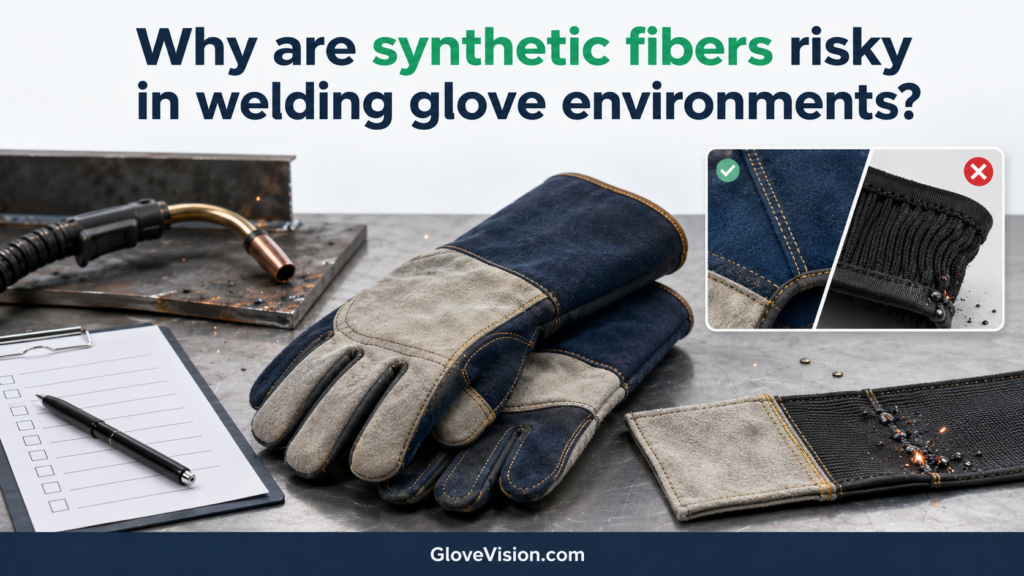
Why are synthetic fibers risky in welding glove environments?
Synthetic fibers are risky in welding glove environments when undocumented or melt-prone materials appear in heat-exposed shell, liner, stitching, cuff, trim, label, elastic, closure, or backing zones. The problem is not the word synthetic alone; it is unverified material behavior under sparks, spatter, flame, radiant heat, or contact heat.
This article covers melt-prone material behavior, welding and thermal classification limits, shell/liner/stitching/cuff/trim verification, sizing and sleeve integration, contamination control, response to melting or burn-through, and a final heat-exposed material safety checklist.
This article is educational only. Welding glove suitability must be determined by hazard assessment, manufacturer documentation, current standards, Safety Data Sheets, facility hot-work procedure, welding PPE policy, machine guarding, lockout/tagout, supervisor instruction, exact welding process, heat exposure, spatter exposure, flame exposure, glove model, material, liner, stitching, cuff, trim, closure, contamination status, glove condition, and facility procedure. [SDS] [OSHA]
Why do standard Welding Gloves avoid undocumented melt-prone synthetic materials in heat-exposed zones?
Standard Welding Gloves avoid undocumented melt-prone synthetic materials in heat-exposed zones because sparks, spatter, flame, radiant heat, or contact heat may cause some materials to soften, shrink, melt, drip, or stick.
Use Work Gloves as the broader category boundary, then narrow selection to welding heat exposure, documented glove components, contamination status, and facility hot-work procedure.
What is the main material concern?
The main concern is not the word synthetic alone. The concern is undocumented melt-prone material in heat-exposed zones of Welding Gloves, such as outer shell, inner liner, sewing thread, cuff, wrist trim, labels, patches, elastic, closures, and exposed backing materials. [CCOHS]
How can melt-prone materials create risk?
Many melt-prone thermoplastic materials can soften, shrink, melt, drip, or stick under welding heat exposure. CCOHS welding PPE guidance warns against synthetic or synthetic-blend clothing because synthetic fabric can burn vigorously, melt, and produce serious skin burns; this is a welding PPE material-risk boundary, not product-specific glove approval.
How should leather, aramid, and heat-resistant materials be described?
Leather, aramid stitching, heat-resistant liners, and documented flame-resistant materials may resist melting better than some thermoplastics, but they can still char, harden, shrink, crack, weaken, or degrade under severe heat, contamination, or prolonged exposure. Do not claim any material is thermally immune.
What should the article avoid saying?
Avoid saying Welding Gloves strictly require only natural leather or aramid, all synthetic fibers are unsafe in every glove location, zero thermoplastic components are always required, leather is non-combustible, aramid survives any heat exposure, exact melting temperatures apply to every synthetic material, avoiding synthetics prevents severe burns, or standards guarantee field protection.
What is the safe explanation?
Welding Gloves should avoid undocumented melt-prone materials in heat-exposed zones. Rough-metal and construction hot-work comparisons can involve Construction Gloves, but welding glove material suitability still requires product documentation, facility PPE requirements, and manufacturer guidance.
Table 1. Heat-exposed glove zones matched to possible melt-prone components, risks, safer verification questions, and documentation needs.
| Glove Zone | Possible Melt-Prone Component | Heat Exposure Risk | Safer Verification Question | Documentation Needed |
|---|---|---|---|---|
| Outer shell | Unknown synthetic coating, synthetic backing, undocumented composite | May soften, shrink, melt, char, or fail under heat | Is the shell documented for welding heat, sparks, spatter, and flame exposure? | Product specification / EN 12477 where relevant |
| Palm | Synthetic grip layer or backing in heat path | May lose grip, melt, harden, or expose hand | Is palm material documented for the welding process? | Product data / facility PPE rule |
| Fingers | Synthetic panels, stretch inserts, undocumented overlays | May melt or shrink near spatter and contact heat | Are all finger-zone materials documented for hot work? | Manufacturer data |
| Seams | Undocumented thread or synthetic reinforcement tape | May shrink, melt, fail, or expose gaps | Is stitching documented as heat-resistant for welding use? | Product seam/stitch documentation |
| Inner liner | Synthetic fleece, polyester blend, acrylic blend, nylon blend, unknown padding | May soften, shrink, melt, or trap heat if exposed through damage | Is the liner documented for the welding task and heat exposure? | Product liner data |
| Cuff | Synthetic cuff trim, backing, elastic, closure material | May melt, drip, or create wrist exposure | Is cuff material documented for the hot-work exposure zone? | Product spec / facility procedure |
| Label / patch | Plastic label, synthetic logo patch, glued panel | May melt or detach if heat-exposed | Is the label/patch outside the heat path or documented for exposure? | Product design documentation |
| Closure | Hook-and-loop, plastic buckle, elastic, snap backing | May melt, deform, or snag if exposed | Is the closure suitable for welding-zone exposure? | Manufacturer guidance |
| Trim / binding | Polyester/nylon edge binding, synthetic piping | May melt, shrink, or expose seams | Is edge trim documented for welding heat exposure? | Product specification |
| Contaminated material | Oil, fuel, solvent, anti-spatter residue, unknown chemical | May increase fire, heat-transfer, or skin-exposure risk | Is glove clean and approved for hot-work use? | SDS / hot-work procedure |
Use this matrix to identify heat-exposed material uncertainty without claiming that every synthetic component is unsafe.
How do Welding Gloves with synthetic components perform under welding, flame, heat, and mechanical classifications?
Welding Gloves with synthetic components should be evaluated under welding, thermal, and mechanical classifications as selection references, not as proof that every hidden liner, trim, or closure component is safe in heat-exposed zones.
How should EN 12477 be handled?
Welding Gloves may reference EN 12477, including EN 12477:2001+A1:2005 where shown on product documentation. SATRA describes Type B as associated with higher dexterity but lower protective properties, while Type A is for more general welding and cutting operations requiring higher protection. [EN 12477]
How should EN 407 be handled?
EN 407-related thermal classifications may help compare thermal-risk performance areas such as limited flame spread, contact heat, convective heat, radiant heat, and molten-metal splash categories where applicable. SATRA describes EN 407 as assessing gloves against thermal risks such as heat and/or fire. [EN 407]
How should EN 388 be handled?
EN 388 may help classify mechanical properties such as abrasion, blade cut, tear, puncture, and impact where applicable. SATRA describes EN 388 as including physical tests for abrasion, cutting, tearing, and puncture. [EN 388]
What do classifications not prove?
Classifications do not prove thermal immunity, safe direct arc contact, safe molten-puddle contact, safe use after oil or fuel contamination, safe use after seam shrinkage, safe use near rotating machinery, defect-free status, or suitability of every hidden liner or trim component.
What is the safe standard-use rule?
Use standards to narrow selection, then verify the exact Welding Gloves against the welding process, heat level, spatter exposure, flame exposure, material documentation, cuff/sleeve coverage, contamination risk, and facility PPE procedure. PPE selection must start with hazard assessment, proper fit, and removal of defective or damaged PPE from use.
Table 2. Welding, thermal, mechanical, PPE, hot-work, and manufacturer classifications interpreted as selection references.
| Standard / Classification | What It Helps Compare | What It Does Not Prove | Material-Safety Question | Verification Needed |
|---|---|---|---|---|
| EN 12477 | Welding-glove performance and Type A/Type B context | Burn immunity, universal process suitability, or hidden trim safety | Does the glove match the welding process and protection/dexterity need? | EN 12477 marking / product documentation |
| Type A | Generally higher protection with lower dexterity | Mandatory MIG/Stick-only rule or synthetic-free construction | Is higher protection needed for spatter/heat? | Product data / facility PPE rule |
| Type B | Generally higher dexterity with lower protection | TIG-only guarantee or heat-proof precision glove | Is precision more important than heavier protection? | Product data / process exposure |
| EN 407 | Thermal-risk performance areas when relevant through EN 12477/product data | Standalone welding-glove suitability or hidden liner safety | Which heat, flame, and molten-splash exposures exist? | EN 407-related data / product data |
| EN 388 abrasion | Abrasion performance under defined test conditions | Heat, flame, spatter, or melting behavior | Is rough metal handling present? | EN 388 marking / product data |
| EN 388 blade cut | Blade-cut test context | Puncture, heat, flame, or spatter protection | Are sharp edges present? | EN 388 marking / task review |
| EN 388 tear | Tear resistance under test conditions | Seam survival after heat damage or liner melting | Will gripping/pulling stress the glove? | Product data / seam inspection |
| EN 388 puncture | Puncture test context | Cut resistance, heat protection, or melt resistance | Are wire ends, burrs, or sharp points present? | EN 388 marking / task review |
| OSHA PPE hazard assessment | Workplace PPE selection and damaged-PPE boundary | Product-specific material suitability | Has the facility identified the heat and material hazard? | Hazard assessment / PPE policy |
| Hot-work procedure | Site-specific welding controls | Public universal glove approval | Does the glove match this hot-work environment? | Facility hot-work procedure |
| Manufacturer data | Exact shell, liner, stitch, cuff, and trim materials | Universal suitability across all welding tasks | Are heat-exposed components documented? | Product specification / care instructions |
Use classifications to narrow selection, then verify every heat-exposed shell, liner, seam, cuff, trim, label, and closure component.
Which structural features in protective Welding Gloves identify risky synthetic materials before work begins?
Protective Welding Gloves identify risky synthetic materials before work begins by checking each heat-exposed shell, liner, stitching, cuff, trim, label, patch, and closure area against manufacturer documentation and facility hot-work requirements.
How should the shell be checked?
Check whether the outer shell is documented for welding heat, sparks, spatter, flame exposure, and mechanical handling. Do not assume the shell is safe only because it looks like leather or feels thick.
How should stitching be checked?
Check whether exposed seams and load-bearing seams use heat-resistant stitching documented for welding use. Use safer wording such as heat-resistant stitching, aramid stitching where documented, manufacturer-documented seam construction, or welding-suitable stitching.
How should liners be checked?
Inner liners should be documented for the welding task and heat exposure. Watch for undocumented or melt-prone liner materials such as synthetic fleece, polyester blends, acrylic blends, nylon blends, unknown padded liners, or undocumented insulation layers.
How should cuff, trim, labels, and closures be checked?
Cuffs, labels, patches, elastic, logo panels, wrist closures, and trim may matter if they are in heat-exposed zones. Avoid melt-prone trim, labels, patches, elastic, or closures in heat-exposed areas unless product documentation supports welding use.
What is the material-verification rule?
Before hot work, verify the heat-exposed shell, palm, fingers, seams, liner, cuff, trim, label, closure, and reinforcements. The goal is not to ban every synthetic component in every location; the goal is to ensure that heat-exposed components are documented for welding conditions. Tool-control and dexterity comparisons may overlap with Mechanic Gloves when the task shifts away from welding heat and toward equipment handling.
Table 3. Workflow for checking shell, palm, fingers, seams, liner, cuff, trim, documentation, and approval.
| Workflow Step | Verification Question | Safe Action | Documentation Needed |
|---|---|---|---|
| Check Shell | Is the outer shell documented for welding heat, sparks, spatter, and mechanical handling? | Reject appearance-only assumptions | Product specification / EN 12477 where relevant |
| Check Palm/Fingers | Are palm and finger materials documented for heat-exposed handling zones? | Verify grip layer, backing, and overlays | Product material data |
| Check Seams | Is stitching documented for welding or heat-exposed use? | Avoid unsupported “pure aramid” claims | Seam/stitch documentation |
| Check Liner | Is the inner liner documented for the welding task and heat exposure? | Avoid undocumented fleece, polyester, acrylic, nylon, or unknown padding in heat-exposed designs | Product liner data |
| Check Cuff/Trim | Are cuff, trim, labels, patches, elastic, logo panels, or closures heat-exposed? | Verify suitability or choose another glove | Product design documentation |
| Check Product Documentation | Does documentation cover all heat-exposed components? | Reject unsupported assumptions | Product spec / care instructions |
| Approve or Replace | Is uncertainty still present? | Replace with documented Welding Gloves | Facility hot-work PPE policy |
This workflow keeps the decision focused on documented heat-exposed components rather than material names alone.
How should operators manage alternative Welding Gloves to reduce synthetic-melting and heat-exposure risk?
Operators should manage alternative Welding Gloves by inspecting heat-exposed components, verifying secure fit, confirming cuff/sleeve overlap, cleaning hands according to procedure, and keeping contaminated gloves out of hot work.
Step 1: Inspect heat-exposed components
Before work, inspect alternative Welding Gloves for shell damage, exposed threads, loose seams, unknown liner material, melt-prone trim in exposed zones, labels or patches near heat exposure, plastic closures near heat exposure, thin leather zones, stiff areas, contamination, embedded spatter, burn marks, cracking, and holes.
Step 2: Verify fit without overstressing the glove
Select gloves that fit securely without excess palm bunching, severe thumb-web tension, restricted circulation, poor finger control, loose cuff behavior, exposed wrist gaps, or overstretched seams. Heavy handling boundaries should be compared with Rigger Gloves rather than inferred from a thick welding glove.
Step 3: Confirm cuff and sleeve overlap
Confirm that cuff coverage and protective clothing overlap follow site hot-work PPE procedure. The goal is to reduce exposed wrist gaps and reduce the chance of sparks, spatter, or hot debris entering the glove or sleeve system.
Step 4: Keep hand cleaning setting-specific
Follow the relevant workplace, fabrication, welding-shop, manufacturing, maintenance, machine-handling, or site hand-cleaning procedure before donning when required and after glove removal. Welding tasks may involve sweat, oil, grease, grinding dust, metal dust, fuel, solvents, anti-spatter spray, flux residue, and shop grime.
Step 5: Keep contaminated gloves out of hot work
Do not use Welding Gloves for hot work if they are contaminated with oil, fuel, solvents, petroleum residue, anti-spatter spray, chemical residue, heavy moisture, or unknown contaminants. OSHA hot-work PPE guidance states that hot work exposes hands to burns and cuts and, in the cited context, requires leather gloves or equivalent free of flammable or combustible materials. [Hot work]
Supporting workflow table. This is not a sixth proof asset.
| Workflow Step | What to Check | Safe Action | Target Outcome |
|---|---|---|---|
| Inspect Materials | Are shell, liner, seams, cuff, trim, labels, or closures damaged or undocumented? | Replace if suitability is uncertain | Reduced hidden material risk |
| Confirm Fit | Does glove fit securely without overstressing seams or exposing wrist gaps? | Choose best-fitting approved glove | Better control and lower seam stress |
| Check Cuff/Sleeve Overlap | Does overlap follow facility hot-work procedure? | Adjust glove/jacket system | Reduced spark/spatter entry risk |
| Clean Hands | Are sweat, oil, solvent, or shop contaminants present? | Clean and dry hands according to site procedure | Reduced transfer and irritation risk |
| Check Contamination | Are gloves contaminated with oil, fuel, solvent, anti-spatter residue, heavy moisture, or unknown material? | Remove from hot-work use | Reduced fire/skin exposure risk |
| Start Hot Work or Replace | Is glove documented, clean, intact, and properly fitted? | Start only if requirements are met | Safer hot-work readiness |
Use this supporting workflow to connect inspection, fit, sleeve overlap, hand cleaning, contamination control, and hot-work readiness.
What immediate protocols address thermal melting, seam damage, or burn-through in compromised Welding Gloves?
Immediate protocols for compromised Welding Gloves should pause hot work safely, secure equipment, move away from heat or spatter, remove the damaged glove carefully, inspect the hand and glove interior, and replace it with Welding Gloves documented for the task.
What should happen after seam melting, shrinkage, or liner damage?
If compromised Welding Gloves show seam shrinkage, melted trim, liner damage, exposed thread failure, or unusual material softening, pause hot work safely, secure the torch or workpiece, step away from the heat or spatter zone, remove the glove carefully, inspect the hand, remove the glove from service, and replace with Welding Gloves documented for the task.
What should happen after spatter burn-through?
If hot spatter burns through the shell, cuff, liner, seam, or trim, stop the task safely, secure hot-work equipment, move away from the hazard, remove the compromised glove carefully, inspect the skin and glove interior, remove the glove from service, and reassess spatter exposure, cuff coverage, process intensity, and product suitability.
What should happen after oil, fuel, or anti-spatter contamination?
If hydraulic oil, fuel, solvents, anti-spatter spray, petroleum-based lubricants, or other chemicals contaminate Welding Gloves, cease hot-work exposure safely, remove the contaminated gloves, reduce skin exposure risk, prevent continued contact, clean hands according to contaminant type and site procedure, and replace or discard according to facility procedure. SDSs include chemical hazards, protective measures, and safety precautions.
Chemical-specific glove selection belongs with Chemical-Resistant Lab Gloves when the task is defined by chemical compatibility rather than welding heat exposure.
What should happen after grip loss or poor control?
If Welding Gloves become slick, stiff, oversized-feeling, heat-damaged, contaminated, or hard to control, pause work safely, secure the torch, electrode holder, filler rod, or tool, inspect the glove, replace if control is compromised, and reassess material, size, cuff, liner, and process match. Wet, solvent, or cleaning-chemical boundaries may need comparison with Cleaning Gloves or Chemical-Resistant Lab Gloves when the task is chemical-specific.
What should happen near rotating machinery?
If operators move from welding into work near rotating spindles, lathes, drills, conveyors, rollers, shafts, or moving parts, do not assume Welding Gloves are safe near rotating machinery. OSHA machine-guarding requirements address hazards including point of operation, ingoing nip points, rotating parts, flying chips, and sparks. [OSHA]
What wording should be avoided?
Avoid zero thermoplastic fibers are always required, pure aramid is always required, leather is non-combustible, synthetics always melt the same way, exact melting temperatures apply universally, avoiding synthetics prevents severe burns, steam burns are automatic, vapor-saturated leather always behaves the same, strict universal bans without site procedure, or standards guarantee field protection.
Table 4. Response workflow for heat damage, equipment security, careful glove removal, skin/interior inspection, removal from service, documentation review, and replacement.
| Response Step | Trigger | Immediate Action | Verification / Follow-Up |
|---|---|---|---|
| Notice Heat Damage | Seam shrinkage, melted trim, liner damage, burn-through, charring, unusual softening | Pause hot work safely | Keep operator away from heat/spatter zone |
| Secure Equipment | Active torch, electrode holder, filler rod, tool, or workpiece | Secure equipment according to procedure | Prevent secondary injury or uncontrolled contact |
| Remove Glove Carefully | Glove is hot, melted, contaminated, or adhered-risk exists | Remove carefully without pulling against adhered material | Follow first-aid/exposure procedure if needed |
| Inspect Skin / Interior | Heat exposure, irritation, adhered material, liner damage, spatter entry | Inspect hand and glove interior | Escalate to first aid if needed |
| Remove from Service | Any melt, burn-through, seam failure, or contamination appears | Do not reuse for hot work | Mark/segregate/dispose according to facility rule |
| Check Documentation | Replacement choice needed | Verify shell, liner, stitching, cuff, trim, and process suitability | Product spec / facility PPE policy |
| Replace with Documented Glove | Task continues | Use Welding Gloves documented for process, heat, spatter, and contamination conditions | Reassess procedure before restarting |
This required flowchart is rendered as a real response workflow table, not a graphic flowchart.
Which pre-task checklist verifies that heat-resistant Welding Gloves avoid undocumented melt-prone materials in heat-exposed zones?
A pre-task checklist verifies that heat-resistant Welding Gloves avoid undocumented melt-prone materials by checking process heat exposure, shell material, stitching, liner, cuff/trim, cuff/sleeve overlap, fit, contamination, hand cleaning, rotating machinery, and replacement triggers.
Electrical or energized-work boundaries should be handled through Electrician Gloves rather than assumed from welding glove heat or synthetic-material documentation.
Welding Gloves heat-exposed material and safety verification checklist
Use a checklist matrix, not a checkbox box. The checklist should verify documented heat-exposed components, contamination status, cuff/sleeve overlap, fit, machinery boundaries, and replacement triggers before hot work begins.
Table 5. Checklist for process heat exposure, shell, stitching, liner, cuff/trim, sleeve overlap, fit, contamination, hand cleaning, machinery, and replacement triggers.
| Checklist Category | Core Verification | Tactical Action | Documentation Needed |
|---|---|---|---|
| Process / Heat Exposure | Will the task involve TIG, MIG/MAG, Stick, flux-cored welding, cutting, grinding-adjacent work, sparks, spatter, radiant heat, contact heat, or molten-metal splash risk? | Match Welding Gloves to process, heat exposure, spatter level, dexterity need, and facility procedure | Work procedure / product data |
| Shell Material | Is glove shell documented for welding heat, spatter, flame exposure, and mechanical handling? | Check specifications and markings; do not rely on appearance alone | Product specification |
| Stitching | Are exposed seams and load-bearing seams documented for welding or heat-exposed use? | Verify heat-resistant stitching, such as aramid stitching where documented | Product seam/stitch data |
| Liner | Is inner liner documented for welding task and heat exposure? | Avoid undocumented synthetic fleece, polyester, acrylic, nylon, or unknown liner materials in heat-exposed designs | Product liner data |
| Cuff / Trim / Label / Closure | Are cuffs, labels, patches, elastic, logo panels, wrist closures, or trim located in heat-exposed areas? | Verify heat-exposed components are documented for welding use or choose a different glove | Product design data |
| Cuff / Sleeve Overlap | Does glove and protective clothing system reduce exposed wrist gaps? | Confirm overlap according to facility hot-work PPE procedure | Facility PPE procedure |
| Fit / Dexterity | Does glove allow torch, electrode, filler rod, or tool control without slack or circulation restriction? | Perform hand-flexion and tool-control checks before hot work | Fit trial / supervisor review |
| Contamination | Are gloves free from oil, fuel, solvents, anti-spatter spray, petroleum residue, chemical contamination, heavy moisture, or embedded debris? | Remove contaminated gloves from hot-work use | SDS / hot-work procedure |
| Hand Cleaning | Are operators following hand-cleaning procedures around glove transitions? | Clean and dry hands according to site procedure and contaminant type | Site procedure / SDS |
| Rotating Machinery | Will operators move near lathes, drills, conveyors, rollers, shafts, spindles, or moving equipment? | Follow guarding, lockout, supervision, and entanglement controls | OSHA/site machinery procedure |
| Replacement Trigger | Do gloves show seam shrinkage, melted trim, burn-through, charring, stiffening, cracking, holes, loose lining, oil contamination, or poor grip? | Remove compromised Welding Gloves from service before returning to hot work | Product care / facility rule |
Use this checklist before hot work to verify documented materials, contamination status, fit, cuff/sleeve overlap, and replacement triggers.
Sources & Evidence Boundaries
This page uses 8 reduced, exact public sources. Manufacturer documentation, care instructions, SDS/manufacturer compatibility data, facility hot-work procedure, and welding PPE policy remain verification requirements inside the article logic, not public source rows.
- CCOHS — Welding – Personal Protective Equipment and Clothing supports welding PPE guidance and the synthetic/synthetic-blend melt and burn-risk boundary.
- SATRA — EN 12477: 2001 + Amendment No. 1: 2005 – Protective Gloves for Welders supports EN 12477 and Type A/Type B welding-glove classification boundaries.
- SATRA — EN 407:2020 – Protective Gloves Against Thermal Risks supports thermal-risk categories used carefully through product or welding-glove documentation.
- SATRA — EN 388: Protective Gloves Against Mechanical Risks supports EN 388 mechanical-risk testing boundaries.
- OSHA — 29 CFR 1910.132 General Requirements for Personal Protective Equipment supports PPE hazard assessment, fit, training, and damaged-PPE boundaries.
- OSHA — PPE Selection: Hot Work supports hot-work sparks, slag, hand protection, and contamination boundaries.
- OSHA — Hazard Communication Standard: Safety Data Sheets supports SDS chemical-hazard and protective-measure boundaries.
- OSHA — 29 CFR 1910.212 General Requirements for All Machines supports machine-guarding boundaries where moving/rotating equipment risk appears.
Conclusion
Synthetic fibers are risky in welding glove environments when melt-prone or undocumented materials appear in heat-exposed zones. The risk is undocumented heat-exposed material, not the word synthetic alone, so shell, liner, stitching, cuff, trim, label, elastic, and closure zones must be verified before hot work.
Melt-prone materials may soften, shrink, melt, drip, or stick, while leather, aramid, and heat-resistant materials can still degrade. EN 12477, EN 407, and EN 388 are classification references, not field guarantees; damaged, melted, contaminated, or structurally compromised Welding Gloves should be removed from hot-work service and replaced according to product documentation and facility procedure.
Frequently Asked Questions
Are all synthetic fibers unsafe in Welding Gloves?
No. The issue is undocumented melt-prone material in heat-exposed zones. Some synthetic or composite materials may be suitable when product documentation supports welding or hot-work use.
Do Welding Gloves need to be only leather or aramid?
No. Welding Gloves do not automatically need to contain only leather or aramid. The key is whether heat-exposed shell, liner, stitching, cuff, trim, and closure components are documented for the welding task.
Can leather Welding Gloves still fail under heat?
Yes. Leather may resist selected welding exposure, but it can still char, harden, shrink, crack, weaken, or degrade under severe heat, contamination, or prolonged exposure.
Does EN 407 prove a Welding Glove is suitable for welding?
No. EN 407 is thermal-risk context and should be used carefully through EN 12477 welding-glove requirements or product documentation. It should not be treated as standalone welding-glove suitability.
Should contaminated Welding Gloves be used for hot work?
No. Gloves contaminated with oil, fuel, solvents, anti-spatter residue, heavy moisture, or unknown chemicals should be removed from hot-work use according to manufacturer and facility procedure.
When should Welding Gloves be removed from service?
Remove them when they show seam shrinkage, melted trim, liner damage, burn-through, charring, stiffness, cracking, holes, loose lining, oil contamination, poor grip, or undocumented heat-exposed materials.