
Where Do Glove Changes Matter Most in Food Prep?
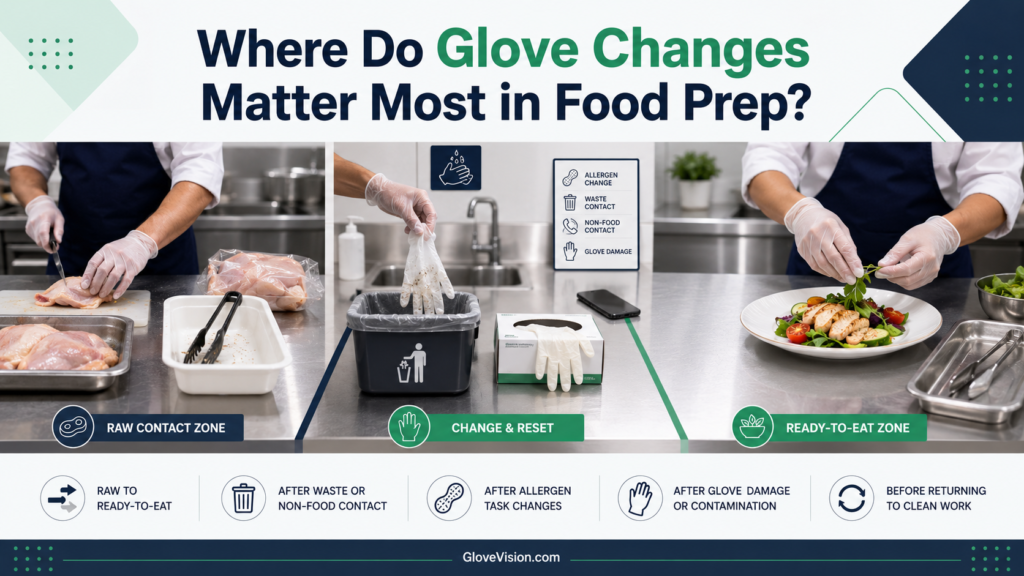
Glove changes matter most when a worker crosses a task, contamination, allergen, non-food-contact, interruption, or glove-integrity boundary. At that point, the current glove pair may no longer match the next task, elapsed time is not the only decision factor, and replacement may need to be paired with handwashing and workstation reset.
This article explains the highest-priority glove-change triggers, how to complete a hygienic replacement, how to reset affected food and surfaces, and how supervisors can confirm readiness before service. Fresh gloves restore only the glove surface; they do not automatically correct earlier contamination.
This article provides educational guidance about glove-change triggers during food preparation. It does not replace local food law, the facility food-safety plan, handwashing requirements, allergen procedures, sanitation controls, exact product documentation, worker training, supervision, machine guarding, or task-specific PPE. Follow the applicable code, manufacturer instructions, and facility procedures for every glove change and workstation reset.
Why Should Glove Changes Follow Task and Contamination Events Instead of a Universal Timer?
Glove changes matter most when the task, food category, contamination status, allergen condition, glove integrity, or workstation context changes—not simply when a fixed period has elapsed.
Food-prep glove replacement belongs inside the broader category of food-handling gloves, but the key decision is operational: has the current pair crossed a boundary that makes it unsuitable for the next action?
Why Should One Glove Pair Remain Assigned to One Controlled Task?
One glove pair should remain assigned to one controlled task because contact with a new food category, surface, allergen, or non-food object can change the glove’s contamination status. FDA describes the Food Code as a model for retail food safety, and its Food Code page identifies the 2022 Food Code as the most recent full edition. [FDA] [FDA 2022]
Why Does Changing Gloves Interrupt Only One Contamination Route?
Removing contaminated gloves removes one potentially contaminated contact surface, but it does not automatically control food, utensils, equipment, allergens, chemicals, or the workstation. A fresh pair should be paired with the hand, tool, food, surface, and station controls required by the event.
How Is Food-Contact Suitability Different From Replacement Timing?
Food-contact suitability determines whether the exact glove may be used for the intended food and conditions, while replacement timing determines whether the current glove pair remains suitable for the next action. Product suitability should be verified separately from broad glove categories and from deeper material comparisons.
When May a Facility-Specific Replacement Interval Be Useful?
A validated facility interval may support long, repetitive, single-task work, but it must remain secondary to immediate event-based triggers. Glove replacement is event-driven first and time-assisted only where a valid facility procedure supports the same controlled task.
Which Food-Task Transitions Require Immediate Glove Replacement?
Fresh gloves should be used before workers move from a contaminated or incompatible task into a clean, ready-to-eat, or otherwise controlled food task, together with the handwashing and workstation controls required by the applicable procedure.
Which Raw-to-Ready-to-Eat Transitions Require Fresh Gloves?
Raw-to-ready-to-eat transitions require removal of the current gloves and completion of the hand, utensil, equipment, and workstation controls required before ready-to-eat handling begins. The Food Code full document is the exact source for provisions involving employee hygiene, handwashing, glove use, ready-to-eat food, and contamination controls. [Food Code]
Which Dirty-to-Clean Transitions Require Fresh Gloves?
Dirty-to-clean transitions require glove replacement before a worker returns from waste, cleaning, dirty equipment, payment handling, deliveries, or another uncontrolled task to controlled food preparation.
Which Production-Stage Transitions Require Glove Reassessment?
Production-stage changes require reassessment whenever the worker moves into a new preparation, plating, packaging, service, or workstation context. The worker should determine whether gloves must be removed, whether hands must be washed, whether food or surfaces were affected, and whether the next task is controlled.
Table 1. A food-prep decision matrix for identifying whether the current glove pair must be replaced and whether food, tools, or surfaces need reset.
| Current Task | Next Task | Main Risk | Glove Action | Handwashing Decision | Food, Tool, or Surface Reset |
|---|---|---|---|---|---|
| Raw animal food | RTE food | Microbial transfer | Discard and replace | Follow applicable procedure | Replace tools and reset station |
| Raw packaging | Clean preparation | Packaging contamination | Replace | Wash where required | Clean affected area |
| Dirty utensils | Clean utensils | Recontamination | Replace | Follow facility rule | Replace or sanitize utensils |
| Cleaning or waste | Food preparation | Dirt, microbes, or chemical residue | Discard immediately | Wash | Reset work area |
| Delivery handling | Controlled preparation | Environmental contamination | Replace | Assess under procedure | Control packaging-contact surfaces |
| Preparation | Final plating | Task-stage contamination | Reassess and replace where required | Assess | Reset tools or surface if needed |
| Workstation departure | Controlled food task | Unknown contact history | Reassess; replace where required | Follow procedure | Recheck station |
| Damaged glove | Any food task | Hand contact or fragments | Stop and discard | Wash | Inspect food and surfaces |
This matrix is event-driven and does not create a universal timer, universal handwashing rule, or material ranking.
Which Allergen and Non-Food Contacts Trigger a Glove Change?
Gloves should be replaced after allergen contact or uncontrolled non-food contact before the worker returns to a controlled food task.
Which Allergen Transitions Require Fresh Gloves?
Fresh gloves should be included wherever required by the facility allergen procedure when workers move between allergen-containing foods, controlled orders, shared equipment, packaging, or cleanup tasks. Glove replacement alone does not prevent allergen cross-contact because utensils, equipment, surfaces, labels, ingredients, and affected food may also need control.
Which Environmental Contacts Contaminate Food Gloves?
Contact with phones, money, payment terminals, hair, clothing, doors, waste, cleaning materials, customer belongings, or dirty controls creates a new glove-change boundary before food handling resumes.
How Should Operational Interruptions Be Handled?
Workers should not automatically resume food handling with the same gloves after an interruption that may have changed glove contact history or hand contamination status. Leaving the workstation, handling a delivery, adjusting clothing, cleaning a spill, taking a break, or temporarily changing duties should trigger reassessment.
How Should Kitchen Staff Complete a Hygienic Glove Change?
A hygienic glove change requires workers to stop the current task, remove the used gloves, wash their hands where required, assess affected food and surfaces, and don fresh gloves only when the next task is ready.
Single-use disposable gloves should not be washed, sanitized for reuse, stored after removal, or carried across incompatible tasks.
What Should Happen Before Gloves Are Removed?
Before removing the gloves, workers should stop the task, secure food and tools, isolate affected items where necessary, and avoid touching additional surfaces. The worker should identify the trigger and avoid “finishing one last action” with a pair that no longer matches the task.
How Should Gloves Be Removed and Discarded?
Gloves should be removed in a way that minimizes contact between contaminated exteriors and clean skin. A practical sequence is to grasp one glove near the wrist, peel it inside out, hold it in the remaining gloved hand, slide clean fingers under the second cuff, peel the second glove over the first, discard both, and avoid touching the contaminated exterior.
When Should Workers Wash Their Hands?
Handwashing should follow the current applicable code and facility procedure rather than one identical rule applied to every glove removal. The relevant trigger may involve beginning a food task, possible hand contamination, raw-food handling, glove failure, dirty or non-food contact, waste, cleaning, restroom use, or return from interruption.
What Must Be Reset Before Fresh Gloves Are Donned?
Fresh gloves should not be donned until affected food, utensils, equipment, surfaces, allergens, chemicals, and possible glove fragments have been assessed and controlled. Possible actions include isolating, replacing, cleaning, sanitizing, relabeling, reprocessing, or discarding according to facility procedure.
How Should Fresh Gloves Be Extracted and Donned?
Fresh gloves should be taken from a clean, protected supply and donned only after the worker’s hands and workstation are ready for the next controlled task. Use hygienic extraction, avoid touching multiple gloves, choose the correct size, inspect the glove, and confirm the next task.
Figure asset. A one-direction workflow showing how to complete a glove change safely after a trigger occurs.
This flowchart includes “do not restart” when food, hand, tool, surface, allergen, chemical, or fragment controls remain unresolved.
What Should Workers Do When Gloves Are Damaged or Become Unsuitable Mid-Task?
Workers should stop immediately when glove damage, contamination, poor fit, discomfort, or loss of control makes the current glove pair unsuitable for safe food handling.
What Should Happen After a Tear, Puncture, or Split?
A tear, puncture, or split requires immediate task stoppage, glove removal, handwashing as required, food and fragment assessment, and workstation reset. Workers should put tools down safely, discard gloves, inspect affected food, check for fragments, assess contamination, replace utensils, clean or sanitize, and restart only when controlled.
What Should Happen When Gloves Become Soiled, Sticky, or Chemically Exposed?
Soiled, sticky, contaminated, or chemically exposed gloves should be removed before food handling continues. The affected food and surfaces should be assessed, and chemical events should follow the relevant SDS and facility procedure rather than a universal glove-service-life rule.
What Should Happen When Fit, Discomfort, or Fatigue Reduces Safe Control?
Poor fit, slipping, discomfort, fatigue, or reduced control should trigger a safe stop and reassessment rather than continued handling. Recurring fit, sweating, pressure, or slippage problems belong in the glove comfort troubleshooter rather than being treated as a universal thickness or material prescription.
When Do Different Hazards Require Different Controls?
Disposable food gloves should be replaced by or combined with different controls when the task involves cuts, heat, chemicals, or machinery hazards outside the glove’s documented role. OSHA requires employers to select appropriate hand protection based on the specific hazards present, and separate work gloves or hazard-specific systems may be needed for non-food-contact hazards. [OSHA]
Machine-related decisions require equipment instructions, guarding, safe operating procedures, and shutdown or lockout steps where applicable; OSHA’s general machine-guarding rule addresses guarding for points of operation and moving parts, so glove changes should not be treated as a machine-safety substitute. [OSHA]
When the task needs a different hazard-control pathway, the glove hazard match tool can route the issue away from routine food-prep replacement timing.
Which Shift-Start Checks Confirm Glove-Change Readiness?
Before food preparation begins, supervisors should confirm that workers understand the station’s glove-change triggers and have the supplies and procedures needed to complete every transition correctly.
Food-contact suitability is a product and use-condition question, not a replacement-timing schedule. FDA’s food-contact-substance information explains the general U.S. framework for substances that come into contact with food, while EU food-contact boundaries rely on the general Regulation (EC) No 1935/2004 framework and the separate plastics measure, Commission Regulation (EU) No 10/2011, where applicable. [FDA] [EU] [EU]
Detailed polymer selection should stay outside this trigger page and move to glove material compare when the reader needs deeper material-side analysis.
Table 2. A station-readiness checklist for confirming workers, supplies, procedures, and reset controls before food preparation starts.
| Check | Verification | Corrective Action |
|---|---|---|
| Station task map | Starting task, next tasks, raw/RTE status, allergens, cleaning duties, and non-food contacts are defined | Mark unclear transitions before service |
| Glove-change triggers | Workers recognize raw/RTE, dirty/clean, allergen, non-food, interruption, damage, and soil triggers | Post station prompts and retrain |
| Product suitability | Exact gloves are documented for intended food and conditions | Do not use undocumented products |
| Replacement supply | Correct sizes and adequate quantities are available in protected locations | Restock before production |
| Handwashing readiness | Water, soap, approved drying, disposal, and required supplies are functional | Do not begin until operational |
| Workstation-reset readiness | Clean utensils, sanitation supplies, isolation containers, allergen materials, and replacement tools are available | Stock the station |
| Doffing and restart knowledge | Workers can stop, secure, remove, wash where required, assess, reset, regloved, and restart | Demonstrate before service |
| Separate hazard controls | Cut, heat, chemical, and machinery controls are available and understood | Do not rely on disposable food gloves |
This checklist is a shift-start screen; it is not proof of complete legal compliance, sanitation validation, allergen-program adequacy, or machine-safety inspection.
Sources & Evidence Boundaries
This page uses 8 public sources. Exact glove specifications, food-contact statements, supplier declarations, station task maps, allergen SOPs, handwashing procedures, sanitation procedures, chemical SDS, machinery instructions, local food codes, training materials, and incident-response procedures remain facility-specific verification requirements.
- FDA — Food Code supports the FDA Food Code model-code context and latest-edition landing page; it does not prove local adoption.
- FDA — Food Code 2022 supports official 2022 Food Code edition information and access context; it does not replace local requirements.
- FDA — Food Code 2022 Full Document supports exact handwashing, ready-to-eat food, glove-use, and contamination-control provisions; it does not approve a specific glove product.
- FDA — Food Packaging and Other Food-Contact Substances supports the U.S. food-contact-substance framework; it does not set glove-change timing.
- EUR-Lex — Regulation (EC) No 1935/2004 supports the general EU framework for food-contact materials and articles; it does not establish replacement intervals.
- EUR-Lex — Commission Regulation (EU) No 10/2011 supports the EU plastics-specific measure and consolidated record context; it does not automatically cover every glove component.
- OSHA — 29 CFR 1910.138 Hand Protection supports hazard-based hand-protection selection boundaries; it does not establish food-contact suitability.
- OSHA — 29 CFR 1910.212 General Machine Guarding supports the machine-guarding boundary for points of operation and moving parts; it does not create a universal glove rule.
Frequently Asked Questions
Should Food Gloves Be Changed on a Fixed Timer?
Not as the primary rule. Replacement should be driven first by task changes, contamination, allergen contact, non-food contact, damage, soil, interruptions, and facility procedures.
Must Gloves Be Changed Between Raw and Ready-to-Eat Food?
Before moving from raw-food contamination sources to ready-to-eat handling, workers should apply the glove, handwashing, utensil, equipment, and workstation controls required by the applicable code and facility procedure.
Should Gloves Be Changed After Touching a Phone or Money?
Yes. Phones, money, and payment equipment create non-food-contact boundaries before controlled food handling resumes.
Should Gloves Be Changed After Leaving the Workstation?
Workers should reassess and normally replace gloves when leaving the station changes or makes the glove-contact history uncertain.
Does Every Glove Change Require Identical Handwashing?
No. Handwashing should follow the applicable code and facility procedure based on the task, contact event, hand contamination status, and reason for glove removal.
Do Fresh Gloves Make Contaminated Food or Surfaces Safe?
No. Fresh gloves restore only the glove surface; food, utensils, equipment, hands, and work surfaces may require separate assessment and control.
Can a Facility Use a Time-Based Replacement Interval?
Yes, where a validated facility procedure supports a repetitive single-task operation, but the interval must never delay replacement after an immediate trigger.
Can Single-Use Gloves Be Washed and Reused?
No. Removed, contaminated, or task-completed single-use gloves should be discarded rather than washed, sanitized, or stored for reuse.
What Should Workers Do After a Glove Tear?
They should stop, discard the gloves, wash hands as required, inspect affected food for contamination or fragments, reset the workstation, and use suitable replacement gloves.
Conclusion
Glove changes matter most when workers cross task, contamination, allergen, non-food-contact, interruption, or glove-integrity boundaries. Replacement should be event-driven first: one pair for one controlled task, with raw-to-ready-to-eat, dirty-to-clean, allergen, non-food, damaged, soiled, chemically exposed, or interrupted work treated as reassessment points.
Fresh gloves restore only the glove surface; they do not independently make contaminated food, hands, utensils, equipment, or work surfaces safe. Safe food-prep glove changes depend on handwashing integration, workstation reset, suitable replacement supplies, worker training, supervision, and facility procedures.