
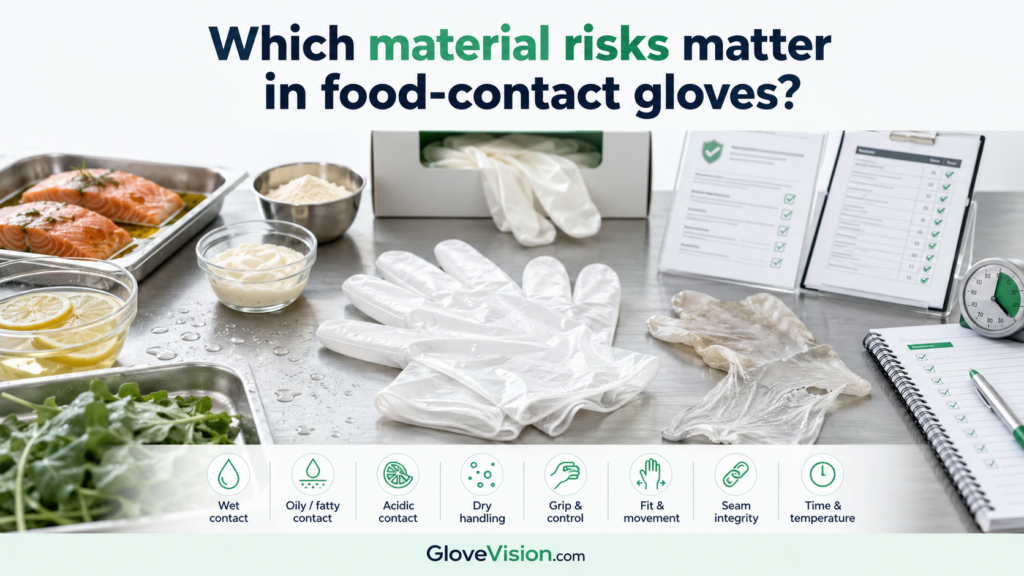
Which material risks matter in food-contact gloves?
The material risks that matter most in food-contact gloves are formulation uncertainty, incomplete documentation, incompatible food-contact conditions, physical task mismatch, and degradation during use. A polymer name alone does not establish food compatibility, migration performance, temperature suitability, contact-duration suitability, fit, grip, durability, or separate hazard protection.
This article explains how to verify the exact glove product, match it to food and contact conditions, assess physical task compatibility, monitor degradation, and apply corrective controls when the glove becomes unsuitable.
This article provides educational guidance about food-contact glove formulation, documentation, task compatibility, degradation, and corrective controls. It does not replace local food law, formal food-contact compliance review, exact supplier documentation, migration testing, the facility food-safety plan, handwashing requirements, allergen procedures, worker training, medical evaluation, machine guarding, or task-specific cut, heat, and chemical protection. Verify the exact finished glove, intended food, temperature, duration, task, jurisdiction, and product restrictions before use.
What Material Risks Should Operators Evaluate Before Using Food-Contact Gloves?
The material risks that matter most are formulation uncertainty, undocumented food-contact conditions, physical incompatibility, degradation during use, and a mismatch between the glove and the actual preparation task.
Food-contact review starts with the exact finished product used in a food station, not a broad category label. The general food-handling gloves context defines the use environment, while FDA food-contact information explains that substances contacting food are evaluated through specific regulatory pathways and conditions rather than informal claims. [FDA]
How Can Formulations and Additives Affect Suitability?
Finished gloves may contain polymers, plasticizers, stabilizers, pigments, processing aids, curing agents, accelerators, coatings, and surface treatments that must be evaluated within the exact formulation and use conditions. Additive presence alone does not prove harmful migration; the relevant questions are the exact substance, concentration, finished formulation, food type, fat or oil content, temperature, duration, surface-area relationship, restrictions, and test documentation.
Why Does Material Name Alone Provide Insufficient Evidence?
A nitrile, vinyl, polyethylene, latex, or other material label does not identify the complete formulation, construction, documentation, or conditions of use. Products in one material category can differ by formulation, thickness, texture, fit, elasticity, cuff design, seam design, manufacturing quality, intended use, food-contact basis, and limitations; use Glove Material Compare for broad category comparison, not final product approval.
How Can Physical Construction Create Material-Related Risks?
Physical construction can make a chemically documented glove unsuitable when weak areas, poor fit, low grip, restricted movement, or inadequate integrity interfere with the task. Thin or inconsistent areas, weak seams, fingertip slack, thumb misalignment, inadequate recovery, premature tearing, and fragment shedding are product and task questions, not automatic conclusions about a polymer family.
Why Must Chemical and Physical Risks Be Evaluated Together?
A glove must be both documented for the intended food-contact conditions and physically capable of completing the task safely. A product can be chemically suitable but physically unsuitable for a wet, repetitive, high-stress task, while another can feel durable but remain undocumented for the food, temperature, duration, or jurisdiction.
Product approval requires both food-contact evidence and acceptable physical task performance.
How Should Operators Verify Documentation for the Exact Glove Product?
Operators should verify the exact finished glove through supplier and manufacturer documentation rather than relying on material names, packaging claims, or broad food-grade language.
The product record should identify the manufacturer, product name, product code, material description, size, lot or traceability information where relevant, supplier documents, intended conditions, and restrictions. FDA explains that food-contact substances can be regulated through different pathways, so the document must identify the actual basis being relied on. [FDA FCS]
Which Documents May Support Food-Contact Suitability?
The required evidence depends on the jurisdiction and construction, but it may include product specifications, supplier statements, test reports, regulatory references, declarations, and conditions-of-use documents. A useful file also includes the technical data sheet, restricted-substance information, identified authorization, intended-use instructions, and any food, temperature, duration, or formulation restrictions.
How Should United States Food-Contact Documentation Be Evaluated?
U.S. documentation should identify the exact regulatory basis and show how it applies to the finished product, relevant components, food types, temperature, duration, and restrictions. Do not assign one FDA provision automatically to nitrile, vinyl, polyethylene, latex, or another polymer family; use exact provisions, notifications, authorizations, exemptions, or product evidence where applicable, and verify references through official CFR resources. [CFR]
How Should European Food-Contact Documentation Be Evaluated?
Where European plastics requirements apply, operators should verify the product’s scope, Declaration of Compliance, migration evidence, food-simulant conditions, temperature, duration, and substance restrictions. Regulation (EC) No 1935/2004 is the general EU food-contact framework, and Commission Regulation (EU) No 10/2011 provides specific rules for covered plastic materials and articles; neither should be stretched beyond its scope. [EU] [EU Plastics]
Which Marketing Claims Are Insufficient by Themselves?
Broad labels such as food grade, FDA compliant, EU compliant, phthalate-free, BPA-free, non-toxic, medical grade, powder-free, or premium nitrile do not independently prove complete suitability. They may describe one useful attribute, but exact conditions still matter: finished formulation, documented food type, temperature, duration, jurisdiction, restrictions, and physical task performance.
Figure asset. This verification workflow converts product identity and document scope into an approval, restriction, clarification, or rejection decision.
If the exact product is not identifiable, documentation is incomplete, actual food and conditions are not covered, or physical demands are incompatible, do not approve the glove for the intended task until the gap is resolved.
How Should Food and Contact Conditions Be Matched to Documented Glove Limits?
A glove should be used only when its documented food categories, temperature range, contact duration, and conditions of use match the actual preparation task.
Condition matching prevents a limited product statement from being stretched into every food, temperature, and handling scenario. A documented claim for brief room-temperature contact, for example, should not be converted into support for hot, oily, extended, or high-pressure handling unless the document actually covers those conditions.
Which Food Characteristics Should Be Checked?
Food compatibility should be verified for the actual food category rather than inferred from the polymer name. Check dry, aqueous, acidic, fatty or oily, dairy, raw animal food, sauces, marinades, alcohol-containing food, and mixed foods where those categories affect the product’s documented scope.
How Should Temperature Be Evaluated?
Temperature suitability should be based on the exact product’s documented contact conditions. Distinguish refrigerated contact, frozen contact, room-temperature contact, warm food, hot food, steam, heated oil, and hot trays or equipment; food-contact temperature scope does not establish thermal PPE protection.
How Should Contact Duration Be Evaluated?
Contact duration should be matched to the documented use condition without converting a test duration into a universal glove-wear schedule. Brief pickup, short preparation, repetitive single-task work, extended direct contact, repeated contact, and intermittent contact should be evaluated separately from task-change, contamination, damage, soil, and interruption triggers.
How Should Exposed Surface and Task Stress Be Considered?
Product suitability should also account for the amount of glove surface exposed and the mechanical stress created by the task. Surface area, pressure, repetitive flexion, stretching, pulling, twisting, wet or oily grip, sharp package edges, manual mixing, lifting, and tool use can make a documented glove physically unsuitable for a demanding station.
Which Product Specifications Should Be Checked for Physical Task Compatibility?
Physical task compatibility should be based on the exact glove’s specifications and performance under representative conditions—not on assumed characteristics of its polymer category.
Specifications should be read together with a safe station trial. If the product does not fit the worker, grip the actual tools, tolerate normal movement, or maintain seam and surface integrity, another documented product, tool, or process may be needed through the Glove Recommendation Engine or the facility’s procurement process.
How Should Thickness Be Evaluated?
Thickness is one construction variable that may affect flexibility, tactile control, durability, stretching, donning, and hand effort, but it does not determine performance alone. Thicker does not automatically mean stronger, thinner does not automatically mean suitable, thickness can vary within a glove, same-material products may differ, and formulation and design matter.
How Should Fit and Movement Be Evaluated?
Fit should allow full finger, thumb, and palm movement without excessive slack, pressure, slipping, or tension. Check finger length, fingertip slack, palm width, thumb alignment, web-space tension, cuff stability, full flexion, and full hand opening and closing; use the Glove Size Translator only to interpret sizing systems, not to replace an on-hand task trial.
How Should Grip and Surface Performance Be Evaluated?
Grip should be assessed under safe conditions representative of the actual dry, wet, oily, sauced, packaging, container, utensil, and repetitive-handling tasks. Do not assume dry grip predicts wet or oily grip, and do not treat texture as proof unless it works under the real task conditions.
How Should Puncture, Tear, and Seam Performance Be Evaluated?
Puncture, tear, and seam performance should be evaluated from exact product data, applicable standards, supplier specifications, and representative task assessment. Do not publish universal polymer-category values or compare results from different test methods as if they were directly equivalent.
Table asset. This matrix screens documentation, food-contact limits, and physical task demands without ranking materials universally.
| Risk Question | Documentation Needed | Intended Food or Condition | Physical Task Demand | Warning Sign | Corrective Control |
|---|---|---|---|---|---|
| Is formulation scope clear? | Product specification and restrictions | All intended foods | Normal use | Unclear additives or limits | Request evidence or reject |
| Is food type covered? | Food-contact statement or test scope | Dry, acidic, fatty, etc. | Direct contact | Food not listed | Use another documented product |
| Is temperature covered? | Conditions-of-use statement | Cold, room, warm | Exposure condition | Temperature outside scope | Restrict use |
| Is duration covered? | Test and use documentation | Brief, repeated, extended | Time under contact | Duration exceeds scope | Shorten use or replace product |
| Is thickness appropriate? | Product specification | Intended food | Flexion and stress | Tearing or poor control | Select another product |
| Does fit support the task? | Size chart and trial | Any food | Precision and movement | Slack, tension, slipping | Change size or design |
| Does grip match conditions? | Product data and safe trial | Wet, oily, dry | Container or utensil control | Slipping | Use another glove or tool |
| Is seam or surface integrity adequate? | Test data and inspection | Actual contact condition | Pulling, twisting, mixing | Split, puncture, fragments | Stop and replace |
| Is degradation occurring? | Product limits and exposure review | Actual food and temperature | Continued use | Swelling, tackiness, stiffness | Stop and reassess |
| Is another hazard present? | Hazard assessment | Task-specific | Cut, heat, chemical, machine | Glove used outside role | Use separate control |
Use approve, restrict, request clarification, or reject decisions. Do not create fake material-risk scores, fake compliance badges, or universal thickness rankings.
How Should Food-Contact Gloves Be Used Within Their Documented Limits?
Food-contact gloves should be stored, selected, donned, used, monitored, and replaced in ways that preserve their documented suitability and physical integrity.
The exact product can lose suitability through poor storage, contaminated extraction, use outside documented food or temperature conditions, uncontrolled task changes, or continued use after damage. Single-use disposable gloves should not be washed, reused, stored after removal, or carried across incompatible tasks.
How Should Glove Supplies Be Stored and Protected?
Glove supplies should remain protected from contamination, heat, sunlight, moisture, chemicals, waste, and damaged packaging. Keep dispensers away from raw-food splash, chemicals, waste, floors, dirty surfaces, excessive heat, direct sunlight, moisture, and compromised packaging, and replace supplies when the box or product identity is no longer controlled.
How Should Gloves Be Extracted and Donned Hygienically?
Workers should wash and dry their hands as required, select the correct product and size, inspect the glove, and remove it from a protected supply without contaminating unused gloves. Use “hygienic” handling language rather than “aseptic” language for ordinary food-preparation glove extraction.
How Should Workers Control the Glove During Use?
Workers should keep one glove pair within one controlled task and remain inside the documented food, temperature, duration, and physical-use conditions. Monitor fit, grip, surface condition, seam integrity, stretching, softening, swelling, and task control while avoiding washing or reuse of single-use gloves.
When Should Food-Contact Gloves Be Replaced?
Food-contact gloves should be replaced after task change, contamination, soil, damage, chemical exposure, degradation, loss of fit, loss of grip, or another documented replacement trigger. Include tears, punctures, seam failure, softening, tackiness, swelling, stiffening, shape loss, fragment concerns, interruptions where required, product limits, and validated facility limits; do not use one universal fixed timer.
How Should Handwashing Be Integrated?
Handwashing should follow the applicable food code and facility procedure based on the task, contact event, hand contamination status, and reason for glove removal. The Food Code full document is the exact source for provisions involving employee hygiene, handwashing, glove use, ready-to-eat handling, and contamination controls in the model code. [Food Code]
What Should Workers Do When Food-Contact Gloves Are Damaged or Become Unsuitable?
Workers should stop using a glove immediately when damage, degradation, contamination, or loss of control makes its barrier or task performance unreliable.
The response should protect food, hands, utensils, surfaces, and the next task. Continuing with a torn, swollen, tacky, stiff, slipping, or fragment-shedding glove can turn a product limitation into a food-contact and workstation-control problem.
What Should Happen After a Tear, Puncture, or Seam Split?
A tear, puncture, or seam split requires immediate task stoppage, glove removal, food and fragment assessment, workstation control, and selection of a suitable replacement. Stop the task, secure tools and containers, discard the glove, wash hands according to procedure, isolate affected food, check for fragments and contamination, assess utensils and surfaces, complete required cleaning or disposition, and restart only after controls are restored.
What Should Happen if the Glove Softens, Swells, Becomes Tacky, or Loses Shape?
Softening, swelling, tackiness, or loss of shape may indicate that the glove is incompatible with the exposure or has been used outside its documented conditions. Stop, remove the glove, isolate food where needed, assess surfaces, review product limits, identify the exposure, and select a documented replacement product, handling tool, or process without prescribing nitrile or one thickness universally.
What Should Happen if the Glove Stiffens, Slips, or Loses Task Control?
Stiffening, internal slipping, poor grip, or loss of movement means the current glove-task match should be reassessed before work continues. Assess size, fit, grip, temperature, task demand, product condition, and whether another tool, container, station adjustment, or process is needed.
How Should Affected Food Be Handled?
Affected food should be isolated and assessed under the facility procedure whenever contamination, fragments, chemical exposure, or process-control loss is suspected. Do not release food merely because no visible defect is seen, and do not prescribe one universal disposal or reprocessing method for every exposure.
Which Hazards Require Different Controls?
Food-contact gloves do not automatically provide cut, puncture, heat, chemical, or machinery protection. General work gloves and the Glove Hazard Match tool belong to separate hazard selection; OSHA requires appropriate hand protection when employees’ hands face recognized hazards, and machine guarding must be addressed separately where moving parts create hazards. [OSHA] [Machine Guarding]
Table asset. This matrix converts observable material degradation into a stop, isolate, assess, replace, and restart decision.
| Warning Sign | Possible Concern | Immediate Action | Food/Surface Decision | Replacement Control | Restart Condition |
|---|---|---|---|---|---|
| Tear or puncture | Barrier failure or fragments | Stop and discard | Isolate and inspect | Suitable replacement glove | Contamination and fragments controlled |
| Seam split | Construction failure | Stop and remove | Assess contacted food and surfaces | Different product or size | Seam issue resolved |
| Swelling | Exposure incompatibility | Stop and discard | Isolate affected food | Product documented for exposure | Compatibility confirmed |
| Tackiness | Surface or formulation interaction | Stop handling | Assess food and tools | Different product or process | Stable surface performance |
| Softening | Heat or chemical interaction | Stop | Isolate and review exposure | Correct glove, tool, or PPE | Documented control available |
| Stiffening | Material change or low-temperature effect | Stop and reassess | Assess task control | Different product or condition | Movement restored |
| Loss of shape | Structural degradation | Remove | Assess food and surfaces | Replacement product | Stable fit confirmed |
| Slipping or grip loss | Task incompatibility | Secure object and stop | Assess affected food | Different glove, tool, or container | Representative control check passes |
| Fragment concern | Physical contamination | Stop and isolate | Inspect and follow procedure | Replacement product | Fragment control complete |
Restart only after contamination, fragments, product limits, affected food, surfaces, and replacement controls have been resolved under facility procedure.
Which Shift-Start Checks Confirm Food-Contact Glove Material Suitability?
Before food handling begins, supervisors should verify that the exact glove product is documented for the intended food and conditions and that workers can recognize when it becomes unsuitable.
Checklist asset. This pre-shift screen confirms exact product identity, documentation, food and condition match, physical compatibility, degradation recognition, and separate hazard controls.
| Check | Verification | Corrective Action |
|---|---|---|
| Exact product identification | Manufacturer, product name, product code, material, size, and traceability are recorded | Do not rely on a generic material description |
| Compliance documentation | Applicable statements, specifications, tests, declarations, authorizations, and conditions are available | Do not use undocumented gloves |
| Intended food types | Actual dry, aqueous, acidic, fatty, dairy, raw, sauced, or alcohol-containing foods are covered | Use another documented product or control |
| Temperature and duration | Actual temperature, duration, repeated-contact status, and restrictions are covered | Do not exceed documented conditions |
| Formulation restrictions | Additives, plasticizers, latex, accelerators, pigments, coatings, and other limits are reviewed where relevant | Do not treat one marketing claim as complete evidence |
| Physical task compatibility | Size, fit, movement, grip, flexibility, thickness, seam integrity, dexterity, and control are acceptable | Test another product, tool, or process |
| Degradation recognition | Workers recognize tears, swelling, tackiness, softening, stiffening, shape loss, slipping, and fragments | Stop and follow corrective response |
| Replacement triggers | Task change, contamination, soil, damage, degradation, chemical exposure, control loss, and documented limits are understood | Do not rely on one universal timer |
| Workstation-reset readiness | Replacement gloves, clean utensils, sanitation supplies, isolation containers, waste receptacles, and procedures are available | Stock the station |
| Separate hazard controls | Cut, heat, chemical, and machinery controls are available and understood | Do not rely on food-contact gloves outside their role |
This checklist is a pre-shift operational screen. It is not complete regulatory approval, migration testing, formal toxicological assessment, complete chemical-resistance evaluation, a medical assessment, a machinery inspection, or a substitute for supplier documentation or supervision.
- FDA — Food Packaging and Other Food-Contact Substances
- FDA — Understanding How FDA Regulates Food-Contact Substances
- FDA — CFR Title 21 Search
- EUR-Lex — Regulation (EC) No 1935/2004
- EUR-Lex — Commission Regulation (EU) No 10/2011
- FDA — Food Code 2022 Full Document
- OSHA — 29 CFR 1910.138 Hand Protection
- OSHA — 29 CFR 1910.212 General Machine Guarding
Frequently Asked Questions
Is Nitrile Automatically Suitable for Food Contact?
No. Nitrile identifies a broad material category, while suitability depends on the exact formulation, food type, temperature, duration, task, jurisdiction, and product documentation.
Are All Vinyl Gloves Unsafe for Fatty Foods?
No. Suitability must be determined from the exact formulation, documentation, migration conditions, and intended food-contact use rather than from the vinyl label alone.
Does Phthalate-Free Mean a Glove Is Suitable for Every Food?
No. Phthalate-free addresses a limited formulation claim and does not prove suitability for every food, temperature, duration, or jurisdiction.
Does FDA Compliant Prove That a Glove Is Suitable for the Intended Task?
No. The supplier should identify the exact regulatory basis and show that it covers the finished product, intended food, conditions of use, and applicable restrictions.
Does a Declaration of Compliance Apply to Every Food-Contact Glove?
No. Its requirement and scope depend on the applicable legal measure, material, product construction, jurisdiction, and supply-chain role.
Are Thicker Food Gloves Always Stronger?
No. Thickness is only one variable, and strength also depends on formulation, geometry, design, manufacturing consistency, test method, and task conditions.
What Does It Mean When a Glove Swells or Becomes Tacky?
Swelling or tackiness may indicate incompatibility, exposure outside documented conditions, heat effects, chemical interaction, or loss of physical integrity.
Can a Food-Contact Glove Be Chemically Suitable but Physically Unsuitable?
Yes. A glove may be documented for the intended food while lacking the fit, grip, flexibility, seam integrity, or durability required by the task.
When Should a Damaged Food-Contact Glove Be Replaced?
It should be replaced immediately when tearing, puncture, seam failure, degradation, contamination, fragment concerns, or loss of safe control makes continued use unreliable.
Conclusion
The material risks that matter in food-contact gloves cannot be determined from nitrile, vinyl, polyethylene, latex, food grade, phthalate-free, or premium labels alone. They must be evaluated through the exact finished product, formulation, additives, documentation, jurisdiction, food type, temperature, duration, thickness, fit, grip, seam integrity, degradation signs, replacement triggers, corrective response, and separate hazard controls.
Safe selection depends on both documented food-contact compatibility and acceptable physical performance under the actual conditions of use. When either evidence set is incomplete, the safer decision is to approve with restrictions, request clarification, reject the product, or choose a documented replacement glove, tool, PPE system, or workstation control.