
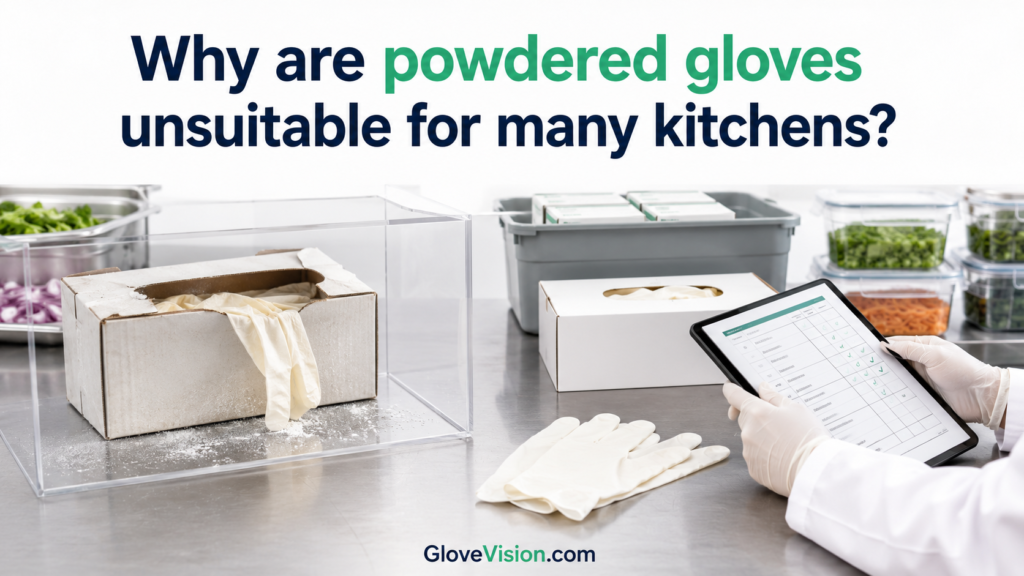
Why are powdered gloves unsuitable for many kitchens?
Powdered gloves may be unsuitable for many kitchens because released powder can create avoidable particulate residue, powdered natural-rubber-latex products can increase latex-protein exposure, and powder status does not prove that the glove is suitable for the intended food or task. Those concerns also connect to housekeeping, purchasing control, and the exact product documentation available to the kitchen.
This article explains how powdered gloves are identified, how powder may transfer, what medical and food-contact rules establish, how powder-free replacements should be approved, and how kitchens should manage stock and accidental use. It keeps product, worker, food, task, facility, and jurisdiction differences separate so managers do not turn one rule or one glove label into a universal conclusion.
This article provides educational guidance about powdered gloves, powder residue, natural-rubber-latex exposure, food-contact documentation, replacement selection, inventory control, and accidental-use response. It does not replace local food law, medical evaluation, occupational-health procedures, exact supplier documentation, the facility food-safety plan, allergen procedures, sanitation controls, worker training, machine guarding, or task-specific cut, heat, and chemical protection. Verify the exact glove product, powder status, latex status, intended food, conditions of use, worker needs, and applicable requirements before approval.
Why Can Powdered Gloves Be Unsuitable for Many Kitchens?
Powdered gloves may be unsuitable for many kitchens because released powder can create avoidable particulate residue, powdered natural-rubber-latex products can increase latex-protein exposure, and powder status alone does not prove that the finished glove is appropriate for the intended food or task.
This topic sits inside the broader decision space for food-handling gloves, but it has its own operational question: does the powder, latex status, documentation, performance, or procurement control make the exact glove product unsuitable for this kitchen?
What Are Powdered Gloves?
Powdered gloves contain intentionally added donning powder or another particulate material intended to make them easier to put on or remove. Products may differ by base material, powder composition, powder quantity, latex status, additives, surface treatment, intended use, documentation, and conditions of use, so the label “powdered” is only the starting point.
Why Was Powder Historically Added to Gloves?
Donning powder was historically added to some glove products to reduce friction during donning and removal. Many modern powder-free products use chlorination, polymer coatings, internal surface treatments, or other manufacturing methods instead; this does not mean every kitchen historically used powdered latex gloves.
Why Does the H1 Say “Many Kitchens” Rather Than “All Kitchens”?
Suitability depends on the exact product, powder and latex status, food-contact documentation, worker needs, facility policy, jurisdiction, food conditions, task demands, and housekeeping controls. A careful article should not call every powdered product automatically illegal, but many commercial kitchens choose to exclude them because the residue, documentation, and substitution risks are avoidable.
Which Decision Areas Matter Most?
Five decision areas determine whether powdered gloves should be excluded, restricted, or replaced: powder release and residue, natural-rubber-latex-specific exposure, food-contact documentation, task performance, and housekeeping or procurement control. Powdered-glove suitability is a product- and context-specific operational decision, not one universal legal conclusion.
How Can Powder From Gloves Transfer Through Food-Preparation Areas?
Powder released while gloves are extracted, donned, adjusted, used, or removed may settle on hands, clothing, utensils, equipment, packaging, food-contact surfaces, or exposed food.
When May Glove Powder Be Released?
Powder may be released when glove packaging is opened or when gloves are extracted, stretched, adjusted, removed, or handled as old or damaged stock. The responsible wording is conditional: release depends on the product, storage condition, handling method, and whether loose residue is present.
Where May Powder Settle or Transfer?
Powder may settle on hands, clothing, counters, cutting boards, utensils, controls, shelves, packaging, plating areas, or open ingredients. The response should focus on the actual location, recent tasks, product identity, direct contact, and facility procedure rather than assuming every use creates widespread residue.
Why Is Glove Powder Primarily a Particulate and Housekeeping Concern?
Powder residue can create an avoidable foreign-residue and housekeeping concern because it may require assessment, cleaning, isolation, or product decisions. It can reappear from stored boxes, move through contact, conflict with a facility powder-free policy, and complicate cleaning even when no direct food impact is confirmed.
Does Glove Powder Automatically Carry Foodborne Pathogens?
No. Glove powder is not automatically a pathogen source, although it may become another contact-transfer route after touching contaminated hands, food, tools, equipment, or surfaces. Specific pathogen-transfer claims require direct evidence in the food environment being discussed.
How Should Unexplained White Residue Be Investigated?
White residue should be investigated before it is attributed to glove powder because flour, sugar, food starch, cleaning products, packaging, and other materials may appear similar. Staff should check recent tasks, glove identity, residue location, direct food contact, tools, surfaces, and the applicable procedure.
Table 1. This matrix helps kitchens identify powder-related observations and choose an immediate response without making a universal legal or food-disposal conclusion.
| Observation or Trigger | What Must Be Verified | Possible Concern | Immediate Action | Food or Surface Decision |
|---|---|---|---|---|
| Powdered glove discovered | Product name, code, powder status, latex status | Unapproved product use | Stop and quarantine | Assess affected food and surfaces |
| Residue near glove station | Residue source and recent tasks | Particulate transfer | Stop and investigate | Clean or isolate under procedure |
| Powdered glove touched food | Direct contact, food type, latex status | Foreign residue or product-specific exposure | Isolate food | Discard or reprocess under procedure |
| Powdered box found in storage | Inventory source and approval status | Reintroduction risk | Quarantine and document | No food action unless use occurred |
| Worker reports symptoms | Product composition and exposure history | Possible irritation or allergy | Stop exposure and report | Follow workplace health procedure |
The matrix does not assign a fake powder-risk score, an automatic pathogen claim, or a universal disposal rule.
When Do Powdered Natural-Rubber-Latex Gloves Create Additional Worker-Health Concerns?
Powdered natural-rubber-latex gloves create an additional concern because natural-rubber-latex proteins may attach to donning powder and become airborne or settle on nearby surfaces when the gloves are handled. NIOSH describes latex allergy prevention in the workplace and explains that latex proteins can become attached to glove powder when powdered latex gloves are worn. [NIOSH]
Why Must Powdered Latex and Powdered Synthetic Gloves Be Distinguished?
Powdered latex and powdered synthetic gloves do not create identical exposure concerns because only products containing natural rubber latex provide the latex-protein pathway. Synthetic gloves can still contain other additives, and a powder-free claim does not mean latex-free status or freedom from every sensitizer.
How May Latex-Protein Exposure Occur?
Natural-rubber-latex proteins may attach to donning powder and become airborne or settle nearby when powdered latex gloves are donned, adjusted, or removed. The article should not imply one exposure level for every event, because product composition, use pattern, room conditions, and worker sensitivity differ.
How Do Irritation, Chemical Sensitivity, and Latex Allergy Differ?
Glove-related skin or respiratory symptoms may arise through different mechanisms, so workers and managers should not diagnose the cause based on appearance alone. Irritation, allergic contact dermatitis, natural-rubber-latex allergy, and respiratory symptoms require workplace reporting and, when needed, occupational-health or medical evaluation.
Which Symptoms Should Workers Report?
Workers should report persistent rash, hives, eye or nasal irritation, coughing, wheezing, breathing difficulty, facial swelling, or repeated glove-related symptoms. Severe symptoms should follow the facility emergency-response procedure and appropriate medical-assistance process.
How Does Latex Exposure Differ From Food-Allergen Cross-Contact?
Natural-rubber-latex proteins are separate from food allergens such as milk, egg, wheat, peanuts, tree nuts, fish, shellfish, soy, or sesame. Food-allergen transfer requires actual contact with the allergenic ingredient, a contaminated utensil, a contaminated surface, or a contaminated glove or hand.
What Do Medical-Glove Bans and Food-Contact Requirements Actually Establish?
The regulatory status of a powdered glove depends on its marketed use, construction, jurisdiction, and documentation; no single medical-device rule or food-contact provision universally governs every kitchen glove.
What Does the FDA Powdered-Medical-Glove Ban Cover?
The FDA ban applies to specified powdered medical products, including powdered surgeon’s gloves, powdered patient-examination gloves, and absorbable powder used with surgeon’s gloves. That medical-device rule should not be presented as a universal restaurant rule or independent proof that every powdered non-medical kitchen glove is illegal. [FR]
What Does the FDA Food Code Establish?
The FDA Food Code is a model code for jurisdictions and does not create a universal powder-free-glove requirement. It should be treated as food-service model-code context, while any local legal conclusion requires the exact adopted local provision. [FDA]
How Should U.S. Food-Contact Documentation Be Evaluated?
U.S. food-contact documentation should identify the exact finished product, regulatory basis, food types, temperature, duration, conditions of use, and restrictions. FDA’s food-contact overview explains the general framework for substances that come into contact with food, but it does not approve a particular glove by material name. [FDA]
How Should EU Documentation Be Evaluated?
Where applicable, European documentation should establish whether the glove or its components fall within the relevant framework and should identify substance restrictions, migration conditions, food types, temperature, duration, and legally required declarations. Regulation (EC) No 1935/2004 is the general EU food-contact framework, while Regulation (EU) No 10/2011 applies to covered plastic materials and articles rather than every glove component automatically. [EU] [EU]
Which Product Claims Are Insufficient by Themselves?
Powder-free, food grade, FDA compliant, EU compliant, medical grade, industrial grade, latex-free, phthalate-free, non-toxic, premium nitrile, and heavy duty are incomplete claims unless the exact use conditions are documented. For single-use context, disposable gloves still need the same product-specific checks.
How Should Kitchens Select Documented Powder-Free Replacements?
A powder-free replacement should be approved by exact product code, food-contact documentation, conditions of use, worker fit, and task performance—not by material name alone.
Detailed polymer comparison belongs in Glove Material Compare; this page only asks whether the exact replacement is documented and workable for the kitchen task.
Is the Transition Powder-Free Only or Both Powder-Free and Latex-Free?
Management should define whether the transition removes intentionally powdered products only or also removes natural-rubber-latex products, undocumented products, or products excluded by policy. Powder-free and latex-free are separate product characteristics, so the receiving and purchasing checks should verify both where both matter.
Which Product Information Must Be Verified?
Every proposed replacement should be verified by manufacturer, product name, product code, powder status, latex status, food-contact documentation, intended conditions, size range, and task limitations. Size labels should be interpreted with the product’s own chart; Glove Size Translator can support size-system interpretation but does not replace an on-hand fit test.
How Should Replacement Products Be Tested?
Powder-free replacements should be tested through safe, representative kitchen tasks before approval. The trial should check donning, fit, grip, tearing, sweating, task control, food-contact documentation, and whether another product or process is needed; Glove Recommendation Engine can route task-first screening before the facility approves a product.
What Should Not Be Assumed From the Material Name?
Nitrile, vinyl, polyethylene, latex, or synthetic labels do not establish universal strength, compatibility, sensitivity, grip, or worker suitability. A replacement should be accepted only when the product, documentation, task, worker, and facility requirements align.
Which Tasks Require Separate Controls?
Standard disposable kitchen gloves do not automatically provide heat, cut, chemical, puncture, or machinery protection. OSHA requires employers to select appropriate hand protection based on hazards, and machinery hazards require separate guarding analysis rather than a universal glove rule. [OSHA] [OSHA]
Table 2. This replacement matrix approves or rejects exact powder-free products by documentation, worker fit, and representative task performance.
| Replacement Question | Documentation Needed | Task Condition | Worker Consideration | Warning Sign | Decision |
|---|---|---|---|---|---|
| Is powder intentionally added? | Product specification | All assigned tasks | Facility policy or sensitivity | Powdered label or residue | Exclude or restrict |
| Does it contain natural rubber latex? | Material declaration | Worker exposure | Known or suspected sensitivity | Latex label or unclear composition | Select documented non-latex product where needed |
| Is it documented for food contact? | Supplier documentation | Exact food, temperature, duration | Not applicable | Missing conditions | Do not approve |
| Does it perform adequately? | Product data and task trial | Wet, oily, repetitive, fine-control | Fit, comfort, movement | Tearing, slipping, poor grip | Select another product, size, tool, or process |
| Does the task require separate protection? | PPE rating and manufacturer data | Heat, cuts, chemicals, machinery | Training and dexterity | No hazard-specific protection | Use separate PPE or controls |
This matrix does not rank materials universally and does not treat powder-free status as food-contact approval.
How Should Facilities Transition Away From Unsuitable Powdered Gloves?
A reliable powder-free transition requires physical inventory control, exact replacement approval, purchasing restrictions, supplier-substitution controls, receiving verification, cleaning, and worker training.
How Should Existing Powdered Stock Be Identified?
Facilities should identify every powdered or unapproved glove product by manufacturer, product name, code, powder status, latex status, location, quantity, supplier, and purchase history. The audit should include active dispensers, storage rooms, satellite stations, first-aid kits, emergency supplies, cleaning cupboards, receiving areas, temporary-event supplies, and employee-supplied products.
How Should Unsuitable Stock Be Quarantined?
Unsuitable stock should be clearly identified, separated from approved products, protected from further use, and assigned a documented return, reassignment, disposal, or waste route. A facility should not simply relabel powdered gloves for another task unless that reassignment has been approved.
Why Is a Purchasing Block Insufficient by Itself?
Blocking one product code reduces reordering risk but does not remove old stock, emergency supplies, local purchases, employee-provided gloves, or supplier substitutions. Effective control combines the purchase block with physical inventory removal and receiving verification.
How Should Supplier Substitutions Be Controlled?
Suppliers should not substitute a different glove without written approval, exact product-code verification, and review of food-contact, powder, latex, and task information. Receiving staff should hold or reject deliveries that do not match the approved list.
How Should Affected Areas Be Cleaned?
Facilities should assess the location and extent of residue, use the approved cleaning method, and sanitize food-contact surfaces where required while avoiding dry actions that may redisperse powder. The cleaning response should match the actual exposure and surface rather than prescribe universal deep cleaning.
How Should Workers Be Trained?
Workers, supervisors, receiving staff, temporary workers, and purchasers should be trained to identify powdered products, verify approved codes, report substitutions, quarantine stock, and respond to accidental use. Recurring fit, pressure, sweating, or irritation concerns should be routed through Glove Comfort Troubleshooter or workplace reporting, not solved by reintroducing powder.
How Should a Kitchen Respond to Accidental Powdered-Glove Use?
When an unapproved powdered glove is used, the kitchen should stop the task, identify the exact glove product, isolate potentially affected food and surfaces, and follow approved food-disposition, cleaning, worker-safety, and corrective-action procedures.
What Should Happen Immediately?
The task should stop immediately so the glove product, food exposure, surfaces, and stock source can be controlled before routine work continues. Staff should remove the product from access, keep the packaging or code for investigation, and prevent further handling until the incident is assessed.
How Should Affected Food Be Evaluated?
Affected food should be isolated and assessed based on direct contact, visible or suspected residue, latex status, food-allergen contact, food type, tools, surfaces, and safe reprocessing options. Discard or reprocess affected food according to the approved facility procedure rather than automatically discarding all nearby food.
How Should Affected Surfaces and Equipment Be Handled?
Affected surfaces and equipment should be assessed, physically cleaned, sanitized where required, and verified as controlled before restart. If moving parts, blades, conveyors, heat, or chemicals are involved, Glove Hazard Match can help route the hazard boundary to the correct owner rather than treating a food glove as the only control.
What Should Happen if a Worker Develops Symptoms?
Workers with persistent or non-emergency symptoms should stop exposure, report the event, and follow workplace occupational-health or medical-evaluation procedures. Severe symptoms such as breathing difficulty, facial swelling, widespread hives, or wheezing should follow the facility’s emergency-response process.
How Should the Cause of the Incident Be Corrected?
The facility should identify and correct the failed control that allowed the unapproved product to enter use. Possible causes include old stock left in storage, supplier substitution, receiving gaps, employee-supplied gloves, unclear approved lists, missing training, or emergency-stock shortcuts.
Figure asset. This workflow controls accidental powdered-glove use without prescribing universal disposal, exposure levels, or whole-facility cleaning.
Do not restart routine food preparation if the product identity, food exposure, surface condition, worker-health response, inventory source, or supplier-control issue remains unresolved.
Which Shift-Start Checks Verify Powder-Free Kitchen Readiness?
Before food preparation begins, supervisors should confirm that only approved glove products are available and that their powder status, latex status, food-contact documentation, and assigned tasks are known.
Table 3. This readiness checklist verifies that powdered products have not been reintroduced before service starts.
| Check | Verification | Corrective Action |
|---|---|---|
| Approved product identity | Manufacturer, product name, code, and approved task match the list | Quarantine unmatched products |
| Powder and latex status | Powder-free claim, latex status, and facility policy are confirmed | Remove conflicting products |
| Food-contact documentation | Regulatory basis, foods, temperature, duration, and conditions are documented | Do not approve undocumented gloves |
| Physical storage audit | Dispensers, storage, first aid, emergency stock, cupboards, receiving, satellite areas, and event stock are checked | Quarantine and trace unapproved inventory |
| Surface and incident status | No unexplained residue or unresolved incident remains | Stop preparation until assessed |
| Worker donning readiness | Handwashing, drying, correct sizes, and hygienic extraction are available | Restock and retrain |
| Purchasing and receiving controls | Approved list, blocked products, substitution process, and receiving records are current | Hold non-matching deliveries |
| Reporting and emergency readiness | Workers know how to report symptoms, products, and shortages | Reinforce reporting and emergency procedures |
This checklist is a shift-start readiness screen. It does not replace active supervision, local-law review, occupational-health reporting, or supplier-documentation control.
- Federal Register — Powdered Medical Glove Ban — used for the scope and rationale of the specified powdered medical-glove ban.
- FDA — Food Code — used for model-code and food-service context.
- FDA — Food Packaging and Other Food-Contact Substances — used for general U.S. food-contact substance framework.
- CDC/NIOSH — Preventing Allergic Reactions to Natural Rubber Latex in the Workplace — used for natural-rubber-latex exposure and workplace prevention context.
- EUR-Lex — Regulation (EC) No 1935/2004 — used for general EU food-contact materials framework.
- EUR-Lex — Regulation (EU) No 10/2011 — used for plastics-specific EU requirements where applicable.
- OSHA — 29 CFR 1910.138 Hand Protection — used for hazard-based hand-protection boundary.
- OSHA — 29 CFR 1910.212 General Machine Guarding — used for machine-guarding boundary.
Frequently Asked Questions
Are Powdered Gloves Illegal in Commercial Kitchens?
Not universally. Some rules apply to specified medical products or local food-service requirements, but kitchen suitability depends on the exact product, jurisdiction, facility policy, food-contact documentation, and intended task.
Why Are Powdered Gloves Unsuitable for Many Kitchens?
They may introduce avoidable particulate residue, may create additional latex-protein exposure when the product contains natural rubber latex, and do not prove food-contact or task suitability.
Does the FDA Food Code Ban Powdered Gloves?
The FDA Food Code is a model code that jurisdictions may adopt or modify. It should not be described as a universal national powder-free-glove ban.
Is Every Powder-Free Glove Suitable for Food Contact?
No. Powder-free status only addresses intentionally added powder; food-contact suitability still requires exact product documentation for the intended food, temperature, duration, and conditions.
Are Powder-Free Gloves Always Latex-Free?
No. Powder-free and latex-free are separate characteristics, so both claims must be documented when both matter to the facility.
Does Glove Powder Automatically Carry Pathogens or Food Allergens?
No. Glove powder is not automatically a pathogen source or food-allergen carrier. It may become a transfer route only after contact with contaminated hands, food, tools, equipment, surfaces, or allergenic ingredients.
What Should a Kitchen Do After Accidental Powdered-Glove Use?
Stop the affected task, identify the exact glove, isolate affected food or surfaces, assess residue and latex status, clean where required, document the event, and restart only when facility controls are restored.
Conclusion
Powdered gloves may be unsuitable for many kitchens because they can create avoidable particulate residue and—where natural rubber latex is present—additional latex-protein exposure concerns. The strongest decision is not to declare every powdered glove illegal, but to verify the exact product, its powder and latex status, food-contact documentation, intended conditions, task performance, and facility policy.
Powder-free status alone does not prove latex-free status, food-contact suitability, task performance, or protection against heat, cuts, chemicals, or machinery. A controlled kitchen should approve documented replacements, quarantine unsuitable stock, block substitutions, verify deliveries, train workers, and respond carefully to accidental use before normal food preparation resumes.