
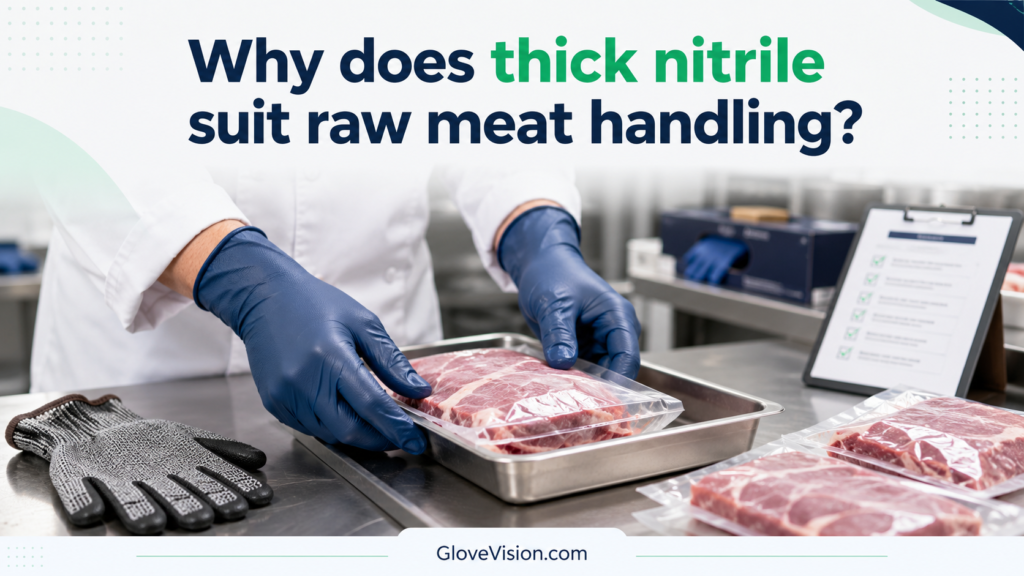
Why does thick nitrile suit raw meat handling?
Thick nitrile may suit raw-meat handling because an appropriately designed glove can provide more material against incidental wear while maintaining stable coverage, controlled grip, fit, and dexterity during repetitive manual tasks. Thickness is only one variable, so the exact product must be documented, fitted to the worker, tested in the task, and kept separate from cut, machinery, thermal, or chemical controls.
This article explains why added thickness may help, how to verify the exact glove product, how to combine nitrile with cut-resistant protection, when gloves must be changed, and how to respond to glove failure. It treats thick nitrile as one component of a wider food-safety and occupational-safety control system, not as a stand-alone guarantee.
This article provides educational guidance about thick nitrile glove selection, food-contact documentation, fit, grip, task trials, cut-protection integration, replacement, and failure response during raw-meat handling. It does not replace local food law, manufacturer instructions, employer hazard assessment, knife training, machine guarding, lockout/tagout, exact supplier documentation, worker training, medical evaluation, or task-specific cut, thermal, and chemical protection. Verify the exact glove, food, task, temperature, duration, worker fit, complete PPE system, and facility procedure before use.
Why Can Thick Nitrile Suit Raw-Meat Handling?
Thick nitrile can suit raw-meat handling because an appropriately designed glove may provide more material against incidental wear while supporting stable coverage, controlled grip, adequate dexterity, and useful durability during repetitive manual tasks.
These benefits depend on the exact product, food-contact documentation, worker fit, task conditions, representative testing, and replacement discipline. Broad food-glove principles belong with food-handling gloves, but this page focuses on the narrower question of thick nitrile in manual raw-meat work.
What Does “Thick Nitrile” Mean?
“Thick nitrile” is a comparative product description rather than a universal regulatory or safety category. A thickness claim should identify whether it refers to fingertip, palm, cuff, nominal average, minimum value, or marketing description, plus units, tolerance, and exact product code.
How May Added Material Support Raw-Meat Tasks?
Added glove material may provide more distance before complete wear-through and may reduce incidental tearing in some repetitive tasks when the product is correctly designed and fitted. This possible benefit must come from exact product data and representative task trials, not from assuming every thicker glove lasts longer.
How Can Stable Fit and Coverage Help?
A properly fitted thicker glove may maintain more stable fingertip, palm, and cuff coverage during repeated handling when it does not bunch, overstretch, slip, or restrict movement. Stable coverage may support meat positioning, tray handling, packaging, repeated flexion, hygienic removal, and damage detection.
Why Must Grip and Dexterity Remain Balanced?
Thick nitrile suits a task only when added material does not create unsafe grip effort, reduced fingertip control, tool rotation, or restricted movement. The right product preserves enough durability for the task while still letting workers detect damage, position meat, and remove gloves safely.
What Does Thickness Not Prove?
Thickness alone does not prove cut resistance, puncture resistance, food-contact suitability, fat compatibility, grip, dexterity, cold performance, chemical resistance, or safe wear duration. Thick nitrile suits raw-meat handling only when its added material supports the task without compromising documentation, fit, grip, dexterity, or separate hazard controls.
Which Tasks May Benefit From Evaluation?
Thick nitrile may be worth evaluating for repetitive raw-meat handling, portioning, packaging, controlled manual trimming, rough packaging edges, or tasks where an approved thinner product failed prematurely during documented trials. It should not be automatically approved for direct knife contact, exposed sharp-bone hazards, powered machinery, heat, or concentrated chemicals.
Which Factors Determine Whether Thick Nitrile Performs Safely?
Exact product construction, food-contact documentation, fit, grip, dexterity, task-tested durability, and separate hazard controls determine performance more reliably than thickness alone.
Why Does Product Construction Matter?
Products with similar thickness claims may perform differently because formulation, manufacturing consistency, thickness distribution, shape, texture, surface treatment, age, storage, and quality control vary. The page should never replace exact product evidence with phrases such as “heavy duty” or “industrial strength.”
Why Does Fit Matter?
Correct fit should support full finger and wrist movement, stable fingertip position, minimal slack, no excessive stretching, hygienic removal, and safe tool control. Size-system interpretation can be supported by Glove Size Translator, but the actual worker still needs an on-hand fit check.
Why Must Grip Be Tested Under Real Task Conditions?
Grip should be tested with the actual raw meat, normal tool handles, realistic moisture and fat, intended size, complete PPE system, and representative task duration. Texture may support grip, but no raised pattern or surface finish guarantees safe knife or meat control.
How Should Dexterity Be Evaluated?
Dexterity testing should confirm that workers can position meat, control approved tools, open packaging, grip containers, detect glove damage, and remove the glove hygienically without excessive effort. A product should not be approved if the trial shows unsafe over-gripping, tool rotation, restricted movement, fatigue, or poor fingertip control.
How Should Durability Be Evaluated?
Durability should be assessed through a documented representative facility trial rather than inferred from thickness alone. Trial records should capture exact product, worker, size, task, tested duration, failure point, fit, grip, soil level, replacement trigger, and worker feedback; tested duration does not become a universal maximum wear time.
How Should Fat and Grease Exposure Be Evaluated?
Animal fat and grease should be evaluated through observable grip, softening, swelling, stretching, tackiness, shape change, soil buildup, and premature failure. Do not claim nitrile is unaffected by every animal fat or that any one material suits every fatty food condition.
How Should Chilled Preparation Conditions Be Evaluated?
Chilled tasks should be assessed for glove flexibility, hand temperature, movement, grip effort, condensation, fit changes, task duration, and worker feedback. Recurring non-emergency fit, pressure, sweating, or slippage problems can be routed through Glove Comfort Troubleshooter, while injuries or medical concerns follow workplace procedures.
How Should Kitchens Verify an Exact Thick Nitrile Product?
A thick nitrile glove should be approved by exact manufacturer and product code only after its food-contact basis, conditions of use, dimensions, fit, performance, and limitations have been verified.
The exact product must be evaluated instead of relying on material-name assumptions; broader material comparison belongs in Glove Material Compare.
Which Product Details Should Be Recorded?
Record the manufacturer, product name, product code, lot or batch where relevant, intended use, single-use or reusable status, powder status, latex status, sizes, glove length, fingertip thickness, palm thickness, texture location, storage, and shelf life. For single-use classification context, disposable gloves can support the product-class boundary.
Which Food-Contact Information Should Be Requested?
Applicable supplier documentation should identify the regulatory basis, finished-product scope, intended foods, temperature, duration, conditions of use, and restrictions. FDA’s food-contact resources describe the framework for substances that contact food, but they do not approve a finished disposable nitrile glove simply by material name. [FDA] [FDA]
Which Performance Information May Be Useful?
Useful product evidence may include tensile data, elongation, puncture data, tear data, dimensions, tolerances, quality-level information, texture descriptions, and test methods. Those results should not be compared as directly equivalent when they come from different methods or product categories.
How Should a Representative Task Trial Be Performed?
A representative task trial should use the intended raw meat, normal tools, correct sizing, expected moisture and fat, realistic duration, normal replacement triggers, cut protection where required, and the actual workstation. The Glove Recommendation Engine can support task-first screening before a facility performs final product approval.
Which Warning Signs Should Prevent Approval?
Do not approve the glove if documentation is missing, product codes mismatch, conditions are unclear, required sizes are unavailable, fit is poor, grip is unsafe, failure is premature, the glove conflicts with inner protection, the system interferes with machinery safety, or hygienic removal is difficult. The FDA CFR search can support exact provision verification, but the supplier must identify the applicable regulatory basis for the finished product and intended conditions. [CFR]
Table 1. This matrix approves, restricts, or rejects an exact thick nitrile product by documentation, task trial, worker fit, and separate hazard controls.
| Verification Question | Evidence Needed | Representative Trial | Warning Sign | Decision |
|---|---|---|---|---|
| Is the exact glove documented? | Supplier evidence and conditions | Intended meat, temperature, and duration | Vague compliance claim | Do not approve |
| Is thickness clearly defined? | Fingertip, palm, basis, and tolerance | Compare with task needs | “Heavy duty” only | Request clarification |
| Does added material provide a useful benefit? | Product data and task trial | Compare wear, control, and failure | No improvement or reduced control | Reject or restrict |
| Does it fit the worker? | Size chart and individual fitting | Full movement and removal | Bunching or overstretching | Change size or product |
| Does grip remain controlled? | Surface data and task trial | Wet or fatty meat | Slipping or excessive grip effort | Reject or change system |
| Does it withstand representative use? | Test data and trial records | Record failures and fit change | Premature failure | Select another product |
| Is another hazard present? | Hazard assessment | Test complete PPE system | Nitrile treated as cut protection | Add separate controls |
Do not add a universal mil-by-task table or treat one thickness number as product approval.
How Should Thick Nitrile Be Combined With Cut-Resistant Protection?
The relationship between thick nitrile and cut-resistant protection depends on the cutting hazard, food type, whether the food will be cooked, the cut-resistant glove’s surface, manufacturer instructions, and the facility hazard assessment.
This section focuses only on how thick nitrile functions with separate cut protection. Detailed cut-level selection and hazard matching belong in Glove Hazard Match or facility PPE procedures.
When Is Separate Cut-Resistant Protection Required?
Separate cut-resistant protection is required when the facility identifies laceration hazards such as boning, trimming, slicing, hand-held knives, scissors, sharp bone, blade handling during approved maintenance, or similar cutting exposures. Standard disposable thick nitrile is not approved cut-resistant PPE, and OSHA requires hand protection to be selected based on identified hazards and task conditions. [OSHA]
Can a Slash-Resistant Glove Directly Contact Raw Meat?
Under the FDA Food Code model, a slash-resistant glove may directly contact food that will subsequently be cooked under specified conditions, subject to exact provision verification and local adoption. For ready-to-eat food or absorbent surfaces, the facility must verify surface requirements, food-contact suitability, cleanability, sanitation, and local code before use. [Food Code]
When May a Disposable Outer Glove Be Needed?
A disposable outer glove may be needed when the inner surface is absorbent, difficult to clean, used with ready-to-eat food, required by facility procedure, needs protection from food soil, or passes a complete-system trial. It should not be required universally over every cut-resistant glove in every raw-meat task.
How Should the Complete Glove System Be Fitted?
The inner and outer gloves should be fitted as one PPE system, including worker dimensions, inner construction, outer dimensions, movement, cuff coverage, dexterity, tool control, tension, bunching, and hygienic removal. Do not automatically size up without testing the complete system.
What Should an Outer Glove Cover?
The outer glove should cover required food-contact areas without overstretching, splitting, exposing restricted absorbent material, rolling excessively, or reducing safe control. A cuff should not be called liquid-tight unless the system has been validated for that claim.
How Should Reusable Cut Protection Be Controlled?
Reusable cut protection should follow product-specific procedures for cleaning, rinsing, sanitizing, drying, inspection, storage, task separation, removal from service, and replacement. The outer disposable glove does not replace those controls.
What Is the Powered-Equipment Boundary?
Powered meat saws, slicers, grinders, mixers, conveyors, rotating shafts, and powered cutting equipment require machine-specific instructions, guards, hazard assessment, and facility procedures. OSHA’s machine-guarding standard and hazardous-energy standard define separate safety boundaries that cannot be solved by choosing a thicker disposable glove. [OSHA] [LOTO]
Figure asset. This pathway separates thick nitrile from rated cut protection and stops the decision when powered equipment is involved.
The pathway uses yes/no branches: if no cutting hazard exists, evaluate the nitrile task; if a cutting hazard exists, select rated protection; if powered equipment is involved, stop and follow machine-specific controls.
When Must Thick Nitrile Gloves Be Changed?
A thicker glove must still be removed when it becomes damaged, soiled, contaminated, unsuitable, or involved in an incompatible task transition or operational interruption.
Which Physical-Condition Triggers Require Replacement?
Replace the glove after a tear, puncture, seam split, cuff damage, visible thinning, stretching, shape loss, slippage, loss of grip, sticky or altered surface, fragment concern, or glove material adhering to food. Added material never overrides immediate failure signs.
Which Soil and Contamination Triggers Require Replacement?
Replace after heavy meat soil, fat or grease buildup, waste contact, dirty equipment contact, floor contact, face, hair, clothing, phone contact, cleaning activity, chemical exposure, or an allergen-related task transition. A soiled glove should not be wiped and reused as a shortcut.
Which Task Changes Require Replacement?
Task changes include raw meat to ready-to-eat food, raw meat to cooked-food handling, butchery to clean packaging, leaving and returning to the station, operational interruption, food handling to cleaning, and allergen-related task change. The Food Code provides model food-service context, but local adoption and facility procedure still matter. [FDA]
Can a Grease-Covered Glove Be Wiped and Reused?
No. A heavily soiled single-use glove or one that no longer provides safe grip should be removed and discarded. The worker should stop the task, secure tools, remove and discard the glove, wash hands when required, assess food, tools, and surfaces, and don a fresh approved glove.
Is There a Universal Wear-Time Limit?
No universal wear-time limit applies to every thick nitrile glove and raw-meat task. Facility limits may support discipline, but they cannot override immediate replacement after damage, soil, contamination, loss of grip, task change, interruption, chemical exposure, altered surface, possible fragments, or a documented product limit.
What Should Workers Do When a Thick Nitrile Glove Fails?
When a glove tears, leaks, loses grip, or may have shed material, the worker should stop immediately and assess the worker, food, tools, and workstation before work resumes.
What Should Happen Immediately?
The worker should stop cutting or handling, secure the knife or tool, secure the food and container, remove the failed glove, wash hands as required, inspect the hand, inspect inner PPE where used, identify the failure location, isolate affected food, and assess tools and surfaces.
How Should Moisture Inside the Glove Be Assessed?
Moisture inside a glove may be perspiration, wash water, condensation, meat fluid, donning moisture, or leakage. Do not label it raw-meat fluid without evidence from the glove condition, task sequence, and exposure assessment.
How Should Possible Glove Fragments Be Handled?
If glove material may be missing, stop, isolate the affected food, locate the damaged area, inspect food, tools, and surfaces, follow the foreign-material procedure, and document where required. Food should not be released merely because a fragment is not immediately visible.
How Should Exposed Meat Be Evaluated?
Exposed meat should be evaluated for bare-skin contact, injury, bodily fluid, glove material, next processing step, affected tools and surfaces, facility procedure, and local rules. Isolate, discard, or reprocess affected food according to the approved facility procedure.
What Should Happen After a Hand Injury?
After a hand injury, work should stop, food should be protected, the injury should be reported, and appropriate first aid or medical assistance should follow workplace procedures. This article does not provide clinical treatment instructions.
How Should Repeated Failures Be Investigated?
Repeated failures should be investigated by manufacturer, product code, lot, size, failure location, task, tool condition, sharp surfaces, bone exposure, fit, duration, storage, inner-glove compatibility, worker technique, and whether the response should change product, process, tools, sizing, or protection system.
Figure asset. This workflow controls glove failure, possible fragments, injury, food exposure, and restart decisions without prescribing universal food disposal.
Restart only after worker condition, food assessment, tool condition, surface condition, replacement glove, and failure cause have been addressed.
Which Shift-Start Checks Confirm Thick Nitrile Readiness?
Before raw-meat preparation begins, supervisors should confirm that the exact glove product, complete PPE system, tools, hygiene supplies, replacement stock, and task procedures are approved and ready.
Table 2. This checklist verifies product, PPE, hygiene, and response readiness before raw-meat handling starts.
| Check | Verification | Corrective Action |
|---|---|---|
| Exact product identity | Manufacturer, product, code, intended use, and single-use/reusable status | Quarantine unmatched products |
| Food-contact documentation | Regulatory basis, foods, temperature, duration, conditions, restrictions | Do not approve undocumented products |
| Thickness information | Fingertip, palm, measurement basis, nominal/minimum value, tolerance | Reject unsupported “heavy duty” claims |
| Added-material benefit | Trial shows useful wear or coverage benefit without loss of control | Reject if benefit is absent or control worsens |
| Worker fit | Correct size, finger and wrist movement, no slack, overstretching, or compression | Provide another size or product |
| Grip and dexterity | Actual meat, tool control, slippage, grip effort, movement, feedback | Reject unsafe systems |
| Cut-protection readiness | Product identity, size, condition, food-contact status, cleaning, outer-cover need | Do not begin without approved protection |
| Powered-equipment boundary | Guards, instructions, glove policy, entanglement assessment, LOTO, training | Do not proceed unless permitted |
| Handwashing and stock readiness | Sink, soap, drying, approved codes, sizes, storage, adequate quantities | Restore supplies before work |
| Failure-response knowledge | Stop, secure, remove, wash, inspect, isolate, assess, report | Demonstrate where gaps exist |
This checklist is an operational readiness screen, not formal food-contact approval, a cut-rating selection tool, a machine inspection, clinical assessment, hazard-assessment substitute, or supervision substitute.
- FDA — Food Code — used for model food-service context.
- FDA — Food Code 2022 Full Document — used for single-use glove, slash-resistant glove, handwashing, and task-control provisions.
- FDA — Food Packaging and Other Food-Contact Substances — used for general U.S. food-contact framework.
- FDA — Understanding How FDA Regulates Food-Contact Substances — used for U.S. food-contact pathway context.
- FDA — CFR Title 21 Search — used for exact CFR verification without treating one provision as universal.
- OSHA — 29 CFR 1910.138 Hand Protection — used for task- and hazard-based hand-protection boundary.
- OSHA — 29 CFR 1910.212 General Machine Guarding — used for powered-machinery guarding boundary.
- OSHA — 29 CFR 1910.147 Control of Hazardous Energy — used for hazardous-energy boundary where applicable.
Frequently Asked Questions
Why Does Thick Nitrile Suit Raw-Meat Handling?
Thick nitrile may suit raw-meat handling because an appropriately designed product can provide more material against incidental wear while maintaining stable coverage, fit, grip, and dexterity during repetitive manual tasks.
Is a Specific Mil Thickness Required for Raw Meat?
No universal mil value applies to every raw-meat task. A thickness claim is useful only when the exact product, measurement location, units, tolerance, and task conditions are known.
Are Thick Nitrile Gloves Cut-Resistant?
No. Standard disposable thick nitrile gloves should not be treated as cut-resistant PPE. Laceration hazards require separate rated protection and facility procedures.
When Should Thick Nitrile Gloves Be Changed?
They should be changed after damage, heavy soil, grease buildup, contamination, loss of grip, task change, interruption, possible fragments, or any product or facility limit.
What Should Happen if a Glove Tears During Raw-Meat Handling?
Stop the task, secure tools, remove the glove, wash hands as required, inspect the worker and PPE, isolate affected food, check for fragments, assess surfaces, and restart only when controls are restored.
Conclusion
Thick nitrile may suit raw-meat handling because an appropriately designed product can provide more material against incidental wear while maintaining stable coverage, controlled grip, suitable fit, and adequate dexterity during repetitive manual tasks. That value remains conditional because thickness is not a regulatory category, no universal mil minimum applies, and product approval depends on documented food-contact scope, thickness location, worker fit, grip, dexterity, fat and chilled conditions, and a representative task trial.
Thick nitrile is one component of a wider control system—not a stand-alone solution for raw-meat handling hazards. Kitchens still need separate cut-resistant protection where laceration hazards exist, clear outer-glove decisions, machine-safety boundaries, event-driven replacement, grease and soil controls, glove-failure response, fragment and food assessment, and shift-start readiness checks.