
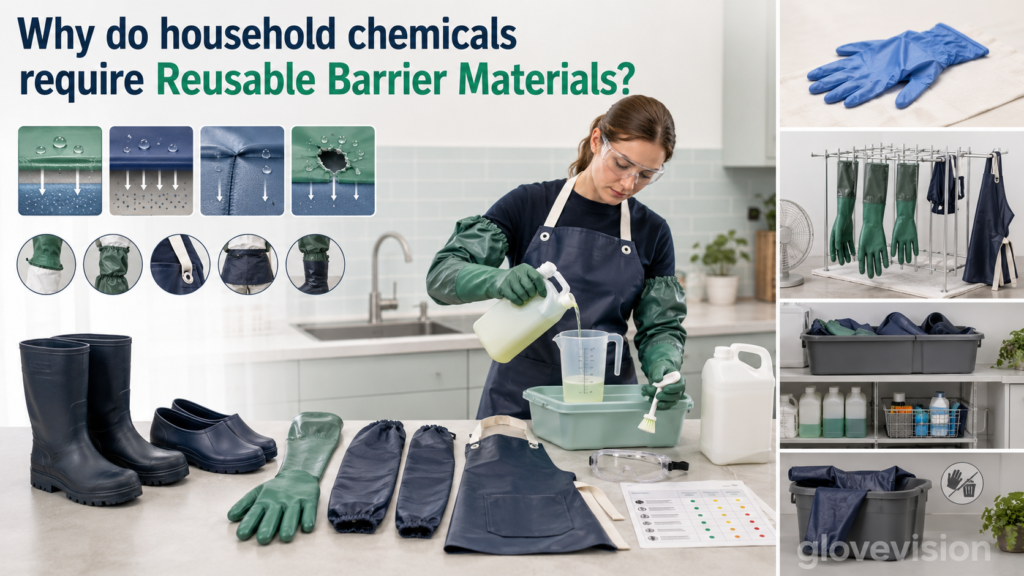
Why do household chemicals require reusable barrier materials?
Certain Household chemicals require Reusable barrier materials when their labels or expected exposure conditions call for repeated skin protection.
The exact item must match the chemical, concentration, temperature, contact type, duration, exposed body area, and physical demands—and it must remain safe to remove, decontaminate, dry, inspect, and reuse.
This article provides general information about Reusable barrier materials. Follow the original Household chemical label and the exact protective-item instructions. Skin barriers protect only the areas they cover and do not replace ventilation, eye protection, safe dilution, chemical-separation rules, or emergency guidance. Stop immediately if chemical reaches the skin, enters the protective item, causes burning, or produces concerning fumes.
Why do household chemical exposures make Reusable barrier materials necessary?
Reusable barrier materials may be necessary when an original product label or a realistic exposure assessment shows that repeated skin protection is required and a suitable reusable item is available.
Which effects may Reusable barrier materials help control?
They may reduce direct skin contact from splashes, contaminated surfaces, wet cloths, pouring, dilution, immersion, and repeated scrubbing when the exact item is documented for those conditions.
When may Reusable barrier materials not be necessary?
Some tasks can avoid contact through safer methods, handled tools, controlled pouring, or a verified disposable item. Reusable protection is not automatically required for every cleaner.
Why are Reusable barrier materials not the only control?
They do not replace safer-product selection, dilution instructions, splash control, ventilation, eye protection, or chemical-separation rules. PPE is a supplemental control. [OSHA]
Which exposure routes must Reusable barrier materials control?
Reusable barrier materials must cover every body area reasonably exposed by the defined task.
How do Reusable barrier materials protect the hands?
Gloves or gauntlets may protect the fingers, palms, wrists, and part of the forearm when the exact product and cuff length match the task.
When must Reusable barrier materials extend beyond the hands?
Splashing, pouring, runoff, or immersion may require sleeves or longer gauntlets. See the apron and sleeve guide.
When must Reusable barrier materials protect the torso or legs?
Aprons, garments, boots, or overshoes may be needed where the torso, upper legs, lower legs, or feet could be exposed.
Which exposure routes cannot Reusable barrier materials control?
Skin barriers do not independently control vapor, gases, inhalation, eye splash, face splash, unsafe mixing, or poor ventilation.
Which protective items use Reusable barrier materials in household tasks?
Reusable barrier materials may form complete gloves, gauntlets, sleeves, aprons, garments, boots, and overshoes.
How are Reusable barrier materials used in gloves and gauntlets?
Gloves protect the hands; gauntlets extend farther along the wrist or forearm. Suitability depends on the exact construction, cuff, immersion depth, and runoff direction.
How are Reusable barrier materials used in sleeves and aprons?
Sleeves protect the arms, while aprons reduce front-of-body splash exposure. Their interfaces must not create gaps.
How are Reusable barrier materials used in boots and garments?
Protective footwear and garments may be required for lower-leg, foot, side-body, or broader splash exposure. Ordinary waterproof clothing must not be assumed chemically resistant.
This table separates coverage from the verification needed for each complete item.
| Protective item | Primary coverage | Critical components | Main verification | Common gap |
|---|---|---|---|---|
| Gloves | Hands and wrists | Fingers, palm, cuff, lining | Exact chemical and task compatibility | Cuff or wrist |
| Gauntlets | Hands and forearms | Extended cuff, shape, closure | Immersion depth and runoff | Upper cuff |
| Sleeves | Forearms or arms | Openings, elastic, seams | Interface with gloves and garment | Glove–sleeve gap |
| Apron | Front torso and upper legs | Neck, waist, edges | Splash direction and coverage | Sides and arms |
| Garment | Broader body area | Closures, seams, openings | Complete ensemble compatibility | Neck, wrist, ankle |
| Boots/overshoes | Feet and lower legs | Sole, upper, opening | Chemical data and traction | Trouser–boot gap |
Coverage and compatibility must both pass; one cannot replace the other.
How should Reusable barrier materials be matched to an exact household chemical?
Selection must start with the original Household chemical label and exact protective-item documentation.
Which chemical information is required for Reusable barrier materials?
Identify the exact product, concentration, dilution, mixture status, temperature, splash or immersion pattern, contact duration, and frequency. The label remains the first authority. [EPA]
Which protective-item information is required for Reusable barrier materials?
Verify manufacturer, model, reusable designation, material formulation where disclosed, thickness, seams, cuffs, closures, coatings, linings, straps, and care instructions.
Why is a generic material name insufficient for Reusable barrier materials?
Products described by the same generic material may differ in formulation, thickness, construction, and tested resistance. Use the exact manufacturer data. [HSE]
How should mixtures be handled when selecting Reusable barrier materials?
Resistance to one ingredient does not prove resistance to a formulated cleaner. Use mixture-specific data where available; otherwise do not approve the item.
How do permeation, degradation, and penetration affect Reusable barrier materials?
Reusable barrier materials can fail through molecular transport, material deterioration, or physical openings.
What is permeation through Reusable barrier materials?
Permeation is molecular movement through a material and may occur without a visible hole. Laboratory breakthrough time is not an automatic safe household wear time. See the breakthrough-time guide.
What is degradation of Reusable barrier materials?
Degradation includes swelling, tackiness, softening, hardening, brittleness, distortion, strength loss, or elasticity loss associated with exposure or condition.
What is penetration through Reusable barrier materials?
Penetration is passage through a tear, puncture, pinhole, seam, cuff, closure, opening, or component interface.
Why must complete items made from Reusable barrier materials be assessed?
A main barrier layer may resist a chemical while a seam, closure, cuff, coating, lining, or interface remains unsuitable. [OSHA CPC]
When should Reusable barrier materials be chosen instead of disposable barriers?
Reusable or disposable protection should be selected from exact product evidence, task conditions, and decontamination feasibility—not from category preference.
When may Reusable barrier materials be appropriate?
They may suit repeated tasks, greater mechanical stress, longer coverage needs, documented repeated use, reliable decontamination, and regular inspection.
When may disposable barriers be appropriate?
A verified disposable item may suit short controlled tasks, frequent changes, immediate disposal, or situations where decontamination is unreliable. Review the disposable barrier guide.
Are thicker Reusable barrier materials automatically safer?
No. Thickness alone does not establish compatibility, formulation, seams, breakthrough behavior, degradation, dexterity, or complete-item performance.
How do concentration, temperature, contact type, and duration affect Reusable barrier materials?
Compatibility data must match the planned concentration, temperature, contact pattern, duration, and physical stress.
How does concentration affect Reusable barrier materials?
Higher or different concentrations may change chemical resistance. Data for a diluted product cannot automatically be applied to a concentrate or another formulation.
How does temperature affect Reusable barrier materials?
Higher temperature can increase permeation or degradation and may reduce practical performance compared with laboratory data.
How do contact type and duration affect Reusable barrier materials?
Brief splash, repeated splash, surface contact, partial immersion, and continuous contact are different exposure conditions. Use the contact-duration guide.
How do flexing and abrasion affect Reusable barrier materials?
Repeated bending, scrubbing, gripping, puncture risk, and abrasion can stress the complete item and its interfaces.
Use this matrix to define the exact task before approving a protective item.
| Condition | What changes | Required evidence | Stop condition |
|---|---|---|---|
| Concentration | Chemical severity | Data at the same concentration | Unknown or unmatched concentration |
| Temperature | Permeation and degradation behavior | Test or manufacturer temperature range | Planned temperature exceeds data |
| Brief splash | Short intermittent contact | Splash-compatible complete item | Coverage or removal cannot be controlled |
| Immersion | Continuous or repeated liquid contact | Immersion-compatible item and cuff plan | Depth or duration exceeds support |
| Flexing/abrasion | Mechanical stress | Task performance and inspection | Grip, integrity, or coverage declines |
| Mixture | Combined formulation behavior | Mixture-specific or product-specific data | Only one ingredient is documented |
Approval applies only to the defined chemical, task, temperature, contact pattern, and duration.
How should Reusable barrier materials be fitted and used during household chemical tasks?
Reusable barrier materials must remain secure, maintain coverage, preserve grip and dexterity, and permit controlled removal.
How should gloves made with Reusable barrier materials fit?
They should avoid excessive tightness, bunching, loose fingertips, twisting, slippage, and removal difficulty while maintaining wet or oily grip.
How should cuffs and sleeves made with Reusable barrier materials interact?
Arrange them according to splash direction, runoff, movement, immersion depth, and product instructions. Do not impose one universal cuff-folding method.
How should aprons and garments made with Reusable barrier materials fit?
They should maintain front, side, and interface coverage during bending, reaching, and movement without creating open gaps.
What should happen when Reusable barrier materials lose grip or shift?
Stop the task, secure the chemical and tools, move away from exposure, and reassess fit, size, condition, and item choice.
How should Reusable barrier materials be removed and decontaminated?
Removal and decontamination must prevent residue transfer to skin, interiors, clean surfaces, and other household areas.
What should be checked before removing Reusable barrier materials?
Identify contamination, damaged areas, runoff direction, available disposal or decontamination controls, and whether pre-removal rinsing is permitted.
When may Reusable barrier materials be rinsed before removal?
Only when both chemical and protective-item instructions permit it, the rinse liquid is appropriate, and runoff can be controlled without driving liquid into openings.
How should Reusable barrier materials be removed?
Use a controlled sequence that avoids touching contaminated exteriors with bare skin. Hand protection should follow the chemical-glove removal guide.
When should Reusable barrier materials not be decontaminated for reuse?
Do not approve reuse when chemical identity, compatibility, decontamination method, interior condition, or complete drying cannot be verified.
How should Reusable barrier materials be dried and stored?
Only approved reusable items should be dried and stored for another task.
How should Reusable barrier materials be dried?
Drain exterior moisture, open cuffs and closures, ventilate internal surfaces, dry removable parts separately, and follow exact instructions. Do not prescribe universal inversion.
Which drying methods should be avoided for Reusable barrier materials?
Avoid unapproved heat, radiators, hair dryers, tumble dryers, hot pipes, direct flames, and prolonged intense sunlight.
How should Reusable barrier materials be stored?
Store clean and fully dry in a designated location away from chemicals, food, kitchen tools, clean clothing, sunlight, heat, and sharp objects.
When must Reusable barrier materials be replaced?
Replace or reject Reusable barrier materials when compatibility, coverage, decontamination, structural condition, or functional performance no longer passes.
Which physical defects reject Reusable barrier materials?
Tears, punctures, cracks, pinholes, seam failure, closure failure, cuff damage, and leaks reject the item.
Which material changes reject Reusable barrier materials?
Swelling, tackiness, softening, hardening, brittleness, distortion, blistering, strength loss, or elasticity loss require replacement or expert reassessment.
Which contamination conditions reject Reusable barrier materials?
Interior contamination, unremovable residue, unknown chemical identity, or unverified decontamination prevents reuse.
Which functional failures reject Reusable barrier materials?
Unsafe fit, grip loss, reduced dexterity, incomplete coverage, unstable interfaces, or removal difficulty reject the item.
This table converts observable findings into a clear action.
| Finding | Why it matters | Immediate action | Reuse decision |
|---|---|---|---|
| Tear, puncture, or leak | Physical penetration path | Stop and remove safely | Replace |
| Swelling or tackiness | Possible degradation | Stop and isolate item | Replace or manufacturer review |
| Interior contamination | Skin exposure risk | Follow chemical instructions | Do not reuse |
| Unremovable residue | Decontamination failure | Treat as contaminated | Do not reuse |
| Unsafe fit or grip | Loss of task control | Stop and reassess size/item | Replace or change item |
| Incomplete coverage | Unprotected body area | Add or change component | Do not proceed until corrected |
A clean-looking item is not automatically safe for reuse.
Which mistakes compromise Reusable barrier materials?
Common mistakes create false confidence before, during, and after chemical contact.
Which selection mistakes compromise Reusable barrier materials?
Choosing by color, price, generic material, thickness, prior success, or one ingredient instead of exact product data.
Which use mistakes compromise Reusable barrier materials?
Mixing cleaners, exceeding supported contact conditions, ignoring coverage gaps, continuing after grip loss, or treating skin barriers as vapor or eye protection.
Which decontamination mistakes compromise Reusable barrier materials?
Assuming water or soap is universally suitable, rinsing without runoff control, machine washing without approval, or believing cleaning restores resistance.
Which inspection mistakes compromise Reusable barrier materials?
Checking only the main surface while ignoring seams, cuffs, closures, linings, straps, interiors, and component interfaces.
What should users verify before using Reusable barrier materials?
Approve an item only when every relevant requirement, coverage, compatibility, reuse-feasibility, and current-condition check passes.
Table 4. Confirm the chemical, task, protective item, and required coverage before use.
| Verification area | What must be confirmed | Pass condition | Stop condition |
|---|---|---|---|
| Household product | Exact product, original label, concentration, dilution, mixture status, and temperature | The product and planned use are fully identified | Chemical identity or instructions are unclear |
| Exposure | Skin-contact possibility, exposed body areas, splash, immersion, duration, and frequency | The expected exposure and coverage need are defined | Exposure route or required body coverage is uncertain |
| Protective item | Manufacturer, model, reusable or disposable designation, construction, and intended use | The exact complete item is documented for the task | Only a generic material name is known |
| Compatibility | Chemical-specific data for the concentration, temperature, contact type, and duration | Compatibility is documented for verified conditions | Compatibility is missing, transferred from another model, or based on one ingredient alone |
| Use controls | Safer methods, ventilation, eye protection, fit, grip, dexterity, and component interfaces | All required controls work together without coverage gaps | Grip, fit, movement, or coverage is unsafe |
Reusable status does not replace chemical-specific compatibility or complete body-area coverage.
Table 5. Approve reuse only when removal, decontamination, drying, condition, and storage checks all pass.
| Readiness area | Required check | Acceptable outcome | Reject or reassess when |
|---|---|---|---|
| Removal | Controlled removal sequence and permitted pre-removal rinsing | Residue is not transferred to skin, interiors, or clean surfaces | Removal or rinsing instructions are unknown |
| Decontamination | Exact approved method, accessible seams and closures, and controlled runoff | Residue can be reliably removed without damaging the item | Decontamination is unverified or interior contamination occurred |
| Drying | Exterior, interior, cuffs, closures, and removable parts | The complete item is fully dry before storage or reuse | Moisture remains trapped or drying instructions cannot be followed |
| Condition | Tears, punctures, cracks, swelling, tackiness, softening, hardening, brittleness, distortion, and grip | The item remains intact, stable, functional, and properly fitted | Any structural or material change affects protection or control |
| Storage and decision | Clean separate location, chemical/task restriction, and final documented outcome | Use, restrict, dry further, or store only within verified conditions | Storage history, contamination status, or next-use approval is uncertain |
Failure in one readiness area cannot be cancelled by passing the others.
Conclusion
Not every Household chemical requires reusable protection. Begin with the original product label, define the likely exposure and body areas at risk, and identify the exact complete protective item rather than relying on a generic material name.
Reusable barrier materials are appropriate only when chemical compatibility, coverage, fit, grip, controlled removal, decontamination, drying, inspection, and current condition all support the next task. Where any required evidence is missing or the item cannot be safely restored, do not approve reuse.
Frequently asked questions about Reusable barrier materials
Do all Household chemicals require Reusable barrier materials?
No. Follow the exact product label and assess the expected exposure. Some tasks may not require skin protection, while others may require reusable or verified disposable protective items.
Are Reusable barrier materials the same as reusable chemical gloves?
No. Reusable chemical gloves are one type. Reusable barrier materials may also be used in gauntlets, sleeves, aprons, garments, boots, and overshoes.
Are thicker Reusable barrier materials always safer?
No. Thickness may affect some performance characteristics, but compatibility, formulation, construction, seams, closures, temperature, flexing, and test data also matter.
Can Reusable barrier materials stop chemical vapor or protect the eyes?
No. Skin barriers protect only covered skin. Ventilation, respiratory controls, and separate eye or face protection may still be required.
Can Reusable barrier materials permeate without visible damage?
Yes. Permeation may occur through a material without a visible tear, puncture, swelling, or color change.
When must Reusable barrier materials be replaced?
Replace them after tears, punctures, seam or closure failure, leakage, swelling, tackiness, hardening, softening, brittleness, distortion, unremovable residue, interior contamination, unsafe fit, grip loss, or incomplete coverage.