
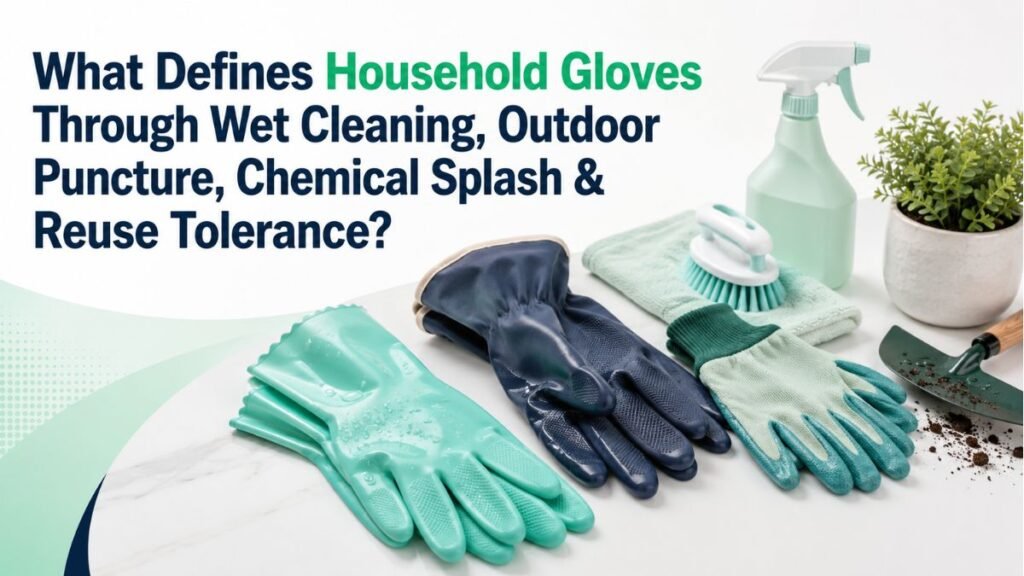
What Defines Household Gloves Through Wet Cleaning, Outdoor Puncture, Chemical Splash & Reuse Tolerance?
Household gloves are defined by the cleaning or gardening task, water and chemical contact, outdoor abrasion or puncture exposure, material and construction, fit and grip, and whether the glove remains suitable for safe reuse. No single household glove is suitable for every domestic chore.
This page explains cleaning and gardening environments, wet work and chemical splash, soil and thorn exposure, materials and constructions, fit and cuff features, task separation, reuse care, replacement triggers, and final verification.
This article is educational and does not replace product labels, SDS instructions, manufacturer compatibility data, pesticide directions, or professional safety advice. Strong chemicals, heat, sharp tools, severe thorns, powered equipment, and prolonged exposure may require separately verified protection.
What are household gloves, and how do they differ from adjacent protective glove categories?
Household gloves are reusable or task-specific protective gloves intended for domestic cleaning, dishwashing, wet work, gardening, waste handling, and light outdoor maintenance.
They differ from general disposable gloves through construction, reuse, cuff coverage, grip, lining, and the intended chore. Reuse and construction matter because household vs disposable gloves.
Household gloves are not automatically interchangeable with medical, food handling, laboratory, chemical-resistant, thermal, or industrial work gloves because those categories may require different labeling, testing, cleanliness, ratings, or procedures.
They may reduce contact with water, dirt, selected cleaners, soil, thorns, and rough surfaces, but no household glove provides universal chemical, cut, puncture, heat, or biological protection. For occupational tasks, hand protection should be selected around the work, conditions, duration, and identified hazards. [OSHA]
| Glove Context or Environment | Typical Household Role or Tasks | Main Exposure or Protection Need | Typical Build Need | Main Limitation | Deeper Verification Required |
|---|---|---|---|---|---|
| Indoor wet cleaning | Dishwashing, bathroom cleaning, surface wiping, laundry treatment, vehicle washing | Water, detergent, selected cleaner splash, friction | Water-resistant shell, wet grip, suitable cuff, comfortable interior | Does not prove suitability for concentrated chemicals, steam, heat, or immersion | Product label, glove compatibility, contact conditions |
| Light gardening | Planting, weeding, soil handling, compost, light pruning | Soil, moisture, abrasion, small splinters | Breathable back, coated or reinforced palm, secure wrist | May not resist severe thorns, sharp wire, pesticides, or powered equipment | Task conditions, garden-product label, manufacturer claims |
| Thorn-aware gardening | Roses, woody plants, rough branches | Pointed plant contact, abrasion, forearm exposure | Denser material, reinforced palm and fingers, longer cuff | Not completely puncture-proof | Thorn severity and product-specific claims |
| Garage or waste handling | Waste bins, greasy surfaces, light maintenance, pet cleanup | Dirt, grease, residue, sharp debris, contamination transfer | Dedicated pair, reliable grip, abrasion-aware construction | May not protect against chemicals, severe puncture, machinery, or heat | Exact task and specialist PPE where needed |
| General disposable glove | Short-use hygiene or light cleanup | Temporary thin barrier | Easy donning and replacement | Limited reuse, cuff coverage, abrasion resistance, and durability | Intended use and task limits |
| Food handling glove | Direct or indirect food-contact tasks | Food-contact suitability and task discipline | Documented food-contact build | Household-cleaning status does not prove food-contact suitability | Food-contact declaration |
| Medical glove | Clinical examination or procedure use | Medical barrier integrity | Medical-use labeling and construction | Household status does not establish clinical suitability | Medical labeling and intended use |
| Chemical-resistant glove | Concentrated, corrosive, solvent, or prolonged contact | Chemical-specific barrier resistance | Product-specific material and cuff system | May reduce dexterity and still require strict change-out rules | Exact chemical, concentration, duration, SDS, manufacturer data |
| Work glove | Heavy abrasion, tools, cut, impact, or industrial tasks | Mechanical or trade-specific protection | Rated or task-specific construction | May not support direct food contact or chemical resistance | Rating, manufacturer data, task assessment |
| Thermal glove | Hot surfaces, steam, ovens, or heated equipment | Verified thermal protection | Rated thermal construction | Household lining or thickness is not a substitute | Temperature, contact mode, duration, thermal rating |
How do cleaning gloves and gardening gloves differ by household environment?
Cleaning gloves and gardening gloves differ because repeated wet and cleaner contact requires different barriers, cuffs, interiors, and grip than soil, abrasion, thorns, splinters, and garden-tool handling.
Cleaning gloves may support dishwashing, bathroom cleaning, surface wiping, laundry treatment, car washing, and repeated wet work when water resistance, wet grip, cuff coverage, lining condition, and drying are matched to the task.
Cleaning builds must manage repeated moisture because wet cleaning exposure changes comfort, grip, and reuse demands.
Gardening gloves may support planting, weeding, compost, soil handling, light pruning, rough branches, and abrasion when breathability, reinforcement, palm construction, and wrist closure match the environment.
Outdoor selection changes when gardening exposure occur together.
Concentrated cleaners, drain products, paint removers, acids, alkalis, solvents, prolonged immersion, heavy brush, severe wire, powered tools, chainsaws, and industrial landscaping exceed ordinary household-glove screening.
How do wet cleaning and chemical splash conditions change household glove requirements?
Wet cleaning and chemical splash conditions change household glove requirements because routine water and detergent exposure differs substantially from concentrated cleaners, solvents, corrosives, mixtures, and prolonged contact.
Repeated water and detergent contact requires water resistance, cuff control, grip, and a manageable interior, but those features do not prove chemical compatibility or heat protection.
Brief contact with a labeled cleaner still requires the exact product label and glove-product compatibility for the documented task and duration. Stronger products require deeper verification through chemical barrier materials.
Concentrated drain cleaners, paint removers, strong acids, strong alkalis, solvents, and degreasers may exceed ordinary household gloves and require the exact label, SDS where available, and specialist verification.
Never mix household cleaning products unless the exact label explicitly directs that combination. Household bleach and disinfectants should not be mixed with other cleaners or disinfectants because dangerous vapors can be released. Follow label directions, ensure good ventilation, and check whether gloves or eye protection are required. [CDC]
Prolonged or immersion contact may require documented compatibility, contact-duration information, and a specialist chemical glove system rather than a general household pair.
| Contact Condition | Example Task | Main Risk | Verification Needed | Household Glove Limit | Deeper Route |
|---|---|---|---|---|---|
| Repeated water contact | Dishwashing, rinsing, car washing | Skin wet work, slipping, water entry | Fit, cuff, grip, interior condition | Does not prove cleaner or heat protection | Cleaning-glove guidance |
| Diluted detergent | Routine surface or dish cleaning | Irritation, friction, residue | Product label and glove instructions | Material may age or retain residue | Manufacturer care guidance |
| Brief labeled cleaner splash | Bathroom or surface product | Chemical irritation or degradation | Exact cleaner label and glove compatibility | Ordinary glove may not suit concentrate | Product-specific verification |
| Concentrated corrosive | Drain or oven cleaner, strong acid or alkali | Chemical burn, rapid degradation | Label, SDS, exact chemical glove data | Standard household glove may be inadequate | Chemical-resistant specialist guidance |
| Solvent or paint remover | Degreasing, adhesive, coating removal | Permeation, swelling, inhalation hazard | Exact product and glove compatibility | Thickness or material name is insufficient | Specialist chemical guidance |
| Mixed or unknown products | Combining cleaners or decanted product | Toxic reaction, unknown exposure | Do not proceed; identify product and label | Gloves cannot make mixing safe | Poison or safety response where necessary |
| Prolonged or immersion contact | Extended soaking or submerged handling | Permeation, cuff entry, degradation | Product-specific duration and construction data | General household glove may be insufficient | Specialist chemical glove system |
How do outdoor puncture, abrasion, and soil contact change gardening glove requirements?
Outdoor puncture, abrasion, and soil contact change gardening glove requirements because friction, moisture, thorns, splinters, branches, compost, fertilizers, and tools stress different parts of the glove.
Soil and repetitive digging may benefit from a coated or reinforced palm, breathable back, secure wrist closure, and construction that limits dirt entry without implying severe abrasion protection.
Roses, woody plants, rough branches, and splintered handles may require denser materials, reinforcement, and longer cuffs. Dense construction may help because thorn-resistant materials differ in performance, but none should be described as completely puncture-proof.
Pesticides—including herbicides, insecticides, and fungicides—require the exact current product label and the protective measures specified by that label. Do not use more product than directed. [EPA] Fertilizers also require their own label and manufacturer directions; a generic gardening glove or waterproof appearance does not establish suitability.
Powered lawn and garden equipment, electric tools, blades, and blade-cleaning or sharpening tasks require manufacturer instructions, equipment safety controls, and appropriate protective equipment rather than reliance on an ordinary gardening glove. [CPSC] Chainsaws, powered cutters, severe wire hazards, and high-pressure equipment require separate task-specific guidance and protection.
| Outdoor Hazard | Typical Task | Helpful Glove Feature | What It May Not Protect Against | Deeper Route |
|---|---|---|---|---|
| Soil friction | Planting, digging, potting | Coated or reinforced palm, secure wrist, washable surface | Severe abrasion, chemicals, blades | Gardening build guidance |
| Small splinters | Wooden handles, dry branches | Dense palm, reinforcement, good fit | Needles, sharp wire, severe puncture | Specialist puncture guidance |
| Thorns | Roses and woody plants | Longer cuff, denser material, reinforced palm and fingers | Complete puncture prevention | Thorn-specific construction |
| Wet soil and compost | Planting, compost handling | Moisture-resistant palm, dedicated pair, washable exterior where permitted | Biological or chemical hazards beyond instructions | Hygiene and product guidance |
| Fertilizer or pesticide | Product application | Exact label-specified PPE | Generic gardening glove may be unsuitable | Exact product label and specialist guidance |
| Pruners and blades | Trimming and cutting | Proper tool technique and task-specific protection | Powered or sharp-blade injury | Cut or work glove guidance |
| Power equipment | Mower, chainsaw, powered trimmer | Equipment-specific controls and PPE | Ordinary gardening glove protection | Manufacturer and specialist safety guidance |
How should household glove materials and constructions be screened for cleaning and gardening tasks?
Household glove materials and constructions should be screened against the exact chore, water or product contact, soil and thorn exposure, grip demand, fit, lining, and intended reuse.
Natural rubber latex may offer elasticity, tactile fit, and water resistance, but product compatibility must still be verified for the task. Repeated latex exposure can lead to irritant, delayed allergic, or immediate allergic reactions; persistent or serious symptoms require medical evaluation rather than self-diagnosis. [NIOSH]
Nitrile may support selected wet, waste, garage, or cleaning tasks, but it is not universally compatible with solvents, acids, alkalis, oils, or cleaners, and accelerator sensitivity may be relevant.
Neoprene, vinyl or PVC, leather, synthetic leather, woven fabric, coated palms, and reinforced thorn-aware builds each offer selected benefits while carrying limits in fit, moisture, chemical exposure, abrasion, coating wear, or puncture resistance.
Material name, glove thickness, waterproof marketing, and visual appearance do not replace the exact product label, manufacturer data, and task assessment.
| Material / Build | Possible Household Role | Main Strength | Main Limitation | Exact Verification Question |
|---|---|---|---|---|
| Natural rubber latex | Dishwashing and selected wet cleaning | Elasticity, tactile fit, water resistance | Latex allergy; limited compatibility with some products | Does the exact glove match the cleaner and user sensitivity? |
| Nitrile | Selected cleaning, waste, garage, or wet tasks | Water resistance and selected durability or puncture support | Not universally compatible; accelerator reactions may matter | Is the exact product compatible with the cleaner and contact duration? |
| Neoprene / chloroprene | Selected splash and wet-cleaning tasks | Flexibility and selected chemical resistance | Performance varies by formulation and product | Does manufacturer data cover the exact glove and cleaner? |
| Vinyl / PVC | Light wet work and selected lower-stress cleaning | Latex-free and water-resistant in suitable builds | Lower elasticity, fit, or puncture performance in some products | Does the build remain secure and suitable for the duration? |
| Leather | Dry soil, branches, rough garden materials | Abrasion support and rugged handling | Absorbs moisture; not chemical or puncture proof | Is the task primarily dry abrasion rather than chemicals or severe thorns? |
| Synthetic leather | Garden tools and light maintenance | Flexibility, grip, repeatable fit | May peel, wear, absorb residue, or lose grip | Does the construction suit moisture and abrasion? |
| Woven fabric | Light gardening and breathability | Ventilation and comfort | Limited moisture and puncture resistance | Is the task low-risk and dry enough for fabric construction? |
| Coated palm | Soil, wet plants, selected cleaning or garden tasks | Grip and selected moisture or abrasion support | Coating wear; back may remain exposed | Does coating type match the surface and contamination? |
| Reinforced thorn-aware build | Roses, branches, woody plants | Denser zones and longer coverage | Not completely puncture-proof | What thorn severity and manufacturer claim apply? |
- Exact cleaner or garden product name and formulation
- Product label and SDS where available
- Concentration, dilution, contact mode, duration, and temperature
- Required PPE and intended use
- Exact glove manufacturer, product code, material, and construction
- Compatibility statement and current document revision
- Cleaning, drying, storage, reuse, and disposal instructions
How do fit, cuff length, lining, and grip affect household glove performance?
Fit, cuff length, lining, and grip affect household glove performance because control can fail when a glove slips, bunches, restricts movement, allows liquid entry, retains moisture, or loses surface traction.
A secure palm and finger fit can support control of dishes, brushes, handles, garden tools, and small objects, while tightness may create fatigue or seam stress and looseness may cause twisting or grip loss.
Cuff length may reduce wrist entry for selected water, soil, and splash tasks, but it does not prove chemical protection. Cuff stability, sleeve overlap, movement, and runoff direction still require checking.
Flock, cotton, or textile lining may reduce sticking and improve comfort, but it can retain moisture or residue. Interior construction matters because lining comfort depends on full drying and intact material.
Palm texture or coating may improve handling of wet, smooth, oily, or rough objects, but it cannot correct poor fit, contamination, degradation, or incompatibility.
Lining, double-gloving, greater thickness, long cuffs, and rubber construction are not proof of heat, hot-water, steam, oven, or heated-equipment protection.
| Feature | Good Sign | Failure Sign | Household Task Test | Safer Adjustment |
|---|---|---|---|---|
| Palm fit | Stable without folding or twisting | Bunching, pressure, slippage | Hold a dish, brush, handle, or garden tool | Reassess size, pattern, or material |
| Finger fit | Controlled movement without compression | Excess slack or painful tightness | Pinch, scrub, grip, and manipulate small items | Adjust size or glove design |
| Thumb web | Smooth movement without seam stress | Pulling, rubbing, tearing | Rotate a tool and perform pinch grip | Select better thumb pattern |
| Cuff | Stable and limits entry for the task | Rolling, gaps, liquid or soil entry | Flex wrist and check sleeve overlap | Choose a more suitable cuff |
| Lining | Clean, dry, intact, and comfortable | Dampness, damage, residue, persistent odor | Inspect before reuse | Dry fully or replace |
| Palm texture | Reliable control on the real surface | Slipping or worn texture | Test on the intended safe object | Reassess texture or replace |
| Coating | Intact and matched to surface | Peeling, cracking, tackiness, slickness | Inspect high-wear zones | Replace or select another build |
| Thermal suitability | Rated equipment used for hot tasks | Reliance on lining or double-gloving | Identify hot-water, steam, or heated contact | Use rated thermal protection |
How should household gloves be separated, cleaned, dried, and stored for safe reuse?
Household gloves should be assigned to compatible tasks, cleaned only as directed, dried completely, inspected before reuse, and stored separately from contaminated or incompatible pairs.
Bathroom, toilet, waste, pet-cleanup, garden, garage, strong-cleaner, kitchen-surface, and dishwashing pairs should not move directly between incompatible zones.
Household-defined colors may identify assigned pairs, but color has no universal safety meaning and does not prove cleanliness or protection.
Not every glove tolerates the same soap, disinfectant, washing method, solvent, machine cycle, bleach treatment, heat drying, powder, oil, or conditioner. Follow the exact glove manufacturer’s instructions.
Remove exterior residue only where product and glove instructions permit it, then remove the glove carefully to limit skin contact.
Dry gloves fully in an approved ventilated location and avoid prohibited heat, direct sunlight, radiators, dryers, or storage conditions.
Reuse depends on condition rather than appearance alone because reuse tolerance includes integrity, cleanliness, dryness, grip, lining, elasticity, and task suitability.
- Assign a dedicated pair.
- Confirm that the pair matches the chore.
- Inspect exterior, interior, cuff, seams, lining, elasticity, and grip before use.
- Complete only the defined task.
- Stop after contamination, damage, or task change.
- Remove exterior residue only as directed.
- Remove carefully.
- Clean according to manufacturer instructions.
- Dry fully in an approved location.
- Inspect the complete glove again.
- Store separately in a clean, dry, identified location.
- Reuse only while condition and task suitability remain acceptable.
When should reusable household gloves be replaced?
Reusable household gloves should be replaced when physical integrity, grip, elasticity, lining condition, cleanliness, dryness, comfort, or task suitability can no longer be confirmed.
Tears, punctures, open seams, worn-through areas, persistent leaking, unexplained interior wetness, tackiness, swelling, softness, stiffness, cracking, discoloration, lost elasticity, worn texture, and coating failure are replacement signals.
A damp, damaged, contaminated, or persistently odorous lining can make continued reuse unreliable, but odor alone does not diagnose infection or microbial growth.
Recurring or worsening redness, burning, swelling, blistering, oozing, pain, numbness, or rash should lead to stopping the suspected glove and seeking qualified healthcare or occupational evaluation rather than self-diagnosis.
Do not rely on improvised water, air, electrical, or chemical integrity tests unless the exact manufacturer instructs that method.
A glove can remain visually intact while becoming unsuitable for a stronger cleaner, sharper plant, hotter object, heavier chore, or different contamination zone.
| Failure Signal | Possible Cause | Protection or Hygiene Concern | Immediate Action | Better Glove Direction |
|---|---|---|---|---|
| Tear, puncture, open seam, worn-through area | Abrasion, thorn, poor fit, aging, tool contact | Water, soil, cleaner, or contaminant entry | Stop and replace | Stronger task-specific construction |
| Persistent leaking or interior wetness | Damage, cuff entry, poor fit, sweat | Integrity uncertain; exposure or control loss | Stop, inspect, replace if uncertain | Better fit, cuff, or barrier |
| Tackiness, swelling, softness, stiffness, cracking | Chemical incompatibility, aging, heat, poor storage | Material degradation | Discard and reassess compatibility | Product-specific chemical material |
| Loss of elasticity or shape | Aging, chemical exposure, heat, repeated stress | Poor fit and barrier control | Replace | Correct material and storage |
| Worn or slick palm texture | Abrasion, coating wear, contamination | Dropping or tool-control risk | Replace or change build | Better surface-specific grip |
| Damp or damaged lining | Incomplete drying, residue, wear | Discomfort, odor, irritation, poor hygiene | Dry as directed or replace | Unlined or easier-drying build if suitable |
| Persistent odor after correct drying | Retained residue, moisture, material aging | Reuse acceptability uncertain | Replace and improve care routine | Manufacturer-approved washable build |
| Recurring skin symptoms | Latex, accelerators, cleaners, sweat, friction, wet work | Possible irritation or sensitivity | Stop suspected glove and seek guidance if persistent | Alternative material and work practice |
| Stronger chemical or sharper or hotter task | Hazard escalation | Glove no longer matches task | Do not continue with current glove | Chemical, thermal, cut, or work glove system |
Which checklist helps verify household glove selection and safe reuse?
A household glove verification checklist should confirm the environment, exact chore, relevant hazards, cleaning or gardening build, chemical limits, material, fit, features, task separation, reuse condition, replacement triggers, and specialist routing.
- ☐ Identify the environment: kitchen, bathroom, laundry, garden, garage, waste, pet cleanup, vehicle care, or another household zone.
- ☐ Define the exact chore rather than selecting by glove color or material name.
- ☐ Identify every relevant hazard: water, detergent, cleaner splash, prolonged contact, soil, thorn, splinter, abrasion, sharp tool, heat, pesticide, fertilizer, waste, or contamination transfer.
- ☐ Separate cleaning requirements from gardening requirements.
- ☐ Verify the exact product label, concentration, dilution, contact mode, duration, SDS where available, and manufacturer compatibility for chemical tasks.
- ☐ Screen material and construction for the chore, including shell, coating, reinforcement, cuff, lining, and intended reuse.
- ☐ Check palm fit, finger fit, thumb movement, cuff stability, lining condition, and grip against the actual safe household object.
- ☐ Assign dedicated pairs for incompatible bathroom, waste, garden, garage, strong-cleaner, kitchen, and dishwashing tasks.
- ☐ Confirm manufacturer-approved cleaning, drying, inspection, storage, reuse, and disposal instructions.
- ☐ Replace the glove after damage, leaking, degradation, grip loss, lining failure, persistent residue or odor, recurring symptoms, or hazard escalation.
- ☐ Route concentrated chemicals, pesticides, heat, steam, severe thorns, blades, powered equipment, heavy mechanical work, medical use, and direct food contact to separately verified protection.
Pre-use verification: Completing this checklist does not guarantee protection. Confirm the exact chore, product label, SDS where available, glove manufacturer data, fit, task separation, care instructions, replacement triggers, and specialist controls before use.
Conclusion
Household gloves work best as task-specific domestic barriers when cleaning and gardening environments, water and chemical contact, outdoor abrasion or puncture exposure, material and construction, fit, cuff, lining, grip, and task separation are matched to the chore.
Safe reuse depends on manufacturer-approved care, full drying, complete inspection, reliable control, intact construction, and timely replacement. Strong chemicals, pesticides, severe thorns, sharp tools, powered equipment, heat, medical work, food contact, and industrial hazards still require separately verified protection.
Frequently Asked Questions
Are household gloves suitable for every cleaner?
Household gloves are not suitable for every cleaner because compatibility depends on the exact product, concentration, contact mode, duration, glove construction, label directions, and manufacturer data.
Can the same household gloves be used for cleaning and gardening?
The same household gloves should not automatically move between cleaning and gardening because task crossover can transfer cleaner residue, soil, waste, or other contamination and the builds may not match both environments.
Are gardening gloves puncture-proof?
Gardening gloves are not puncture-proof because thorns, splinters, wire, blades, and severe pointed hazards can penetrate ordinary materials even when the glove has reinforcement.
Can reusable household gloves be washed or disinfected the same way?
Reusable household gloves cannot all be washed or disinfected the same way because cleaning, drying, disinfection, and storage depend on the material, lining, coating, contamination, and manufacturer instructions.
When should reusable household gloves be replaced?
Reusable household gloves should be replaced when integrity, grip, elasticity, lining condition, cleanliness, dryness, comfort, or suitability for the assigned task can no longer be confirmed.