
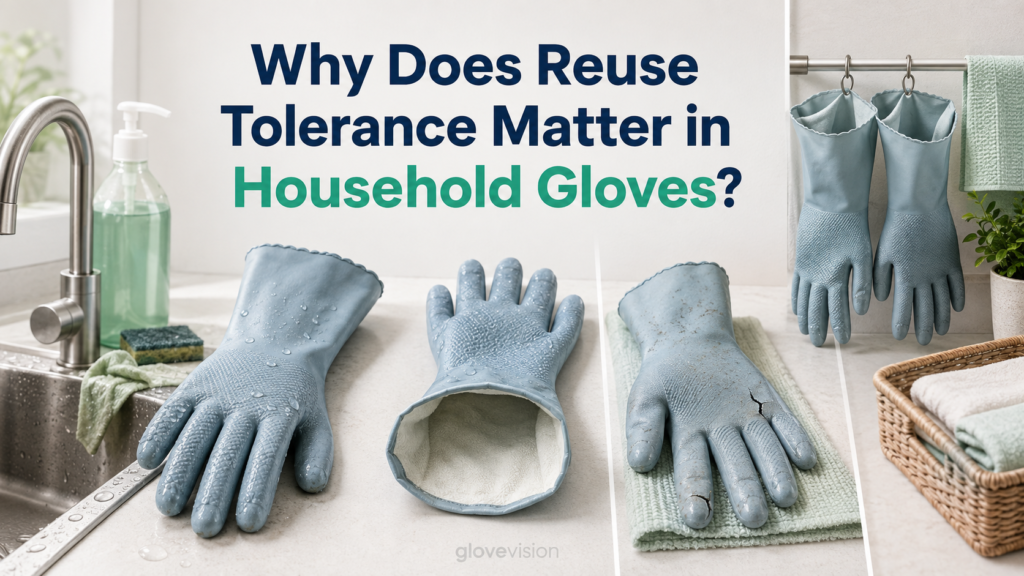
Why does reuse tolerance matter in household gloves?
Household glove reuse tolerance matters because reusable household gloves may not remain equally suitable after repeated cleaning sessions. Mechanical wear, cleaner exposure, moisture, cleaning, drying, storage, and ageing can all change the condition of the exact glove.
There is no universal safe number of reuses. Continued use requires manufacturer permission, known previous exposure and care history, intact construction, appropriate hygiene condition, current fit and grip, and verified compatibility with the next defined task.
Why Does Reuse Tolerance Matter for Reusable household gloves?
Reusable household gloves can be designed for repeated use without being suitable for unlimited use, because their condition and next-task suitability can change after each cleaning session. PPE selection should consider suitability to the work task, durability, cleanliness, fit, comfort, and the need to change or remove protection rather than assuming that one construction is suitable for every hazard. NIOSH
Why does “reusable” not mean indefinite use?
Reusable status exists within intended tasks, exposure conditions, care requirements, inspection, and replacement criteria. Mechanical wear, chemical exposure, moisture, cleaning, drying, storage, and ageing may change a glove between sessions.
Why can two pairs of Reusable household gloves have different reuse tolerance?
Material, formulation, thickness, construction, cuff, lining, intended task, care requirements, and previous exposure all matter. Do not rank nitrile, natural rubber, latex, neoprene, PVC, or another polymer universally.
Why must Reusable household gloves be reassessed before another task?
The next task may involve a different cleaner, concentration, contact duration, abrasion level, wet-work duration, cuff exposure, grip requirement, or dexterity demand. A glove that suited one previous task does not automatically suit the next.
The broader differences between household gloves and disposable gloves involve lifecycle, construction, hygiene strategy, care, replacement, and disposal, while this page focuses specifically on repeated reuse of reusable products.
| Repeated Task | Main Reuse Stress | What Must Be Verified | Reuse Concern | Decision |
|---|---|---|---|---|
| Dishwashing | Wet work, detergent, grip | Cleaner compatibility, cuff, interior dryness | Persistent moisture or grip loss | Reuse only if checks pass |
| Bathroom wiping | Cleaner contact, splash, hygiene | Exact cleaner, coverage, previous exposure | Degradation or contamination | Reassess before next task |
| Repeated scrubbing | Abrasion, flexing, pressure | Palm, fingertips, seams, grip | Thinning or structural wear | Replace when integrity is uncertain |
| General surface cleaning | Cleaner changes, repeated handling | Next-cleaner compatibility and care history | Assuming prior success proves future suitability | Verify each defined task |
| Sink or tub cleaning | Wet work, cuff entry, friction | Cuff stability, drying, cleaner compatibility | Interior moisture or cuff failure | Dry or replace as needed |
| Equipment cleanup | Residue, grip, repeated flexing | Exact substance, cleaning method, structural condition | Unknown residue or damage | Do not proceed if uncertain |
How Does Repeated Cleaning Exposure Affect Reusable household gloves?
Repeated cleaning exposure can affect Reusable household gloves through several independent pathways, including mechanical wear, chemical degradation, wet-work effects, care practices, heat, storage, and ageing. Chemical-risk performance is a separate property from mechanical or thermal performance, so one protective characteristic should not be used to infer another. ISO 374-1
How can mechanical wear affect Reusable household gloves?
Repeated scrubbing, gripping, stretching, bending, and tool handling may contribute to surface wear, local thinning, seam stress, cracking, or grip loss. The rate varies by product and task.
How can chemical exposure affect Reusable household gloves?
Chemical exposure can involve degradation, permeation, or penetration, which should not be treated as the same mechanism. ISO 6529 describes laboratory permeation testing for protective materials, including gloves, and notes that laboratory conditions do not necessarily reproduce actual use conditions; breakthrough information should therefore not be converted into a universal household reuse schedule. ISO 6529
How can wet work affect Reusable household gloves?
Repeated wet work may influence interior moisture, drying time, wet grip, lining condition, comfort, and cuff exposure. Wet use alone does not prove barrier failure.
Repeated wet household exposure should also be assessed for cuff runoff, wet grip, detergent contact, interior moisture, sustained immersion, and post-use drying.
How can cleaning and storage affect Reusable household gloves?
Unapproved cleaning, excessive heat, prolonged sunlight, damp storage, compression, residue, and incomplete drying can undermine a reliable reuse decision. Follow the exact manufacturer’s care instructions.
How Should Reusable household gloves Be Selected for Repeated Use?
Reusable household gloves should be selected for repeated use according to the exact cleaning task, cleaner, exposure conditions, construction, coverage, fit, required grip, care process, and manufacturer reuse instructions. OSHA requires hand-protection selection to consider performance relative to the task, conditions present, duration of use, and identified hazards. OSHA
Which task information matters when selecting Reusable household gloves?
Assess the exact chore, wet-work duration, cleaner, contact duration, mechanical friction, grip, dexterity, cuff exposure, and intended reuse frequency.
Which product information matters when selecting Reusable household gloves?
Check the exact model, manufacturer, reusable designation, intended use, material, formulation, thickness, coverage, cuff, lining, grip surface, and care instructions.
How should chemical suitability be verified for Reusable household gloves?
Where applicable, review the exact cleaner’s label and SDS together with the glove manufacturer’s compatibility information. OSHA’s SDS framework includes product identification, hazard information, and Section 8 exposure-control and personal-protection information. OSHA SDS
More demanding cleaner exposure requires dedicated household chemical glove selection based on exact formulation, compatibility, coverage, contact duration, construction, and current glove condition.
Should one polymer be ranked best for Reusable household gloves?
No. The exact complete product and task determine suitability; material name or thickness alone does not establish reusable life.
| Feature | Possible Reuse Benefit | Important Limitation | Verification |
|---|---|---|---|
| Full polymer shell | Continuous coverage may suit some wet tasks | Does not prove chemical compatibility | Exact material, model, cleaner, care |
| Long cuff | May increase wrist/forearm coverage | Cuff entry and fit still matter | Length, stability, task position |
| Reinforced palm | May support friction-heavy work | Reinforcement does not prove chemical performance | Wear condition and product data |
| Textured grip | May improve control | Grip texture can wear | Wet and dry control before reuse |
| Flock lining | May improve comfort and donning | Not a chemical or heat rating | Dryness, cleanliness, bunching, fit |
| Unlined construction | May simplify interior inspection | Not automatically safer or more compatible | Exact product documentation |
| Seamless construction | May reduce some seam-related wear points | Whole shell can still degrade or thin | Complete construction inspection |
How Do Construction, Fit, and Linings Affect Reusable household gloves?
Reusable household gloves should be assessed as complete products because palms, fingertips, seams, cuffs, lining, fit, grip, and other construction features may deteriorate or affect reuse differently. ISO 21420 covers glove design and construction, comfort, efficiency, marking, and information supplied by the manufacturer; hazard-specific protection still requires the appropriate specific evidence. ISO 21420
How do palms and fingertips affect Reusable household gloves?
These zones experience friction, gripping, flexing, local pressure, and local thinning, so they need close inspection before another cleaning session.
How do seams and cuffs affect Reusable household gloves?
Check seam opening, cuff damage, cuff stretching, cuff entry, loss of shape, and any closure condition.
How does fit affect Reusable household gloves?
How do linings affect Reusable household gloves?
Linings may affect comfort, moisture management, drying, interior inspection, hygiene, and fit. Do not treat lining as a chemical-barrier rating.
A separate assessment of glove lining and comfort can help distinguish flocked, textile-lined, removable-liner, and unlined constructions by moisture management, rubbing, donning, fit, and drying behavior.
When does lining damage affect Reusable household gloves enough to require replacement?
Change or replace the product when lining damage creates unresolved contamination, persistent drying problems, unsafe fit, excessive rubbing, bunching, loss of control, or unacceptable hygiene.
How Should Damage and Degradation in Reusable household gloves Be Recognized?
Damage and degradation in Reusable household gloves should be judged from observable changes, exposure history, complete construction, function, and manufacturer information rather than from one visual sign alone.
What does thinning mean in Reusable household gloves?
Thinning may indicate material loss from mechanical wear. Check location, extent, progression, grip, and remaining structure, and stop reuse when required protection becomes uncertain.
What does swelling mean in Reusable household gloves?
Swelling can be an observable sign that warrants concern about degradation or incompatibility. ISO 374-4 specifies a method for evaluating protective-glove material resistance to degradation during continuous chemical contact and explains that degradation testing should be considered alongside other chemical-resistance tests. ISO 374-4
What does tackiness or permanent softening mean in Reusable household gloves?
Tackiness or permanent softening can indicate an unsuitable condition involving degradation, incompatibility, ageing, or storage damage. Do not rely on another exposure when integrity is uncertain.
How are penetration and permeation different?
Penetration concerns passage through physical pathways or defects, while permeation concerns molecular passage through the material. ISO 374-2 specifies testing for penetration resistance of gloves protecting against dangerous chemicals and/or microorganisms. ISO 374-2
What does persistent interior odor mean in Reusable household gloves?
Possible contributors include retained moisture, residue, contamination, or incomplete drying. Odor alone does not diagnose microbial growth.
| Finding | Possible Concern | Check | Decision |
|---|---|---|---|
| Light surface wear | Mechanical abrasion | Depth, location, grip, progression | Continue only if required protection remains clear |
| Local thinning | Material loss | Remaining structure and task stress | Replace when protection is uncertain |
| Swelling | Possible degradation/incompatibility | Exposure history and exact compatibility | Stop and reassess |
| Tackiness | Possible degradation | Cleaner, storage, material condition | Replace when integrity is uncertain |
| Permanent softening | Material condition change | Exposure and function | Stop and reassess |
| Permanent hardening | Ageing, heat, chemical or care effect | Flexibility, fit, grip | Replace when function is affected |
| Cracking | Structural deterioration | Depth and location | Replace when barrier integrity is uncertain |
| Seam opening | Physical pathway | Extent and location | Replace |
| Persistent interior dampness | Incomplete drying, cuff entry, leakage, storage | Drying and structural inspection | Dry further or replace if unresolved |
| Persistent odor | Moisture, residue, contamination | Interior cleanliness and drying | Do not diagnose microbes from odor alone |
| Lining wear | Comfort, hygiene, drying or fit issue | Bunching, cleanliness, friction | Replace if safe function is affected |
How Should Reusable household gloves Be Cleaned, Dried, and Stored?
Reusable household gloves should be cleaned, dried, inspected, and stored only through methods appropriate to the exact product and previous exposure, because care can support approved reuse but cannot restore lost material or barrier integrity.
Should Reusable household gloves always be rinsed before removal?
No. Exterior cleaning before removal should occur only when manufacturer instructions and cleaner instructions permit it, runoff can be controlled, skin contact is avoided, and the process does not create another hazard.
Before post-use care begins, users should understand how cleaning gloves should be removed safely so residue on the exterior is not transferred to bare skin, clean surfaces, or the glove interior.
How should Reusable household gloves be cleaned?
Use only manufacturer-approved methods, cleaning agents, and decontamination procedures where applicable. Do not assume ordinary washing restores chemical resistance or lost barrier performance.
Can the inside of Reusable household gloves be washed?
Only when permitted for the exact product. Interior washing may affect lining, adhesives, drying, fit, and material condition.
How should Reusable household gloves be dried?
Follow the exact product instructions and ensure the glove is appropriately dry before reuse. Avoid unapproved direct heat, open flame, excessive heat, and damp storage.
The full reusable cleaning-glove drying process should address exterior moisture, interior moisture, ventilation, lining condition, approved drying methods, and storage readiness.
How should Reusable household gloves be stored?
Control heat, prolonged sunlight, sharp objects, compression, moisture, and cross-contamination according to manufacturer guidance.
| Stage | Checks |
|---|---|
| Identify glove | Exact model, manufacturer, reusable designation, intended uses, material, lining, care instructions. |
| Record previous exposure | Previous task, cleaner, duration, splash, cuff entry, immersion, abrasion, heat exposure. |
| Review cleaning instructions | Approved method and agent, interior-cleaning permission, no universal soap or rinse-while-worn rule. |
| Clean as permitted | Manage residue safely, separate clean surfaces, control runoff, avoid interior transfer. |
| Dry as permitted | Approved method, interior dry, no open flame or unapproved heat, no damp storage. |
| Inspect after care | No hole, tear, seam failure, significant thinning, swelling, tackiness, permanent softening, severe hardening, cracking, or coating separation. |
| Store correctly | Follow manufacturer guidance; avoid excessive heat, sunlight, sharp objects, dampness, and inappropriate contamination transfer. |
| Field | Record |
|---|---|
| Exact glove | Manufacturer and model |
| Previous task | Defined cleaning activity |
| Previous cleaner | Exact product/substance |
| Exposure duration | Known contact time and frequency |
| Unexpected contact | Splash, immersion, cuff entry, contamination |
| Cleaning | Method and agent used |
| Drying | Method and completeness |
| Storage | Conditions after use |
| Current condition | Structural, material, interior, fit and grip findings |
| Next task | Exact planned cleaning task and cleaner |
| Compatibility | Verified / unresolved |
| Final decision | Reuse, clean, dry further, reassess, choose another glove, replace, or do not proceed |
When Should Reusable household gloves Be Replaced?
Reusable household gloves should be replaced when structural damage, material degradation, unresolved contamination, functional failure, or uncertain exposure history makes another cleaning session unreliable.
Which structural failures require Reusable household gloves replacement?
Replace after a hole, tear, confirmed pinhole, seam opening, worn-through area, coating separation, or protective cuff damage.
Which degradation findings require Reusable household gloves replacement?
Significant swelling, tackiness, permanent softening, severe hardening, cracking, distortion, or loss of material strength are stop-and-reassess findings rather than conditions to simply dry and reuse.
Which interior and functional conditions require replacement?
Replace when contamination cannot be resolved, cleaner remains inside, visible mold is present, persistent dampness cannot be resolved, the lining prevents hygienic reuse, fit becomes unsafe, grip becomes unreliable, dexterity becomes inadequate, or the cuff no longer stays correctly positioned.
Which history problems require Reusable household gloves replacement?
Stop reuse when previous significant chemical exposure or care history is unknown, compatibility cannot be verified, manufacturer reuse instructions cannot be met, or structural integrity cannot be confidently assessed.
The broader cleaning-glove replacement framework covers structural damage, degradation, contamination, failed fit, lost grip, and other conditions that make continued use unreliable.
| Group | Continue Only When | Replace / Stop When |
|---|---|---|
| Structural integrity | No hole, tear, pinhole, seam opening, worn-through area, or cuff failure | Any structural pathway or failed protective zone appears |
| Material condition | No significant swelling, tackiness, softening, hardening, cracking, distortion, or coating separation | Material integrity is uncertain |
| Interior and lining | Clean, appropriately dry, functional lining | Unresolved contamination, mold, dampness, or unusable lining |
| Functional condition | Fit, grip, dexterity, flexibility, and cuff stability remain safe | Control or fit becomes unreliable |
| Exposure and care history | Previous task, cleaner, care and storage are known | Critical history is unknown |
| Next-task compatibility | Exact next cleaner and conditions are verified | Compatibility cannot be confirmed |
| Final decision | Reuse / clean / dry / reassess | Choose another glove / replace / do not proceed |
Which Mistakes Reduce Safe Reuse of Reusable household gloves?
Safe reuse of Reusable household gloves is reduced when users rely on material names, thickness, appearance, generic cleaning habits, or previous successful use instead of verifying the exact glove, exposure history, current condition, and next task.
What Should Users Check Before Reusing Reusable household gloves?
Before Reusable household gloves are used again, the exact glove, previous exposure, care history, complete construction, interior condition, fit, grip, and compatibility with the next cleaner should all be checked.
| Decision Stage | What to Verify | Stop / Reassess When |
|---|---|---|
| Identify exact glove | Model, manufacturer, reusable designation, intended uses, material, lining, care instructions | Product identity or reuse permission is unknown |
| Review previous use | Task, cleaner, duration, splash, immersion, cuff entry, abrasion, unexpected contact | Significant exposure history is unknown |
| Review previous care | Approved cleaning, approved interior care, approved drying, suitable storage | Unapproved chemical or heat method was used |
| Inspect construction | Palm, fingertips, thumb web, finger sides, back, seams, cuff, lining, reinforcement | Integrity cannot be confidently assessed |
| Check material condition | No holes, tears, pinholes, severe thinning, swelling, tackiness, softening, hardening, cracking, distortion, separation | Any serious degradation or barrier concern exists |
| Check interior readiness | Clean, dry, no cleaner residue, no unresolved contamination, no visible mold, lining functional | Interior hygiene remains unresolved |
| Check fit and function | Correct fit, finger position, grip, dexterity, cuff stability, no twisting | Control or fit is unsafe |
| Verify next task | Exact task, cleaner, label, SDS where relevant, compatibility, duration, mechanical stress, grip and cuff needs | Next-task suitability is uncertain |
| Final decision | Reuse, clean as permitted, dry further, reassess, choose another glove, replace, or do not proceed | Any essential requirement cannot be verified |
Conclusion
Reusable household gloves should be reused only when their exact construction, exposure history, care history, condition, fit, and compatibility remain suitable for the next defined cleaning task. Reusable does not mean unlimited, and no universal reuse count applies.
Mechanical wear, chemical compatibility, interior condition, fit, grip, approved care, and the exact next cleaner all matter. When significant damage, degradation, unresolved contamination, failed function, or uncertain history prevents a confident reuse decision, the glove should not simply be returned to service.
Frequently Asked Questions
01How many times can Reusable household gloves be reused?
There is no universal number. Reuse depends on the exact glove, manufacturer instructions, previous exposure, care history, drying, storage, current condition, and next task.
02Can Reusable household gloves be reused after they swell?
Significant swelling can indicate degradation or incompatibility. Do not simply dry and reuse the glove unless exact manufacturer instructions establish continued suitability.
03Can the inside of Reusable household gloves be washed?
Only when the exact manufacturer permits interior washing and provides an appropriate care method.
04Can Reusable household gloves be used with a different cleaner next time?
Only after verifying compatibility with the new cleaner and confirming that previous exposure, care, and current condition still support reuse.
05When should Reusable household gloves be replaced?
Replace them when damage, significant degradation, unresolved contamination, unsafe fit, lost grip, or uncertain exposure history makes the next use unreliable.