
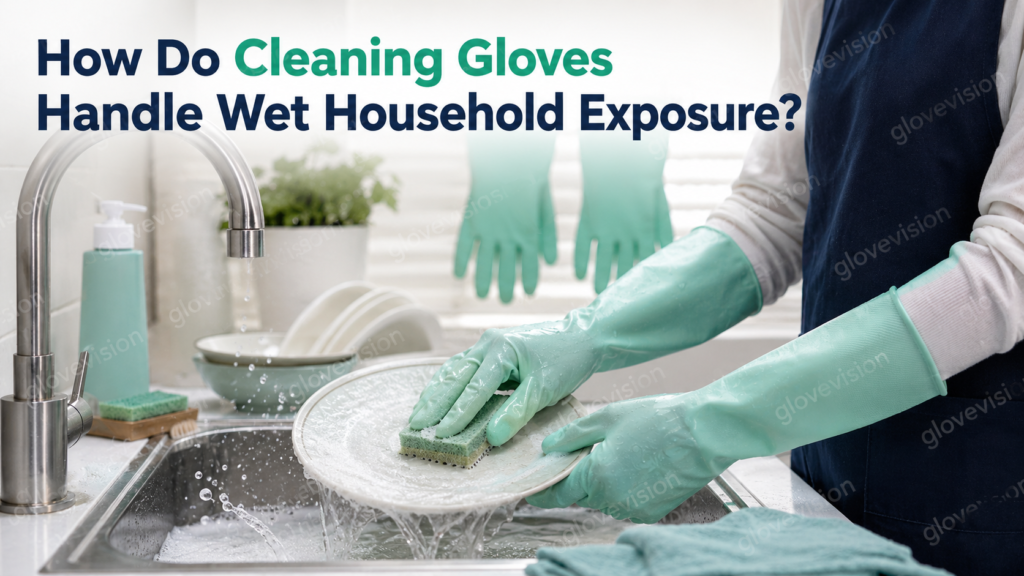
How Do Cleaning Gloves Handle Wet Household Exposure?
Cleaning Gloves handle wet household exposure well when the exact product remains intact, excludes external water, provides safe wet grip, fits the task, and matches the detergent or cleaner.
Wet-use performance is not determined by material or thickness alone. Immersion, splashing, water temperature, cuff position, perspiration, lining, repeated flexing, abrasion, drying, storage, and condition-based replacement all affect the result.
This article provides general Cleaning Glove guidance. Always follow the household-cleaner label and exact glove instructions. Stop use when water enters unexpectedly, the gloves are damaged, grip becomes unsafe, cleaner compatibility is unclear, or persistent skin irritation develops.
Why Does Sustained Wet Household Exposure Matter for Cleaning Gloves?
Sustained wet household exposure matters because Cleaning Gloves must exclude water while maintaining grip, comfort, fit, and integrity during repeated immersion, splashing, flexing, and detergent contact.
How does wet work affect the hands?
Repeated or prolonged contact with water, soaps, and detergents may dry or irritate the skin and can contribute to contact dermatitis. HSE presents this as workplace guidance, but the general principle is useful for household wet tasks. [DER]
How can Cleaning Gloves reduce wet-work exposure?
Cleaning Gloves may reduce direct contact with water, detergent, cleaning solution, wet surfaces, and residue when the exact pair remains intact and suitable. Cleaning Gloves overview.
Why is sustained wet work different from brief wiping?
Longer or repeated tasks increase immersion, detergent contact, flexing, abrasion, perspiration, cuff exposure, and dependence on wet grip. HSE advises selecting gloves around the substance, other hazards, contact type and duration, wearer, and task rather than from material name alone. [SEL]
Which Wet-Use Conditions Affect Cleaning Gloves?
Cleaning Gloves should be assessed against the exact combination of water, cleaner, temperature, duration, frequency, immersion, and mechanical stress.
Is the task immersion, splashing, or brief contact?
Distinguish hands submerged in a sink from repeated spray, running water, bucket contact, runoff, and short damp wiping. Cuff length must exceed the expected immersion depth, but arm position and runoff still matter.
Which detergent or cleaner is present?
Identify the exact dishwashing detergent, bathroom cleaner, bleach-containing product, descaler, disinfectant, degreaser, or floor cleaner. Waterproof integrity does not establish cleaner compatibility. Cleaner-matching guide.
What water temperature and mechanical stress are involved?
Assess cool, warm, or changing water together with scrubbing, wringing, wet-object handling, repeated finger flexing, abrasion, and sharp objects. Cleaning Gloves are not automatically thermal or cut-resistant gloves.
Table 1. This matrix connects each household wet task to its main exposure and glove need.
| Household task | Wet exposure | Temperature | Cleaner | Mechanical stress | Main glove need |
|---|---|---|---|---|---|
| Dishwashing | Immersion and rinsing | Warm | Detergent | Wet dishes and glassware | Grip, fit, dexterity, cuff control |
| Bathroom cleaning | Splash and rinse | Cool to warm | Bathroom cleaner | Scrubbing and abrasion | Compatibility, cuff, durability |
| Toilet or drain | Heavy splash or contact | Variable | Strong cleaner possible | Scrubbing | Separate pair and verified compatibility |
| Mopping | Bucket and splash | Variable | Floor cleaner | Wringing and handle grip | Cuff coverage and wet grip |
| Cloth rinsing | Repeated running water | Variable | Mild cleaner | Twisting and flexing | Dexterity and integrity |
| Quick wiping | Brief damp contact | Usually cool | Mild cleaner | Light | Fit and cleaner compatibility |
Task labels describe conditions, not universal wear-time or material rankings.
How Do Water Entry and Internal Moisture Affect Cleaning Gloves?
Moisture inside Cleaning Gloves may result from perspiration, cuff entry, damage, saturated lining, or incomplete drying, and each cause requires a different response.
How can perspiration be distinguished from a leak?
Even dampness across both hands is more consistent with perspiration or incomplete drying, while one localized wet spot suggests shell or seam damage. Internal moisture alone does not prove leakage.
How does water enter through the cuff?
Water may run down the forearm, enter a loose opening, or reach the cuff when the arm is lowered or submerged. Longer cuffs add coverage but cannot prevent every entry event.
What should happen when the cause is uncertain?
Stop the task, dry the hands and gloves, inspect the shell, seam, cuff, and lining, then reassess under a controlled condition. Repeated unexplained entry is a replacement or escalation trigger.
Table 2. This matrix separates a useful wet-use feature from its limitation and required verification.
| Moisture pattern | Likely cause | What to check | Required action | Replacement trigger |
|---|---|---|---|---|
| Even dampness | Perspiration | Wear duration, temperature, lining | Air hands and dry gloves | Persistent discomfort or degraded lining |
| Wet wrist area | Cuff entry or runoff | Cuff fit, arm angle, water depth | Stop, dry, and correct technique | Repeated unexplained entry |
| One localized wet spot | Pinhole or tear | Shell and seam integrity | Stop use and inspect | Confirmed leak or damage |
| Damp before donning | Incomplete drying | Interior and storage | Dry fully before reuse | Odor or material deterioration |
| Saturated lining | Moisture retention | Lining condition and drying time | Dry longer or use suitable liner | Lining remains wet or damaged |
| Persistent odor | Poor drying or retained contamination | Interior, storage, assigned zone | Clean and dry per instructions | Odor persists after correct care |
| Repeated unexplained entry | Unknown cause | Cuff, shell, seams, task | Remove from use pending review | Cause cannot be resolved |
No single feature proves complete suitability for the task or cleaner.
Which Household Tasks Require Cleaning Gloves Designed for Wet Use?
Household tasks require different Cleaning Glove controls because immersion, cleaner strength, hygiene concerns, cuff exposure, and wet grip vary by zone.
What do Cleaning Gloves need for dishwashing?
Dishwashing emphasizes wet grip, dexterity, fit, cuff control, warm-water comfort, and intended use for dishes or food-related surfaces.
What do Cleaning Gloves need for bathroom cleaning?
Bathroom tasks may add stronger cleaner exposure, abrasion, splashing, and longer cuffs. Bleach-task guide.
Why should toilet or drain pairs remain separate?
Prefer a clearly identifiable pair that does not move into kitchen or food-related use. Color may support identification, but color alone does not prove suitability or cleanliness.
Table 3. This matrix uses moisture location and timing to guide the next inspection.
| Household zone | Main exposure | Hygiene concern | Assigned Cleaning Gloves | Storage rule |
|---|---|---|---|---|
| Dishwashing | Water and detergent | Food-related items | Kitchen-assigned pair | Dry and store away from bathroom pairs |
| Food-related surfaces | Water and cleaner | Food-contact suitability | Verified intended-use pair | Keep clean and identifiable |
| Bathroom | Cleaner and splash | Cross-zone transfer | Bathroom-assigned pair | Store separately |
| Toilet or drain | Strong contamination potential | Transfer to cleaner areas | Dedicated toilet/drain pair | Isolate from kitchen gloves |
| Mopping | Bucket and floor cleaner | Floor residue | Floor-cleaning pair | Dry away from dirty tools |
| General wiping | Brief wet contact | Multiple-surface transfer | Defined general-use pair | Keep status clear |
Likely causes are screening clues, not confirmed diagnoses of leakage.
Which Features Make Cleaning Gloves Suitable for Wet Household Tasks?
The most useful Cleaning Glove features work together: intact construction, cuff control, safe wet grip, correct fit, suitable lining, dexterity, and documented cleaner compatibility.
Are thicker Cleaning Gloves always better?
No. Greater thickness may support some durability needs but can reduce dexterity, tactile feedback, comfort, and fine control. HSE recommends balancing protection with task performance. [WET]
How should wet grip and fit be assessed?
Test representative wet dishes, bottles, cloths, brushes, buckets, or handles. HSE recommends considering roughened or textured surfaces where wet objects are handled, while also preserving dexterity and correct fit. [SEL]
Are lined Cleaning Gloves always more comfortable?
No universal winner applies. Flocked lining or a compatible removable cotton liner may absorb some perspiration, but either can become damp and must preserve fit, grip, and cuff control. [CLEAN]
Table 4. This matrix keeps kitchen, bathroom, toilet, drain, floor, and general-use pairs from uncontrolled cross-use.
| Feature | Wet-use benefit | Limitation | Verification | Rejection trigger |
|---|---|---|---|---|
| Waterproof shell | Excludes external water when intact | Does not prove cleaner resistance | Inspect exact product and instructions | Leak, tear, crack, or pinhole |
| Cuff length | Adds splash coverage | Cannot stop submerged or runoff entry | Compare task depth and arm position | Water repeatedly enters cuff |
| Cuff fit | May reduce open-gap entry | Too tight or loose impairs use | Check wrist and forearm fit | Twisting, gaps, discomfort |
| Textured grip | May improve wet control | Texture appearance alone is insufficient | Test representative wet objects | Objects slip or glove rotates |
| Thickness | May support durability | Can reduce dexterity and feedback | Balance task protection and control | Unsafe handling |
| Lining | May improve comfort | Can remain damp or retain odor | Inspect and dry fully | Saturated or persistent odor |
| Correct size | Supports control and comfort | Poor fit reduces grip | Use product sizing guidance | Fatigue, folds, slipping |
| Cleaner compatibility | Supports exact task approval | Waterproofing does not establish it | Check cleaner label and glove documentation | Unknown or contradictory evidence |
Color can identify a zone but cannot prove cleanliness or product suitability.
How Should Cleaning Gloves Be Used During Dishwashing, Bathroom Cleaning, and Mopping?
Cleaning Gloves should be used with dry hands, a controlled cuff position, a verified cleaner, safe wet grip, and planned breaks when the task can be paused safely.
How should the cuff and water level be controlled?
Keep the cuff opening above the expected water level, avoid arm positions that direct runoff inside, and do not prescribe one universal folding technique.
How should perspiration and hot, sticky hands be managed?
Use safe glove breaks, air the hands, and dry damp liners before reuse. HSE describes glove breaks and suitable cotton liners as conditional comfort controls rather than one mandatory schedule. [CLEAN]
What should happen when grip, fit, or skin comfort becomes unsafe?
Stop at a safe point, remove the gloves carefully, wash and dry the hands as appropriate, inspect the pair, and continue only after the cause is controlled.
How Should Cleaning Gloves Be Rinsed, Dried, and Stored After Wet Use?
Reusable Cleaning Gloves should follow a product-specific rinse, drain, dry, inspect, and storage process that leaves both exterior and interior ready for the next task.
How should Cleaning Gloves be rinsed?
Follow product instructions and keep contaminated rinse water from flowing into the cuff. HSE advises rinsing reusable gloves before removal when practical and storing them correctly. [SEL]
Should Cleaning Gloves always be turned inside out?
No. Open the cuffs and use ventilated drying; invert only when the product design and instructions permit it. Avoid high heat, radiators, hair dryers, flame, and intense sunlight unless expressly approved.
How should dry pairs be stored?
Keep them dry, ventilated, shaded, away from sharp objects, and separated by household zone. Drying and storage guide.
Table 5. This matrix defines rinse, drain, dry, inspect, and storage controls after wet use.
| Stage | Required action | Failure sign | Corrective action | Replacement trigger |
|---|---|---|---|---|
| Rinse | Follow product instructions and keep runoff away from cuff | Residue remains | Repeat approved rinse or reassess cleaner | Material changes or unsupported cleaning |
| Drain | Allow water to leave exterior and cuff safely | Water trapped inside | Reposition and ventilate | Repeated internal water without known cause |
| Dry | Open cuffs and use ventilated drying | Interior remains damp | Extend drying; invert only if permitted | Persistent wet lining or odor |
| Inspect | Check shell, seams, cuff, grip, fit, lining | Cracks, tackiness, thinning, lost texture | Remove from use | Any integrity or control failure |
| Store | Keep dry, ventilated, shaded, and zone-separated | Heat, sunlight, damp container, sharp contact | Relocate and reassess | Damage or degradation |
Exact manufacturer care instructions remain the final authority.
When Should Cleaning Gloves Be Replaced After Wet Use?
Cleaning Gloves should be replaced according to observed condition, task performance, compatibility, fit, lining, and skin response rather than one universal wear time.
Which integrity changes require replacement?
Replace for tears, pinholes, cracks, seam failure, cuff damage, thinning, tackiness, swelling, hardening, softening, brittleness, or repeated water entry.
Which performance changes require replacement?
Replace or reject the pair when grip texture is worn, objects slip, the glove twists, fit is poor, dexterity becomes unsafe, lining remains saturated, or cleaner compatibility is unresolved.
What should happen when skin symptoms occur?
Stop use and reassess the pair when persistent redness, itching, cracking, pain, swelling, or rash develops. Natural-rubber latex proteins and glove-manufacturing chemicals can cause allergic or irritant reactions, but symptoms should not be self-diagnosed. [LATEX]
For follow-up detail, see the replacement guide.
Table 6. This matrix links observable glove conditions to immediate action and replacement decisions.
| Observed condition | Possible meaning | Immediate action | Decision | Escalation trigger |
|---|---|---|---|---|
| Local water entry | Pinhole, tear, or seam failure | Stop use and inspect | Replace if leak confirmed | Cleaner contacted skin |
| Wet cuff area | Runoff, immersion, or loose cuff | Dry hands and gloves; correct technique | Continue only after cause is controlled | Repeated entry |
| Even perspiration | Occlusive wear or warm conditions | Take safe break and air hands | Adjust comfort controls | Persistent skin symptoms |
| Worn grip texture | Surface wear | Test control with representative object | Replace if grip unsafe | Dropping risk |
| Tackiness or swelling | Cleaner incompatibility or degradation | Stop use | Replace and review product evidence | Unknown cleaner effect |
| Cracking or brittleness | Aging, heat, or chemical damage | Remove from use | Replace | Skin exposure occurred |
| Damp lining | Incomplete drying or saturation | Dry fully | Restrict reuse until dry | Persistent odor or damage |
| Poor fit | Wrong size or product deformation | Stop unsafe task | Select correct size | Loss of control |
| Skin irritation | Irritation or sensitivity possible | Stop use and wash hands appropriately | Reassess product and seek advice if persistent | Pain, swelling, cracking, or rash |
No universal calendar interval or wear time applies to every Cleaning Glove product.
Which Mistakes Shorten the Wet-Use Life of Cleaning Gloves?
Cleaning Gloves fail early when wet exposure, cleaner compatibility, cuff entry, drying, storage, household-zone assignment, and skin comfort are managed through assumptions.
Which selection mistakes should be avoided?
Avoid universal material rankings, thickness-only decisions, waterproof-equals-cleaner-compatible claims, and using a product whose exact instructions are missing or contradictory.
Which use mistakes should be avoided?
Avoid submerging the cuff, continuing after unexplained water entry, handling dangerously hot water, using poor wet grip, and exposing gloves to sharp objects beyond their intended protection.
Which care and hygiene mistakes should be avoided?
Avoid wet sealed storage, universal inside-out drying, high heat, cross-use between toilet and kitchen zones, and reusing disposable gloves as sustained wet-work Cleaning Gloves.
Which evidence claims require product-specific proof?
Exact cleaner resistance, food-related suitability, drying method, service life, and replacement instructions must come from the cleaner label and exact glove documentation. General HSE principles cannot approve a specific household product. [PPE]
What Should Households Verify Before Using Cleaning Gloves for Wet Tasks?
Households should verify the exact task, cleaner, Cleaning Glove product, water exclusion, wet grip, cuff, lining, zone assignment, care, condition, and skin response before routine use.
- Define the Household Task:
- Identify the exact task, household zone, water exposure, and duration.
- Record water temperature, cleaner, dilution, and mechanical stress.
- Identify sharp-object, abrasion, and slipping hazards.
- Identify the Cleaner:
- Read the cleaner label before use.
- Do not infer cleaner compatibility from waterproof claims.
- Pause when product or glove evidence is unclear.
- Identify the Exact Cleaning Gloves:
- Record manufacturer, product name, size, cuff, lining, and intended use.
- Confirm reusable status and care instructions.
- Do not approve from material name or thickness alone.
- Verify Water Exclusion:
- Inspect shell, seams, cuff, and interior before use.
- Keep cuffs above the expected water level.
- Stop when water enters unexpectedly.
- Verify Wet Grip and Dexterity:
- Test control with representative wet objects.
- Reject twisting, slipping, fatigue, or poor finger control.
- Balance protection with dexterity.
- Verify Lining and Internal Comfort:
- Begin with dry hands and a dry interior.
- Use flock lining or removable liners only when suitable.
- Take safe breaks before hands become excessively hot or sticky.
- Separate Household Zones:
- Assign identifiable pairs to kitchen, bathroom, toilet or drain, and floor tasks where appropriate.
- Do not move a dirty-zone pair into food-related use after a quick rinse.
- Store zone pairs separately.
- Use Cleaning Gloves Correctly:
- Keep water below the cuff opening.
- Avoid unsafe hot water and sharp-object contact.
- Stop when grip, fit, or comfort becomes unsafe.
- Manage Water Entry:
- Identify whether moisture is sweat, cuff entry, damage, or incomplete drying.
- Dry hands and gloves before reassessment.
- Replace a leaking or unresolved pair.
- Rinse After Use:
- Follow the exact product instructions.
- Prevent rinse water from entering the cuff.
- Do not use incompatible cleaning agents.
- Dry Cleaning Gloves:
- Open cuffs and dry in ventilation.
- Invert only when the design permits it.
- Avoid radiators, hair dryers, direct flame, and high heat unless explicitly permitted.
- Store Cleaning Gloves:
- Store fully dry, shaded, ventilated, and away from sharp objects.
- Do not seal damp gloves in a container.
- Keep incompatible household zones separate.
- Inspect Before Reuse:
- Check for cracks, pinholes, swelling, tackiness, brittleness, worn grip, odor, and damp lining.
- Confirm correct fit and cuff condition.
- Do not rely on visual appearance alone when water entry repeats.
- Replace Cleaning Gloves:
- Use condition-based replacement criteria.
- Replace after integrity, grip, fit, compatibility, or lining failure.
- Do not reuse disposable gloves as sustained wet-work Cleaning Gloves.
- Protect the Hands:
- Check for dryness, redness, itching, cracking, pain, swelling, or rash.
- Moisturize as skin care, not as a glove substitute.
- Stop use and seek appropriate advice when symptoms persist.
Completion rule: this checklist supports a product- and task-specific decision but does not prove universal cleaner compatibility, leak resistance, service life, or medical suitability.
- HSE — Choosing the Right Gloves to Protect Skin — used for task, substance, contact, fit, grip, and duration principles.
- HSE — Gloves: Choosing the Right Gloves to Protect Skin — used for wet grip, glove breaks, cotton liners, and reusable care.
- HSE — Work-Related Contact Dermatitis: Cleaning — used for repeated water, soap, detergent, and skin-risk context.
- HSE — Skin at Work: Cleaning FAQs — used for flock lining, removable liners, and comfort controls.
- HSE — Latex Allergies — used for natural-rubber-latex and glove-additive reaction context.
- HSE — PPE Selection and Use — used for fit, wearer, exposure, duration, and task-selection principles.
- HSE — Using the Right Type of PPE — used for immersion depth, cuffs, hands, and other hazard considerations.
What Should Households Remember About Cleaning Gloves and Wet Exposure?
Cleaning Gloves handle wet household exposure reliably only when the exact pair remains intact, fits the wearer and task, excludes external water, grips wet objects safely, matches the cleaner, and controls cuff entry and internal moisture.
Material name, thickness, cuff length, or lining alone cannot guarantee suitability. Correct use, household-zone separation, ventilated drying, inspection, and condition-based replacement determine whether the pair remains ready for reuse.
Frequently Asked Questions
How long can Cleaning Gloves be worn continuously in water?
No universal wear time applies. Duration depends on the exact product, cleaner, temperature, task, comfort, perspiration, grip, and condition. Take a safe break or stop when hands become excessively hot, sticky, wet, irritated, or difficult to control.
Why are Cleaning Gloves wet inside when no hole is visible?
Internal moisture may come from perspiration, damp hands, cuff entry, saturated lining, or incomplete drying. Repeated localized wetness is more suggestive of a pinhole, tear, or seam problem.
Should Cleaning Gloves always be turned inside out to dry?
No. Use open cuffs and ventilated drying, and invert only when the design and manufacturer instructions permit it.
Can the same Cleaning Gloves be used for dishwashing and bathroom cleaning?
Prefer separate identifiable pairs where cross-use could move contamination or cleaner residue into food-related tasks. A quick rinse does not automatically make a bathroom pair suitable for dishes.
Does water resistance mean Cleaning Gloves resist bleach or bathroom cleaner?
No. Water exclusion and cleaner compatibility are separate properties. Check the cleaner label and documentation for the exact Cleaning Glove product.