
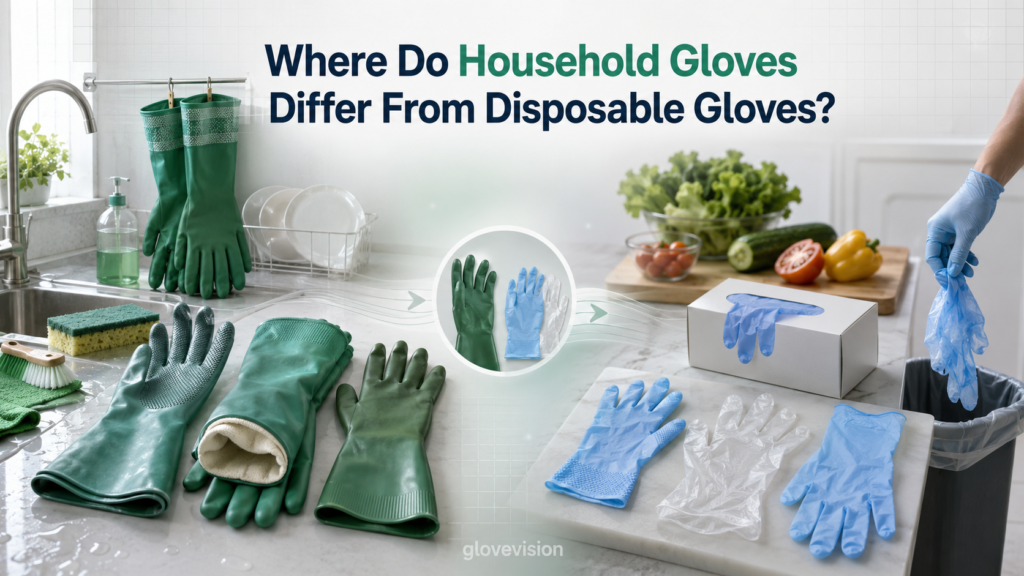
Where do household gloves differ from disposable gloves?
Household gloves and disposable gloves differ mainly in intended lifecycle, construction, durability, dexterity, coverage, hygiene use, and how they are maintained or discarded.
Neither category is automatically safer or more chemical-resistant. Suitability depends on the exact task, cleaner or substance, contact duration, mechanical stress, glove model, material, fit, coverage, compatibility information, hygiene strategy, condition, and manufacturer instructions.
How Do Household gloves and disposable gloves Differ in Construction and Intended Use?
Household gloves and disposable gloves differ first in how they are intended to be used, maintained, changed, and discarded. Household gloves and disposable gloves should be selected according to the task, conditions, expected duration, and identified hazards rather than category name alone. OSHA Household gloves are often designed for repeated chores and approved reuse, while disposable gloves are commonly designed for single-use or limited-duration tasks and frequent glove changes.
How does intended lifecycle differ?
Reusable does not mean indefinitely reusable, and disposable does not automatically mean weak, food-safe, medical-grade, or unsuitable for cleaning.
How do thickness and coverage differ?
Do not use category-wide thickness ranges. Compare the exact product’s palm, finger and cuff thickness, material formulation, texture, lining, seams, back-of-hand coverage, and cuff length. Household gloves may provide longer cuffs or full polymer shells, while disposable products vary widely by application.
Why does lifecycle matter?
Reusable products require a documented care, inspection, drying, storage, and exposure-history workflow. Reusable status alone does not establish long-term suitability; gloves intended for repeated wet reuse also need an appropriate shell, cuff, lining, drying behavior, and condition-management process. Single-use products require appropriate change points, safe removal, and disposal rather than routine washing and reuse.
| Feature | Household Gloves | Disposable Gloves | Important Limitation |
|---|---|---|---|
| Intended lifecycle | Often repeated use where approved | Often single-use or limited-duration | Verify exact manufacturer designation |
| Thickness | May be greater in some products | May be lower in some products | No universal category range |
| Cuff length | May extend farther up the wrist or forearm | Varies by product and application | Coverage must match splash and task needs |
| Lining | May be flock-lined, textile-lined, or unlined | Often unlined, but exact construction varies | Lining does not prove thermal protection |
| Dexterity | May trade tactile sensitivity for structure | May support fine tactile work | Fit and thickness still matter |
| Cleaning | Only as manufacturer permits | Ordinary single-use gloves should not be routinely washed for reuse | Cleaning is not validated decontamination |
| Chemical performance | Product-specific | Product-specific | Reusable/disposable status is not compatibility evidence |
| Mechanical durability | Varies by exact build | Varies by exact build | Category alone does not prove abrasion, tear, or puncture performance |
| Hygiene strategy | Task separation plus approved care | Frequent changes across contamination boundaries | Both require safe removal and hand hygiene |
How Do Household gloves and disposable gloves Differ in Mechanical and Barrier Performance?
Household gloves and disposable gloves cannot be compared reliably by thickness or lifecycle alone because abrasion, tear, puncture, penetration, permeation, degradation, and chemical compatibility are separate product-specific properties. Chemical-risk performance should be evaluated separately from mechanical or thermal performance; one protective property does not establish another. ISO 374-1
How should abrasion, tear, and puncture be compared?
Check the exact material, thickness, reinforcement, surface construction, fit, existing damage, expected friction, object shape, applied force, task stress, and manufacturer performance data. Neither category is puncture-proof, and a product that performs well against abrasion does not automatically provide equivalent tear or puncture resistance.
How should chemical barrier performance be compared?
Compare the exact chemical, concentration, glove material and formulation, model, thickness, coverage, duration, temperature, flexing conditions, manufacturer compatibility data, and breakthrough or permeation information where available.
Penetration is evaluated separately from permeation and concerns resistance to passage through physical defects or construction pathways under the applicable test method. ISO 374-2
How Should Household gloves and disposable gloves Be Matched to Household Tasks?
Household gloves and disposable gloves should be matched to the exact household task, hazard, duration, hygiene boundary, required coverage, grip, dexterity, and product documentation.
What should be checked for dishwashing and repeated wet work?
Assess repeated wet exposure, detergent compatibility, water temperature, wet grip, cuff coverage, interior drying, duration, and whether the exact product is documented for the task. Repeated dishwashing and rinsing create a separate wet household exposure problem involving water contact, detergent compatibility, cuff control, wet grip, interior moisture, and drying.
What should be checked for bathroom cleaning?
Check the exact cleaner, compatibility, splash risk, abrasion, cuff coverage, contact duration, and hygiene boundaries between toilet, sink, shower, waste, and clean areas.
What should be checked for food preparation?
Disposable status does not prove food-contact suitability. Verify the exact product’s food-contact documentation, raw-versus-ready-to-eat boundaries, hand hygiene, glove-change points, dexterity, and cross-contamination controls. In food handling, single-use gloves should remain limited to the defined task and be discarded when damaged, soiled, or when the operation is interrupted rather than carried into another task. FDA Food Code When direct food handling is involved, evaluate disposable gloves for food preparation separately because food-contact suitability, hygiene boundaries, glove changes, fit, and the exact intended use still need verification.
What should be checked for painting, adhesives, heavy scrubbing, and waste?
Identify the exact paint, adhesive, solvent, cleaner, or waste exposure; expected abrasion and tear stress; grip requirements; duration; compatibility; coverage; and change or replacement schedule.
| Task | Main Requirement | Household Gloves May Suit When | Disposable Gloves May Suit When | Required Verification |
|---|---|---|---|---|
| Dishwashing | Wet grip, cuff coverage, detergent contact | Repeated wet use is permitted and glove can be dried | Short task and exact product suits detergent/water contact | Cleaner, temperature, grip, cuff, drying |
| Bathroom wiping | Cleaner compatibility and hygiene separation | Barrier, cuff, reuse, and care are documented | Short-duration contact and frequent changes are appropriate | Cleaner label, compatibility, splash, zones |
| Heavy scrubbing | Abrasion, grip, mechanical durability | Construction tolerates repeated friction | Mechanical demands remain within product capability | Abrasion, tear, grip, compatibility |
| Food preparation | Food-contact approval and hygiene changes | Only when exact product is approved and task-appropriate | Food-contact status is documented and changes are controlled | Food-contact declaration, task, hygiene boundaries |
| Painting | Paint/solvent compatibility and dexterity | Exact reusable glove is compatible | Exact disposable glove is compatible for the defined duration | Paint label, SDS, compatibility, duration |
| Adhesive handling | Chemical compatibility and tactile control | Exact model is compatible and reusable | Exact model is compatible for intended use | Adhesive, SDS, glove data, change schedule |
| Waste handling | Puncture, contamination, grip, hygiene | Construction and cleaning pathway fit the task | Mechanical risk is low and frequent disposal is appropriate | Sharp hazards, contamination, fit, removal |
How Should Household gloves and disposable gloves Be Selected for Chemical Contact?
Household gloves and disposable gloves should be selected for chemical contact using the exact cleaner, label, SDS where relevant, exact glove model, material, thickness, compatibility data, duration, and coverage—not reusable or disposable status alone.
Which cleaner information should be checked?
For chemical contact, review the exact product information and SDS where applicable; SDS Section 8 includes exposure-control and personal-protection information. OSHA SDS
- Exact product name and formulation.
- Label directions and hazard statements.
- SDS where relevant.
- Required PPE and dilution.
- Contact mode, duration, splash, immersion, and cleanup conditions.
Which glove information should be checked?
- Exact model and intended use.
- Material, formulation, and thickness.
- Palm, finger, back-of-hand, and cuff coverage.
- Chemical compatibility and breakthrough information where available.
- Reusable or single-use designation.
- Cleaning, change, replacement, and disposal instructions.
Permeation and breakthrough data apply to the tested material and chemical under defined laboratory conditions and should not be treated as a universal safe-wear time for every glove or task. ISO 6529
Why can either category still be unsuitable?
A reusable household glove may still use an incompatible polymer, lack coverage, have uncertain breakthrough data, or be damaged. Stronger or longer-duration cleaner exposure requires deeper household chemical glove selection based on the exact formulation, compatibility, coverage, contact conditions, and complete glove construction. A disposable glove may be appropriate only when compatibility is documented, the intended duration is appropriate, mechanical demands are acceptable, coverage is adequate, and change points are controlled.
| Field | Record Before Use |
|---|---|
| Task | Exact household activity and work sequence |
| Product handled | Exact cleaner, paint, adhesive, food, waste, or substance |
| Label / SDS | Relevant directions, hazards, PPE, dilution, and handling information |
| Glove model | Manufacturer and exact product |
| Lifecycle | Reusable, limited-use, or single-use |
| Material / thickness | Exact formulation and documented thickness |
| Coverage | Palm, fingers, back, cuff, lining, seams |
| Chemical compatibility | Exact glove + exact chemical evidence |
| Mechanical suitability | Abrasion, tear, puncture, grip, flexing needs |
| Duration | Expected contact and task time |
| Hygiene boundary | Where gloves must be changed or removed |
| Final decision | Use, change, choose another glove, add coverage, replace, dispose, or do not proceed |
How Do Fit, Grip, and Dexterity Affect Household gloves and disposable gloves?
Household gloves and disposable gloves must fit securely enough to maintain grip, dexterity, tactile control, cuff stability, and safe removal throughout the task. Material alone does not describe the finished glove; construction, comfort, efficiency, marking, and manufacturer information also form part of protective-glove evaluation. ISO 21420
How does lining affect comfort?
Flock or textile lining may affect comfort, sweating, donning, friction, and drying. Reusable constructions may also require a separate assessment of glove lining and comfort, because flocked, textile-lined, and unlined interiors can differ in hand feel, moisture retention, donning, fit, and drying behavior. Lining does not automatically establish thermal or hot-water protection.
How Should Failures in Household gloves and disposable gloves Be Diagnosed?
Failures in household gloves and disposable gloves should be evaluated from observable damage, task conditions, exposure history, fit, material changes, and manufacturer information rather than appearance alone.
What do tearing, swelling, tackiness, cracking, or hardening mean?
Repeated tearing may involve poor size, excessive stress, existing damage, aging, or inappropriate construction. Chemical degradation is a separate performance question: ISO 374-4 specifies a method for evaluating protective-glove material resistance to degradation during continuous chemical contact and notes that degradation testing should be considered alongside other chemical-resistance tests. ISO 374-4 Swelling, tackiness, cracking, or hardening are reasons to stop and inspect rather than assume continued suitability. Stop use when material integrity is uncertain.
What does moisture inside a reusable glove mean?
Possible causes include perspiration, cuff entry, leakage, or incomplete drying. Do not diagnose the cause before inspection.
What does persistent interior odor mean?
Odor may reflect moisture, residue, inadequate drying, or contamination. Odor alone does not diagnose bacterial or fungal growth. Visible mold or unresolved unsanitary contamination should trigger replacement.
| Finding | Possible Concern | Required Check | Action |
|---|---|---|---|
| Thumb-web tear | Stress, poor fit, abrasion | Extent, task stress, size | Stop and replace |
| Swelling | Possible chemical degradation | Exposure history and compatibility | Stop, replace, reassess chemical match |
| Tackiness | Possible degradation or aging | Cleaner, material, storage, heat | Stop and replace |
| Cracking | Material deterioration | Depth, flexing, previous care | Replace if integrity is uncertain |
| Water inside reusable glove | Perspiration, cuff entry, leak, incomplete drying | Interior, cuff, seams, drying history | Stop, inspect, dry or replace |
| Loose fit | Wrong size, stretching, degradation | Grip, dexterity, cuff stability | Change size or replace |
| Persistent interior dampness | Incomplete drying, leakage, storage issue | Drying method, integrity, cuff | Dry further or replace if unresolved |
| Visible mold | Unsanitary contamination | No organism diagnosis required | Replace |
| Pinhole or tear | Barrier breach | Location and task exposure | Change or replace immediately |
How Should Household gloves and disposable gloves Be Handled for Hygiene and Safe Removal?
Household gloves and disposable gloves require different post-use workflows, but both must be handled in ways that prevent contaminated glove surfaces from transferring material to skin, food, phones, tools, or clean areas. Defined glove changes between cleaning zones help prevent a pair used for toilets, waste, bathrooms, or contaminated surfaces from carrying residue into kitchen, food, or other cleaner areas.
How should reusable household gloves be handled?
Confirm the reusable designation, keep clean and contaminated surfaces separated, avoid face and phone contact, remove safely, clean only as permitted, dry fully, inspect the exterior and interior, and store according to product instructions. After approved cleaning, reusable cleaning-glove drying should address both exterior and interior moisture before the glove is inspected, stored, or returned to service.
Should reusable household gloves always be washed before removal?
No. Exterior cleaning while worn is appropriate only when instructions permit it, the contaminant can be managed safely, runoff does not create another hazard, and the glove remains compatible.
How should disposable gloves be handled?
Change them when contaminated or when a hygiene boundary changes, remove them carefully, do not routinely wash them for reuse, and discard them after their intended use.
How should hands be managed?
Hands should be appropriately clean and dry before glove use, and washed after removal where hygiene requires. If irritation occurs, stop the suspected exposure and follow appropriate health guidance.
| Stage | Checks |
|---|---|
| Define the task | Identify substances, contamination zones, food contact, duration, wet work, and mechanical hazards. |
| Confirm the glove | Verify exact model, lifecycle, compatibility, coverage, fit, and condition. |
| Before donning | Clean and dry hands as appropriate; inspect glove exterior, interior, cuff, seams, and lining. |
| During use | Avoid touching face, phone, handles, clean tools, or food outside the defined task. |
| Remove safely | Avoid transferring contamination from the outside surface to skin or clean areas. |
| Manage reusable gloves | Clean only as permitted, dry fully, inspect, and store in an approved clean, dry location. |
| Manage disposable gloves | Change at contamination boundaries and discard after intended single use. |
When Should Household gloves and disposable gloves Be Changed, Replaced, or Discarded?
Household gloves and disposable gloves reach end of use for different reasons: single-use gloves are changed according to task and contamination boundaries, while reusable gloves require continuing structural, material, functional, cleanliness, and exposure-history checks. A broader cleaning-glove replacement assessment can be used when cracks, swelling, tackiness, coating failure, persistent dampness, contamination, fit problems, or lost grip make continued reuse uncertain.
When should disposable gloves be changed?
- When the defined task ends.
- When a hygiene boundary changes.
- After contamination.
- After a tear, hole, or pinhole.
- When compatibility or duration limits are reached.
- When fit or grip becomes unsafe.
- After removal from the intended single use.
When should reusable household gloves be replaced?
- Hole, confirmed pinhole, tear, or seam failure.
- Cracking, swelling, tackiness, hardening, or coating separation.
- Unsafe fit, unsafe grip, or lost dexterity.
- Unresolved interior contamination or visible mold.
- Unknown exposure history that prevents a reliable reuse decision.
What does persistent dampness mean?
Persistent dampness requires further drying, leak inspection, cuff review, and storage review. Replace the glove when cleanliness or structural integrity remains uncertain.
| Inspection Group | Continue Only When | Change / Replace / Dispose When |
|---|---|---|
| Disposable-glove triggers | Defined task continues and glove remains suitable | Task ends, zone changes, contamination occurs, damage appears, or limits are reached |
| Reusable structural integrity | No holes, tears, open seams, pinholes, or coating separation | Any barrier breach or structural failure is present |
| Reusable material integrity | No swelling, tackiness, cracking, hardening, or severe distortion | Material degradation is visible or suspected |
| Interior condition | Clean, fully dry, no unresolved contamination | Persistent dampness, visible mold, or unsanitary contamination remains |
| Functional condition | Fit, grip, dexterity, and cuff stability remain safe | Glove twists, slips, restricts movement, or loses control |
| Exposure history | Previous task and care remain known and acceptable | History is unknown or incompatible exposure occurred |
| Final decision | Reuse, clean as permitted, dry further, change, replace, dispose, choose another glove, or do not proceed | Any essential condition cannot be verified |
Which Mistakes Cause Problems With Household gloves and disposable gloves?
Problems with household gloves and disposable gloves often begin when users choose by category label alone, ignore task-specific compatibility, cross hygiene boundaries, reuse single-use products, or continue using damaged reusable gloves.
Also avoid improvised balloon testing, aggressive stretching, palm-only inspection, ignoring cuffs or interiors, and approving a glove solely because no damage is visible.
What Should Users Check Before Choosing Household gloves and disposable gloves?
Before choosing household gloves and disposable gloves, users should define the exact task, substance, hazard, duration, hygiene boundary, mechanical demands, required coverage, exact glove product, fit, condition, and lifecycle.
| Decision Stage | What to Verify | Stop or Reassess When |
|---|---|---|
| Define the task | Exact activity, duration, wet work, hygiene objective, food contact, and expected glove changes | The task or boundary is unclear |
| Identify substances and hazards | Cleaner, chemical, food, waste, abrasion, tear, puncture, splash, label, and SDS where relevant | Hazards or product identity remain unknown |
| Verify the exact glove | Manufacturer, model, lifecycle, material, formulation, thickness, coverage, compatibility, intended use | Documentation is incomplete for the task |
| Inspect condition | Holes, tears, pinholes, cracking, swelling, tackiness, hardening, coating separation, interior contamination | Barrier or material integrity is uncertain |
| Check fit and function | Grip, dexterity, tactile control, finger movement, cuff stability, safe removal | Glove twists, slips, restricts movement, or reduces safe control |
| Establish the hygiene plan | Change points, zone separation, hand hygiene, reusable-care or disposal workflow | Contamination could move between tasks or clean areas |
| Make the final decision | Household gloves, disposable gloves, another glove, added coverage, change gloves, replace reusable glove, dispose single-use glove, or do not proceed | Any required condition cannot be confirmed |
Evidence note: The supplied brief marks this article as ready for evidence research but not publication-ready until exact glove documentation, cleaner labels or SDS where relevant, compatibility data, food-contact documentation, care instructions, and current standards are verified. No product-specific performance values have been invented here.
Conclusion
Household gloves and disposable gloves differ mainly in lifecycle, construction, durability, dexterity, coverage, hygiene workflow, care, reuse, and disposal. Neither category is universally safer: suitability depends on the exact task, hazard, glove product, fit, condition, and documented performance.
Reusable does not automatically mean chemical-resistant, disposable does not automatically mean weak or food-safe, and thickness or material name alone is not enough. Choose, change, care for, replace, or discard the exact glove according to its intended use and current condition.
Frequently Asked Questions
01What is the main difference between household gloves and disposable gloves?
Household gloves are commonly intended for repeated household use, while disposable gloves are commonly intended for single-use or limited-duration tasks. Exact performance still depends on the product.
02Are household gloves more chemical-resistant than disposable gloves?
Not automatically. Chemical suitability depends on the exact glove, chemical, concentration, duration, construction, and compatibility information.
03Can disposable gloves be washed and reused?
Ordinary single-use gloves should not be routinely washed and reused. Change and discard them according to their intended use and contamination conditions.
04Are disposable gloves automatically suitable for food preparation?
No. Food-contact suitability and glove-change requirements must be verified for the exact product and task.
05When should household gloves be replaced?
Replace them when holes, tears, cracks, swelling, tackiness, coating failure, contamination, poor fit, or lost grip make continued use uncertain.