
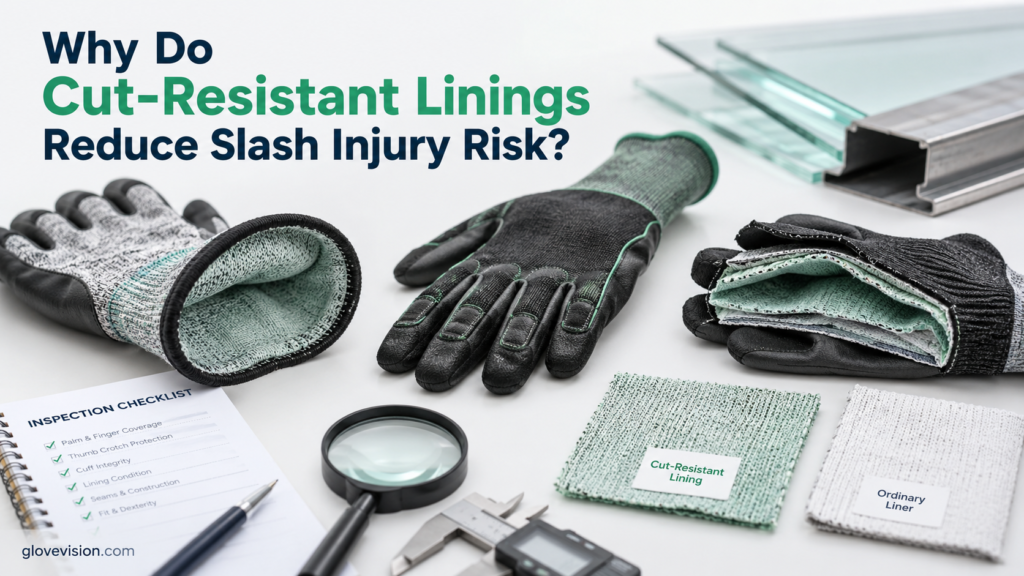
Why Do Cut-Resistant Linings Reduce Slash Injury Risk?
Cut-resistant glove linings reduce slash injury risk by placing a tested mechanical barrier between the hand and a moving sharp edge. Fiber strength, yarn architecture, reinforcement, layers, protected-zone coverage, and the complete-glove construction can increase the cutting interaction required before penetration occurs.
They do not make a glove cut-proof. The result still depends on the exact edge, cutting conditions, test method, protected zones, seams, outer layers, fit, grip, wear, contamination, and current product condition.
Educational and safety notice: This article explains Cut-resistant glove linings for occupational sharp-edge protection. Cut-resistant gloves are not cut-proof and do not replace hazard assessment, machine guarding, safe work procedures, manufacturer documentation, workplace PPE requirements, or task-specific training. Knife defense, stabbing, powered blades, chainsaws, chemicals, heat, electricity, needles, and other specialist hazards require separately verified controls and protective equipment.
What Are Cut-Resistant Glove Linings?
Cut-resistant glove linings are internal or integrated protective material structures designed to provide documented resistance to cutting by sharp edges within specified areas of a glove.
OSHA’s hand-protection rule requires selection to be based on the glove’s performance characteristics relative to the task, conditions, duration, and identified hazards, so material preference or a cut label should not come before the actual exposure assessment. [OSHA]
Where are cut-resistant linings positioned?
Depending on the glove, the protective construction may cover the full hand, palm and fingers, palm only, fingertips, thumb, selected back-of-hand zones, wrist/cuff areas, or may be integrated through a shell construction. The claimed protection should be tied to the actual zone rather than inferred from the glove’s general appearance.
How do they differ from comfort liners?
Comfort liners are primarily selected for softness, moisture management, warmth, or skin feel. Cut-resistant linings have a different job: they incorporate a tested mechanical construction intended to resist defined sharp-edge cutting. A soft liner is not automatically a protective cut layer.
How do linings differ from complete gloves?
The complete glove also includes the outer shell, palm, coating, fingers, fingertips, fourchettes, thumb, seams, reinforcements, cuff, closures, and fit. A lining test applies only to the tested specimen and cannot automatically establish every property of the finished glove.
Why must coverage be verified?
Cut resistance is useful only where the claimed protective construction is actually present and remains aligned with the exposed hand zone. Palm-only evidence should not be extended to the fingertips, fourchettes, thumb crotch, back of hand, or cuff unless those areas are specifically covered and documented.
| Lining Characteristic | Possible Protective Contribution | Required Evidence | What It Does Not Prove |
|---|---|---|---|
| High-strength fiber system | May resist severing and help maintain the lining structure under defined cutting action | Exact tested yarn/lining or finished-glove construction | A cut level from the fiber name alone |
| Yarn architecture | Can present multiple filaments, reinforcement, friction, and mobility to the cutting edge | Product-level construction and test evidence | One universal protective mechanism |
| Dense or multilayer construction | May increase material depth and create multiple cutting interfaces | Test result for the actual assembly | That thicker is always safer |
| Composite reinforcement | Glass, steel, mineral, or other engineered elements may increase resistance in some systems | Exact blend, architecture, and tested specimen | Universal superiority over other systems |
| Coverage and integration | Keeps tested protection over the intended hand zone | Coverage map, seams, attachment, finished-glove fit | Full-hand protection from a palm-only claim |
How Do Cut-Resistant Glove Linings Resist Slash Penetration?
Cut-resistant glove linings resist slash penetration by forcing a moving cutting edge to interact with fibers, yarns, reinforcement, layers, and material structures engineered to withstand more cutting action than ordinary lining constructions.
ASTM F2992-23 measures material cut resistance using a tomodynamometer under specified loads and explicitly limits the test to cutting action by a smooth sharp edge; it does not represent puncture, tear, serrated edges, saw blades, or motorized cutting hazards. [ASTM]
ISO 13997:2024 is the current published ISO tomodynamometer method for materials and assemblies used in protective clothing, including gloves, and it separately states that the test does not provide penetration data for pointed objects such as needles, thorns, or blade points. [ISO Cut]
How does fiber strength contribute?
High-strength fibers may resist severing or help the yarn maintain structure during defined cutting action, but fiber strength alone does not determine a cut level. The fiber must be evaluated inside the actual yarn, knit, reinforcement, layer arrangement, and tested glove construction.
How can yarn architecture contribute?
Yarn systems may present multiple filaments to the edge, increase material engagement, use fiber mobility or friction, and integrate reinforcement. The mechanism varies by product, so one yarn description should not be treated as a universal explanation for every cut-resistant lining.
How can multiple layers contribute?
Additional layers may increase material depth, create multiple interfaces, or combine complementary constructions. Those possible benefits must be balanced against bulk, heat, tactility, flexibility, and the requirement to preserve stable glove fit.
How can reinforcement contribute?
Some constructions use glass, steel, mineral, or other engineered filaments. Reinforcement can increase resistance in a documented system, but it can also change stiffness, weight, feel, laundering behavior, and durability. No reinforcement material is universally superior.
Why do edge conditions still matter?
Sharpness, edge geometry, load, movement, contact distance, material tension, repetition, and glove condition can all change a cutting event. A laboratory level should therefore be used to compare defined test performance, not as a universal prediction of injury outcome.
How Do Materials and Construction Affect Cut-Resistant Glove Linings?
Cut-resistant glove linings should be compared as tested constructions rather than as isolated fiber names because yarn blends, reinforcement, knit architecture, layer count, coatings, fit, and finished-glove design can substantially change performance and handling.
Honeywell currently lists cut-resistant Spectra/HPPE glove constructions in multiple configurations, including unreinforced and steel-blended designs, illustrating why HPPE is a material family within different finished constructions rather than one fixed cut level. [Honeywell]
How do para-aramid linings differ?
Para-aramid can be used in strong protective yarn systems and flexible glove constructions, but the cut result, thermal limits, comfort, and care requirements remain product-specific. Do not assign a universal cut rating to the fiber family.
How do HPPE/UHMWPE linings differ?
HPPE/UHMWPE systems can support lightweight, high-strength, flexible knits, but reinforcement, coating, knit density, layer architecture, heat exposure, care, and finished-glove design can materially change the result.
How do reinforced composites differ?
Composite yarns may combine polymer fibers with glass, steel, mineral, comfort yarns, or elastic components. Their performance should be judged by the exact tested construction because reinforcement type alone does not establish handling quality or cut level.
How do density and thickness matter?
Denser or thicker constructions may contribute more material to a cutting interaction, but thickness does not equal rating. A thinner engineered construction can outperform a thicker lower-performing one under the applicable test, so product evidence controls the comparison.
How do seams and attachment matter?
Check for lining gaps, layer alignment, fingertip transitions, cuff transitions, seam placement, and detached internal layers. In mechanic tasks, the balance between cut protection and fingertip control shows why lining architecture, coatings, fit, and exact cut evidence must be evaluated together rather than maximizing one rating in isolation.
| Construction | Potential Contribution | Possible Trade-Off | Required Evidence | Protection Boundary |
|---|---|---|---|---|
| Para-aramid system | Strong protective yarn system; flexible designs are possible | Heat/care behavior and tactility remain product-specific | Exact test result and finished construction | No universal cut level |
| HPPE / UHMWPE system | Lightweight high-strength knit constructions are possible | Heat/care limits and reinforcement effects vary | Exact product test and care data | Fiber name ≠ rating |
| Steel-reinforced composite | May raise cut resistance in selected blends | Bulk, stiffness, comfort, laundering may change | Exact blend and tested assembly | Steel ≠ automatic superiority |
| Glass-reinforced composite | May contribute hardness and cut resistance in selected yarns | Fiber feel, durability, care, and handling vary | Exact blend and product evidence | Glass ≠ automatic superiority |
| Multilayer knit | More depth and interfaces may resist continued cutting | Heat, bulk, tactility, flexion | Actual multilayer specimen test | More layers ≠ guaranteed rating |
| Partial protective lining | Targets selected palm/finger or other zones | Unprotected transitions may remain exposed | Exact coverage map | Palm rating ≠ full-hand protection |
Which Hazards Fall Outside Cut-Resistant Glove Linings Protection?
Cut-resistant glove linings address defined cutting hazards and must not be treated as automatic protection against pointed penetration, needles, impact, chemicals, heat, biological exposure, or other unrelated hazards.
ANSI/ISEA 105-2024 classifies cut, puncture, and abrasion as separate hand-protection performance properties, reinforcing that one mechanical result should not be extended into another hazard category. [ISEA]
ISO 23388:2018 remains the published ISO protective-glove standard covering mechanical risks such as abrasion, blade cut, tear, puncture and, where applicable, impact; ISO currently lists it as a published standard that is to be revised rather than already replaced. [ISO Glove]
Why does cut resistance not equal stab resistance?
A moving edge and a concentrated point load interact with materials differently. Sharp-edge cut data should not be treated as proof that a glove resists deliberate or accidental pointed penetration.
Why does cut resistance not equal puncture resistance?
Cut and puncture are separate performance properties with different test approaches. A cut level may be relevant to an edge hazard while providing no basis for a puncture claim unless separate evidence exists.
Why does cut resistance not prove needlestick resistance?
ASTM F2878-19(2024) specifically evaluates protective-clothing material resistance to hypodermic needle puncture using defined needles, so a cut-resistant lining should not be called needlestick-resistant without separate needle-specific evidence. [Needle] Similar boundaries apply to laboratory sharps and mechanical glove protection, where broken glass, blades, needles, chemicals, and routine barrier tasks cannot be treated as one interchangeable glove requirement.
Which other hazards require separate evidence?
Abrasion, impact, chemical exposure, biological exposure, heat/flame, cold, electricity, powered blades, chainsaw hazards, and specialist sharps exposures require their own verified controls and product evidence rather than an extension of a cut rating.
How can damage and contamination change protection?
Cut fibers, broken reinforcement, abrasion, heat, chemical exposure, improper care, contamination, and layer separation can change whether the original product evidence still applies. The same distinction matters in tactical glove cut and sharps protection, where cut, standard puncture, and needle-related claims must remain separately verified.
| Hazard | Does Cut Evidence Cover It? | Separate Evidence Needed? | Key Boundary |
|---|---|---|---|
| Moving sharp edge | Yes, when the exact cut test and specimen apply | Task and product verification still required | Cut rating is not an injury guarantee |
| Point / stab | No automatic coverage | Yes | Point loading differs from edge cutting |
| General puncture | No | Yes | Separate puncture property/test |
| Needle puncture | No | Yes — needle-specific evidence | Cut level cannot be extended to hypodermic needles |
| Abrasion | No | Yes | Abrasion and cut are separate properties |
| Impact | No | Yes | Impact requires separate evidence |
| Heat | No | Yes | Mechanical cut evidence does not establish thermal protection |
| Chemical | No | Yes | Cut evidence does not establish chemical compatibility |
Which Cut-Resistant Glove Linings Match the Task?
Cut-resistant glove linings should be selected from the exact sharp-edge task, required protected area, applicable test evidence, handling demands, environmental conditions, and complete-glove construction.
What should be defined first?
Identify the sharp material, exposure type, exposed hand zone, frequency, grip requirement, dexterity requirement, and any additional hazards before comparing glove materials or ratings. Do not prescribe universal blade force, speed, contact distance, or duration.
Which test information should be verified?
Verify the standard, edition, method, reported result, tested specimen, number and arrangement of layers, protected zone, and whether the evidence applies to a material sample, lining assembly, glove section, or finished glove.
How should coverage match exposure?
Map the hazard against the palm, fingers, fingertips, thumb crotch, fourchettes, back of hand, and wrist/cuff. Protection should be accepted only for the zones actually covered by the tested construction.
How should grip and dexterity be balanced?
Assess liner bulk, palm texture, coating, internal movement, tactility, finger flexion, and hand fatigue. Palm coating should be evaluated separately from the lining because coated work glove grip and tactile control depends on coating type, surface condition, liner construction, fit, wear, and the actual handling task.
Which evidence matters beyond cut rating?
Require the exact glove identity, coverage map, intended use, grip and handling information, fit, care, inspection, retirement guidance, and separate evidence for any additional hazard. Jobsite selection should also account for construction glove cut risk and grip, because coatings, abrasion, sharp materials, tools, and dexterity can change which complete glove construction is appropriate.
| Task / Hazard | Primary Cut Concern | Coverage Priority | Handling Need | Evidence Check |
|---|---|---|---|---|
| Sheet metal | Moving sharp edges, burrs, unfinished corners | Palm, fingers, thumb crotch, exposed transitions | Secure grip and tactile control | Exact cut test + coating/fit |
| Glass handling | Sharp sheet edges and breakage risk | Zones contacting edges and surfaces | Grip stability; separate puncture review where relevant | Cut evidence + task-specific product data |
| Construction | Sheet metal, wire, rough sharp materials | Task-dependent hand zones | Grip, abrasion, dexterity | Cut + separate abrasion/puncture evidence |
| Mechanic work | Burrs, brackets, metal edges | Fingertips, palm, fingers | High fingertip control | Cut rating + fit/coating evidence |
| Warehouse / material handling | Strapping, edges, broken packaging, sheet goods | Palm and finger coverage | Repeat handling and comfort | Task hazard + finished-glove data |
| Search-related duty | Mixed sharp and pointed objects | Zones exposed by role | Tactility and control | Cut plus separately verified puncture/needle protection when required |
| Food processing where applicable | Knives and sharp processing materials under approved procedures | Task-specific coverage | Grip, hygiene, compatibility | Exact glove and workplace requirements |
How Should Cut-Resistant Glove Linings Be Fitted and Checked for Coverage?
Cut-resistant glove linings provide useful coverage only when the finished glove fits correctly and the protective material remains aligned with the hand zones exposed to the sharp-edge hazard.
How should glove fit be assessed?
Check palm width, hand length, finger length and width, thumb alignment, closure security, full hand closure, and whether the glove causes pressure, numbness, fingertip excess, or unwanted material bunching.
How should liner stability be checked?
During normal hand movement, check for bunching, rotation, fingertip pullback, layer separation, thumb-crotch shift, and internal sliding that moves protection away from the required zone.
How should protected zones be checked?
Use the manufacturer’s coverage information or exact product construction to verify which zones actually carry the cut-resistant lining. Do not assume a general cut marking automatically means equal protection across every part of the hand.
How does poor fit affect protection and handling?
Poor fit can move coverage away from the hazard zone, destabilize grip, create excess material, restrict movement, or accelerate wear. The interaction between coated palm grip and liner construction matters because the lining must stay positioned inside a glove whose palm surface still supports usable handling for the intended material and environment.
| Check | What to Verify | Failure Sign | Decision |
|---|---|---|---|
| Palm | Claimed protection actually covers the exposed palm zone | Coverage gap or shifted lining | Reassess size/construction |
| Fingers | Protective lining follows the fingers through normal movement | Rotation, bunching, missing zone | Resize/change glove |
| Fingertips | Lining remains seated at the tips | Pullback, excess slack, detached layer | Reassess before use |
| Thumb crotch | Protection remains aligned through thumb movement | Gap or layer shift | Change construction if exposed |
| Fourchettes | Side-of-finger zones match the task exposure | Unprotected side panel or seam gap | Verify coverage map |
| Back of hand | Only rely on dorsal protection when specifically documented | Palm-only evidence assumed full-hand | Do not extend the claim |
| Wrist / cuff | Coverage meets the task and stays secure | Liner or cuff migration | Adjust/replace as appropriate |
| Liner movement | No persistent bunching, rotation, separation, or fingertip pullback | Internal instability | Remove/reassess |
| Glove fit | Palm width, hand length, fingers and thumb align without pressure or slack | Numbness, excess material, restricted closure | Resize |
| Grip | Handling remains stable for the actual material and surface | Slippage or over-gripping | Change coating/construction |
How Should Cut-Resistant Glove Linings Be Inspected and Maintained?
Cut-resistant glove linings should be inspected as part of the complete glove because protective damage may exist beneath an outer shell even when the outside does not immediately reveal the full condition of the lining.
Ansell’s cut-resistance guidance notes that cut-resistant gloves use varied coatings and fabrics and recommends following the manufacturer’s cleaning guidance, which is why one universal detergent, wash temperature, bleach rule, or drying method should not be prescribed across products. [Ansell]
What should be inspected?
Inspect the outer shell, palm, fingers, fingertips, thumb crotch, fourchettes, seams, internal lining, reinforcing fibers, liner attachment, coating, cuff, contamination, and any change in fit or layer position.
How should the glove be cleaned?
Follow the exact finished-product instructions. Cleaning method, detergent, bleach allowance, water temperature, drying method, solvent restrictions, coating care, and reshaping requirements can vary by fiber system and complete-glove construction.
Which repairs should be avoided?
Do not use unauthorized patches, glue, stitching, liner replacement, fiber trimming, added reinforcement, or heat treatment to return the glove to protective service. An unapproved modification can change the tested construction, coverage, seams, fit, or material behavior.
When should the glove be removed from service?
Reassess or replace when the outer shell is cut through, the liner is visibly damaged, reinforcement is broken or exposed, a seam is open, the liner detaches, coverage becomes unstable, fit materially changes, heat or chemical damage is suspected, contamination cannot be safely resolved, or the original product evidence can no longer be relied upon.
| Inspection Point | What to Look For | Why It Matters | Action |
|---|---|---|---|
| Outer shell | Cuts, tears, abrasion, holes, heat or chemical damage | May expose or conceal liner damage | Stop and inspect complete glove |
| Liner | Cut fibers, holes, thinning, bunching, separation | Protective structure may no longer match test condition | Replace/reassess |
| Reinforcing fibers | Broken, protruding, exposed, displaced elements | Composite construction may be compromised | Remove from service |
| Seams | Open, stretched, cut, detached seams | Coverage can shift or gaps can form | Replace unless approved repair exists |
| Coating | Peeling, slickness, saturation, severe wear | Grip and handling may degrade independently of cut rating | Reassess handling and product guidance |
| Liner attachment | Detached, twisted, migrating internal layer | Coverage and fit become unstable | Replace/reassess |
| Contamination | Oil, chemicals, debris, unknown residue | Can change grip, materials, care, or exposure | Follow exact workplace/product procedure |
| Care history | Cleaning method matches finished-product instructions | Wrong care can alter coatings, fibers, fit, or layers | Retest/reassess if suitability is uncertain |
| Unauthorized repair | Glue, patch, stitching, fiber trimming, added reinforcement | Original tested construction may no longer apply | Do not return to protective service without approved process |
Why Should Cut-Resistant Glove Linings Follow a Complete Glove Decision?
Cut-resistant glove linings should be evaluated through a complete-glove decision because the lining’s laboratory cut performance cannot by itself establish task suitability, coverage, handling, fit, or current serviceability.
What final questions determine suitability?
Confirm the exact task, whether the hazard is truly a moving sharp edge, exposed hand zones, applicable test method and edition, reported performance, tested specimen, protected areas, complete-glove fit, liner alignment, grip, dexterity, additional puncture/needle/chemical/thermal hazards, current damage, and whether approved care can preserve serviceability.
Which decision rule should readers retain?
Start with the hazard, verify the test and tested specimen, confirm the protection zone, then judge the complete glove for fit, grip, dexterity, liner stability, environment, damage, contamination, and care history. If any required element cannot be verified, reassess, select another glove, or replace the current one.
Conclusion
Cut-resistant glove linings can reduce slash injury risk by increasing resistance to defined sharp-edge cutting, but no lining makes a glove immune to cuts or guarantees prevention of injury.
Material name and thickness do not establish a rating; cut is not puncture, needle, or stab resistance; the test method and tested specimen matter; coverage must match the exposed hand zone; and the complete glove still has to fit, grip, move, remain stable, and stay in serviceable condition under product-specific care instructions.
Frequently Asked Questions
Are Cut-Resistant Glove Linings Cut-Proof?
No. They increase resistance to defined sharp-edge cutting but cannot eliminate injury risk.
Do Cut-Resistant Glove Linings Stop Needles?
Not automatically. Needle resistance requires separate needle-specific evidence.
Does a Higher Cut Rating Always Mean a Better Glove?
No. The rating must be interpreted alongside the hazard, test method, protected zones, grip, dexterity, fit, and complete-glove construction.
Can Cut-Resistant Glove Linings Lose Protection After Damage or Washing?
Yes. Damage, layer separation, broken reinforcement, heat, chemicals, contamination, or unsuitable laundering can alter suitability. Follow the exact product’s inspection and care requirements.
When Should Cut-Resistant Glove Linings Be Replaced?
Remove the complete glove from protective service when lining damage, broken reinforcement, failed seams, unstable coverage, contamination, altered fit, or another condition prevents its required protection from being verified.