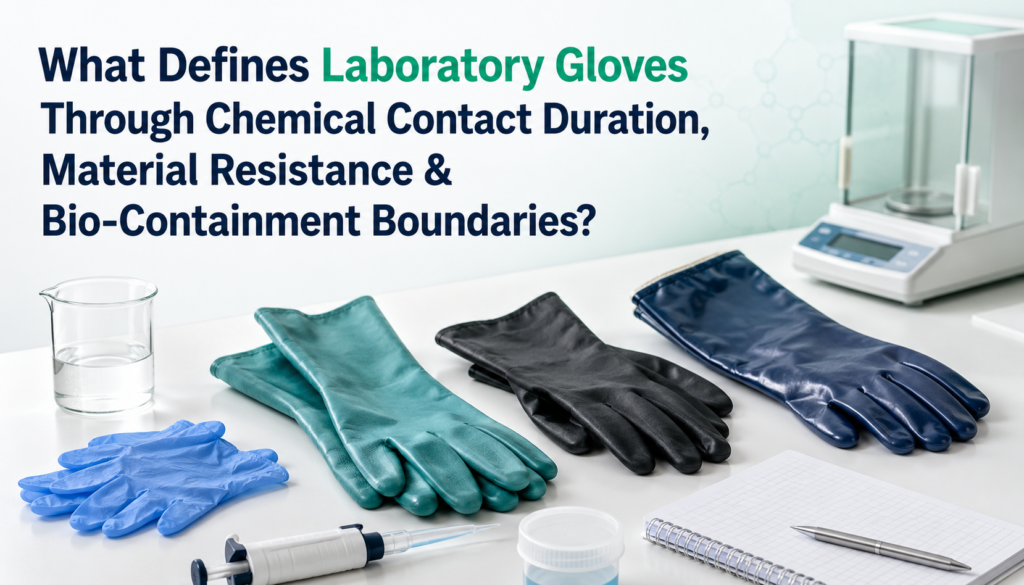
What Defines Laboratory Gloves Through Chemical Contact Duration, Material Resistance & Bio-Containment Boundaries?
Laboratory gloves are defined by the exact laboratory hazard, chemical contact mode and duration, product-specific material resistance, tactile requirements, containment boundaries, and documented change-out plan. No single glove or material protects against every chemical, biological, clean-process, cryogenic, sharps, or mechanical task.
This page explains laboratory environments, contact duration, material screening, test-data interpretation, fit and cuff coverage, bio-containment, change-out triggers, and final verification before work begins.
This article is educational and does not replace the SDS, manufacturer compatibility data, laboratory risk assessment, Chemical Hygiene Plan, facility procedures, or specialist PPE verification. Verify the complete glove system before hazardous work.
Laboratory glove selection is one part of a documented laboratory risk assessment, not a guarantee of skin protection or biological containment.
This article provides educational laboratory glove-selection guidance and does not replace an SDS, laboratory risk assessment, Chemical Hygiene Plan, biosafety procedure, manufacturer compatibility data, engineering controls, training, or professional safety evaluation. For hazardous chemicals, mixtures, infectious materials, cryogenic substances, sharps, extreme temperatures, or other high-consequence tasks, verify the complete glove system and facility requirements before beginning work.
What are laboratory gloves, and how do they differ from adjacent protective glove categories?
Laboratory gloves are protective hand barriers selected for laboratory tasks involving chemicals, biological materials, samples, instruments, contamination-sensitive processes, or controlled work areas.
They are not automatically interchangeable with medical examination gloves, general disposable gloves, cleanroom gloves, cryogenic gloves, heavy chemical systems, or mechanical and sharps gloves because each category has different barrier, cleanliness, packaging, durability, fit, and rating requirements.
Routine disposable barriers require caution because examination-grade gloves have limits after chemical splash.
No laboratory glove provides universal protection. Suitability depends on the exact hazard, contact pattern, finished glove product, construction, manufacturer data, laboratory procedure, and facility risk assessment. [OSHA]
| Glove Context | Typical Laboratory Role | Main Protection Need | Main Limitation | Deeper Verification Required |
|---|---|---|---|---|
| General laboratory glove | Routine sample, instrument, biological, or selected chemical handling | Task-specific barrier and tactility | No universal chemical or biological protection | Hazard, contact mode, exact product data |
| Medical examination glove | Patient examination and routine clinical contact | Medical barrier | May be limited for chemical contact or specialist lab tasks | Medical labeling and chemical splash data |
| General disposable glove | Short-use hygiene or light contact | Temporary thin barrier | Not automatically laboratory- or chemical-suitable | Intended-use and compatibility documentation |
| Chemical-resistant laboratory glove system | Extended, continuous, immersion, or high-consequence chemical handling | Chemical-specific resistance | May reduce dexterity or require layered system | Exact chemical, concentration, temperature, duration |
| Cleanroom glove | Controlled particle and contamination-sensitive work | Cleanliness, packaging, particle control | Cleanliness does not prove chemical resistance | Cleanroom specifications and task compatibility |
| Cryogenic glove | Handling near cryogenic liquids or extreme cold | Cold and splash protection appropriate to system | Standard lab gloves do not provide cryogenic protection | Cryogenic rating and facility procedure |
| Mechanical or sharps glove | Broken glass, sharps, cutting, heavy handling | Cut, puncture, or mechanical protection | May reduce tactility and may not be chemically suitable | Mechanical rating and chemical compatibility |
How do laboratory task environments change glove requirements?
Laboratory task environments change glove requirements because chemical handling, biological work, clean-process analysis, and specialist hazards create different barrier, cleanliness, fit, and procedural demands.
Chemical laboratory work may involve splash, intermittent contact, continuous exposure, solvents, acids, bases, mixtures, chemical waste, and contaminated equipment.
Biological laboratory work may involve specimens, cultures, infectious materials, animal work, contaminated surfaces, biological waste, and risk-based donning and doffing. A biosafety level alone does not determine the correct glove system. [CDC/NIH]
Clean-process and analytical work may prioritize low contamination, packaging, extractables, instrument control, and sample integrity, but cleanliness does not prove chemical resistance.
Cryogenic liquids, extreme heat, sharps, pressure, radiation-related contamination, and heavy mechanical stress exceed the role of standard laboratory gloves and require separately verified controls.
| Environment | Main Hazard | Broad Glove Requirement | What Standard Lab Gloves May Not Cover | Deeper Route |
|---|---|---|---|---|
| Chemical laboratory | Splash, repeated contact, continuous exposure, mixtures, waste | Product-specific compatibility and documented replacement | Immersion, aggressive mixtures, heat, pressure | Chemical specialist guidance |
| Biological laboratory | Specimens, cultures, infectious material, contaminated surfaces | Risk-assessment-based barrier and containment discipline | Sharps, chemical disinfectants, high-consequence agents | Institutional biosafety guidance |
| Clean-process laboratory | Particles, residues, extractables, sample contamination | Cleanliness, packaging, surface compatibility | Chemical resistance or full cleanroom qualification | Cleanroom guidance |
| Analytical laboratory | Instruments, small samples, fine manipulation | Tactility, grip, low contamination, compatibility | Heavy chemical, sharps, thermal hazards | Task-specific assessment |
| Waste-handling area | Mixed contamination, damaged containers, leakage | Hazard-defined glove system and disposal discipline | Unknown mixtures, sharps, leakage | SDS, waste procedure, specialist PPE |
| Cryogenic laboratory | Extreme cold and splash | Rated cryogenic system | Standard disposable glove protection | Cryogenic PPE guidance |
| Sharps/mechanical laboratory | Broken glass, needles, blades, pressure equipment | Mechanical protection combined with chemical needs | Standard thin-film puncture resistance | Work or cut-resistant guidance |
How does chemical contact duration change laboratory glove requirements?
Chemical contact duration changes laboratory glove requirements because incidental splash, intermittent contact, continuous contact, and immersion place different demands on permeation resistance, degradation resistance, cuff coverage, and replacement planning.
Material selection should begin with exposure pattern because laboratory gloves must match chemical contact duration.
Incidental splash is brief and unintended, but it still requires compatibility with the exact chemical and prompt procedure-based removal after contamination.
Intermittent contact consists of repeated short events that may create cumulative exposure, while continuous contact requires data and a documented change-out plan matched to sustained exposure.
The glove system may change when incidental contact becomes extended chemical contact.
Immersion or prolonged handling often exceeds the role of thin disposable gloves and may require an extended cuff, heavier construction, reusable system, or specialist barrier.
Mixtures, elevated temperature, pressure, flexing, stretching, and abrasion can change performance. Compatibility for one ingredient must not be generalized to an untested mixture.
| Contact Mode | Typical Pattern | Main Risk | Data Needed | Possible Glove Direction | Change-Out Requirement |
|---|---|---|---|---|---|
| Incidental splash | Brief unintended droplet or splash | Incompatibility, delayed removal, trapped chemical | Exact product splash data and SDS | Compatible disposable or specified system | Immediate response after contamination according to procedure |
| Intermittent contact | Repeated short contacts with rest periods | Cumulative permeation and surface transfer | Intermittent-contact data where available and actual task cycle | Product documented for repeated contact | Match replacement to cycle, exposure plan, and facility rule |
| Continuous contact | Sustained contact during a task | Permeation without visible damage | Continuous-contact data matching the exact product and chemical | Chemical-specific glove system | Documented change-out before the assessed margin is exhausted |
| Immersion | Glove repeatedly or substantially surrounded by liquid | High permeation, cuff entry, degradation | Immersion/contact data, cuff and construction details | Longer-cuff, heavier, reusable, or specialist system | Strict task-specific replacement and inspection |
| Unknown mixture | Variable or incompletely characterized exposure | Unpredictable compatibility | Mixture data, supplier input, qualified EHS review | Conservative specialist system or process redesign | Facility-defined plan |
| Heated or pressurized contact | Elevated temperature or pressure | Accelerated permeation or mechanical failure | Data matching temperature and pressure | Specialist glove plus engineering controls | Qualified risk-assessment plan |
A permeation breakthrough result is a test result under defined conditions, not an automatic safe workplace wear time. Interpret it against the actual task, glove product, chemical concentration, temperature, movement, abrasion, planned duration, facility procedure, and documented change-out plan. [ASTM]
How should laboratory glove materials be screened against chemical exposure?
Laboratory glove materials should be screened against the exact chemical, concentration, contact mode, duration, temperature, glove product, and manufacturer test data rather than broad material reputation.
Material names are only a starting point because different laboratory chemical families require different glove materials.
Nitrile may support dexterity and selected splash tasks, but its performance varies significantly by formulation, thickness, product, chemical, concentration, temperature, and duration.
Neoprene or chloroprene, butyl rubber, fluoroelastomer, laminate barriers, latex, PVC, and other polymers may support selected tasks, but each has limitations outside its tested profile.
Routine materials may be insufficient when specialized laboratory glove materials become necessary.
A laminate barrier may broaden resistance for selected tasks but can reduce grip, dexterity, comfort, and puncture resistance, which may require a verified layered system.
| Material | Potential Laboratory Role | Main Strength | Main Limitation | Exact Data Required | Deeper Route |
|---|---|---|---|---|---|
| Nitrile | Routine sample work and selected splash tasks | Dexterity, availability, selected puncture and chemical performance | Highly variable by formulation, thickness, product, and chemical | Exact product, chemical, concentration, temperature, contact data | Chemical-specific compatibility |
| Neoprene / chloroprene | Selected acids, bases, solvents, or mixed tasks where documented | Flexibility and useful resistance in selected applications | Not universal and may perform poorly with untested substances | Product-specific permeation and degradation data | Specialist material guidance |
| Butyl rubber | Selected gases, vapors, ketones, and documented tasks | Low gas permeability and strong performance for selected chemicals | Bulk, lower tactility, poor performance against other classes | Exact substance and product data | Specialist chemical selection |
| Fluoroelastomer | Selected aggressive solvent or chemical exposure | Strong resistance in specific tested profiles | Cost, stiffness, limited use outside profile | Exact chemical, mixture, concentration, temperature | Qualified specialist selection |
| Laminate barrier | Selected high-consequence or broad chemical tasks | Broad resistance across selected chemicals | Poor grip, limited dexterity, puncture vulnerability, system complexity | Complete liner and outer-glove system data | Layered glove-system guidance |
| Natural rubber latex | Selected tasks where permitted and documented | Elasticity and tactility | Latex allergy and limited chemical profile | Exact product compatibility and workplace allergy policy | Allergy and chemical verification |
| PVC or other polymer | Selected acids, bases, oils, or other tasks where supported | Useful task-specific resistance | Variable flexibility, durability, and chemical limits | Exact product and chemical data | Manufacturer compatibility review |
- Exact manufacturer and product code
- Material, thickness, cuff length, and construction
- Exact chemical, CAS number where needed, concentration, and mixture
- Temperature, pressure, movement, flexing, and abrasion conditions
- Continuous or intermittent contact mode
- Permeation, penetration, and degradation results
- Detection threshold or reporting basis where provided
- Recommended change-out, reuse, disposal, and storage instructions
- Current revision date of the compatibility document
How do ASTM and EN test results help interpret laboratory glove performance?
ASTM and ISO/EN test results help compare defined aspects of laboratory glove performance, but they apply only to the tested material, chemical, concentration, temperature, thickness, contact pattern, and test conditions.
ASTM F739 addresses permeation under continuous-contact test conditions, while ASTM F1383 addresses repeated intermittent contact-and-rest cycles. Neither test automatically defines safe workplace wear time. [ASTM]
ISO 374-2 addresses penetration through defects or openings, while ISO 374-4 addresses material degradation. Penetration, degradation, and molecular permeation are separate mechanisms.
ISO 374-1 provides chemical-protective glove terminology and requirements, and ISO 374-5 addresses microorganism-risk claims, but a marking does not approve a glove for every laboratory task. [ISO]
Permeation can occur without visible swelling, cracking, or discoloration. Visual inspection remains necessary, but it cannot replace documented test data and a change-out plan.
| Test or Data Type | What It Measures | Useful Selection Question | Key Limitation | Additional Verification |
|---|---|---|---|---|
| ASTM F739 continuous-contact permeation | Chemical movement through material under continuous contact | Was the exact product tested against the exact chemical under comparable conditions? | Not an automatic safe workplace wear time | Temperature, concentration, flexing, task duration, assessed margin |
| ASTM F1383 intermittent-contact permeation | Chemical movement during repeated contact-and-rest cycles | Does the tested cycle resemble the real task cycle? | Workplace contact may not match the test pattern | Actual frequency, contamination, removal, reuse |
| ISO 374-2 penetration | Passage through defects, holes, seams, or closures | Does the glove resist penetration under the relevant test? | Does not measure molecular permeation | Permeation and degradation data |
| ISO 374-4 degradation | Physical material change under chemical contact | Does the material swell, soften, crack, or lose strength? | Lack of visible degradation does not prove no permeation | Permeation data and task inspection |
| ISO 374-1 chemical requirements | Terminology and performance framework | What chemical claims and markings apply to the exact glove? | Marking does not approve every laboratory task | Exact chemical and manufacturer instructions |
| ISO 374-5 microorganism risks | Requirements for microorganism-protection claims | Does the exact glove carry the relevant claim? | Does not replace protocol-specific biosafety assessment | Agent, route, sharps, disinfectants, facility controls |
| Manufacturer compatibility chart | Product-specific performance summary | Is the exact product listed for the exact substance and conditions? | May use laboratory conditions and may not cover mixtures | SDS, facility assessment, current revision |
| Visible inspection | Tears, swelling, softness, cracks, discoloration, stickiness | Is the glove physically compromised? | Permeation may occur without visible change | Documented limit and test data |
How should thickness, fit, cuff coverage, and tactility be evaluated for laboratory handling?
Thickness, fit, cuff coverage, and tactility should be evaluated together because a laboratory glove must support both the required barrier and controlled handling of the actual instruments, samples, containers, and protective clothing.
Greater thickness may improve durability in selected tasks, while thinner gloves may improve feedback, but thickness does not prove chemical compatibility or breakthrough time.
A secure palm and finger fit can improve pipetting, sample handling, cap control, and instrument manipulation. Excess tightness can increase fatigue and seam strain, while looseness can reduce control and increase contamination risk.
Extended cuffs may improve wrist or sleeve overlap, but cuff length alone does not replace compatibility with the gown, sleeve, task motion, and exposure direction.
Texture may support wet-container or instrument grip, but it cannot correct poor fit, contamination, incompatibility, or excessive bulk.
| Feature | Good Sign | Failure Sign | Task Test | Safer Adjustment |
|---|---|---|---|---|
| Palm fit | Stable without bunching or excessive tension | Twisting, folds, pressure, circulation restriction | Hold and rotate the actual permitted instrument or container | Reassess size, pattern, or material |
| Finger fit | Controlled fingertip movement | Excess slack or painful compression | Pipetting, pinch grip, cap handling, fine manipulation | Adjust size or glove design |
| Thumb web | Controlled grip without strain | Seam pulling, rubbing, tearing | Pinch, rotate, and hold the intended tool | Choose better thumb pattern or fit |
| Thickness | Balances barrier and task control | Excess tearing or excessive tactile loss | Perform the actual movement under safe conditions | Verify product and task requirements |
| Cuff coverage | Stable sleeve or gown overlap | Rolling, gaps, exposed wrist, restricted movement | Flex wrist and check overlap direction | Select appropriate cuff and clothing interface |
| Texture | Reliable grip on intended surface | Slipping or false grip confidence | Handle permitted wet or dry container | Reassess texture and material |
| Double-glove fit | Layers remain controlled where protocol requires | Bunching, loss of tactility, cuff conflict | Perform procedure simulation | Verify layer compatibility and protocol |
| Interior moisture | Hands remain manageable for task duration | Excess sweat, slippage, irritation | Monitor during approved task duration | Change gloves, dry hands, reassess material and schedule |
How do bio-containment and clean-work boundaries shape laboratory glove use?
Bio-containment and clean-work boundaries shape laboratory glove use by controlling where contaminated gloves may move, what they may touch, how they are removed, and which disposal and hygiene procedures follow the task.
Selection should follow the agent, procedure, exposure route, aerosol potential, sharps, animal work, disinfectants, chemical coexistence, facility controls, and institutional biosafety assessment rather than a biosafety level alone.
Contamination control depends on zoning because laboratory gloves help define clean-area boundaries.
A glove can become a contamination source because laboratory gloves can create surface-transfer risks.
Phones, doors, keyboards, writing areas, shared devices, clean instruments, and clean zones require procedural control before contact.
Double-gloving may support selected protocols, but it is not universally required and does not automatically stop chemical permeation.
Glove color may serve as a facility-defined workflow cue, but it does not prove containment status, chemical resistance, cleanliness, or protection.
- Complete protocol-specific risk assessment.
- Identify chemical, biological, sharps, and contamination hazards.
- Select and verify the glove system.
- Prepare hands and PPE according to procedure.
- Enter the defined task zone.
- Limit contact to approved surfaces and equipment.
- Stop after contamination, damage, hazard change, or task completion.
- Remove gloves using the approved doffing method.
- Dispose through the correct waste stream.
- Perform required hand hygiene.
- Record or report exposure when applicable.
- Enter the clean zone only after the procedure is complete.
When should laboratory gloves be changed, and what failure signs require immediate action?
Laboratory gloves should be changed after task completion, contamination, physical damage, material degradation, hazard change, clean-surface contact, a documented product limit, or any condition suggesting possible exposure or loss of control.
Permeation may occur without visible change, so replacement must not depend only on swelling, cracking, discoloration, stickiness, or other visible damage.
A documented test breakthrough result must not be copied directly into a workplace wear-time rule without qualified interpretation and a facility-approved change-out plan.
Burning, pain, cold sensation, numbness, swelling, blistering, oozing, or worsening irritation requires work stoppage and procedure-based exposure response rather than continued use.
Persistent redness, itching, dryness, or rash should be assessed by qualified occupational or medical personnel; this page does not diagnose allergy, dermatitis, chemical burn, cold injury, nerve injury, infection, or occupational skin disease.
| Trigger | Possible Meaning | Immediate Action | Exposure Assessment | Deeper Verification |
|---|---|---|---|---|
| Task completed | Glove may transfer contamination to next task | Remove and dispose correctly | Determine whether decontamination or reporting is needed | Facility procedure |
| Chemical or biological hazard changes | Original glove may not match new exposure | Stop and reassess before continuing | Review the new hazard and compatibility | SDS and risk assessment |
| Tear, puncture, cut, stretch, or seam failure | Physical barrier compromised | Stop, remove safely, assess exposure | Check skin contact and task incident | Exposure-response procedure |
| Swelling, softness, stiffness, cracking, discoloration, stickiness | Degradation or incompatibility | Stop use immediately | Evaluate chemical contact and skin exposure | Product degradation and permeation data |
| Documented change-out point reached | Permeation may occur without visible damage | Replace according to plan | Confirm no task overrun | Manufacturer data and facility margin |
| Contaminated glove touches clean surface | Cross-zone contamination | Replace glove and decontaminate surface | Identify affected equipment or samples | Containment procedure |
| Wet interior | Sweat, leak, cuff entry, or liquid penetration | Stop and remove safely | Determine source of moisture | Fit, integrity, exposure review |
| Burning, pain, cold, or numbness | Possible chemical, thermal, cryogenic, pressure, or fit problem | Stop work and follow emergency procedure | Seek medical evaluation where required | SDS and incident response |
| Recurrent redness, itching, dryness, or rash | Possible latex, accelerator, friction, soap, or occlusion issue | Stop suspected glove and document pattern | Occupational or medical review if persistent | Alternative material and work-practice assessment |
| Compatibility data absent or unclear | Suitability cannot be confirmed | Do not begin or continue hazardous contact | Escalate to qualified safety review | Manufacturer and EHS verification |
Which checklist helps verify laboratory glove selection before use?
A laboratory glove verification checklist should confirm the task, every relevant hazard, contact mode, contact duration, conditions, material data, test interpretation, fit, containment procedure, replacement plan, emergency readiness, and specialist routing before work begins.
- ☐ Define the exact laboratory task, equipment, process, and work zone.
- ☐ Identify chemical, biological, contamination, sharps, heat, cold, pressure, radiation-related, and mechanical hazards.
- ☐ Classify the contact mode as incidental splash, intermittent contact, continuous contact, immersion, or contamination-only handling.
- ☐ Record the exact chemical or agent, concentration, mixture, temperature, pressure, task duration, movement, and abrasion conditions.
- ☐ Identify the exact glove product, material, thickness, cuff, construction, and intended use.
- ☐ Review product-specific permeation, penetration, degradation, and microorganism data where applicable.
- ☐ Confirm that test data match the actual chemical, concentration, contact pattern, and relevant conditions.
- ☐ Do not treat breakthrough time as an automatic safe wear time.
- ☐ Test palm stability, finger control, thumb movement, grip, cuff coverage, and compatibility with laboratory clothing.
- ☐ Confirm task zoning, clean-surface restrictions, donning, doffing, hand hygiene, waste route, and double-gloving rules.
- ☐ Define replacement triggers for task completion, contamination, damage, degradation, hazard change, clean-surface contact, and documented product limits.
- ☐ Confirm SDS first aid, eyewash, safety shower, spill response, exposure reporting, emergency contacts, and medical escalation before hazardous work.
- ☐ Route cryogenic, sharps, mechanical, cleanroom, high-pressure, thermal, radiation-related, or high-consequence chemical tasks to specialist guidance.
- ☐ Obtain qualified laboratory EHS, biosafety, or Chemical Hygiene Officer review where compatibility or procedure remains uncertain.
Pre-use verification: Laboratory glove selection is only one control within a larger laboratory safety system. Verify the exact glove product, hazard, exposure pattern, SDS, manufacturer compatibility data, Chemical Hygiene Plan, containment procedure, engineering controls, change-out plan, and emergency response before hazardous work begins.
Conclusion
Laboratory gloves work as task-specific barrier systems only when the laboratory environment, exact hazard, contact mode and duration, product-specific material data, test interpretation, fit, cuff coverage, containment workflow, and change-out triggers have been verified together.
No glove is universal, and test results remain conditional rather than automatic safe wear times. The SDS, Chemical Hygiene Plan, engineering controls, facility procedures, training, emergency readiness, and separately verified specialist PPE still govern high-risk work.
Frequently Asked Questions
Are nitrile gloves suitable for every laboratory chemical?
Nitrile gloves are not suitable for every laboratory chemical because resistance varies by product, formulation, thickness, chemical, concentration, temperature, and contact duration. Product-specific compatibility data must be verified.
What is the difference between permeation, penetration, and degradation?
Permeation is molecular movement through glove material, penetration is passage through physical defects or openings, and degradation is a physical change in the material caused by contact.
Is chemical breakthrough time the same as safe glove wear time?
Chemical breakthrough time is not automatically the same as safe glove wear time because test conditions may differ from the actual task, movement, temperature, concentration, abrasion, and contamination pattern. A documented facility change-out plan and safety assessment are still required.
When should laboratory gloves be changed?
Laboratory gloves should be changed after task completion, contamination, damage, degradation, hazard change, clean-surface contact, a documented product limit, or any sign of possible exposure.
Does double-gloving prevent chemical permeation?
Double-gloving does not automatically prevent chemical permeation because protection depends on the materials, complete glove system, chemical, contact conditions, and procedure. It may support selected protocols but is not a universal chemical solution.
Can standard laboratory gloves protect against cryogenic liquids or sharps?
Standard laboratory gloves do not automatically protect against cryogenic liquids, needles, broken glass, blades, or heavy mechanical hazards. Separately verified specialist PPE and work controls may be required.