
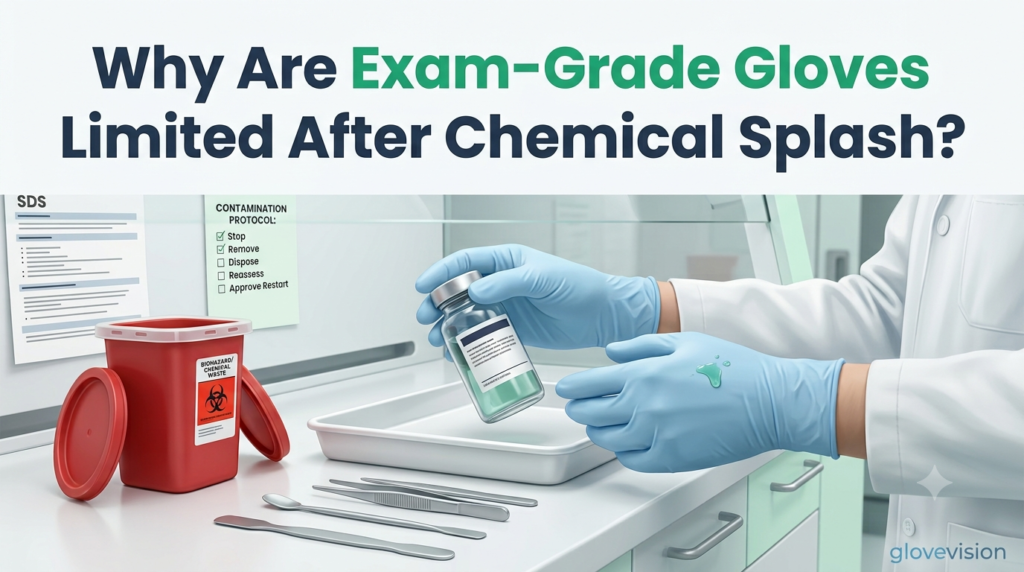
Why Are Exam-Grade Gloves Limited After Chemical Splash?
Exam-grade gloves are limited after hazardous chemical splash because the glove exterior becomes contaminated and continued protection cannot be confirmed from appearance alone. Exam-grade gloves after chemical splash should be removed and reassessed because workers do not need proof of visible failure before stopping continued use.
Exam-grade status supports examination-related barrier and physical requirements, but it does not independently establish resistance to a particular laboratory chemical. Some exact exam-grade products may carry separate chemical evidence, but that evidence must match the exact product, chemical, concentration, task, and exposure mode before work restarts.
Why is the protection provided by exam-grade gloves limited after chemical splash?
The protection provided by exam-grade gloves is limited after hazardous chemical splash because the exterior becomes contaminated and examination-glove status alone cannot confirm continued resistance to that chemical. The limitation should be understood within the broader requirement that laboratory gloves match the actual hazard, contact pattern, exact product, and laboratory procedure.
FDA’s polymer patient examination glove classification describes a disposable medical device worn for medical purposes to provide a barrier against potentially infectious materials and other contaminants. That intended-use context does not prove suitability for every laboratory chemical. [LZA]
What does exam-grade status establish?
Exam-grade status may establish applicable examination-glove requirements and intended examination use. Depending on the product and applicable standard, evidence may cover freedom from holes, dimensions, tensile strength, elongation, physical properties, sterility status where applicable, and labeling.
ASTM D6319-19(2023) covers nitrile examination gloves used for medical examinations and diagnostic or therapeutic procedures, including freedom from holes and specified physical properties. It is not a universal chemical-compatibility approval for every splash or laboratory task. [D6319]
Why can an exact exam-grade glove still have separate chemical evidence?
An exact exam-grade glove can have separate chemical evidence when the manufacturer has documented chemical permeation, degradation, penetration, splash, or specialty labeling data for that exact product. FDA separately identifies medical gloves with chemotherapy labeling claims, showing that specialty chemical claims require additional product-specific testing and documentation beyond ordinary examination-glove status. [OPJ]
The relevant evidence must be tied to manufacturer, product code, formulation, thickness, cuff construction, chemical, concentration, mixture, temperature, exposure mode, test method, test conditions, and restrictions. It should not be transferred from a different glove model, thickness, chemical, concentration, or task.
Why is replacement justified without proving barrier failure?
Replacement is justified because the exterior is contaminated, continued chemical-material contact may occur, transfer to tools and surfaces may occur, and poor removal may transfer chemical to skin. Permeation may be invisible, exact continued performance is uncertain, and single-use examination gloves are not intended to be restored and returned to service.
| Evidence type | What it may establish | What it cannot establish alone | Next verification |
|---|---|---|---|
| Examination-glove compliance | Intended examination use and covered physical or barrier requirements. | Protection against a particular chemical. | Review exact-product chemical data. |
| FDA examination-glove classification | Disposable medical barrier intended use. | Laboratory chemical suitability. | Verify chemical-specific claims. |
| Exact-product chemical evidence | Performance against a tested chemical under stated conditions. | Universal performance for other tasks. | Compare test and workplace conditions. |
| Material name | General polymer family. | Exact compatibility. | Confirm product-specific data. |
| Thickness | One construction attribute. | Chemical suitability by itself. | Review formulation and test data. |
| Visible appearance | Obvious damage or degradation. | Absence of invisible permeation. | Follow replacement procedure. |
| Single-use labeling | Intended disposal after use. | Suitability for every chemical task. | Confirm task and hazard match. |
How can chemical splash affect exam-grade gloves?
Chemical splash contaminates exam-grade gloves and may also involve permeation, degradation, penetration, or cuff entry. These mechanisms are different, and some may occur without visible warning.
What is surface contamination of exam-grade gloves?
Surface contamination means the hazardous chemical remains on the glove exterior. It may create ongoing material contact, transfer to tools, contaminate clean equipment, contaminate another worker, or reach bare skin during poor removal. Contamination alone is enough to stop continued use.
What is permeation through exam-grade gloves?
Permeation is molecular movement of a chemical through glove material. It can occur without a visible hole, tear, swelling, odor, or discoloration, so a normal-looking glove cannot be used as proof that continued chemical protection remains adequate.
What is degradation of exam-grade gloves?
Degradation is physical alteration of the glove material caused by chemical contact. Swelling, softening, stiffening, tackiness, shrinkage, cracking, discoloration, deformation, loss of grip, or loss of fit can all be warning signs, but the absence of those signs does not rule out permeation.
What is penetration through exam-grade gloves?
Penetration is passage through tears, holes, punctures, pinholes, cuff damage, or other physical openings. It is different from permeation because the chemical passes through a physical pathway rather than moving molecularly through intact material.
How can chemical enter around exam-grade gloves?
Cuff entry occurs when chemical bypasses the glove material through the opening near the wrist. The glove material may remain intact, but the worker may still have possible skin, sleeve, or interior-glove contamination that requires exposure assessment.
| Mechanism | What happens | What may be observable | Why appearance may be insufficient | Response implication |
|---|---|---|---|---|
| Surface contamination | Chemical remains on the exterior. | May be visible or invisible. | Residue can remain without obvious damage. | Stop spread and remove. |
| Permeation | Chemical moves through material molecularly. | Often not visible. | No hole or color change may appear. | Do not continue while waiting for signs. |
| Degradation | Material changes physically. | Swelling, tackiness, cracking, softening, or loss of grip may appear. | Early or internal changes may not be obvious. | Remove and reassess compatibility. |
| Penetration | Chemical passes through holes, tears, punctures, or defects. | Small openings may be hard to see. | A normal look does not confirm freedom from defects. | Treat as possible exposure. |
| Cuff entry | Chemical bypasses the glove through the opening. | Wrist, sleeve, or interior contamination may appear. | Material may remain intact while exposure occurs. | Activate exposure assessment. |
Which chemical-contact events limit continued use of exam-grade gloves?
Known or reasonably suspected hazardous chemical contact with exam-grade gloves should limit continued use even when damage is not visible. Repeated splash, persistent contamination, or immersion should also be reclassified through the laboratory’s contact framework before protection planning continues.
Which contamination events require replacement of exam-grade gloves?
Replacement is required when a known hazardous chemical contacts the exterior, when the chemical is unknown, when compatibility is uncertain, when the contact is outside approved task conditions, when the glove touches contaminated tools or surfaces, or when splash reaches the cuff area. Workers should not wait to see whether the glove later changes appearance.
Which glove-condition events require replacement?
Visible material change, swelling, softening, tackiness, cracking, loss of grip, tear, puncture, pinching damage, cuff damage, interior contamination, loss of fit, or uncertain integrity should trigger immediate removal and reassessment.
Which exposure events require escalation beyond glove replacement?
Escalation is required when skin contact, eye or face contact, affected clothing, affected sleeves, affected lab coat, worker symptoms, unknown chemical exposure, continuing spill, uncontrolled leak, pressurized spray, or broader area contamination may be involved. At that point, the response should follow the SDS, CHP, exposure procedure, and qualified safety or medical pathway.
What must not justify continued use?
Small volume, dilution, normal appearance, absence of odor, absence of symptoms, material name, glove thickness, a previous successful task, or a generic compatibility chart should not justify continued use of contaminated single-use exam-grade gloves.
What should workers do immediately after chemical splash on exam-grade gloves?
After hazardous chemical splash on exam-grade gloves, the immediate response is to stop the task, control the source where safe and authorized, prevent contamination spread, follow the approved removal procedure, dispose of the gloves correctly, and reassess before restart.
How should workers stop and control the task?
Workers should stop ordinary handling, avoid touching clean surfaces, keep contaminated gloves away from phones, keyboards, handles, notebooks, and personal items, and control the chemical source only where doing so is safe and authorized. If the event involves a continuing spill, leak, pressure, unknown chemical, or possible exposure, the spill or emergency procedure should take over.
How should contaminated exam-grade gloves be removed?
Contaminated exam-grade gloves should be removed through the approved laboratory procedure to reduce contact between the contaminated glove exterior, bare skin, clothing, other PPE, clean equipment, and the surrounding work area. This page does not prescribe one universal doffing technique for every chemical or splash pattern.
What should happen when skin exposure is suspected?
When skin, eyes, face, clothing, or other PPE may have been affected, ordinary glove-replacement guidance is not enough. OSHA’s mandatory SDS format includes sections for identification, hazard information, first aid, handling, exposure controls, PPE, and toxicological information, making it a route to the chemical-specific response information. [SDS]
What should happen to contaminated tools, surfaces, clothing, and other PPE?
Contaminated tools, surfaces, clothing, and PPE should be isolated, cleaned, discarded, or released only through the approved chemical-specific procedure. The response should prevent spread into clean areas and preserve the information needed for investigation or reassessment.
Why must contaminated exam-grade gloves be discarded instead of monitored or reused?
Contaminated exam-grade gloves should be discarded because monitoring, wiping, washing, and reuse do not restore validated chemical protection for the single-use gloves covered by this page.
Why is monitor-and-continue unsuitable?
Monitor-and-continue assumes incorrectly that degradation is the only possible mechanism, that permeation will always be visible, that no symptoms means no exposure, that exterior contamination will not transfer, and that the glove remains suitable for the task. It also treats splash volume or a laboratory test value as if it directly equals workplace wear time.
Why is wipe-and-continue unsuitable?
Wiping may leave residue, spread contamination, fail to stop permeation, transfer chemical to the wiping material, contaminate additional surfaces, damage the glove surface, or create false confidence. Wiping is not validated restoration of a single-use glove’s chemical protection.
Why should exam-grade gloves not be washed or reused?
The page treats exam-grade gloves as single-use products. They should not be washed, decontaminated for reuse, dried and redonned, stored for another task, or managed under reusable chemical-glove procedures. Reusable chemical-protective gloves are a separate system requiring manufacturer authorization, validated decontamination, inspection, storage controls, reuse limits, and retirement criteria.
| Splash scenario | Immediate action | Additional escalation | Restart condition |
|---|---|---|---|
| Known hazardous chemical on glove exterior | Stop, remove, dispose, and replace. | Reassess glove suitability. | Source controlled and protection confirmed. |
| Suspected skin contact | Stop, remove, and activate exposure procedure. | Medical or incident process where required. | Exposure addressed and task reapproved. |
| Unknown chemical | Stop, isolate, remove safely, and suspend task. | Supervisor, CHO, or EHS review. | Chemical identified and controls approved. |
| Tear, puncture, cuff entry, or interior contamination | Remove immediately. | Treat as possible exposure. | Worker and task cleared. |
| Visible material change | Stop and remove. | Exact-product chemical review. | Compatible protection selected. |
| Eyes, face, clothing, arms, or other PPE affected | Activate broader exposure response. | Emergency or medical response where required. | Person and area cleared. |
| Repeated splash during normal work | Suspend task. | Review engineering controls and work method. | Splash source corrected. |
| Continuing spill or leak | Isolate or leave as required. | Spill-response or emergency team. | Area formally released. |
What must laboratories reassess before restarting work with exam-grade gloves?
A fresh pair of exam-grade gloves does not automatically make the task safe. The laboratory must confirm that the chemical source is controlled and that the glove, other PPE, engineering controls, and work method match the actual hazard.
Were the original exam-grade gloves appropriate?
The laboratory should verify the exact chemical, concentration, mixture, temperature, contact mode, expected duration, splash potential, repetition, manufacturer, product name, product code, formulation, thickness, test conditions, product restrictions, cuff length, and required wrist or arm coverage. Where chemical contact is foreseeable, the exact product must also be evaluated against the expected chemical contact duration and relevant permeation evidence.
Does the task require protection beyond exam-grade gloves?
Repeated splash, sustained contamination, continuous contact, immersion, highly toxic skin-absorbed chemicals, corrosives, hot chemicals, pressurized contact, extended cuff needs, or documented permeation-performance needs may require specialized materials and a more complete protective system.
Did the splash reveal an engineering or work-practice gap?
Repeated or foreseeable splash should trigger review of fume-hood use, splash shields, closed transfer, container design, container size, pouring technique, pipetting technique, funnels, pumps, secondary containment, quantity handled, workspace layout, equipment condition, worker position, task speed, training, staffing, remote handling, or automation.
Where OSHA’s Laboratory Standard applies, the Chemical Hygiene Plan must address procedures, control measures, equipment, PPE, and work practices capable of protecting workers from laboratory chemical hazards. [CHP]
Is additional PPE required beyond exam-grade gloves?
Additional PPE may include chemical splash goggles, face protection, lab coat, protective sleeves, extended cuffs, chemical-resistant apron, protective footwear, or separately assessed respiratory protection. OSHA’s nonmandatory laboratory guidance emphasizes preventing laboratory chemicals from contacting skin, selecting gloves carefully for the chemicals used, and using appropriate controls such as hoods where airborne hazards are present. [AppA]
Who must approve restart?
Restart may require approval from the task supervisor, principal investigator, Chemical Hygiene Officer, EHS professional, spill-response lead, medical professional, or another designated authority. OSHA hand-protection requirements connect glove selection to the task, conditions present, duration of use, and hazards identified, which supports reassessment rather than automatic restart. [HP]
What should laboratories verify after chemical splash on exam-grade gloves?
A complete post-splash review should confirm that the event was controlled, possible worker exposure was addressed, contaminated gloves and materials were managed correctly, and the task was reassessed before restart.
Repeated brief contact may require evidence that reflects intermittent exposure, because ASTM F1383-20 addresses permeation testing under intermittent-contact conditions. That evidence boundary does not create safe wear time or immersion approval. [F1383]
- Chemical task stopped.
- Source controlled where safe and authorized.
- Contaminated gloves kept away from clean surfaces.
- Affected area isolated where required.
- Spill or emergency procedure activated where necessary.
- Exact chemical or mixture identified where possible.
- Concentration, temperature, and approximate amount recorded.
- Affected glove and body areas identified.
- Cuff entry, possible skin contact, and symptoms assessed.
- Current SDS available.
- Approved removal procedure followed.
- Contaminated exterior kept away from bare skin.
- Gloves placed in the approved waste container.
- Gloves not wiped, washed, stored, or reused.
- Other contaminated PPE assessed.
- SDS and workplace procedure followed.
- Eyewash or safety-shower procedure activated where required.
- Chemical-specific decontamination completed where required.
- Medical evaluation obtained where indicated.
- Incident reported and product information retained.
- Contaminated tools isolated.
- Work surfaces controlled.
- Approved cleanup method selected.
- Waste classified and contained.
- Area inspected or released by the appropriate authority.
- Exact chemical, concentration, temperature, and exposure mode reviewed.
- Exact glove manufacturer and product code known.
- Exam-grade status not treated as proof of chemical resistance.
- Exact-product chemical information reviewed.
- Cuff and body coverage needs reviewed.
- Fume hood, splash shield, and secondary containment reviewed.
- Container size, transfer technique, and tools reviewed.
- Equipment condition checked.
- Training gaps addressed.
- Repeated splash triggers task redesign.
- Eye and face protection confirmed.
- Protective clothing, sleeves, apron, and footwear reviewed.
- Respiratory protection assessed separately where required.
- PPE fit and safe removal confirmed.
- Chemical source controlled.
- Work area released.
- Possible worker exposure addressed.
- Appropriate replacement gloves and PPE available.
- Engineering controls functioning.
- Required approval documented.
Checklist completion does not prove exact chemical compatibility, safe wear duration, zero exposure, suitability for another task, or complete regulatory compliance.
Conclusion
Exam-grade gloves are limited after hazardous chemical splash because contamination creates uncertainty about continued protection. The gloves should be removed without waiting for visible evidence of failure, because normal appearance does not prove that chemical protection remains adequate.
Exam-grade status does not independently prove chemical resistance, and a fresh pair alone does not authorize restart. Before work continues, the chemical source, possible worker exposure, affected PPE or surfaces, exact glove suitability, engineering controls, work practices, and required approvals must be reviewed.
Frequently Asked Questions About the Limits of Exam-Grade Gloves After Chemical Splash
Does every chemical splash prove that exam-grade gloves have already failed?
No. A splash confirms or reasonably indicates contamination, but it does not automatically prove measurable permeation, degradation, penetration, or material failure. Controlled removal is justified because continued protection cannot be confirmed from appearance alone.
Can some exam-grade gloves have chemical-resistance data?
Yes. Exam-grade classification alone does not establish chemical resistance, but an exact product may have separate chemical-specific evidence. The evidence must match the product, chemical, concentration, temperature, exposure mode, and test conditions.
Can exam-grade gloves remain in use if no visible damage appears?
No, not after known or suspected hazardous chemical contamination under the page’s stop-and-remove procedure. A normal appearance cannot confirm the absence of permeation or continued chemical protection.
Does a small or dilute hazardous chemical splash still limit exam-grade gloves?
Yes. Volume and dilution alone do not establish low risk. Chemical identity, concentration, toxicity, temperature, skin absorption, exposure location, and exact-product evidence must still be considered.
Can exam-grade gloves be wiped or washed and then reused?
No. The exam-grade gloves covered by this page are single-use products and should not be wiped, washed, decontaminated, or returned to service after hazardous chemical contamination.
Does replacing exam-grade gloves make the task safe to restart immediately?
No. The chemical source, possible worker exposure, affected surfaces, exact glove suitability, other PPE, engineering controls, and work method must first be reassessed.
Should exam-grade gloves be used when chemical splash is routinely expected?
Only when the hazard assessment and exact-product evidence support their use for the chemical, contact mode, duration, and task. Otherwise, the work method or protective system must be changed.