
How Do Lab Gloves Match Chemical Contact Duration?
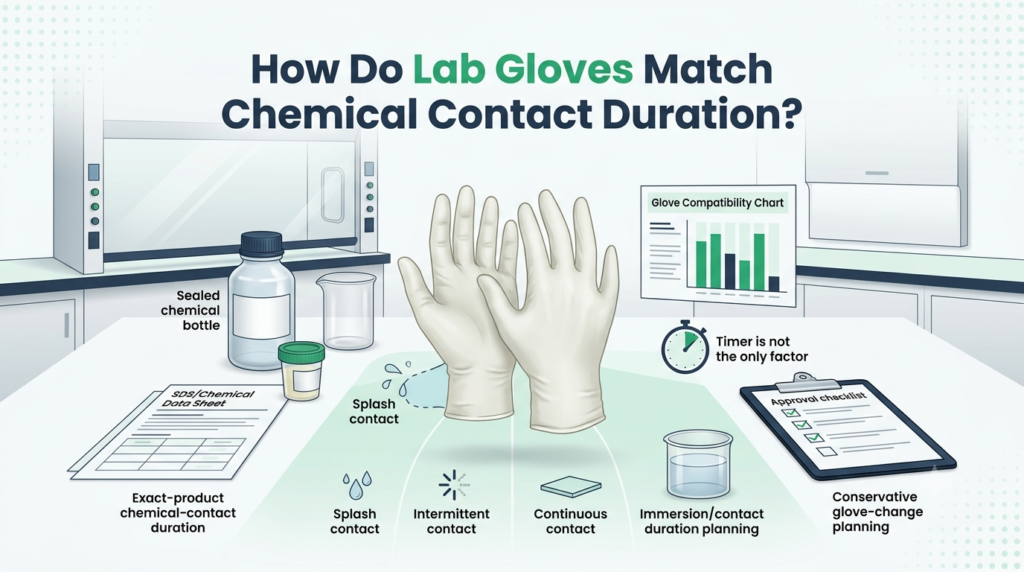
Chemical-handling lab gloves match chemical contact duration only when the expected exposure mode and task conditions are compared with resistance data for the exact chemical and exact glove product.
A defensible decision must also consider permeation rate, cumulative permeation, degradation, penetration, concentration, mixtures, temperature, flexing, pressure, fit, and the laboratory’s change and emergency procedures. This article covers exposure modes, resistance metrics, task factors, exact-product evidence, change planning, failure response, and pre-task verification.
This article provides general chemical-glove selection and change-planning guidance. It does not replace a laboratory hazard assessment, Chemical Hygiene Plan, Safety Data Sheet, engineering-control evaluation, exact-product compatibility data, emergency procedure, or qualified EHS and medical guidance.
How do contact duration and exposure mode affect chemical-handling lab gloves?
Contact duration affects chemical-handling lab gloves only as part of the broader exposure profile because a brief immersion, repeated splash, and continuous surface contact place different demands on the glove.
The exposure assessment should remain within the wider principle that laboratory gloves must match the actual chemical, biological, physical, or procedural task. For covered U.S. workplaces, OSHA requires hand protection to be selected by performance relative to the task, conditions, duration of use, and identified hazards, while general PPE rules support hazard assessment, fit, and training. [HP] [PPE]
Which contact modes must be distinguished?
The laboratory must distinguish incidental splash, repeated splash, intermittent contact, continuous contact, immersion, contaminated-object handling, vapor contact, and pressurized contact before evaluating glove data. Splash does not mean safe, and immersion may require more substantial coverage or a different protective ensemble.
Vapor, gas, and pressurized liquid contact should not be treated as routine disposable-glove work. They may require engineering-control review, ensemble compatibility, source control, or task redesign before any glove is approved.
How do frequency and repetition alter the exposure?
Frequency and repetition alter the exposure when chemical remains on the glove, contacts the same area repeatedly, or combines with flexing, pressure, and incomplete decontamination. A series of brief contacts can become a cumulative task problem even when each contact appears short.
Do not add contact seconds together as a universal calculation, assume a dry interval resets the glove, or assume removing and redonning a reusable glove resets chemical exposure. The approved procedure should define what happens after contact, interruption, contamination, and task completion.
Why must the test method match the exposure mode?
The test method must match the exposure mode because continuous-contact and intermittent-contact tests challenge protective materials through different contact patterns. ASTM F739-20 is used for continuous contact, ASTM F1383-20 addresses intermittent contact, and ISO 6529:2026 addresses continuous contact with liquid or gaseous chemicals. [F739] [F1383] [ISO]
Results from unlike standards, temperatures, test cells, contact cycles, and analytical systems should not be treated as directly interchangeable. A number stripped from its test conditions is not enough to approve a real laboratory task.
The contact-mode table connects the real task pattern to the type of evidence and control that should be reviewed.
| Contact Mode | Practical Example | Duration Pattern | Primary Concern | Evidence to Verify | Immediate-Control Requirement |
|---|---|---|---|---|---|
| Incidental splash | Small droplet during transfer | Brief, unplanned | Rapid removal and contamination control | Product splash guidance and task procedure | Stop or replace as required |
| Repeated splash | Multiple transfers | Recurrent short contact | Accumulated and intermittent permeation | Intermittent-contact data | Defined replacement procedure |
| Continuous contact | Glove remains contaminated | Sustained | Ongoing permeation | ASTM F739 or ISO 6529 data | Conservative change point |
| Partial immersion | Fingers enter liquid | Sustained local contact | High localized exposure | Exact-product continuous-contact data | Coverage and change controls |
| Full immersion | Hand enters chemical | Sustained broad contact | Extensive permeation and coverage | Exact-product and ensemble data | EHS approval |
| Contaminated objects | Wet glassware or tools | Repeated localized contact | Pressure, friction, and carryover | Task and product data | Controlled handling and replacement |
| Vapor or gas | Volatile chemical operation | Airborne contact | Ensemble compatibility | Gas-specific evidence and engineering controls | Source-control review |
| Pressurized contact | Line, leak, or spray | High-energy contact | Penetration and splash failure | Specialized hazard assessment | Do not rely on routine disposable gloves |
The table separates continuous and intermittent contact and does not prescribe a safe duration.
What do breakthrough and permeation results mean for chemical-handling lab gloves?
Breakthrough time is one part of chemical-handling glove evaluation and must be interpreted alongside permeation rate, cumulative permeation, degradation, penetration, and the test conditions used to produce the result.
Breakthrough should not be turned into a safe-wear clock. ASTM F739-20 treats breakthrough detection time, standardized breakthrough, permeation rate, and cumulative permeation as separate measures, and its public information warns that the results cannot independently establish safe dermal-exposure levels.
What is the difference between detection and standardized breakthrough?
Breakthrough detection time records the first analytical detection under the stated system, while standardized breakthrough records when permeation reaches a defined rate threshold. Detection depends on analytical sensitivity; standardized breakthrough depends on the selected threshold.
Standardized breakthrough does not mean zero earlier transfer. Where ASTM’s public page identifies standardized breakthrough concepts and threshold-based reporting, those results still remain test metrics, not permissions to wear until a minute mark.
Why do permeation rate and cumulative permeation matter?
Permeation rate and cumulative permeation matter because gloves with similar breakthrough results can permit different transfer rates and total transferred quantities. Rate describes transfer speed, while cumulative permeation describes the amount transferred over a defined area and time.
Toxicity and skin absorption determine the significance of those values. A low rate does not prove no risk, and a low cumulative amount does not establish a safe skin dose without chemical-specific toxicological and EHS review.
How do degradation and penetration differ from permeation?
Permeation is molecular movement through the material, degradation is physical change in the material, and penetration is passage through holes, tears, seams, pores, or defects. A glove may permeate without visible degradation, and a punctured glove may fail despite strong permeation resistance.
ISO 374-2:2019 addresses resistance to penetration, while ISO 374-4:2019 addresses degradation caused by chemicals. These tests support different questions and should not be used as substitutes for permeation timing or safe-wear approval. [PEN] [DEG]
Each chemical-resistance metric answers a different question and none independently establishes a universally safe glove-wear period.
| Metric | What It Measures | Relevant Standard or Evidence | What It Does Not Prove | Decision Use |
|---|---|---|---|---|
| Breakthrough detection time | First analytical detection | ASTM F739/F1383 data | Safe wear or zero earlier transfer | Compare test performance cautiously |
| Standardized breakthrough | Time to a defined permeation-rate threshold | ASTM test result | No chemical passed earlier | Threshold-based comparison |
| Permeation rate | Speed of molecular transfer | ASTM or ISO test report | No degradation or penetration | Evaluate barrier behavior |
| Cumulative permeation | Total transferred mass over time | ASTM or ISO data | Safe skin dose | Combine with toxicity review |
| Degradation | Physical material change | ISO 374-4 or product data | Exact permeation timing | Stop and reassess product |
| Penetration | Passage through discontinuities | ISO 374-2 or product data | Molecular barrier performance | Integrity assessment |
Detection, standardized breakthrough, rate, cumulative amount, degradation, and penetration should remain separate during approval.
Which task factors determine the protection required from chemical-handling lab gloves?
The protection required from chemical-handling lab gloves depends on the exact chemical hazard and how the task is performed—not merely the chemical name or planned duration.
Laboratories can use the glove hazard-matching tool to organize task hazards before completing exact-product verification, but chemical compatibility still needs exact evidence.
Which chemical factors must be identified?
Chemical identification must include the exact substance or mixture, concentration, physical form, temperature, toxicity, and skin-exposure hazard. Confirm the chemical name, CAS number where available, purity, liquid or vapor form, carrier solvent, acute and chronic effects, corrosivity, sensitization, and whether skin absorption is a concern.
The SDS supports identification, composition, handling, engineering-control, PPE, and route-specific first-aid information, but generic SDS glove wording is not enough to prove exact-product compatibility.
Which task factors must be identified?
Task assessment must identify how often chemical contact may occur, how much contact is possible, and which physical stresses or coverage needs accompany the exposure. Confirm contact mode, duration, frequency, quantity, open or closed handling, splash potential, immersion potential, pressure, flexing, gripping, abrasion, puncture stress, dexterity, coverage, doffing, and emergency removal.
Where regional sizes differ, the glove size translator can support size conversion without determining chemical compatibility. Fit must not compromise the chemical barrier, doffing, or physical control.
How should chemical mixtures be assessed?
Chemical mixtures should be assessed using exact-mixture data wherever possible because component data may not predict how the formulated product permeates the glove. The sequence should be: identify the formulation, confirm concentrations, seek exact-mixture test data, contact the glove manufacturer, consult EHS or the Chemical Hygiene Officer, review carrier solvents, and use component data only for conservative screening.
OSHA Appendix B advises using exact mixture data where available and, when unavailable, considering the component with the shortest breakthrough time as a conservative selection input; that screening step does not create a guaranteed mixture-safe duration. Do not average component values or select from the dominant ingredient alone. [AB]
The task requirement matrix links the chemical and task profile to the evidence needed before an exact glove can be approved.
| Task Factor | Protection Implication | Required Glove Evidence | Verification Source | Escalation Trigger |
|---|---|---|---|---|
| Exact pure chemical | Direct chemical resistance | Exact chemical/product data | Manufacturer test report | Data absent |
| Diluted solution | Concentration-sensitive performance | Relevant concentration data | Manufacturer or EHS | Only neat-chemical data exist |
| Mixture | Unpredictable combined behavior | Exact-mixture evidence | Manufacturer and EHS | Mixture data unavailable |
| Incidental splash | Rapid response and replacement | Splash or intermittent evidence | Product data and procedure | Splash exceeds procedure |
| Repeated splash | Accumulated intermittent exposure | ASTM F1383 or equivalent data | Test report | No relevant intermittent data |
| Continuous contact | Sustained permeation risk | ASTM F739 or ISO 6529 data | Test report | Task exceeds conditions |
| Elevated temperature | Faster permeation may occur | Relevant-temperature evidence | Manufacturer and assessment | Only room-temperature data |
| Strong flexing or gripping | Physical thinning and stress | Chemical and physical evidence | Task observation and data | Repeated failure |
| High skin toxicity | Greater conservatism needed | Permeation and toxicology review | SDS, CHP, EHS | No defensible change point |
| Forearm exposure | Greater body coverage | Longer cuff or protective clothing data | Hazard assessment | Glove coverage inadequate |
| Pressurized contact | Splash and physical failure | Specialized ensemble evidence | Engineering and PPE review | Routine glove proposed |
The matrix uses exact chemical and exact product logic and does not recommend generic materials.
How should workers select chemical-handling lab gloves from exact-product data?
Chemical-handling lab gloves should be selected from data tied to the exact glove product, exact chemical, concentration, temperature, contact mode, and test conditions.
Generic polymer differences belong in the glove material comparison tool, while this page remains focused on exact-product chemical evidence. Material family, color, thickness, and retailer wording do not approve a glove for a chemical task.
Which product identity details must match?
Product data must match the exact manufacturer, model, formulation, thickness, size, cuff design, and intended-use status of the glove being approved. Verify product code, material formulation, thickness, size, cuff length, lining, supported use, lot or version where relevant, and disposable or reusable status.
Generic nitrile data do not apply to all nitrile gloves, and generic neoprene, butyl, latex, PVC, or laminate data do not apply universally. Data for another product family, thickness, formulation, or test revision are insufficient.
Which test details must be reviewed?
Test review must confirm the chemical, concentration, temperature, exposure model, standard, detection threshold, test duration, and measured performance. The laboratory should review breakthrough definition, detection sensitivity, test cell, open-loop or closed-loop design, permeation rate, cumulative permeation, degradation, penetration, specimen location, and seam testing where relevant.
ASTM public material warns that results from different test systems may not be directly comparable without details about test cells, procedures, and analytical techniques. Do not compare one number stripped from its test conditions.
What should happen when exact data are unavailable?
When exact chemical and exact-product data are unavailable, the task should not be approved through assumption or generic material charts. Pause the approval, contact the manufacturer, consult EHS or the Chemical Hygiene Officer, seek another product with relevant data, reduce quantity or contact, use tools, improve enclosure, substitute a less hazardous chemical where feasible, and document the decision.
A task-first screen through the glove recommendation engine may support initial routing but cannot replace chemical compatibility data.
When should another control replace glove dependence?
Engineering or process controls should replace glove dependence when they can prevent or substantially reduce chemical contact at the source. Consider closed transfer, fume hood, glove box, remote tools, tongs or forceps, splash shields, secondary containment, smaller quantities, automation, chemical substitution, and task redesign.
OSHA Appendix B states that PPE should not be relied on alone and should be used with guards, engineering controls, and sound work practices. This page does not select a fume hood or design a closed system.
How should laboratories establish change schedules for chemical-handling lab gloves?
A chemical-handling glove change schedule should be established through the laboratory hazard assessment and Chemical Hygiene Plan using exact-product evidence, real task conditions, chemical toxicity, and documented conservatism.
Where OSHA’s Laboratory Standard applies, the employer must maintain a written Chemical Hygiene Plan with procedures, control criteria, engineering controls, PPE, hygiene practices, training, prior-approval circumstances, and medical provisions. [CHP]
Why must the schedule be more conservative than a raw breakthrough result?
The approved change point should be more conservative than a raw breakthrough result because actual use can involve higher temperature, hand warmth, pressure, flexing, thinning, contamination, mixtures, aging, and product variability.
OSHA’s Technical Manual warns that actual breakthrough may be earlier than published laboratory data because of real-use factors such as temperature, pressure, thinning, degradation, reuse, mixtures, batch variability, and product-model differences. That warning supports conservative planning, not one universal percentage reduction. [OTM]
Which events require immediate change regardless of the schedule?
Immediate-change triggers override the scheduled change point whenever chemical contact, damage, degradation, internal contamination, uncertainty, or worker symptoms fall outside the approved procedure. Known contamination, puncture, tear, cuff failure, seam failure, swelling, softening, stiffening, tackiness, discoloration, cracking, loss of grip, internal contamination, uncertain contact, leaving the controlled area, task completion, and the approved change point should all be handled by procedure.
Do not wait for visible damage, odor, or symptoms. Absence of signs does not prove protection.
How should scheduled changes be documented?
A glove-change procedure should document the exact chemical, exact glove, exposure assumptions, source evidence, conservative change point, immediate triggers, and approval authority. It should also record concentration, mixture, task, contact mode, test conditions, assumptions, basis for conservatism, maximum approved interval, doffing, disposal, decontamination where approved, review date, incident history, product changes, and training.
The procedure should not claim zero exposure. It should document why the selected approach is acceptable for the defined task and when it must be reviewed.
The workflow converts chemical and glove evidence into a documented change point without treating breakthrough as a countdown clock.
- 1Identify exact chemical and concentration
- 2Classify contact mode
- 3Define temperature, pressure, flexing, and coverage
- 4Identify exact glove product
- 5Review breakthrough, rate, cumulative permeation, degradation, and penetration
- 6Compare test conditions with the actual task
- 7Assess toxicity and mixture uncertainty
- 8Consider engineering and process controls
- 9Apply laboratory-approved conservatism
- 10Establish change point
- 11Define immediate-change triggers
- 12Document in the CHP or task procedure
- 13Train workers
- 14Review after incidents, process changes, product changes, or new data
The workflow does not create a universal numerical safety factor or add double-glove times.
What should workers do after suspected permeation or failure of chemical-handling lab gloves?
Suspected permeation, penetration, degradation, glove damage, internal contamination, or worker symptoms should be treated as an exposure-control event even when the published breakthrough time has not been reached.
The response should stop the exposure, activate the chemical-specific procedure, and preserve evidence for investigation. It should not diagnose, treat, or invent a universal decontamination method.
What should happen immediately?
Immediate response begins by stopping the task, moving away from the source where safe, securing the operation, and activating the chemical-specific exposure procedure. The approved response may include removing gloves by the approved method, avoiding secondary contamination, following the SDS and CHP, using eyewash, shower, or another method where the procedure requires it, obtaining medical evaluation where indicated, and reporting the incident.
SDS Section 4 contains route-specific first-aid information, but this article does not prescribe water, neutralization, or treatment universally. Do not delay emergency action to check breakthrough charts. [SDS]
Why are odor and visible appearance unreliable?
Odor and visible appearance are unreliable because permeation can occur without visible damage, and odor thresholds do not establish safe skin exposure. Some chemicals have little or no warning odor, degradation does not reveal the exact start of permeation, and symptoms may mean exposure has already occurred.
Do not tell workers to smell gloves, wait for tingling, treat discoloration as a timer, or treat no visible damage as proof of compatibility.
What should happen to the gloves and affected area?
Contaminated gloves, surfaces, tools, and waste should be controlled according to the chemical-specific disposal, decontamination, incident, and waste-management procedures. Disposal, containment, surface control, waste classification, product-lot review, replacement selection, medical follow-up, and procedure review belong in the approved system.
Do not return contaminated single-use gloves to service, do not reuse chemical gloves unless reuse is permitted and validated, and do not prescribe one surface-cleaning method for every chemical.
Which mistakes weaken protection from chemical-handling lab gloves?
Chemical-glove protection is weakened when workers or laboratories misread resistance data, select from generic material assumptions, ignore real task conditions, or continue use after contamination or uncertainty.
Which data-interpretation mistakes are common?
Data-interpretation mistakes commonly involve converting laboratory metrics into permissions they were not designed to provide. Avoid treating breakthrough as safe wear, comparing unlike thresholds, ignoring rate, ignoring cumulative permeation, using continuous data for intermittent work, using intermittent data for immersion, using another product model, ignoring concentration or temperature, treating qualitative ratings as complete evidence, assuming “no breakthrough reported” means zero permeation, or citing withdrawn versions as current.
Which chemical-assessment mistakes are common?
Chemical-assessment mistakes occur when identity, concentration, mixture behavior, toxicity, or physical form is simplified beyond what the task evidence supports. Avoid selecting by material name, ignoring mixtures, averaging component results, treating shortest component time as guaranteed, ignoring carrier solvents, relying only on generic SDS wording, ignoring skin absorption, vapor, pressure, or temperature, and assuming dilution always simplifies selection.
Which glove-use mistakes are common?
Glove-use mistakes occur when workers continue wearing contaminated or damaged gloves, spread chemical outside the work area, reuse disposable gloves, or substitute PPE for engineering controls. Avoid wearing until visible damage, reusing disposable gloves, resetting an exposure clock after doffing, wearing contaminated gloves outside the area, touching phones, keyboards, notebooks, or door handles, adding double-glove times, accepting poor fit, failing to inspect gloves, continuing after uncertainty, or using gloves instead of engineering controls.
Persistent pressure, sweating, bunching, or fit concerns can be routed through the glove comfort troubleshooter after the chemical task has been made safe.
What should laboratories verify before approving chemical-handling lab gloves?
Before approving chemical-handling lab gloves, the laboratory should verify the chemical, exposure profile, exact product, resistance evidence, change procedure, engineering controls, and emergency readiness.
The checklist helps a supervisor, Chemical Hygiene Officer, or EHS reviewer approve, restrict, reject, or redesign the proposed glove procedure.
- Chemical Identification: Exact chemical name, CAS number where available, concentration, physical form, mixture composition, carrier solvent, temperature, toxicity, skin-absorption hazard, and current SDS are known.
- Exposure Profile: Contact mode, expected duration, frequency, splash potential, immersion potential, vapor or gas contact, pressurized contact, flexing, abrasion, puncture stress, and required coverage are documented.
- Exact Glove Product: Manufacturer, product name, product code, formulation, thickness, size range, cuff length, disposable or reusable status, and exact-product data are verified.
- Resistance Evidence: Chemical, concentration, temperature, contact mode, test-standard version, breakthrough definition, permeation rate, cumulative permeation, degradation, penetration, and mixture uncertainty are reviewed.
- Change Procedure: A conservative change point, immediate-change triggers, doffing, disposal, double-gloving approval where used, reuse controls where applicable, approval authority, and review date are documented.
- Engineering Controls: Closed handling, fume hood or enclosure needs, splash shields, remote tools, secondary containment, quantity reduction, substitution, and process redesign are considered before relying on gloves.
- Emergency Readiness: Workers know permeation may be invisible, odor is unreliable, symptoms are not a timer, and the chemical-specific exposure procedure, SDS Section 4, CHP, eyewash or shower access where required, medical pathway, and incident reporting route are available.
- Final Decision: Approve, approve with a more conservative change point, approve with engineering controls, add body coverage, restrict to splash-only work, restrict quantity or temperature, reject for insufficient data, reject for task capability, escalate to EHS, or redesign the task.
Checklist completion does not prove zero exposure, universal compatibility, suitability for another chemical, concentration, temperature, glove model, mixture, changed task, or full legal compliance.
- OSHA — 29 CFR 1910.138 Hand Protection — retained for the page’s evidence-controlled chemical-glove claims.
- OSHA — 29 CFR 1910.132 General PPE Requirements — retained for the page’s evidence-controlled chemical-glove claims.
- OSHA — 29 CFR 1910.1450 Laboratory Standard — retained for the page’s evidence-controlled chemical-glove claims.
- OSHA — Subpart I Appendix B PPE Selection Guidance — retained for the page’s evidence-controlled chemical-glove claims.
- OSHA — Technical Manual Section II, Chapter 2 — retained for the page’s evidence-controlled chemical-glove claims.
- OSHA — 1910.1200 Appendix D Safety Data Sheets — retained for the page’s evidence-controlled chemical-glove claims.
- ASTM — F739-20 — retained for the page’s evidence-controlled chemical-glove claims.
- ASTM — F1383-20 — retained for the page’s evidence-controlled chemical-glove claims.
- ISO — 6529:2026 — retained for the page’s evidence-controlled chemical-glove claims.
- ISO — 374-2:2019 — retained for the page’s evidence-controlled chemical-glove claims.
- ISO — 374-4:2019 — retained for the page’s evidence-controlled chemical-glove claims.
Frequently Asked Questions
Does a longer breakthrough time mean a lab glove is safe to wear until that time?
No. Breakthrough time is a laboratory test result under stated conditions, not permission to wear a glove until that minute. The exact chemical, exact product, temperature, contact mode, toxicity, flexing, pressure, and conservative procedure still control the decision.
Does greater thickness always make chemical-handling lab gloves more protective?
No. Thickness may influence performance within a comparable product, but it does not independently establish chemical compatibility or task suitability. Formulation, exact product, chemical, concentration, temperature, construction, degradation, penetration, and fit still matter.
Can chemical-handling lab gloves be selected from material name alone?
No. Nitrile, neoprene, butyl, latex, PVC, laminate, and other material names do not establish the performance of every finished glove in that family. Manufacturer, product code, formulation, thickness, test method, exact chemical, and conditions must be matched.
Does double-gloving double the breakthrough time?
No. Breakthrough times for two glove layers cannot simply be added or multiplied. Layer interaction depends on exact products and conditions, while dexterity and doffing also matter. Double-gloving requires an approved procedure, not a time calculation.
How should chemical mixtures be handled when exact glove data are unavailable?
Do not guess. Seek exact-mixture evidence, contact the manufacturer, and consult the laboratory safety or EHS function. Component data are screening inputs only; do not average results or treat the shortest component breakthrough as a guaranteed duration.
What should laboratories remember about chemical-handling lab gloves?
Chemical-handling lab gloves should be selected and changed through a documented hazard assessment using exact-product data and actual task conditions. Contact duration must be paired with contact mode, continuous and intermittent contact need relevant evidence, and breakthrough should not be treated as a safe-wear deadline.
Permeation rate, cumulative permeation, degradation, penetration, chemical identity, concentration, mixture behavior, temperature, toxicity, glove model, formulation, thickness, and test conditions all matter. Conservative change procedures must be established before work, immediate-change triggers override schedules, gloves do not replace engineering controls, and exposure response follows the SDS, CHP, and approved procedure.