
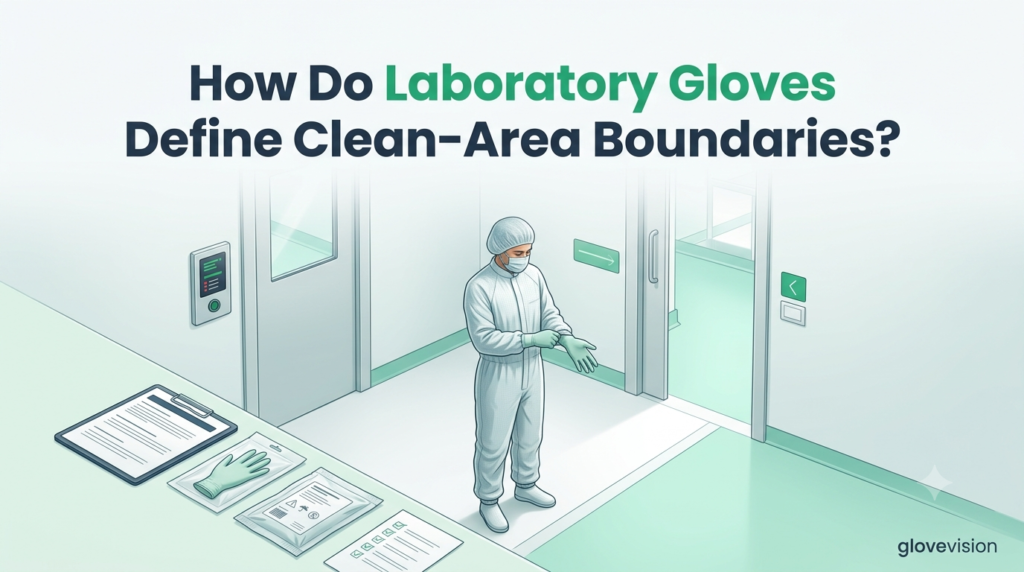
How Do Laboratory Gloves Define Clean-Area Boundaries?
Laboratory gloves at clean-area boundaries support facility controls but do not independently define the boundary. A clean-area boundary is created by the facility’s zoning, access controls, gowning procedures, material flow, monitoring, and approved operating instructions.
There is no single glove sequence that applies to every cleanroom or controlled laboratory. The correct Laboratory Glove action depends on the zone, process, contamination-control purpose, exact glove product, current glove state, surface contact, damage, exit status, re-entry rule, and facility SOP.
Why Do Laboratory Gloves Support Rather Than Define Clean-Area Boundaries?
Laboratory Gloves support clean-area boundaries by controlling hand-mediated contamination, but zoning, facility design, access controls, procedures, personnel behavior, and monitoring establish the boundary. This boundary role begins with the broader requirement that laboratory gloves and process.
ISO 14644-1 classifies cleanroom air by airborne particle concentration. It does not prescribe glove products, gowning order, disinfection frequency, replacement rules, or zone-transition procedures. [ISO1]
Which controls establish a clean-area boundary?
A boundary may be physical, procedural, or both. Walls, doors, airlocks, change rooms, floor lines, pressure or airflow relationships, equipment interfaces, access permissions, cleaning, disinfection, material transfer, and monitoring create the operating boundary.
What contribution do Laboratory Gloves make?
Laboratory Gloves cover personnel hands, reduce direct skin transfer, protect product or samples, reduce cross-zone carryover, create a replaceable contact surface, and support controlled or aseptic handling where the procedure assigns that role.
Why do Laboratory Gloves not prove correct entry?
A worn glove does not prove hand preparation, correct garment use, exact product approval, packaging transfer, current qualification, controlled surface history, or successful monitoring. Entry is complete only when the assigned sequence is finished and verified.
How is correct glove-boundary use verified?
Verification may include the approved SOP, direct observation, gowning qualification, access records, glove-state checks, monitoring where justified, deviation records, and periodic reassessment. Facility-specific instructions require facility evidence. [SOP]
| Boundary Context | Contamination-Control Purpose | Laboratory Glove Role | Governing Procedure | Verification |
|---|---|---|---|---|
| Personnel airlock | Prevent transfer from uncontrolled to controlled areas. | Assigned state during transfer, donning, inspection, or disinfection. | Entry and gowning SOP. | Observation, access record, qualification. |
| Change room | Control garment and glove sequence. | First or outer pair according to validated sequence. | Gowning procedure. | Gowning qualification and supervisor checks. |
| Critical workstation | Protect product, sample, or process from hand-mediated transfer. | Approved working contact surface with defined replacement triggers. | Workstation SOP. | Direct observation or monitoring where justified. |
| Zone-transition line | Prevent cross-zone carryover. | Disinfect, change, remove, or verify before crossing. | Transition procedure. | Glove-state check and deviation record. |
| Equipment interface | Control contact with equipment, tools, or panels. | Permit only approved surface contact and response rules. | Equipment-use SOP. | Task observation and maintenance records. |
| Exit area | Prevent uncontrolled spread and maintain removal order. | Sampling, disinfection, removal, and waste actions. | Exit procedure. | Exit record and waste route check. |
| Re-entry point | Prevent automatic reuse of unknown glove state. | New gloves, partial regowning, full regowning, or approval. | Re-entry procedure. | Supervisor authorization where required. |
Which Clean-Area Conditions Determine How Laboratory Gloves Are Used?
Laboratory Gloves should be controlled according to the exact clean-area context: facility type, process, contamination-control purpose, zone or grade, movement direction, contact surfaces, criticality of the activity, and governing procedure.
ISO 14644-5:2025 provides cleanroom-operations context for personnel management, entry and exit, training, gowning, cleaning, maintenance, and monitoring, but it does not supply one universal glove sequence for every industry or process. [ISO5]
Which clean-area type is involved?
The context may be a generic cleanroom, clean zone, controlled laboratory area, low-bioburden area, product-protection area, sample-protection area, cross-contamination control zone, or sterile-manufacturing area when that example is clearly labeled.
What is the contamination-control purpose?
Gloves may protect a product from personnel, protect samples from cross-contamination, protect a controlled zone from uncontrolled surfaces, protect personnel from process hazards, contain hazardous material, or support multiple protection directions.
What is the exact zone or classification?
The ISO class, internal zone name, process grade, critical work zone, access route, and movement direction matter. However, classification alone does not select the glove product, layer count, donning stage, disinfection step, or replacement action.
Which governing documents apply?
The facility SOP, operations control program, contamination-control strategy where applicable, gowning procedure, material-transfer procedure, monitoring procedure, and deviation procedure should define the actual glove action at each boundary. [CCS]
Which Laboratory Gloves Are Suitable for the Defined Clean Area?
Suitable Laboratory Gloves are exact approved products that match the intended clean area, process, packaging transfer, sterility need, cleanliness attributes, cuff interface, fit, disinfectant compatibility, inspection rules, and change criteria. Final approval requires a documented glove suitability assessment for the exact product and intended use.
ISO 14644-18 provides a risk-based framework for assessing cleanroom consumables by intended use, product and process requirements, cleanliness attributes, functional properties, special contamination properties, associated risks, and documentation. It does not by itself test glove barrier performance or approve every glove use. [ISO18]
Which exact product information is required?
Confirm manufacturer, product name, product code, material, size, cuff length, surface texture, powder status, sterility status, packaging configuration, lot traceability, intended zone, intended task, shelf life, storage, and revision date.
Which cleanliness attributes may matter?
Particle cleanliness, surface residues, extractables, ionic contamination, endotoxin or pyrogen requirements where relevant, biocontamination properties, shedding risk, and packaging cleanliness may be important. sterile gloves are required only where the defined process requires validated sterile status.
Which functional attributes may matter?
Fit, grip, dexterity, cuff length, sleeve–cuff overlap, tensile strength, tear risk, donning control, removal control, and comfort during the procedure affect whether the glove can support the clean-area boundary safely.
How should disinfectant compatibility be assessed?
Assess the exact glove against the assigned agent, concentration, method, coverage, repetition, wet-state or drying requirement, tackiness, swelling, discoloration, loss of grip, loss of integrity, and manufacturer restrictions.
What does glove color establish?
Color may support product recognition, layer differentiation, zone visual management, damage visibility, and training. It does not prove product identity, sterility, cleanliness, qualification, zone authorization, correct entry, or freedom from contamination.
| Glove Attribute | Zone or Process Requirement | Required Evidence | Rejection Trigger |
|---|---|---|---|
| Sterility | Required only where process and zone demand sterile status. | Sterility documentation and packaging status. | Sterility assumed from cleanroom label. |
| Particle cleanliness | Needed where particle transfer affects product or sample. | Product cleanliness documentation. | No particle or residue data. |
| Surface residues | Relevant for sensitive products or materials. | Extractables, residues, or ionic contamination data where required. | Residue risk not evaluated. |
| Packaging | Must support controlled transfer into the area. | Inner and outer packaging configuration. | Packaging cannot be transferred cleanly. |
| Powder status | Powder may create contamination risk. | Powder-free product documentation. | Powder status unclear. |
| Cuff length | Must maintain sleeve–cuff overlap. | Cuff length and interface assessment. | Cuff rolls, gaps, or exposed wrist risk. |
| Fit | Must allow controlled donning, work, and removal. | Size, grip, dexterity, task trial. | Poor handling or high fatigue. |
| Disinfectant compatibility | Must withstand assigned agent and repetition. | Compatibility evidence for agent and method. | Tackiness, swelling, discoloration, loss of grip. |
| Lot traceability | May be needed for quality investigations. | Lot-controlled packaging and records. | No traceability where required. |
| Color | May support visual management only. | Facility procedure and training use. | Color treated as authorization. |
How Should Laboratory Gloves Be Managed During Entry and Gowning?
Laboratory Gloves should be assigned to a specific entry and gowning stage. The procedure should define when each pair is transferred, donned, inspected, disinfected, overlapped with sleeves, verified, changed, or rejected.
What should be confirmed before gowning begins?
Confirm the approved product, package status, correct size, required number of pairs, hand-preparation step, transfer route, gowning sequence, allowed surfaces, inspection criteria, and failure response.
Can Laboratory Gloves be worn during gowning?
Yes, where the validated facility sequence assigns gloves at an earlier stage. A sterile-manufacturing example in EU GMP Annex 1 describes sterile gloves worn while sterile garments are donned, followed by a second sterile pair over garment sleeves for certain Grade B access. This example must not be turned into a universal cleanroom rule. [ANNEX1]
Can Laboratory Gloves be donned after the gown?
Yes, if the facility procedure assigns them after garment donning. The key point is not whether gloves are first or last; it is whether the current glove state, layer order, cuff overlap, and surface-contact history match the approved sequence.
How should the sleeve–cuff interface be controlled?
The procedure should define cuff length, sleeve overlap, taping if used, exposed-wrist prevention, cuff-roll response, garment interaction, disinfection limits, and replacement triggers.
What confirms successful entry?
Successful entry requires the assigned product, correct layers, intact gloves, controlled contact history, required disinfection or inspection, acceptable sleeve–cuff position, and any required observation, access record, or qualification check.
| Gowning Stage | Current Glove State | Assigned Action | Failure Response |
|---|---|---|---|
| Before change area | No approved clean-area glove state yet. | Follow hand preparation and transfer rules. | Stop if product or package is wrong. |
| Early gowning | First pair may be assigned. | Don first pair where procedure requires it. | Restart or correct under supervision. |
| Garment donning | Glove may contact garment surfaces under procedure. | Maintain approved contact and cuff position. | Assess suspected contamination. |
| Final gowning | Outer pair may be assigned. | Don, inspect, disinfect, or verify before entry. | Replace layer or regown as required. |
| Before zone crossing | Glove state must be known. | Confirm correct product, layer, and surface condition. | Do not cross with unknown state. |
| Entry complete | Approved for defined work only. | Begin work within task boundary. | Record deviation if sequence was missed. |
Which Contacts or Transitions Require Laboratory Gloves to Be Disinfected, Changed, or Removed?
Laboratory Gloves should be managed according to the event: approved surface contact, routine disinfection point, uncontrolled surface contact, zone transition, monitoring sample, damage, cuff roll, unknown contact, or procedure deviation.
Which routine contacts may be permitted?
Routine contacts may be permitted where the surface is controlled, the glove state is current, the contact is part of the task, and the facility procedure allows continued work or scheduled disinfection.
What should happen after contact with an uncontrolled surface?
The worker should stop and assess the event according to the SOP. Possible outcomes include inspection, glove disinfection, outer-pair replacement, all-layer replacement, exit and regowning, deviation recording, and product or sample impact assessment.
When should Laboratory Gloves be disinfected?
Disinfection should occur only at defined points using the approved agent, concentration, method, coverage, repetition, contact condition, and drying or wet-state requirement. Disinfection does not repair holes, restore sterility, or make every contact event acceptable.
When should Laboratory Gloves be changed?
Laboratory Gloves should be changed when the SOP requires replacement because of damage, contamination, monitoring, zone transition, time or task limit, loss of cuff position, failed inspection, or procedure deviation. Documented glove replacement criteria should define whether one layer or every layer must be changed.
When should the activity stop?
Stop work when the correct action is missing, contradictory, unvalidated, unknown to the worker, or when damage, uncontrolled contact, failed disinfection, wrong product, lost cuff overlap, or possible product impact cannot be resolved immediately.
| Event | Risk Question | Possible SOP Outcome | Escalation Trigger |
|---|---|---|---|
| Approved surface | Was contact permitted for this glove state? | Continue, inspect, or disinfect. | Contact exceeds task boundary. |
| Routine disinfection point | Is the assigned agent and method compatible? | Disinfect using validated method. | Agent, coverage, or wet-state is wrong. |
| Uncontrolled surface | Could contamination transfer affect the process? | Replace outer layer, all layers, or stop. | Unknown impact or critical exposure. |
| Phone or personal item | Was an uncontrolled item contacted? | Stop and follow deviation procedure. | Product or sample impact possible. |
| Glove tear | Is integrity compromised? | Change affected layer or regown. | Exposed hand or critical product risk. |
| Cuff roll | Is sleeve–cuff overlap lost? | Correct, replace, or exit. | Wrist exposure or repeated failure. |
| Monitoring sample | Does procedure require replacement after sampling? | Replace outer pair or continue by SOP. | Sampling step not defined. |
| Unknown contact | Can the event be reconstructed? | Stop, assess, and document. | No reliable event information. |
| Movement or Transition | Current Glove State | Required Procedure Question | Possible Action |
|---|---|---|---|
| Lower to higher control | Known but may be insufficient. | Is a new glove state required before crossing? | Disinfect, replace, or regown. |
| Higher to lower control | Potentially contaminated by process or zone. | What removal or waste route applies? | Remove layer, discard, or sample. |
| Critical zone intervention | Working glove may be exposed. | Does intervention reset the glove state? | Monitor, replace, or stop. |
| Material-transfer point | Glove may contact transfer packaging. | Is surface approved or uncontrolled? | Disinfect, replace, or record event. |
| Routine exit | Procedure-defined state. | Where should gloves be removed? | Remove in assigned order. |
| Contaminated exit | Suspected contaminated or damaged. | How is spread prevented? | Stop, segregate, decontaminate, escalate. |
| Brief exit | Previous state may not carry over. | Is automatic reuse permitted? | New gloves or regowning. |
| Re-entry | State must be newly authorized. | What entry step restarts? | Repeat hand prep, glove, or gowning step. |
How Should Laboratory Gloves Be Managed During Exit and Re-entry?
Laboratory Gloves need separate exit and re-entry decisions. The exit procedure may define sampling, disinfection, outer-layer removal, inner-layer removal, garment interaction, waste segregation, hand hygiene, and records. Re-entry may require a new glove state.
What must be known before exit?
Before exit, identify the current glove state, contamination history, monitoring requirement, removal point, waste route, hand-hygiene step, whether garments interact with gloves, and whether the exit itself creates a deviation.
Can Laboratory Gloves be monitored before removal?
Yes, where the procedure requires it. In sterile-manufacturing examples, EU GMP Annex 1 includes risk-based personnel monitoring and glove monitoring after certain critical interventions or on Grade B exit; those examples should not be transferred automatically to every cleanroom. [ANNEX1]
Where should Laboratory Gloves be removed?
The validated exit procedure should define whether gloves are removed before a line, after a line, inside an airlock, at a waste point, after sampling, or after another disinfection step. One removal location does not apply to all facilities.
How should removal order be controlled?
Removal order should prevent uncontrolled contact, preserve garment control where needed, support waste segregation, allow hand hygiene, and avoid contaminating clean surfaces or personnel.
What does re-entry require?
Re-entry should not automatically carry over the previous glove state. It may require new outer gloves, new inner and outer gloves, partial regowning, full regowning, repeated hand preparation, monitoring, supervisor approval, or delayed re-entry.
How Should Laboratory Gloves Be Monitored and Verified?
Laboratory Gloves are verified through qualification, observation, records, glove-state checks, risk-based monitoring where justified, deviation trending, retraining, and requalification. Monitoring supports the control system but does not replace a sound procedure.
What should initial personnel qualification cover?
Qualification should cover the approved product, clean-area purpose, gowning sequence, glove states, disinfection method, replacement triggers, sleeve–cuff interface, permitted surfaces, exit steps, re-entry rules, and deviation reporting.
What should routine observation verify?
Observation should verify correct product use, correct layer, package handling, donning, inspection, disinfection, permitted contact, cuff position, change behavior, removal, waste routing, and hand hygiene.
When may microbial glove monitoring be required?
Microbial glove monitoring may be required where process criticality, product exposure, manual intervention, zone proximity, regulatory framework, or contamination-control strategy justifies it. It should not be imposed as a universal rule for every laboratory.
What should happen after a monitoring or qualification failure?
Failures may require stopping the activity, replacing gloves, regowning, isolating product or sample impact, documenting a deviation, retraining, requalification, procedure revision, or access restriction.
What should documentation record?
Records should identify the product, lot where required, training status, qualification, observation, glove-state events, contact events, changes, exit or re-entry actions, monitoring results, deviations, corrective actions, and approval authority.
| Process Context | Verification Method | What It Confirms | Failure Response |
|---|---|---|---|
| Routine controlled laboratory | Observation and glove-state checks. | Workers follow assigned product and procedure. | Retraining or local correction. |
| Qualified gowning | Initial and periodic qualification. | Sequence, cuff overlap, and disinfection are performed correctly. | Requalification before unsupervised work. |
| Aseptic intervention | Risk-based monitoring where applicable. | Critical glove contact and contamination-control actions. | Replace outer pair, investigate, or stop. |
| Zone transition | Access record and direct observation. | Correct crossing action and glove state. | Deviation record and impact assessment. |
| Repeated deviation | Trend review and reassessment. | Procedure clarity, training, or product suitability. | CAPA, SOP change, or access restriction. |
Which Mistakes Break the Clean-Area Controls Supported by Laboratory Gloves?
Clean-area glove control breaks when facilities treat glove presence, sterility, color, disinfection, or monitoring as substitutes for exact-product approval and facility-defined procedures.
Which boundary mistakes affect Laboratory Gloves?
Avoid saying gloves create the boundary, prove entry, authorize a zone, replace access control, replace a gowning sequence, or make an uncontrolled surface acceptable.
Which gowning mistakes affect Laboratory Gloves?
Avoid universal gloves-first, gloves-last, one-pair, or two-pair rules. The number of pairs and donning stage must come from the facility procedure and process risk.
Which product-selection mistakes affect Laboratory Gloves?
Avoid approving a glove because it is labeled laboratory, cleanroom, sterile, nitrile, powder-free, low-lint, aseptic, or color-coded. Exact product documentation should control the decision.
Which contact-response mistakes affect Laboratory Gloves?
Avoid vague “sanitize and continue” decisions. Disinfection, inspection, replacement, stop-work, deviation, and investigation require defined criteria.
Which exit and re-entry mistakes affect Laboratory Gloves?
Avoid assuming all gloves are removed at the same exit line, that gloves always remain until the uncontrolled area, or that a brief exit allows automatic reuse.
Which monitoring mistakes affect Laboratory Gloves?
Avoid treating monitoring alone as proof of contamination control. Monitoring should verify the design and procedure, not replace them.
What Should Laboratories Verify About Laboratory Gloves at Clean-Area Boundaries?
Laboratories should verify the clean-area context, protection direction, exact product, clean-area suitability, entry stage, routine glove state, contact responses, exit and re-entry procedure, visual controls, personnel qualification, monitoring, deviation management, and approval authority.
- Facility type, process, zone, boundary, movement direction, and governing procedure are identified.
- Product, sample, worker, environmental, containment, or cross-contamination purpose is documented.
- Manufacturer, product name, product code, material, size, cuff length, sterility, packaging, and lot needs are known.
- Cleanliness attributes, particle or residue concerns, packaging transfer, powder status, and intended use are supported.
- Fit, grip, dexterity, sleeve–cuff overlap, cuff roll risk, and removal control are acceptable.
- Each entry stage assigns the glove state, layer number, donning point, inspection, and disinfection step.
- Permitted surfaces, working state, time or task limits, disinfection points, and inspection intervals are clear.
- Approved contact, uncontrolled contact, personal-item contact, unknown contact, damage, and monitoring events have defined responses.
- Tears, pinholes, cuff roll, loss of grip, discoloration, contamination, or failed inspection trigger documented action.
- Sampling, disinfection, removal order, waste route, hand hygiene, and records are defined.
- Brief exit, partial regowning, full regowning, new gloves, monitoring, and authorization rules are documented.
- Color is treated only as a secondary cue and never as proof of authorization, sterility, or suitability.
- Initial qualification, periodic observation, risk-based monitoring, retraining, and requalification triggers are defined.
- Undefined, contradictory, or unvalidated actions trigger stop-work, assessment, documentation, escalation, and authorized restart.
Checklist completion supports a defined facility procedure; it does not prove universal compliance, universal cleanroom suitability, or authorization for another zone.
Conclusion
Laboratory Gloves do not independently define a clean-area boundary. They support a facility-defined boundary when the exact product, current glove state, donning stage, contact response, disinfection, replacement, exit, re-entry, monitoring, and deviation rules are integrated into the approved control system.
The safest approach is procedural: define the zone, define the contamination-control purpose, approve the exact glove product, assign each glove action, verify personnel performance, and stop or escalate when the required action is unclear.
Frequently Asked Questions About Laboratory Gloves and Clean-Area Boundaries
Do Laboratory Gloves alone make it acceptable to enter a clean area?
No. Gloves support hand-mediated contamination control, but entry depends on the complete approved sequence, facility access rules, product suitability, gowning, verification, and current glove state.
Are Laboratory Gloves always donned as the final gowning step?
No. Some procedures may require gloves early, late, or in more than one layer. The correct stage must come from the validated facility procedure.
Must Laboratory Gloves always be sterile?
No. Sterile status is required only where the defined process and zone require it. Cleanroom-compatible does not automatically mean sterile, and sterile does not prove current cleanliness.
Can the same Laboratory Gloves be worn across multiple clean-area zones?
Only where the facility procedure allows it and the current glove state remains acceptable for the next zone. Many transitions require disinfection, replacement, removal, or regowning.
Does glove color prove that Laboratory Gloves are correct for a zone?
No. Color may support visual management, layer recognition, or training, but it does not prove product identity, sterility, cleanliness, qualification, or authorization.
What should happen when the required action for Laboratory Gloves is unclear?
The worker should stop the transition or activity, maintain the safest available state, consult the governing procedure, escalate to the responsible function, assess impact, document the event where required, and resume only after authorized resolution.