
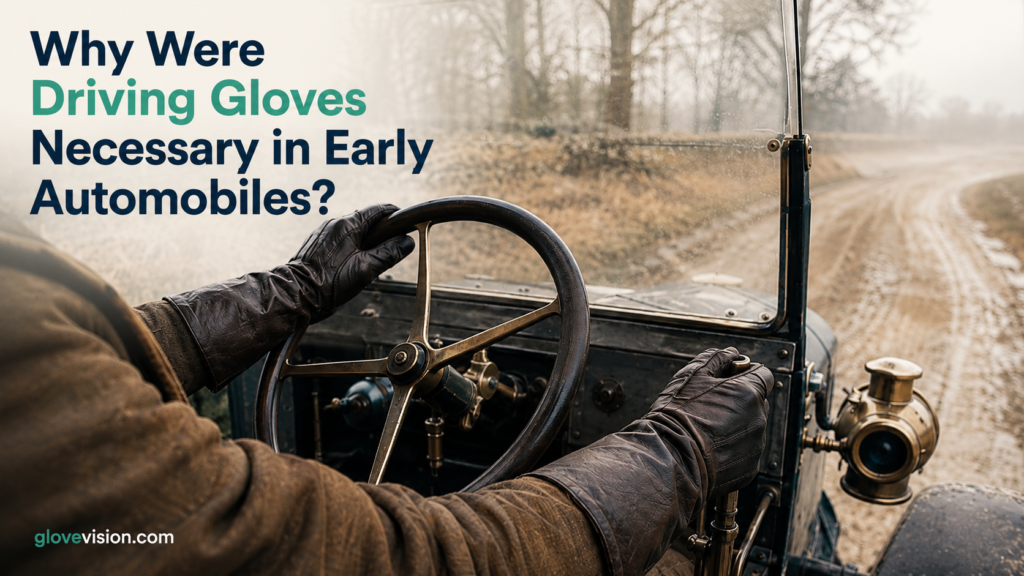
Why Were Driving Gloves Necessary in Early Automobiles?
Many early automobiles left motorists directly exposed to cold moving air, rain, dust, dirt, and repeated contact with steering wheels, levers, and other manual controls. In those conditions, specialized handwear could be practical equipment rather than merely a fashion accessory.
Driving Gloves addressed these demands through hand warmth, wrist and sleeve coverage, and separation from uncomfortable or contaminated surfaces while preserving enough movement to operate the vehicle. Driving Gloves were not universally identical or necessary in every early vehicle, but they served a documented practical role in early motoring clothing.
Functional qualification: Here, “necessary” means practically useful under particular historical conditions—not legally required or universally worn. Vehicle design, climate, journey length, driving purpose, and glove construction varied.
What Conditions Made Driving Gloves in Early Automobiles Necessary?
Driving Gloves in Early Automobiles became useful where environmental exposure and repeated manual operation overlapped. Open or lightly enclosed bodies, variable weather protection, moving airflow, dust, dirt, moisture, and long journeys could leave the hands exposed while the driver still had to operate vehicle-specific controls.
How Did Early Automobile Design Expose Motorists?
Some early automobiles had open or lightly enclosed bodies, and windshields or weather protection varied by vehicle and period. Occupants could therefore remain exposed to airflow, rain, dust, and dirt. The Metropolitan Museum of Art describes early motoring ensembles in the context of open automobiles and exposure to dust, dirt, and weather; its linked object is a pair of goggles, so it supports the wider motoring context rather than glove construction. [Met]
Why Could Vehicle Movement Intensify Hand Exposure?
Vehicle movement could sustain airflow around exposed occupants, while longer journeys extended the duration of exposure. The actual effect depended on speed, cabin enclosure, climate, and journey length; there is no single historical temperature or exposure threshold that applies to every motorist.
Which Environmental Conditions Increased Glove Use?
Cold, wind, rain, dust, dirt, moisture, and seasonal changes created different hand-level problems. Cold could reduce comfort and mobility, rain could alter skin and surface contact, and dust or dirt could contaminate hands and controls. These exposures should be treated separately rather than as one identical mechanism.
Why Were Driving Gloves Part of a Larger Motoring Outfit?
Driving Gloves often appeared alongside motoring coats, goggles, hats, face coverings, and other weather-protective clothing because the practical problem involved whole-body exposure in early motoring. The glove’s role remained specific: covering the hands and wrists while preserving vehicle operation.
How Did Driving Gloves in Early Automobiles Protect Hands From Open-Cabin Exposure?
Driving Gloves in Early Automobiles could address exposed-cabin conditions through a combination of cuff length, shell material, lining, and full-hand coverage. These features were practical only to the extent that they protected the hand without making vehicle controls unusable.
How Did Motorists’ Gauntlets Limit Cold-Air Exposure?
Extended cuffs could cover the wrist, overlap a coat sleeve, reduce exposed gaps, and limit cold air entering the sleeve opening. The Henry Ford documents a leather pair dated 1910–1920 and describes the gauntlet form as helping keep motorists’ hands warm and reduce cold air entering sleeves. That artifact is a documented example, not a universal pattern. [Ford 1910–20]
How Did Linings Support Hand Warmth?
A lining could add insulation, hold relatively still air, reduce direct contact with a cold outer shell, and improve cold-weather comfort. The trade-off was added bulk, potentially lower sensitivity, and possible restriction of finger movement. Historical examples should therefore be evaluated by the conditions they addressed rather than by modern expectations of thinness.
How Did Outer Materials Protect Early Motorists?
Documented leather examples show how an outer shell could provide wind resistance, skin coverage, durability, and separation from cold, dirty, or worn surfaces. Leather type, thickness, finish, lining, and condition varied, so the word “leather” alone does not establish exact warmth, friction, or durability.
Why Did Full Hand and Wrist Coverage Matter?
Coverage could protect the palms, fingers, backs of the hands, wrists, and sleeve openings from different aspects of the motoring environment. This was ordinary clothing protection, not evidence of certified impact, abrasion, fire, or crash protection.
Why Did Driving Gloves in Early Automobiles Matter When Operating Vehicle Controls?
Driving Gloves in Early Automobiles had to do more than shield the skin. A glove that protected against weather but prevented steering, lever operation, or deliberate hand repositioning would not have served the practical task of driving.
How Could Cold Hands Affect Vehicle Operation?
Cold exposure can contribute to discomfort, reduced finger mobility, less precise hand movement, and greater effort during small manual tasks. Historical evidence does not establish identical effects for every driver, but the general need to preserve usable hand movement helps explain why warmth and mobility had to coexist in motoring handwear. General glove-dexterity research also shows that glove construction can change manual performance, though modern occupational findings cannot be transferred numerically to historical motoring. [Dexterity]
How Could Control Surfaces Affect the Hands?
Early vehicle controls varied in material, finish, wear, moisture, temperature, dirt, and shape. Some components could be wooden or metallic, but no single material should be assigned to every steering wheel or lever. A glove’s friction also depended on the complete contact system rather than material identity alone; the broader principle is discussed in palm friction and grip behavior.
How Could Driving Gloves Stabilize Control Contact?
A suitable glove could create a consistent contact layer, separate skin from cold or rough surfaces, manage some perspiration, reduce direct irritation, and support prolonged contact. This should not be turned into a universal grip claim. General research on protective gloves shows that construction can influence grip and manual performance, but it does not validate the performance of any historical artifact. [Grip]
Why Was Finger Movement Still Necessary?
Depending on the vehicle, motorists might need to operate steering wheels, gear levers, hand throttles, brake levers, switches, or other controls. The exact layout varied, but the principle was stable: warmth and coverage had to preserve enough finger and thumb movement for the actual machine.
Where Did Historical Driving-Glove Protection End?
Ordinary historical Driving Gloves did not automatically provide impact protection, crush protection, fire resistance, certified abrasion resistance, crash protection, or prevention of mechanical injury. The broader modern principle of protection-and-dexterity trade-offs is useful only as a separated human-factors comparison, not as evidence that mechanic gloves and early motoring gloves are interchangeable.
How Did Driving Gloves in Early Automobiles Balance Protection With Usable Hand Control?
Driving Gloves in Early Automobiles varied because protection and manual control could pull construction in different directions. Longer cuffs and insulation could improve exposure protection, while reduced bulk and flexible fingers could preserve sensitivity and movement.
How Did Glove Length Affect Protection and Movement?
Extended gauntlets increased wrist and sleeve coverage, mid-length cuffs offered a compromise, and shorter constructions reduced material around the wrist. None is universally superior: the useful choice depended on weather exposure, sleeve interface, wrist movement, and driving context.
How Did Lined and Unlined Gloves Serve Different Needs?
Lined gloves could support cold-weather protection but add bulk. Unlined or less bulky gloves could preserve more direct contact and finger mobility but provide less insulation. A thin or unlined construction should not automatically be interpreted as a deliberate “maximum control” design.
How Did Material Thickness Affect Early Driving Handwear?
Thickness could influence durability, wind resistance, flexibility, control sensitivity, and break-in behavior. Appearance alone cannot establish exact thickness or performance. General sports-glove research supports the principle that fit and material interact with comfort and hand performance, but it does not directly test historical Driving Gloves. [Fit]
Why Could Road and Racing Gloves Differ?
Road-motoring examples could emphasize weather coverage, warmth, journey comfort, and sleeve overlap, while early racing contexts could prioritize secure contact, finger movement, reduced bulk, or repeated control operation. The Henry Ford preserves automobile-racing gloves associated with Joe Tracy and dated circa 1905, showing that specialized automotive handwear also existed in racing contexts. That artifact does not establish ordinary road-glove design or modern motorsport compliance. [Ford c.1905] Modern sport-specific glove construction belongs to a separate category.
Which Evidence Shows Driving Gloves in Early Automobiles Were Functionally Necessary?
Driving Gloves in Early Automobiles should be explained through dated artifacts, museum descriptions, historical images or catalogs, and carefully bounded human-factors evidence. The strongest conclusion is usually specific: a source documents one glove, one period, or one motoring context—not every motorist and every vehicle.
What Can Museum Artifacts Confirm?
Museum records may document an artifact’s approximate date, material, dimensions, cuff length, lining, ownership, motoring association, or road/racing context. The Henry Ford’s 1910–1920 driving gloves are particularly useful because the museum explicitly connects their gauntlet form with keeping motorists’ hands warm and limiting cold air at the sleeves. [Ford]
How Can Historical Images Support Glove Claims?
Images can show gloves worn with motoring clothing, approximate cuff length, vehicle exposure, hand placement, and road or racing context. They usually cannot prove exact material, insulation, friction, thermal performance, or wearer experience without supporting records.
Which Historical Claims Require Qualification?
Universal necessity, exact invention dates, standardized materials, steering-wheel composition, measured grip improvement, warmth, driver preference, and fashion-versus-function claims all require qualification. Saint Louis Art Museum offers useful museum interpretation of changing motoring clothing as automobiles evolved, but it is not mechanical or thermal testing. [SLAM]
Why Is Practical Necessity Different From Legal Requirement?
Practical necessity describes usefulness under a set of conditions; it does not establish a legal mandate. Glove use could vary with vehicle, place, weather, journey, driving purpose, and driver preference. Museum evidence demonstrates adoption and construction examples, not universal regulation.
How Should Conflicting Historical Explanations Be Evaluated?
Start with the dated source, confirm its motoring association, inspect observable construction, connect that construction with a documented need, label interpretation as inference, and state the limitation. This keeps practical motoring evidence separate from historical and fashion-glove classification. Later evolution into close-fitting modern handwear belongs on the broader page about the evolution from historical need to modern hand control.
Evidence-transfer rule: General glove research can support broad principles about fit, thickness, dexterity, or grip behavior, but finished historical Driving Gloves require artifact-level or driving-context evidence. The research must not override the historical record.
Conclusion
Driving Gloves were necessary for many early motorists because exposed automobiles subjected their hands to cold airflow, weather, dust, dirt, moisture, and repeated contact with manual vehicle controls. Gauntlet cuffs, linings, outer shells, and full-hand coverage could protect the hands and sleeve interface while preserving enough movement for steering and lever operation.
The need was never universal. Historical gloves varied by period, climate, vehicle, journey, and driving purpose; road and racing examples could prioritize different features, and museum artifacts document examples rather than one standard design. Practical necessity therefore means context-specific usefulness, not legal obligation or proof that every glove improved grip or safety.
Frequently Asked Questions
Were Early Driving Gloves Worn Only for Warmth?
No. Warmth was important in exposed conditions, but Driving Gloves could also provide wind protection, wrist coverage, surface protection, and usable contact with vehicle controls.
Were Driving Gloves Merely an Early Motoring Fashion?
No. They became part of recognizable motoring clothing, but documented examples also show practical roles related to weather exposure, warmth, coverage, and vehicle operation.
Did Every Early Motorist Wear Gauntlet Driving Gloves?
No. Glove use and construction varied by period, vehicle, weather, journey, driving purpose, and personal preference.
Did Early Driving Gloves Improve Steering Grip?
They could provide a more consistent contact layer, but the result depended on material, fit, condition, moisture, and the control surface. Historical evidence does not justify a universal grip-improvement claim.
Why Did Driving Gloves Become Less Necessary in Modern Cars?
Enclosed cabins, heating, power-assisted steering, and improved control surfaces reduced many original practical pressures. Modern evolution and present-day suitability belong on GloveVision’s broader Driving Gloves page rather than this historical explanation.