
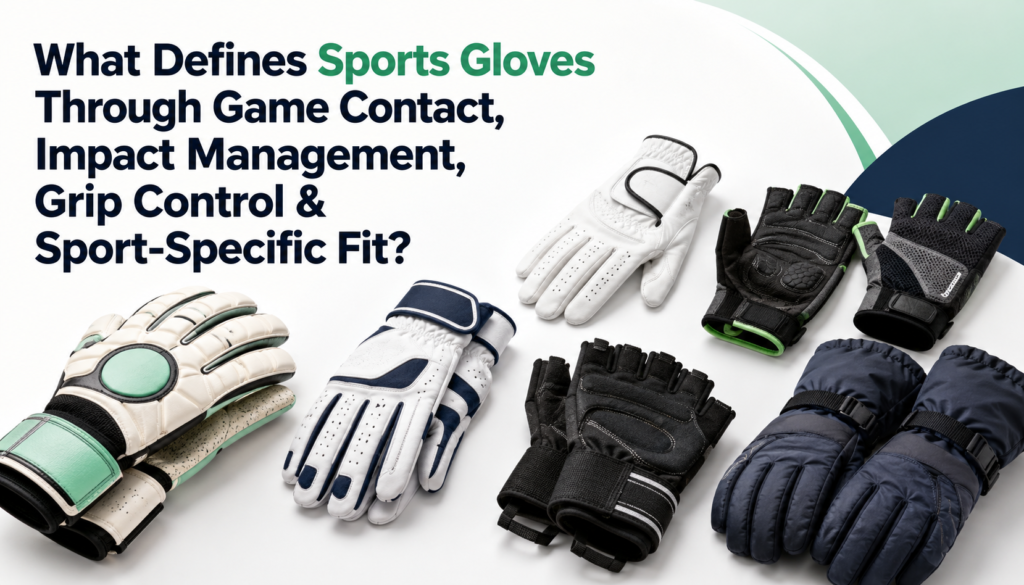
What Defines Sports Gloves Through Game Contact, Impact Management, Grip Control & Sport-Specific Fit?
Sports gloves are defined by the sport’s contact surface, grip and control demand, impact or pressure pattern, material and padding construction, fit, closure, playing conditions, and remaining performance. Athletic appearance or a material name alone does not prove suitability for a sport.
This article explains sports-glove classification, game-contact surfaces, grip, impact, vibration, pressure, abrasion, materials, padding, reinforcement, category-specific fit and closure, moisture and weather limits, care, replacement, and final verification.
This article provides educational sports-glove selection guidance and does not replace manufacturer instructions, sport or competition rules, coaching guidance, medical evaluation, or specialist protective-equipment advice. Sports gloves cannot guarantee protection from impact, abrasion, joint injury, cold exposure, skin irritation, or equipment failure.
What are sports gloves, and how do they differ from work, tactical, and general protective gloves?
Sports gloves are athletic handwear designed around the movement, grip, contact feel, pressure, impact, comfort, or weather demands of a particular sport.
Sport-specific design prioritizes the athlete’s real contact interface, movement pattern, palm feel, finger articulation, wrist motion, closure security, moisture load, and playing environment.
A goalkeeper glove may emphasize ball contact and hand closure, while a batting glove emphasizes handle friction and flexible knuckles, and a golf glove emphasizes close palm feel with minimal wrinkling.
General protective gloves may cover the hand without placing grip, padding, ventilation, reinforcement, or seams where a specific sport needs them.
Work gloves prioritize occupational hazards and trade tasks, while tactical gloves prioritize duty environments, controlled equipment interaction, and localized protective zones.
Sports gloves prioritize athletic handling and sport-specific movement, so they do not automatically provide industrial cut, puncture, impact, chemical, electrical, flame, thermal, or crush protection.
An industrial rating also does not establish sport suitability because a workplace test does not evaluate the rules, contact surface, fit pattern, equipment feel, or movement demand of a particular sport.
ISO 21420:2020 becomes relevant only when a sports glove is discussed as protective PPE or carries an applicable protective claim; it specifies general design, construction, innocuousness, comfort, marking, and manufacturer-information requirements but does not establish hazard-specific or sport performance by itself. [ISO 21420]
ISO 21420:2020/Amd 1:2022 is a published amendment that applies to the base standard and should be considered with it rather than treated as a separate sports-glove approval. [Amd 1]
ISO/TR 8546:2022 gives risk-assessment-based guidance for selecting and using protective hand PPE after hazards have been reduced by other measures, and its published scope explicitly excludes sport; it therefore supports specialist PPE routing rather than sports-glove approval. [ISO/TR 8546]
ISEA lists ANSI/ISEA 105-2024 and ANSI/ISEA 138-2019 as workplace hand-protection standards for classification and back-of-hand impact performance. Any such claim on a sports glove still requires the exact finished product, edition, level, tested construction, protected zone, and manufacturer limitation. [ISEA][Catalogue]
How do goalkeeper, batting, and golf gloves differ within the sports-glove classification?
Goalkeeper, batting, and golf gloves differ because catching a ball, gripping a bat, and controlling a club create different palm, padding, movement, and fit requirements.
Goalkeeper gloves manage repeated ball contact through a broad palm surface, a playing-condition-dependent palm compound, hand closure, wrist security, finger movement, and optional support elements.
Catching performance requires deeper comparison because goalkeeper grip and durability depend on the palm compound, glove cut, ball and surface context, weather, preparation, cleaning, drying, and manufacturer limitations.
The current IFAB Law 4 permits non-dangerous protective equipment such as gloves, and its published FAQ states that goalkeeper gloves are optional rather than compulsory under the Laws of the Game. Competition organisers, national associations, leagues, and facilities may still apply additional conditions. [IFAB Law 4]
Batting gloves manage bat-handle friction through palm stability, flexible knuckle zones, reinforcement over real wear areas, secure wrist closure, and enough finger movement to avoid bunching or seam pressure.
Repeated handle contact matters because batting vibration exposure combines friction, repeated equipment-transmitted movement, palm wear, and control trade-offs without guaranteeing blister or injury prevention.
More padding is not automatically better because excess or misplaced material can reduce bat feel, alter pressure, fold under the palm, or change closure security.
Golf gloves manage club feel through a close, wrinkle-limited fit, smooth palm and digit surfaces, stable grip pressure, flexible fingers, and controlled moisture response.
Close palm fit matters because golf swing control depends on the finished glove, club interface, fit, weather, and playing conditions rather than on leather or thinness alone.
USGA Equipment Rules allow a glove to assist grip only when it meets the applicable “plain glove” requirements, including fitted digit coverings and smooth palm and gripping surfaces, with restrictions on padding, binding, adherence, and other assistance features. [USGA Equipment]
USGA Rule 4.3 also restricts equipment use that artificially reduces the need for a skill or judgment essential to the game or uses equipment in an abnormal way. Current competition and committee conditions should be checked rather than treating commercial availability as conformity. [USGA Rule 4]
Cycling, weightlifting, skiing, boxing, equestrian riding, football, racket sports, and other activities require their own contact, padding, closure, weather, and fit systems.
The three primary categories form the page’s classification spine, but they are not the only sports gloves and should not be used as templates for every athletic task.
| Category | Primary Contact | Main Performance Goal | Typical Construction Priority | Main Limitation | Deeper Route |
|---|---|---|---|---|---|
| Goalkeeper gloves | Ball and playing surface | Catching grip, hand closure, contact management | Large palm surface, catching compound, wrist closure, optional finger support | Grip and durability vary by palm, weather, surface, and care | Goalkeeper Gloves |
| Batting gloves | Bat handle | Palm stability, friction control, flexible closure | Reinforced palm, flexible knuckles, stable wrist closure | Does not eliminate vibration, blistering, or impact risk | Batting Gloves |
| Golf gloves | Club grip | Club feel, stable grip pressure, low bunching | Close fit, smooth palm, flexible fingers | Competition conformity and weather use require verification | Golf Gloves |
| Cycling gloves | Handlebar | Pressure distribution, vibration management, steering control | Palm padding, reinforcement, ventilation | Poorly placed padding may create pressure or reduce feel | Cycling Gloves |
| Weightlifting gloves | Bar or handle | Friction management, grip support, palm comfort | Reinforced palm, grip texture, optional wrist closure | Padding may reduce direct bar feel | Weightlifting Gloves |
| Ski gloves | Poles, snow, winter equipment | Warmth, weather control, equipment handling | Insulation, weather barrier, cuff coverage | Standard ski gloves may not suit severe or alpine cold | Ski Gloves |
| Boxing gloves | Opponent, pads, bag | Sport-regulated impact delivery and hand enclosure | Padded structure, wrist closure, defined glove form | Requires sport-specific rules and coaching | Boxing Gloves |
| Equestrian gloves | Reins | Rein feel, friction control, close hand fit | Reinforcement, grip surface, flexible fingers | Does not eliminate injury during sudden rein loads | Equestrian Gloves |
How do game-contact surfaces change sports glove requirements?
Game-contact surfaces change sports glove requirements because balls, bats, clubs, handlebars, bars, rackets, and reins transmit different combinations of friction, impact, pressure, vibration, moisture, and movement.
Ball contact spreads repeated impact and catching demand across a large palm and finger surface, so conformity, hand closure, finger-box volume, wrist security, palm condition, and weather-dependent grip matter.
Bat and club handles concentrate friction and pressure through a narrow interface, so palm bunching, seam placement, reinforcement, moisture response, closure stability, and equipment feel become dominant.
Handlebars and lifting bars create sustained pressure and repeated loading at specific palm zones, so pad location, reinforcement, grip texture, wrist position, ventilation, and feedback should be checked together.
Palm construction changes the equipment interface because bar-grip mechanics can be altered by padding folds, overlays, closure position, palm thickness, or surface texture.
Rackets and paddles require repeated grip with sweat management and low glove rotation, while reins require close finger feel, friction control, flexible joints, and reinforcement that does not block fine movement.
These interfaces should be tested with the actual sporting equipment in a safe practice setting rather than inferred from the glove’s appearance.
Wet, muddy, or cold surfaces can change glove weight, stiffness, grip, drying time, and dexterity, so the exact playing condition and manufacturer weather limits must be part of the decision.
Water resistance should not be described as waterproofing, and a wet-grip claim should not be extended beyond the exact palm, product, surface, and test or manufacturer evidence.
How should impact, vibration, abrasion, and finger-support features be evaluated in sports gloves?
Impact, vibration, abrasion, and finger-support features should be evaluated by their location, flexibility, sport-specific purpose, fit interaction, documented evidence, and limitation.
Impact concerns shorter contact events such as ball, player, pad, or ground contact, while pressure concerns where sustained force is concentrated across the palm, fingers, thumb saddle, or equipment interface.
Foam or molded structures may distribute selected contact, but the intended zone, pad thickness, compression behavior, fit dependence, and movement trade-off must be verified without promising injury prevention.
Vibration is repeated equipment-transmitted movement, while abrasion is rubbing or surface contact that wears the glove and may expose the hand.
Gel, foam, overlays, or reinforcement may alter pressure or wear, but they do not eliminate vibration, prevent nerve injury, or make the glove suitable for every surface.
Padding placement matters because cycling pressure and vibration depend on the actual handlebar contact zone, riding posture, glove fit, and control feedback.
Finger-support systems may limit selected backward movement, but they do not guarantee prevention of hyperextension, sprains, fractures, or other injuries.
Support elements require careful trade-off analysis because goalkeeper finger spines can reduce natural flexion, change finger-box fit, create pressure, or conflict with competition and manufacturer requirements.
Industrial ratings matter only when the exact finished sports glove carries a documented claim and the standard, edition, test level, tested construction, protected zone, and manufacturer limitation are available.
Workplace classifications must remain a hazard-specific evidence layer and should not be converted into athletic performance, competition approval, or injury-prevention claims.
How do sports glove materials, grip treatments, and reinforcements affect performance?
Sports glove materials and grip systems change equipment feel, friction, durability, moisture response, padding behavior, and fit, but every construction introduces trade-offs.
Natural leather may conform closely and provide controlled equipment feel, but moisture, finish, drying, care, and aging can change stiffness, dimensions, grip, and surface integrity.
Synthetic leather or suede may support repeatable construction and flexible patterning, but breathability, stretch, wet grip, heat response, and durability vary by finished product.
Neither material is universally superior; verify the exact palm, seams, thickness, finish, intended sport, weather claim, size guidance, and care instructions.
Goalkeeper palm compounds create a broad catching surface, while silicone or polymer prints add friction only in selected zones on batting, football, cycling, lifting, or other gloves.
Palm compounds can change with dirt, surface abrasion, weather, formulation, preparation, cleaning, and drying, while prints can flatten, peel, collect debris, stiffen, or lose alignment.
Any grip claim should identify the exact product, contact surface, dry or wet condition, durability limit, care method, and manufacturer restriction rather than promising guaranteed control.
Foam, gel, molded inserts, palm overlays, thumb saddles, and reinforcement panels may support cushioning, pressure distribution, or wear control, but they can add bulk, heat, stiffness, seam pressure, or reduced equipment feel.
Stretch panels and finger gussets may improve joint movement and close fit, but they may wear faster, admit moisture, or distort the glove if material tension and size are mismatched.
Seams and bonding are part of the finished construction because their location can create pressure, open under repeated motion, allow layer movement, or change the contact surface.
| Construction | Possible Sport Role | Potential Strength | Main Limitation | Product-Level Verification Question |
|---|---|---|---|---|
| Natural leather palm | Golf, riding, selected batting use | Close feel, flexibility, conforming surface | Moisture absorption, stiffening, shrinkage, care sensitivity | What leather, finish, weather limit, and care method apply? |
| Synthetic leather or suede | Batting, cycling, lifting, golf | Consistent construction, flexibility, variable durability | Breathability, stretch, and wet grip vary | How does the finished palm perform in the intended sport and climate? |
| Goalkeeper palm compound | Goalkeeping | Catching grip, surface conformity, cushioning | Grip and wear change with dirt, weather, care, and formulation | What conditions and care does the manufacturer specify? |
| Silicone or polymer grip print | Batting, football, lifting, cycling | Added friction in selected zones | Peeling, flattening, debris attraction, wet-performance variation | Is the print flexible, securely bonded, and correctly positioned? |
| Foam padding | Goalkeeping, cycling, batting, contact sports | Cushioning and selected contact distribution | Compression, heat retention, reduced feel | Is the foam placed over the actual contact zone? |
| Gel padding | Cycling and selected pressure-contact sports | Alters pressure distribution | Can create new pressure zones or reduce equipment feel | Does pad position match the athlete’s hand-to-equipment contact? |
| Molded insert | Contact or support applications | Structured coverage | Stiffness, pressure, movement restriction | Does the insert stay aligned during full sport motion? |
| Finger-support system | Goalkeeping | Limits selected backward movement | Reduced natural flexion, feel, and fit adaptability | Is the support permitted, correctly fitted, and manufacturer-approved? |
| Reinforcement panel | Batting, cycling, lifting, riding | Added wear resistance | Bulk, seam pressure, stiffness | Does the reinforcement match the real high-wear area? |
| Stretch gusset | Batting, golf, cycling | Joint movement and close fit | May wear faster or admit moisture | Does it preserve movement without distorting fit? |
How should fit, palm feel, finger movement, and closure style be checked across sports gloves?
Sports glove fit should match the category’s palm contact, finger movement, equipment interface, wrist motion, and closure demand without painful compression or unstable excess material.
Goalkeeper gloves need enough finger-box volume for natural hand closure while limiting excess fingertip space, palm shift, support misalignment, and closure movement.
Batting gloves need palm stability, knuckle flexion, thumb movement, and wrist security without bunching, fingertip collapse, or seam pressure.
Golf gloves usually need a close, wrinkle-limited fit that preserves finger control and club feel without painful compression or gaps.
Cycling and weightlifting gloves require padding or reinforcement to stay aligned with the handlebar or bar, while ski and riding gloves require cuff integration and movement suited to their weather and equipment interface.
Palm bunching, glove rotation, fingertip slack, fingertip compression, finger restriction, thumb-web pressure, seam pressure, wrist slippage, closure movement, and pad misalignment are practical failure signs.
A good fit keeps the palm aligned, allows required finger and thumb movement, keeps padding over the real contact zone, and secures the wrist without blocking circulation or sport motion.
Hook-and-loop straps, elastic wrists, slip-on openings, and extended cuffs create different security, movement, ventilation, weather, and equipment-interaction trade-offs.
The closure should remain secure through sport-appropriate movement without creating wrist pressure, rolling, opening, snagging, or interference with sleeves, watches, guards, or equipment.
Fit testing should use the actual sport equipment in a safe practice setting, follow manufacturer sizing guidance, and use sport-appropriate movement rather than an abstract hand squeeze.
An athlete should not continue a fit test through pain, numbness, swelling, burning, blistering, loss of movement, or worsening symptoms.
| Category | Fit Priority | Good Sign | Failure Sign | Sport-Specific Test | Deeper Route |
|---|---|---|---|---|---|
| Goalkeeper | Finger-box volume, palm tension, wrist security | Palm stays aligned and fingers close naturally | Excess finger space, palm shift, closure movement | Catch and distribute a ball in a safe practice setting | Goalkeeper Gloves |
| Batting | Palm stability, knuckle flexion, closure security | Glove stays aligned during grip and swing movement | Palm bunching, fingertip collapse, seam pressure | Grip an approved bat or training handle | Batting Gloves |
| Golf | Close, wrinkle-limited fit | Minimal palm movement without painful compression | Wrinkles, fingertip gaps, seam pressure | Grip the club and move through a controlled practice motion | Golf Gloves |
| Cycling | Palm-pad alignment and finger control | Padding aligns with handlebar contact | Pad edge creates pressure or grip feels unstable | Hold the actual handlebar in normal riding posture | Cycling Gloves |
| Weightlifting | Palm stability and bar feel | Reinforcement stays aligned during grip | Padding folds, bar feel disappears, closure interferes | Grip an unloaded or safely controlled bar | Weightlifting Gloves |
| Skiing | Warmth, finger movement, cuff integration | Fingers move while cuff and insulation stay stable | Compression, cold spots, cuff gaps, excess bulk | Grip poles and operate approved closures | Ski Gloves |
| Riding | Close rein feel and finger flexibility | Rein stays controlled without glove rotation | Seam pressure, slipping, excess finger material | Hold reins in a safe stationary setting | Equestrian Gloves |
How do ventilation, moisture, rain, wind, and cold affect sports gloves?
Ventilation, moisture, rain, wind, and cold affect sports gloves by changing internal stability, material flexibility, grip, drying time, warmth, and finger control.
Heat and perspiration can increase internal movement, friction, odor, material softening, and palm rotation, so ventilation must be balanced against coverage, durability, weather resistance, and the sport’s contact demand.
Mesh, perforation, wicking linings, and quick-drying panels may help moisture movement, but the exact material, location, drying instruction, and wear limit require product-level verification.
Rain and wet equipment can increase glove weight, change palm friction, soften leather, alter compounds, slow drying, and reduce closure stability.
A wet-condition palm or water-resistant shell may support selected conditions, but water resistance is not immersion protection or universal waterproofing, and wet grip must be tested or documented for the exact product and interface.
Wind-resistant layers and cuff coverage may reduce heat loss, but they can reduce ventilation and increase internal moisture during active use.
Light insulation may support mild cold, but added bulk can reduce tactile feel, closure access, pole or equipment control, and drying speed.
Cold-weather design requires separate evaluation because ski cold and warmth involve activity intensity, moisture, wind, snow, cuff integration, and exposure duration.
Snow exposure increases saturation, insulation, cuff-entry, drying, and dexterity demands, while prolonged or alpine cold requires specialist hand protection and exposure planning.
Ordinary athletic insulation should not be converted into a temperature rating or cold-injury-prevention claim without exact product evidence and the applicable specialist system.
When should sports gloves be cleaned, maintained, or replaced?
Sports gloves should be cleaned only as directed and replaced when grip, fit, structure, padding, flexibility, or hygiene can no longer be restored reliably.
Cleaning should be attempted when dirt, oil, grass, sweat, or surface residue affects grip, comfort, or hygiene and the exact manufacturer provides an approved method.
Washing, rinsing, detergent, conditioner, palm preparation, support-element removal, reshaping, drying, heat exposure, and storage should follow the exact product instructions.
Machine washing, bleach, solvents, alcohol, leather conditioner, direct heat, direct sunlight, tumble drying, or waterproofing treatment should not be recommended unless the manufacturer expressly permits it.
Grip-print peeling, palm-compound cracking, leather shrinkage, open seams, worn fingertips, shifted or permanently compressed padding, damaged supports, closure failure, and loss of flexibility can make continued performance unreliable.
Improvised repairs should not return a glove to service when grip, structure, padding alignment, support function, or competition conformity matters.
A glove can require replacement even when it appears broadly intact because internal padding, fit, friction, moisture response, or support alignment may already have failed.
Persistent dampness or odor can indicate incomplete drying, retained residue, contamination, or material deterioration, but odor alone does not diagnose infection.
Persistent or worsening pain, numbness, swelling, blistering, burning, loss of movement, skin breakdown, or recurring rash should lead to stopping use and seeking qualified medical evaluation rather than self-diagnosis.
No universal time-based replacement interval applies because sport, frequency, surface, climate, care, construction, and remaining condition differ.
| Wear Signal | Possible Cause | Performance Concern | Safe Maintenance Step | Replacement Trigger |
|---|---|---|---|---|
| Grip reduced by dirt, oil, grass, or residue | Normal use or poor storage | Reduced tack or friction | Clean only as manufacturer directs | Replace if grip cannot be restored |
| Leather stiff, dry, shrunken, or cracked | Moisture, heat, unsuitable drying, aging | Reduced flexibility and palm control | Dry and condition only as permitted | Replace when flexibility or integrity does not recover |
| Goalkeeper palm cracking or wearing smooth | Surface abrasion, dirt, drying, age | Reduced catching grip and cushioning | Follow product-specific palm care | Replace when palm performance is unreliable |
| Grip print peeling or flattening | Repeated friction, poor bonding, heat | Reduced surface friction | Clean and inspect | Replace when pattern no longer performs |
| Seam fraying or opening | Stress, poor fit, abrasion, age | Fit change, skin exposure, layer movement | Stop and inspect | Replace when structural integrity is affected |
| Padding shifted or permanently compressed | Repeated load, poor fit, material fatigue | Uneven pressure and reduced intended performance | Reposition only if product design permits | Replace when padding no longer aligns or rebounds |
| Finger support cracked or displaced | Impact, flexion, material fatigue | Pressure, restriction, unreliable support | Remove only if manufacturer permits | Replace system or glove |
| Closure no longer holds | Contamination, wear, elastic fatigue | Wrist movement and unstable fit | Clean only as directed | Replace when secure fit cannot be maintained |
| Interior remains damp or odorous | Sweat, rain, poor drying, contamination | Discomfort, hygiene issue, material damage | Clean and dry as directed | Replace when clean, dry condition cannot be restored |
| Recurring redness, itching, burning, or blistering | Friction, sweat, detergent, dye, additive, sensitivity | Skin irritation | Stop use and document pattern | Replace material and seek guidance if symptoms persist |
| Climate or sport exceeds intended use | Wrong glove category | Grip, warmth, protection, or control mismatch | Stop using the glove for that condition | Route to specialist glove |
Which checklist helps verify sports glove selection before use or purchase?
A sports glove verification checklist should confirm the sport, category, contact interface, performance demand, construction, fit, climate, rules, condition, care requirements, and specialist boundaries.
Product-level verification should identify the exact manufacturer, model, product code, revision, intended sport, palm material, padding or reinforcement layout, closure, weather claim, size guidance, care instructions, replacement warning, test or standard where claimed, and exclusions.
Goalkeeper palm or support claims also require the palm compound, glove cut, playing condition, ball or surface context, wet- or dry-grip claim, durability claim, support design, removability, manufacturer limitation, and applicable competition rule.
Padding or vibration claims require the sport, contact or pressure zone, padding material and location, test or manufacturer evidence, fit dependence, control trade-off, and an explicit injury-prevention limitation.
The decision should begin with the sport and contact surface, then identify the grip, impact, pressure, vibration, abrasion, warmth, comfort, or weather demand before materials and padding are considered.
Category-specific fit, closure, equipment interaction, current governing-body or competition rules, manufacturer evidence, care requirements, physical condition, and replacement triggers should then be confirmed.
Machinery, industrial handling, tactical duty, chemicals, electricity, flame, severe impact, or extreme cold should route to separately verified protective equipment rather than being absorbed into a sports-glove decision.
Completing a checklist does not guarantee injury prevention, competition conformity, or performance improvement.
- ☐ Identify the exact sport and glove category.
- ☐ Define whether the primary interface is a ball, bat, club, handlebar, bar, racket, rein, or another sporting surface.
- ☐ Identify the main demand: catching grip, handle control, palm comfort, pressure management, vibration management, abrasion, warmth, or weather resistance.
- ☐ Identify the exact manufacturer, model, product code, revision, intended sport, finished palm material, padding layout, closure, weather claim, size guidance, care instructions, replacement warning, and exclusions before relying on a product-performance claim.
- ☐ Check grip prints, compounds, textures, overlays, and high-wear areas.
- ☐ Check foam, gel, molded padding, or support elements for correct location and flexibility.
- ☐ Confirm that padding or support features do not create painful pressure or block required movement.
- ☐ Apply the correct fit logic for the glove category.
- ☐ Check palm bunching, fingertip slack, finger-box volume, seam pressure, thumb movement, and joint flexion.
- ☐ Check wrist closure, cuff position, and equipment interaction.
- ☐ Test the glove with actual sport equipment in a safe practice setting and stop if pain, numbness, swelling, burning, blistering, or movement loss occurs.
- ☐ Match ventilation and moisture control to expected perspiration.
- ☐ Match wet-weather features to rain, field moisture, and equipment condition.
- ☐ Match insulation and cuff coverage to the expected cold, wind, snow, activity intensity, and exposure duration.
- ☐ Verify the current governing body, competition level, rule edition, rule section, facility requirements, and local modifications where glove features may be regulated.
- ☐ Inspect palm surfaces, seams, grip prints, padding, supports, closures, lining, and material flexibility before use.
- ☐ Follow exact manufacturer cleaning, drying, storage, reshaping, and support-element instructions.
- ☐ Define replacement triggers for grip loss, material cracking, seam damage, padding shift, support failure, closure failure, persistent moisture, odor, or recurring skin symptoms.
- ☐ Route machinery, industrial handling, tactical duty, chemical exposure, electricity, flame, or extreme cold to separately verified protective equipment.
Pre-use verification: Verify the exact sport, product, contact interface, playing conditions, current rules, manufacturer instructions, fit, condition, and specialist boundaries before use.
Conclusion
Sports gloves perform best when the sport, contact surface, grip demand, impact or pressure pattern, construction, fit, closure, climate, rules, and remaining condition are evaluated together. Goalkeeper, batting, golf, cycling, lifting, skiing, and other categories require different contact, padding, fit, weather, care, and replacement decisions.
No material, grip treatment, support feature, or padding system is universally superior, and padding does not guarantee injury prevention. Competition rules and manufacturer evidence remain controlling, while industrial, tactical, chemical, electrical, flame, machinery, and extreme-cold hazards require separately verified protective equipment.
Frequently Asked Questions
Do sports gloves prevent hand injuries?
Sports gloves do not guarantee injury prevention because protection depends on the sport, contact event, fit, construction, condition, rules, and forces beyond the glove’s intended role.
Are thicker sports gloves always more protective?
Thicker sports gloves are not always more protective because extra bulk can change grip, movement, equipment feel, pressure distribution, heat retention, and fit.
Do goalkeeper finger spines prevent hyperextension?
Goalkeeper finger spines are intended to limit selected backward movement, but they do not guarantee prevention of hyperextension, sprains, fractures, or other injuries.
Are leather sports gloves always better than synthetic gloves?
Leather sports gloves are not always better because performance depends on the finished design, climate, grip surface, fit, maintenance, and intended sport.
Can one pair of sports gloves work across several sports?
One pair may work for limited casual activities, but different contact surfaces, grip demands, padding locations, closures, and weather conditions usually require sport-specific construction.
When should sports gloves be replaced?
Sports gloves should be replaced when grip, fit, seams, padding, support features, closure, flexibility, or hygiene can no longer be restored reliably.