
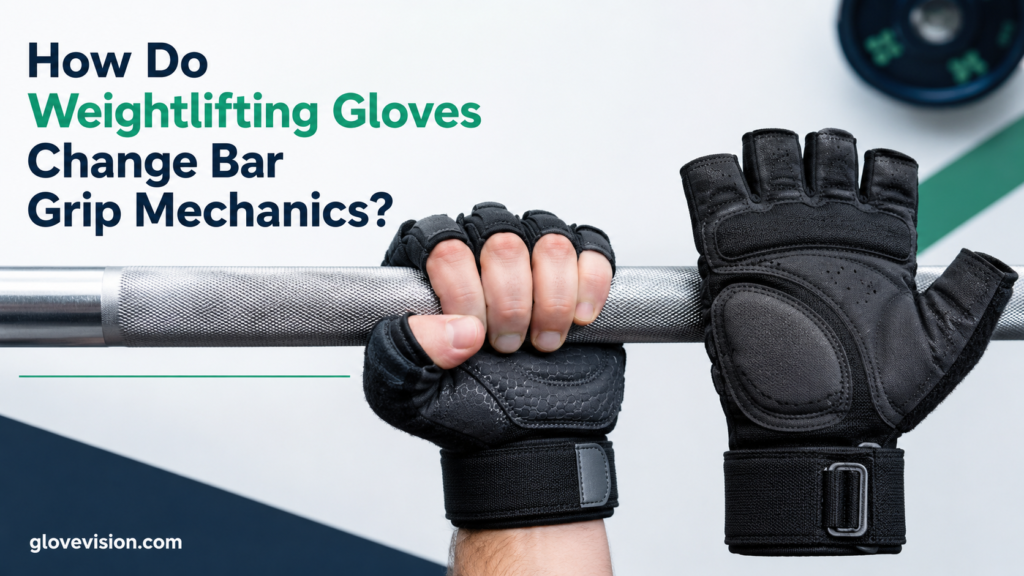
How Do Weightlifting Gloves Change Bar Grip Mechanics?
Weightlifting Gloves add a material system between the hand and a bar, dumbbell, pull-up bar, cable attachment, or machine handle. That extra interface can change external friction, internal hand stability, palm pressure, effective grip diameter, finger wrap, thumb position, hand closure, and the tactile information reaching the lifter.
Those changes are condition-dependent rather than automatically beneficial. Palm construction, padding, fit, handle diameter and texture, knurling, moisture, exercise demands, wrist construction, wear, and current glove condition can each improve or degrade the final hand-to-handle interface.
Educational and safety notice: Weightlifting Gloves can alter friction, palm pressure, effective grip diameter, hand-to-bar contact, and tactile feedback, but they cannot guarantee bar retention, correct lifting technique, replace task-appropriate grip aids, or prevent every hand or wrist injury. Follow the exact manufacturer’s sizing, use, care, inspection, and replacement guidance, and seek appropriate assessment for persistent pain, numbness, tingling, weakness, swelling, loss of grip strength, or reduced hand or wrist movement.
What Do Bar Grip Mechanics Mean for Weightlifting Gloves?
Weightlifting Gloves change bar grip mechanics through three interacting layers: the hand against the glove interior, the glove’s palm and padding construction, and the glove against the bar or handle.
Laboratory glove research shows that thickness, tactile sensitivity, flexibility, and changes in finger geometry can affect power-grip force and effort, but those experiments did not test ordinary Weightlifting Gloves during resistance-training lifts. Use the research to understand mechanisms, not to predict one product’s gym performance. [Willms]
Which Interfaces Exist When Weightlifting Gloves Hold a Bar?
The first interface is hand ↔ glove interior; the second is the glove construction itself; the third is glove palm ↔ handle. Grip instability can occur internally, externally, or because the added glove geometry interferes with hand closure.
How Does Friction Affect Weightlifting Gloves Bar Grip?
Friction affects resistance to initial sliding and movement after slip begins. Palm material, handle texture, contact pressure, moisture, contamination, and wear all matter, so a generic friction coefficient should not be invented for “lifting gloves.” Handhold research also shows that glove effects can help or hinder retention depending on interface friction. [Young]
How Does Hand Closure Affect Weightlifting Gloves Bar Grip?
Finger flexion, finger wrap, thumb opposition, palm contact, handle diameter, glove thickness, and hand dimensions determine whether the hand can close naturally around the combined interface.
How Does Pressure Distribution Affect Weightlifting Gloves?
Palm material or padding can spread selected contact and cushion knurling, but seams, padding edges, material folds, or migration can move pressure to new locations instead of eliminating it.
How Does Tactile Feedback Affect Weightlifting Gloves?
Feedback helps the lifter perceive handle position, rotation, pressure, knurling, glove movement, and early slip cues. Reduced discomfort and increased feedback are not the same goal. Related sports glove grip, padding, and fit provides the broader sports-glove framework. The handle friction and equipment feedback sibling is used only for general handle-feedback reasoning; baseball vibration claims do not transfer to lifting.
| Grip Component | Mechanical Role | Possible Glove Effect | Failure Mode |
|---|---|---|---|
| Internal friction | Resists hand movement inside the glove | Stable liner and correct fit may keep the palm aligned | Sweat, oversizing, stretch or smooth lining allows internal slip |
| External friction | Resists glove movement on the bar/handle | Palm material or grip texture may change surface retention | Worn, wet or contaminated palm may slip externally |
| Finger wrap | Determines how the fingers close around effective diameter | Low-bulk construction may preserve closure; thick layers may reduce wrap | Excess diameter, short finger openings or stiff padding restrict closure |
| Palm pressure | Distributes handle/knurling contact across the palm | Padding may spread or cushion selected zones | Edges, seams or migrated padding create pressure points |
| Tactile feedback | Conveys texture, rotation, pressure and early slip cues | Flexible, stable construction may preserve useful bar feel | Bulk, movement or thick padding can obscure feedback |
| Closure stability | Keeps glove position and cuff/backhand aligned | Secure closure can reduce glove migration | Overtight closure distorts fit; weak/worn closure allows movement |
How Do Weightlifting Gloves Change Friction and Bar Contact?
Weightlifting Gloves change bar contact through both outer palm-to-handle friction and inner hand-to-glove friction, so a high-friction palm is useful only when the glove itself also remains stable on the hand.
How Do Palm Materials Change Weightlifting Gloves Friction?
Leather, synthetic leather, textiles, PU textures, polymer prints, and multi-material palms can behave differently when dry, damp, worn, contaminated, flexed, or compressed. Exact product construction matters more than a universal material ranking.
How Does Bar Knurling Interact with Weightlifting Gloves?
Knurling can create mechanical engagement and strong surface feedback, but it can also concentrate pressure, abrade seams, indent padding, and accelerate wear. “More aggressive” is not automatically better.
How Does Moisture Change Weightlifting Gloves Grip?
Moisture can change external friction, internal sliding, palm softness, liner movement, material stretch, and closure stability. Under Armour’s current Weightlifting glove uses a leather palm, palm/backhand perforations, a sweat-wipe thumb panel, and an adjustable wrist strap; these are product-specific construction details rather than proof of universal moisture performance. [UA Glove]
How Does Internal Hand Movement Undermine Weightlifting Gloves?
Oversizing, sweat, a smooth liner, palm bunching, material stretch, or closure failure can let the hand slide even when the glove palm stays fixed on the bar. This is why external tack cannot solve internal instability.
Can Tackier Weightlifting Gloves Always Improve Bar Control?
No. A tackier surface can still collect contamination, wear unevenly, complicate repositioning, perform differently across surfaces, or leave internal hand movement unresolved.
| Interface Variable | Possible Benefit | Possible Trade-Off | Required Verification |
|---|---|---|---|
| High-friction palm | May resist external sliding on compatible dry surfaces | Can wear, collect contamination or make repositioning harder | Test on intended handle and inspect wear |
| Flexible palm | Conforms around handle and preserves movement | May offer less cushioning or reinforcement | Check pressure and durability requirements |
| Reinforced palm | Adds material at wear/contact zones | Can add stiffness, seam bulk or effective diameter | Check finger wrap and pressure edges |
| Stable liner | Reduces internal hand movement | Can still become slippery with sweat or poor sizing | Check dry and in-use stability |
| Knurled handle | Provides texture and mechanical engagement | Can increase local pressure and palm wear | Inspect glove after realistic contact |
| Moisture | May soften materials or change surface friction | Can destabilize internal and external interfaces | Recheck fit and friction when damp |
| Contamination | None mechanically desirable | Oil, dust, chalk buildup or debris can change friction unpredictably | Clean handle/glove as appropriate before judging grip |
How Do Weightlifting Gloves Padding and Thickness Change Grip Diameter?
Weightlifting Gloves padding adds material between the palm and handle, increasing effective grip diameter to some degree and potentially changing finger wrap, thumb position, hand closure, pressure distribution, and tactile feedback.
Glove-thickness research and handhold-diameter research both support the principle that added material and diameter can alter hand performance, but neither source establishes a universal padding thickness or “best” bar diameter for Weightlifting Gloves. [Willms] [Young]
How Does Padding Increase Effective Bar Diameter?
Palm layers physically separate the hand from the handle. Compression reduces the thickness of softer layers during contact, while zoned padding can change effective diameter differently across the palm.
How Can Increased Diameter Affect Finger Wrap?
More effective diameter can reduce fingertip overlap, change thumb opposition, limit complete closure, and alter pressure. The effect depends on hand size, handle diameter, glove fit, and padding compression rather than one universal threshold.
How Does Padding Redistribute Palm Pressure?
Padding may cushion knurling and spread contact, but uneven compression, pad edges, seams, or migration can create new localized pressure points.
How Does Padding Firmness Affect Weightlifting Gloves?
Firmness changes initial compression, conformity, resistance to further compression, palm feel, closure, and feedback. Neither softer nor firmer padding is universally superior.
How Can Weightlifting Gloves Padding Bottom Out?
Conceptually, as pressure increases, compressible padding deforms until less deformation remains and underlying layers carry more of the contact. The point at which this happens is construction-specific and should not be assigned a universal load.
How Does Padding Thickness Affect Bar Feedback?
More material can reduce perception of knurling detail, rotation, pressure changes, and early slip cues; less material can preserve feedback while offering less physical separation. The analogous handle pressure and padding trade-offs page is useful only for general pressure-and-padding reasoning, not for inferring lifting performance.
| Padding Pattern | Pressure Effect | Diameter Effect | Finger-Wrap Effect | Feedback Trade-Off |
|---|---|---|---|---|
| Minimal padding | Less pressure redistribution | Smallest added bulk among padded options | Usually least interference if fit is correct | More direct texture/pressure may remain |
| Zoned padding | Targets selected high-contact areas | Adds thickness unevenly by zone | Can preserve wrap if zones stay aligned | Local pad edges may change feel |
| Full-palm padding | Spreads contact broadly | Adds material across most palm contact | May reduce closure on larger handles | Can mute texture and pressure detail |
| Softer padding | Compresses more readily at first contact | Effective added thickness changes under load | May conform but can shift or bottom out | Can soften local feedback |
| Firmer padding | Resists compression more | Added diameter may remain more consistent | Can feel bulkier or create edges if poorly aligned | May transmit more structure than soft foam |
| Worn/compressed padding | May lose original cushioning distribution | Thickness becomes uneven | Can alter wrap asymmetrically | Unpredictable feedback and pressure |
How Do Weightlifting Gloves Construction and Fit Affect Grip Stability?
Weightlifting Gloves grip stability depends on more than the palm surface because finger openings, thumb geometry, seams, reinforcement, backhand stretch, liners, closures, and anatomical fit determine whether the palm remains correctly positioned on the hand.
A sports-glove case study found that finger-length fit and hand/wrist/finger dimensions were associated with grip or dexterity measures in the tested gloves. This supports multidimensional fit checks, not direct prediction of lifting-glove performance. [Sports Fit]
How Should Weightlifting Gloves Fit the Palm?
The palm should lie substantially flat, padding should remain aligned, internal movement should be minimal, bunching should not disrupt contact, severe compression should be absent, and natural hand closure should remain possible.
How Should Weightlifting Gloves Fit the Fingers?
Fingerless designs require attention to opening position, edge pressure, flexion, material migration, and pull-tab interference. Full-finger designs add fingertip seating, finger width, seam alignment, and feedback requirements.
How Does Thumb Construction Affect Weightlifting Gloves?
Thumb length, angle, palm transition, seam placement, material tension, handle contact, and mobility must be checked independently of palm fit.
How Do Seams Affect Weightlifting Gloves Grip?
Seams placed under high-pressure zones can create ridges, skin irritation, folding, uneven handle contact, or premature wear. Smooth seam placement matters especially where padding and knurling concentrate contact.
How Do Reinforcement Zones Affect Weightlifting Gloves?
Reinforcement can improve durability or padding retention in wear zones, but it can also add stiffness, bulk, seam concentration, and reduced feedback.
How Do Closures Affect Weightlifting Gloves Stability?
A closure can retain glove position and stabilize the cuff/backhand, but it cannot fix an oversized palm, wrong finger proportions, or a stretched-out glove.
When Is a Wrist Feature More Than a Closure?
Only when the exact construction documents a support or wrap function. Harbinger’s current Pro Wristwrap Gloves 3.0 combine lightly padded dual-layer leather palms, textured PU grip, half-finger construction, flat stitching, four-way stretch back material, and a tapered integrated wrist wrap. Those are model-specific features, not proof that every glove strap is wrist support. [Harbinger]
The close glove fit and handle control sibling supports only the general principle that close, low-bunching fit and equipment feedback matter; golf performance claims do not transfer to lifting.
How Do Exercises and Handle Conditions Change Weightlifting Gloves Performance?
Weightlifting Gloves can behave differently across barbells, dumbbells, pull-up bars, cable attachments, and machines because handle diameter, texture, orientation, load direction, contact duration, and moisture change the mechanical interface.
How Do Weightlifting Gloves Interact with Barbells?
Check diameter, knurling, palm pressure, finger wrap, feedback, and wear. The barbell is an interface context here, not a cue for lifting-technique instruction.
How Do Weightlifting Gloves Interact with Dumbbells?
Handle contour, diameter, knurling, independent hand positioning, thumb geometry, and moisture can create a different feel from the same glove used on a straight bar.
How Do Weightlifting Gloves Interact with Pull-Up Bars?
Sustained retention, shear, diameter, finger wrap, glove rotation, and bunching can become more prominent. Do not convert this fit analysis into pull-up coaching.
How Do Weightlifting Gloves Interact with Cable Attachments?
Attachment shape, rubber or metal surfaces, rotation, local pressure, and grip width can change both external friction and hand geometry.
How Do Weightlifting Gloves Interact with Machine Handles?
Foam or rubber coatings, fixed handle positions, diameter, wear, contamination, and material compatibility may produce different friction and pressure behavior than a knurled steel bar.
How Do Repetition Volume and Load Direction Affect Weightlifting Gloves?
Repeated use can increase moisture, contact exposure, padding compression, internal movement, seam stress, and wear. No universal set, repetition, or load threshold should be assigned.
| Handle Context | Main Interface Demand | Glove Features to Check | Main Failure Risk | Verification |
|---|---|---|---|---|
| Barbell | Knurling, consistent diameter, palm pressure, feedback | Palm material, pad placement, seams, finger wrap | External slip, pressure ridges, wear | Use unloaded or safely controlled bar |
| Dumbbell | Independent hand position, handle contour, rotation | Thumb fit, palm alignment, closure, moisture | Glove rotation or uneven pressure | Check both hands across intended dumbbells |
| Pull-up bar | Sustained retention, shear, diameter | Internal stability, finger wrap, palm durability | Bunching, rotation, internal slip | Controlled hang/contact check only; no technique coaching |
| Cable attachment | Shape, rotation, rubber/metal interfaces | Grip texture, seam position, flexible palm | Local pressure or surface mismatch | Test relevant attachment safely |
| Machine handle | Foam/rubber coating, fixed angle, contamination | Palm material, effective diameter, feedback | Surface incompatibility or excessive bulk | Inspect handle condition separately |
| High-volume repeated use | Heat, sweat, repeated pressure and movement | Ventilation, liner stability, durability, care | Moisture, compression, seam fatigue | Reassess during use and inspect afterward |
Where Does Grip Support from Weightlifting Gloves End?
Weightlifting Gloves can modify friction, pressure, comfort, and hand-to-handle contact, but they do not directly generate grip strength, prevent every slip, replace straps or wrist wraps, correct lifting technique, or guarantee protection from hand and wrist injury.
Do Weightlifting Gloves Increase Grip Strength?
Not directly. The hand and forearm generate muscular grip force. Glove construction can alter measured hand performance under test conditions, which is different from the glove creating strength. Research comparing bare hands with different glove types supports this distinction. [Rock]
Can Weightlifting Gloves Prevent Every Bar Slip?
No. Moisture, palm wear, poor fit, internal movement, handle condition, task demand, and closure failure can all contribute to slip despite a grippy palm.
Do Weightlifting Gloves Replace Lifting Straps?
No. Lifting straps mechanically connect the hand/wrist to the bar in a different way. A controlled deadlift study found straps changed grip fatigue, perceived grip security, and performance outcomes; those findings establish that straps are a distinct device, not evidence for Weightlifting Gloves. [Straps]
Do Weightlifting Gloves Replace Wrist Wraps?
No. A normal closure primarily retains the glove. Only call a glove feature wrist support when the exact product documents a support or integrated wrap construction. [Harbinger]
Do Weightlifting Gloves Prevent Calluses and Blisters?
No guarantee exists. Gloves can reduce direct skin-to-handle contact, but internal rubbing, seams, moisture, finger-opening edges, and pressure can still irritate skin.
Can Weightlifting Gloves Correct Poor Lifting Technique?
No. Interface equipment cannot substitute for appropriate lifting instruction, exercise selection, or technique.
When Do Hand Symptoms Require More Than Weightlifting Gloves?
Persistent or significant pain, numbness, tingling, weakness, swelling, reduced movement, loss of grip strength, or symptoms away from training require appropriate assessment rather than repeated glove changes alone.
| Claim Area | What Weightlifting Gloves Can Change | What They Cannot Guarantee | Correct Boundary |
|---|---|---|---|
| External grip | Surface friction conditions at glove-to-handle contact | No-slip retention on every handle | Grip depends on palm, handle, moisture, fit and force |
| Palm pressure | Cushioning and contact distribution | Elimination of discomfort or skin injury | Padding can help or hinder depending on alignment and thickness |
| Grip strength | Conditions under which muscular force is applied | Generation of stronger hand/forearm muscles | Grip strength remains muscular capability |
| Wrist support | Only where exact glove has a documented support/wrap structure | That every closure is a wrist wrap | Basic closure and support structure are separate |
| Callus / blister risk | May reduce direct skin contact | Prevention of every callus or blister | Internal rubbing, seams and moisture can still irritate skin |
| Heavy-load retention | May alter friction and comfort conditions | Safe retention of any heavy load | No universal safe-load claim |
| Persistent symptoms | May reveal a poor fit or interface problem | Diagnosis or treatment of pain, numbness or weakness | Persistent symptoms need appropriate assessment |
Which Weightlifting Gloves Match Different Grip Requirements?
Weightlifting Gloves should be selected according to the required balance of friction, palm cushioning, finger wrap, tactile feedback, moisture control, wear resistance, finger coverage, and wrist construction rather than by one “maximum grip” feature.
Which Weightlifting Gloves Suit Lifters Prioritizing Bar Feedback?
Look for low unnecessary bulk, a flexible palm, smooth seams, stable fit, and minimal internal movement. Do not assume the thinnest glove is automatically the best.
Which Weightlifting Gloves Suit Lifters Prioritizing Palm Cushioning?
Compare pad location, firmness, compression, pressure distribution, effective diameter, hand closure, and feedback together. Cushioning that blocks natural closure is a poor trade.
Which Weightlifting Gloves Suit High-Sweat Training?
Prioritize internal stability, practical ventilation, secure closure, drying requirements, and a palm construction that remains usable under expected conditions. Under Armour’s current model illustrates one combination of perforation, backhand cooling fabric, leather palm, and sweat-wipe thumb construction. [UA Glove]
Which Weightlifting Gloves Suit Aggressive Knurling?
Evaluate reinforcement, palm durability, seam location, padding, feedback, and inspectability. No glove should be described as “knurling-proof.”
Which Weightlifting Gloves Suit Users Wanting More Finger Coverage?
Compare fingerless, short-finger, and full-finger designs through heat, dexterity, finger friction, feedback, seam pressure, and actual coverage rather than assuming more coverage is always better.
Which Weightlifting Gloves Suit Users Wanting Wrist Support?
Separate a basic closure, extended cuff, integrated wrist wrap, and separate wrist wrap. Harbinger’s current integrated-wrap glove is one documented example of a glove-plus-wrap architecture. [Harbinger]
Which Evidence Should Support Weightlifting Gloves Selection?
Prefer the exact finished model, intended use, palm material, grip texture, padding location, finger coverage, manufacturer sizing, wrist construction, care instructions, return/fitting options, and any product-level testing that actually exists.
| Priority | Look For | Trade-Off to Check | Reject / Reconsider If |
|---|---|---|---|
| Direct feedback | Low unnecessary bulk, flexible palm, smooth seams, stable fit | Less cushioning or separation from knurling | Palm still moves or pressure is unacceptable |
| Palm cushioning | Pad location, firmness, compression, pressure distribution | Effective diameter and reduced feedback | Hand closure becomes restricted |
| High sweat | Interior stability, ventilation, secure closure, practical drying | Material may feel different when wet | Hand begins sliding inside glove |
| Aggressive knurling | Reinforcement, durable palm, seam placement, inspectability | More bulk or stiffness | Wear exposes seams or padding shifts |
| Finger coverage | Fingerless/short/full-finger according to need | Heat, dexterity, finger friction and seam pressure | Openings/stalls interfere with natural flexion |
| Wrist-support preference | Documented integrated wrap or separate support device | Bulk and wrist movement | Only a basic closure is present |
| Mixed exercises | Balanced padding, adaptable fit, multiple-handle testing | One glove may not optimize every handle | Performance changes substantially across handles |
How Should Weightlifting Gloves Be Fitted and Function-Checked?
Weightlifting Gloves should be fitted so the palm and padding remain aligned without internal slipping or bunching while the fingers, thumb, and wrist retain enough movement to close naturally around the intended handles.
How Should Weightlifting Gloves Size Be Checked?
Use the exact manufacturer guide. Under Armour’s current men’s glove chart, for example, uses hand length and hand circumference around the knuckles while excluding the thumb; those measurement landmarks and size ranges remain Under Armour-specific. [UA Size]
How Should Weightlifting Gloves Fit the Palm?
Look for flat material, aligned padding, minimal internal slide, low bunching, no severe compression, and smooth seams through hand opening and closure.
How Should Weightlifting Gloves Fit the Fingers and Thumb?
Check finger openings or fingertip seating as applicable, finger width, thumb angle, seam pressure, and whether all digits can close naturally around the intended handle.
How Should Weightlifting Gloves Closures Be Adjusted?
The closure should retain the glove without excessive wrist compression or palm distortion, while preserving intended wrist movement. Integrated support should be credited only where the product actually documents it.
How Should Weightlifting Gloves Be Tested on a Bar?
Use an unloaded or safely controlled handle and check finger wrap, effective diameter, palm stability, internal movement, external grip, knurling feedback, thumb alignment, glove rotation, and seam pressure. Do not turn the check into lifting coaching.
How Should Weightlifting Gloves Be Tested Across Intended Handles?
Where relevant, repeat the interface check on the barbell, dumbbell, pull-up bar, cable attachment, or machine handle actually used. A glove that works well on one handle does not automatically behave the same on another. Related palm grip and fit stability supplies only general palm-alignment and interface-stability logic.
Which Weightlifting Gloves Fit Problems Require Rejection?
Reject or reassess palm bunching, internal slipping, padding migration, painful finger openings, restricted closure, thumb twisting, glove rotation, wrist numbness, or an effective diameter that prevents manageable hand closure.
| Check | Good Sign | Failure Sign | Action |
|---|---|---|---|
| Model / size | Exact manufacturer sizing used | Label copied from another brand without checking | Re-measure using exact size guide |
| Palm | Flat, aligned and stable | Bunching, sliding or severe compression | Try another size/model |
| Padding | Pads remain under intended zones | Migration, edge pressure or asymmetric compression | Change configuration or replace worn glove |
| Fingers | Openings/stalls allow natural flexion | Painful edges, excess material or restriction | Reject fit |
| Thumb | Natural angle and palm transition | Twisting, pressure or seam pull | Try another model/size |
| Seams | Stay out of disruptive pressure zones | Ridges, irritation or uneven bar contact | Change construction |
| Closure | Retains glove without excessive compression | Palm distortion, wrist pressure or migration | Readjust or change model |
| Hand opening / closure | Full opening and natural wrap remain possible | Glove blocks closure or feels bulky | Reduce bulk/change fit |
| Effective diameter | Handle remains manageable | Added bulk prevents secure wrap | Choose thinner/different padding |
| Internal stability | Hand and glove move together | Hand slides inside glove | Resize/reassess moisture/liner |
| External grip | Glove remains stable on intended handle | Palm slips despite stable internal fit | Check palm/handle condition |
| Feedback | Bar position and slip cues remain usable | Bulk or movement obscures feel | Choose different construction |
How Should Weightlifting Gloves Be Maintained and Troubleshot?
Weightlifting Gloves should be cleaned, dried, and maintained according to the exact finished-product instructions because leather, synthetic palms, padding, grip textures, liners, seams, closures, and integrated wrist structures can require different care.
How Should Weightlifting Gloves Be Cleaned?
Follow the exact product instructions rather than a universal wash routine. Under Armour currently instructs washing its Weightlifting glove inside out, machine washing cold with like colors, tumble drying low, and avoiding bleach, ironing, softener, and dry cleaning; those directions apply to that model only. [UA Glove]
How Should Weightlifting Gloves Be Dried and Stored?
Use product-specific guidance for ventilation, heat exposure, shape, padding compression, closure position, and any integrated wrap storage. Do not transfer one manufacturer’s drying method to another glove.
How Should Weightlifting Gloves Be Inspected?
Check palm thinning, worn grip texture, holes, tears, seam separation, padding compression or movement, delamination, liner movement, stretched finger openings, thumb wear, closure failure, and wrist-wrap damage.
Why Do Weightlifting Gloves Slip on the Bar?
Possible causes include a worn palm, moisture, contamination, handle condition, surface mismatch, or padding movement. Separate external slip from internal hand movement before changing the glove.
Why Do Hands Slip Inside Weightlifting Gloves?
Oversizing, sweat, a smooth liner, stretch, bunching, or closure failure can destabilize the hand inside the glove even when the outer palm remains attached to the handle.
Why Do Weightlifting Gloves Create Pressure Points?
Inspect seam location, padding edges, uneven compression, wrong size, folds, thumb alignment, knurling contact, and effective diameter.
Why Do Weightlifting Gloves Reduce Hand Closure?
Excess padding, undersizing, stiff reinforcement, seam bulk, bunching, finger design, or moisture-related material change can all interfere with closure.
When Should Weightlifting Gloves Be Replaced?
Replace or reassess the glove when palm grip becomes unreliable, holes expose the hand, internal fit becomes unstable, padding stays flattened or migrates, seams or finger openings fail, the closure fails, an integrated wrap is damaged, or natural closure cannot be restored.
| Problem | Possible Cause | What to Inspect | Next Action |
|---|---|---|---|
| Bar slip | Worn palm, moisture, contamination, handle condition, surface mismatch | Glove exterior and handle separately | Clean/replace/reassess interface |
| Internal slip | Oversizing, sweat, smooth liner, stretch, closure failure | Hand movement inside glove | Resize, dry as directed, or replace |
| Weak feedback | Excess bulk, thick padding, bunching, poor fit | Palm layers and hand closure | Try lower-bulk or better-aligned design |
| Restricted closure | Padding, wrong size, reinforcement, seam bulk, moisture | Finger wrap and effective diameter | Change size/padding/construction |
| Palm pressure | Seam, pad edge, uneven compression, fold, knurling | Pressure location during controlled grip | Re-align or change model/padding |
| Glove rotation | Poor fit, weak closure, smooth interior, moisture | Palm/closure during hand movement | Resize/reassess closure and liner |
| Wrist discomfort | Overtight closure, wrong cuff, unsuitable wrap structure | Wrist pressure and mobility | Loosen or choose different wrist construction |
| Uneven cushioning | Compressed/migrated padding or wear | Pad thickness and placement | Replace when stable cushioning cannot be restored |
How Should Weightlifting Gloves Be Chosen for Reliable Bar Grip Mechanics?
Weightlifting Gloves should be chosen by starting with the actual exercise and handle, then balancing external friction, palm protection, cushioning, effective diameter, finger wrap, tactile feedback, anatomical fit, wrist requirements, moisture, maintenance, and current condition.
Which Final Questions Should Be Answered?
Confirm the exercises and handles, their approximate diameter and surface texture, the priority between friction, cushioning, feedback and skin protection, acceptable padding bulk, finger coverage, palm material, palm flatness, internal stability, external stability, natural finger wrap, thumb position, manageable effective diameter, feedback, whether wrist support is actually required, whether the product documents it, practical care requirements, and current structural condition.
Which Final Rule Should Guide Weightlifting Gloves Selection?
Choose the Weightlifting Gloves that provide the best complete hand-to-handle interface for the intended exercises—balancing friction, palm pressure, cushioning, effective diameter, finger wrap, tactile feedback, fit, wrist requirements, moisture, and durability rather than choosing the thickest, tackiest, or most heavily marketed glove.
Conclusion
Weightlifting Gloves change bar grip mechanics by altering the physical interface between the hand and handle, including friction, palm pressure, effective grip diameter, finger wrap, hand closure, tactile feedback, moisture behavior, and internal glove stability.
Internal friction is not external friction, grip strength is not grip security, comfort is not proof of retention, more padding is not automatically better, and a high-friction palm cannot correct a hand sliding inside the glove. Final suitability depends on the intended handle, complete glove construction, anatomical fit, natural closure, wrist requirements, care, moisture, and current condition.
Frequently Asked Questions
Do Weightlifting Gloves Improve Grip Strength?
Not directly. Weightlifting Gloves can change friction, palm pressure, comfort, effective grip diameter, and grip security, but muscular grip strength is generated by the hand and forearm.
Do Padded Weightlifting Gloves Improve Bar Grip?
Not automatically. Padding can redistribute palm pressure, but added thickness can also increase effective grip diameter, reduce finger wrap, alter hand closure, or reduce tactile feedback.
Why Can Weightlifting Gloves Slip Even with a Grippy Palm?
Because grip can fail at either interface. The glove palm may remain engaged with the bar while sweat, oversizing, liner movement, material stretch, palm bunching, or closure failure allows the hand to move inside the glove.
Do Weightlifting Gloves Provide Wrist Support?
Only when the exact product includes a documented wrist-support construction. A normal wrist closure primarily retains the glove and should not automatically be treated as equivalent to an integrated or separate wrist wrap.
When Should Weightlifting Gloves Be Replaced?
Replace or reassess Weightlifting Gloves when worn palms, permanent padding compression, failed seams, unstable internal fit, torn or stretched finger openings, damaged wrist structures, unreliable closures, excessive glove rotation, or restricted hand movement prevents reliable contact with the intended handle.