
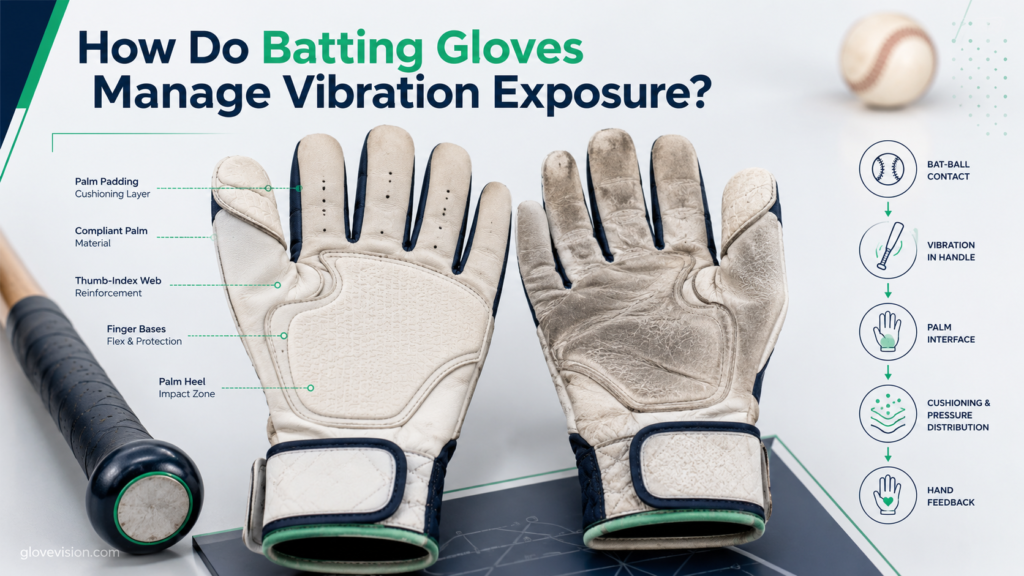
How Do Batting Gloves Manage Vibration Exposure?
Batting Gloves sit directly between the hand and the baseball or softball bat handle, so their palm material, localized cushioning, reinforcement, grip surfaces, and fit can change how transient loading, palm pressure, handle vibration, and tactile feedback reach the hand.
That effect is not universally vibration-reducing. It changes with the bat, impact location, palm construction, padding, material dynamics, contact area, fit, hand-to-handle coupling, feedback preference, weather, wear, and current glove condition, so Batting Gloves should be evaluated as part of the complete bat–handle–glove–hand system.
Educational and safety notice: Batting Gloves may alter some localized loading, pressure, vibration transmission, or perceived hand sting, but they cannot eliminate bat vibration or guarantee prevention of hand, finger, nerve, tendon, or wrist injuries. Follow the exact glove manufacturer’s sizing, use, care, inspection, and replacement guidance. Persistent or recurring pain, numbness, tingling, swelling, weakness, loss of grip strength, or reduced hand movement should receive appropriate assessment rather than being managed through glove selection alone.
What Does Vibration Exposure Mean for Batting Gloves?
Batting Gloves encounter a combination of transient impact loading, subsequent bat-handle vibration, palm pressure, and tactile feedback when bat-ball contact sends mechanical motion through the bat and into the hands.
Baseball-bat research identifies flexural bending modes as an important part of post-impact handle vibration and the sensation of sting, with bat construction and impact location influencing the resulting response. [Russell]
How does bat-ball contact create handle vibration?
The rapid collision excites the bat’s structural modes. The bat then oscillates after the initial contact event, and motion at the handle can be transmitted to the hands. An impact away from low-vibration regions can excite greater bending response, but this page does not turn contact location into batting instruction.
How does transient impact differ from vibration?
Transient impact shock is the initial rapid loading from the collision. Handle vibration is the oscillatory structural response that follows. They occur on different time scales and should not be treated as one identical mechanism.
What is perceived sting?
Perceived sting is the player’s sensory response to the loading and vibration reaching the hands. A 2024 study of college baseball players found strong correlations between bat-knob acceleration in a second-bending-mode frequency band and reported hand pain; the study did not test Batting Gloves and does not establish a safe threshold or glove-effectiveness claim. [Chen 2024]
Which hand zones receive the interface loading?
The handle can load the palm heel, central palm, finger bases, finger pads, thumb, and thumb-index web at the same time. Which zone dominates depends on hand position, handle geometry, glove fit, and how the palm wraps the handle.
Why does vibration exposure vary?
Bat construction, impact location, ball contact, handle geometry, hand coupling, glove construction, weather, fit, wear, and individual perception can all change what reaches the hands. The broader framework for sports glove grip, vibration, and fit shows why batting-glove evaluation should begin with the real sport contact interface rather than with padding or material names alone.
How Do Batting Gloves Attenuate Bat-Handle Vibration?
Batting Gloves may change vibration transmission by altering the compliance, dynamic stiffness, contact area, friction, padding, and coupling between the hand and bat handle, but the effect can vary by vibration frequency, hand location, direction, and construction.
General glove research supports that caution: increasing glove-material thickness does not create one simple whole-hand attenuation rule, contact area can materially change transmissibility, and directional studies show that performance can differ by vibration axis. These occupational studies establish mechanical principles only; they do not prove Batting Gloves performance. [Thickness] [Area] [Direction]
How do compliant palm materials respond?
Compliant palm materials deform under load and can redistribute pressure. Where the material has suitable dynamic behavior, internal deformation can also change how oscillatory motion is transmitted, but “soft” or “thick” is not enough to predict the result.
How can damping occur?
Damping involves mechanical-energy loss during repeated deformation. In glove interfaces, viscoelastic losses, friction between layers, material stiffness, contact area, and coupling can alter transmissibility. A generic claim that padding “absorbs vibration” is too broad without exact evidence.
How does pressure distribution differ from vibration attenuation?
Pressure distribution concerns how contact force is spread across the hand. Vibration attenuation concerns dynamic oscillatory motion. A pad may improve local comfort or pressure distribution without producing the same effect across the relevant vibration spectrum.
How does grip stability affect the interface?
A stable palm can reduce internal slipping, preserve pad alignment, and reduce repeated micro-adjustment. That can make the hand-to-handle interface more consistent, but it does not stop the bat itself from oscillating.
Can cushioning bottom out?
Yes, conceptually. A local cushion has finite compression travel, so heavy compression can reduce the remaining deformation distance. Bottoming out describes compressive cushioning; it is not a complete model of vibration transmissibility.
Can a glove amplify some vibration?
In principle, yes. Glove-transmission research shows that attenuation can vary with frequency, hand location, direction, thickness, and interface conditions. Do not claim that a particular sports glove amplifies vibration unless the exact finished product has been tested.
The wider principles of glove pressure and vibration trade-offs reinforce that pad placement, contact area, fit, and equipment feedback need to be considered together rather than assuming that more cushioning always means less transmitted vibration.
| Exposure Stage | Glove Response | Possible Contribution | Limitation |
|---|---|---|---|
| Initial transient loading | Palm and localized padding deform under the rapid contact load | May alter local pressure and compressive loading at the hand–handle interface | This is not the same mechanism as attenuating later oscillatory vibration |
| Oscillatory vibration | Palm layers, contact area, friction and hand coupling change the dynamic interface | May change selected vibration transmission depending on frequency, direction and construction | A glove can attenuate some components while leaving others unchanged or, in principle, increasing them |
| Palm pressure | Compliant material and pad geometry spread contact over the palm | May reduce concentrated pressure or sting-like discomfort from a local zone | Pressure distribution does not prove vibration attenuation |
| Grip stability | Palm friction and secure fit reduce internal slipping and preserve alignment | May reduce repeated micro-adjustment and maintain a consistent handle interface | Stable grip does not stop the bat itself from vibrating |
| Tactile feedback | Glove construction filters and changes handle sensation | May preserve useful contact information when bulk remains controlled | Less sensation is not automatically better performance |
Which Construction Features Control How Batting Gloves Manage Vibration?
Batting Gloves vibration and sting management cannot be inferred from one palm material or padding thickness because the complete interface includes material compliance, dynamic stiffness, layering, padding placement, reinforcement, seams, friction, fit, and handle contact.
Exact sports-product evidence illustrates why construction must stay product-specific. Easton’s Gametime VRS batting gloves, sold through Rawlings, use a VRS palm pad that the manufacturer specifically markets for reduced vibration and blisters, together with a goatskin palm and flexible mesh back. That claim applies to the exact product, not to batting gloves generally. [VRS]
How does palm material matter?
Leather, synthetic leather, textile-backed palms, and multi-material palms can differ in compliance, friction, moisture response, durability, and layer design. None of these broad material families proves better vibration management by name alone.
How does padding thickness matter?
Additional thickness can provide more separation and compression distance, but it can also increase effective handle diameter, reduce direct feedback, and make hand closure harder. General glove-transmission research specifically cautions against treating greater thickness as a simple universal attenuation rule. [Thickness]
How do firmness and resilience matter?
Firmness describes resistance to compression under a condition; resilience describes recovery and returned energy. Neither property should be treated as a stand-alone vibration score.
How does padding placement matter?
Pad location should match the real palm heel, central palm, finger-base, or thumb-web contact zone. A pad outside the primary handle path can add bulk without addressing the pressure or sensation the player is trying to change.
How do overlays and reinforcement matter?
Overlays can support wear zones, local stiffness, friction, and padding retention. They may also create new seam edges or change how the palm bends around the handle.
How do seams matter?
Seam location can create pressure ridges, bunching, or uneven contact, especially where the palm closes tightly around a narrow handle.
How do layered palms matter?
A finished palm can combine a grip-facing layer, local cushioning, reinforcement, and liner. The stack should be evaluated as a system because each layer changes thickness, compliance, moisture behavior, friction, and feedback.
| Construction | Possible Interface Effect | Feedback Effect | Wear / Grip Trade-Off | Evidence Required |
|---|---|---|---|---|
| Leather palm | Can conform closely and provide a stable contact surface | Often preserves direct handle feel when construction is low bulk | Moisture, finish and wear can change friction and stiffness | Exact finished-glove material and product documentation |
| Synthetic palm | Allows repeatable patterning, overlays and grip treatments | Feedback varies with thickness, coating and layers | Wet grip, durability and stretch vary by product | Exact palm specification and intended-use evidence |
| Compliant insert | Adds a deformable layer within selected contact zones | May filter or soften some sensations | Can add thickness and alter hand-to-handle coupling | Exact material/location if a performance claim is made |
| Local padding | Adds compression distance at selected palm zones | Can reduce directness if too thick or misplaced | May compress permanently or increase effective grip diameter | Exact pad placement and manufacturer claim |
| Reinforcement | Supports wear zones and can retain padding or palm shape | May add local stiffness | Can improve durability but create seam or pressure ridges | Exact reinforced zone and construction |
| Grip print | Changes surface friction in selected zones | Can stabilize contact without necessarily changing padding | May flatten, peel or change with moisture and contamination | Exact print, surface and condition claim |
| Layered palm | Combines grip surface, cushioning, reinforcement and liner | Can be tuned for balance rather than one property | More layers can increase bulk, heat and seam complexity | Complete layer stack or finished-product evidence |
How Do Batting Gloves Balance Vibration Management with Grip and Feedback?
Batting Gloves must balance cushioning against the need to wrap the handle naturally, maintain stable friction, preserve useful tactile feedback, and avoid increasing effective grip diameter or restricting hand closure.
Bat vibration can also carry useful sensory information: batting research describes tactile feedback from bat vibration as one source players use to judge bat-ball contact. That does not mean more sting is desirable; it means complete elimination of handle sensation should not automatically be treated as the performance target. [Gray]
How can excessive padding change grip?
Extra bulk can increase effective handle diameter, reduce finger wrap, create palm folds, and make closure less natural. The useful amount of cushioning therefore depends on the player’s hand size, handle geometry, palm construction, and feedback requirement.
How does palm friction matter?
Friction helps stabilize the glove against the bat handle and can reduce slipping. It should not be described as vibration absorption; its main role here is contact stability and consistency.
How does fit matter?
Poor fit can create internal slipping, palm bunching, misaligned padding, seam pressure, or fingertip collapse. Those changes alter the interface even when the palm material itself is unchanged.
Why is some handle feedback useful?
Handle feedback contributes to contact perception and can help reveal whether the glove itself is moving, bunching, or filtering the interface too heavily. The broader relationship between close glove fit and handle feedback shows the same general decision principle in another handle sport: close fit and low bunching can matter as much as added material.
How do moisture and weather matter?
Moisture can change external friction, internal slipping, leather or synthetic feel, drying time, and fit retention. Wet or humid performance should therefore be checked at the exact product level rather than inferred from a material category.
How does palm wear change the interface?
Palm thinning, flattened grip prints, exposed padding, hardened areas, worn seams, or layer separation can change friction, pressure, thickness, and tactile feedback even if the glove originally fit well.
Related bar and handle grip mechanics show why padding thickness, overlays, palm folds, surface texture, and closure position can change the effective hand-to-equipment interface without proving sports-specific performance across categories.
Where Does Vibration Protection from Batting Gloves End?
Batting Gloves modify the hand-to-handle interface but do not stop the bat from vibrating, eliminate all transmitted loading, make mishits harmless, or guarantee prevention of hand, finger, nerve, tendon, or wrist injuries.
Can Batting Gloves eliminate vibration?
No. The bat can still vibrate after impact, and the glove can only modify the interface between that moving handle and the hand.
Can Batting Gloves prevent every hand injury?
No. A change in selected pressure or transmitted sensation is not equivalent to reliable prevention of bruises, fractures, sprains, nerve symptoms, tendon problems, or wrist injuries.
Can Batting Gloves fix an unsuitable handle interface?
Not completely. Damaged grip material, moisture, handle geometry, glove mismatch, or severe contact can still dominate the player’s experience. This article does not turn those issues into a grip-tape or bat-selection tutorial.
Are sports Batting Gloves anti-vibration PPE?
No, unless an exact finished product has relevant verified testing and an intended occupational use. Research on vibration-reducing work gloves establishes mechanical boundaries, not baseball or softball PPE claims. [Direction]
Does more padding always help?
No. More material can increase handle diameter, reduce feedback, restrict closure, create pressure, or destabilize fit. The correct amount is the amount that works in the complete hand-to-handle interface.
When do symptoms require assessment?
Persistent or recurring pain, numbness, tingling, weakness, swelling, loss of movement, or reduced grip strength should be assessed appropriately rather than managed only by changing glove padding.
| Concern | What Batting Gloves May Change | What They Do Not Prove | Separate Check |
|---|---|---|---|
| Initial shock | Localized cushioning and pressure distribution | Elimination of transient loading | Exact palm/padding construction and fit |
| Handle vibration | Selected interface transmissibility under some conditions | Universal vibration reduction | Frequency, direction, contact area and finished-product evidence |
| Palm pressure | Contact distribution and local cushioning | Whole-hand vibration attenuation | Pad location and actual handle contact zone |
| Grip stability | Friction, alignment and internal movement | Vibration absorption | Palm fit, moisture and surface condition |
| Blister risk | Surface friction and local padding may alter rubbing | Guaranteed blister prevention | Fit, moisture, seams and wear |
| Hand injury | May change selected loading or pressure | Prevention of fractures, sprains, nerve, tendon or wrist injuries | Appropriate assessment for persistent symptoms |
| Occupational vibration | Sports gloves are a different intended-use category | Anti-vibration PPE classification | Use occupational PPE only where formally intended and tested |
Which Batting Gloves Best Match Different Vibration-Management Needs?
Batting Gloves should be selected by identifying whether the player primarily needs lower bulk and direct feedback, more localized cushioning, improved palm stability, better moisture control, or a balanced construction rather than choosing by material name or padding quantity alone.
Rawlings’ Workhorse batting glove provides another product-specific construction example: the manufacturer lists a Dura-Plus palm pad and Oiltac leather palm and relates the pad to protection from mishits that rattle the hands. The same product page also shows manufacturer-specific hand-length sizing, which should not be transferred to other brands. [Workhorse]
What if feedback is the priority?
Look for low bunching, stable palm contact, flexible fingers, natural closure, and only as much material as the player needs. Do not turn “thin” into a universal recommendation.
What if cushioning is the priority?
Evaluate where the pad sits, how the palm wraps the handle, whether the glove still closes naturally, and whether added thickness creates an unacceptable handle-diameter or feedback trade-off.
What matters for frequent practice?
Reinforcement, palm wear, seam condition, padding recovery, closure durability, and replacement burden become more important as use frequency increases.
What matters in wet or humid conditions?
Check external palm friction, internal slipping, material response, fit retention, and the exact drying requirements for the product.
What if the hands are pressure-sensitive?
Prioritize smooth seams, correct sizing, aligned padding, stable fit, and the absence of painful pressure. Do not treat glove choice as medical treatment.
Which product evidence should be verified?
Confirm the exact model, intended sport, palm material, padding type and location, reinforcement, manufacturer vibration or comfort claim if one exists, sizing, care requirements, and current condition before relying on marketing language.
| Player Need | Prioritize | Trade-Off to Check | Decision Cue |
|---|---|---|---|
| Feedback priority | Close fit, low bunching, smooth palm and flexible fingers | Too much padding can enlarge grip diameter or mute feel | Handle wrap stays natural and contact remains predictable |
| Cushioning priority | Pad placement, compliance and palm coverage | Bulk, closure and feedback | Padding aligns with the real high-pressure area without forcing the grip |
| Frequent practice | Wear resistance, reinforcement, seam condition and padding recovery | Added reinforcement can increase stiffness or bulk | Palm and padding remain stable through repeated use |
| Wet / humid use | Palm friction, internal stability and drying requirements | Moisture can change grip and material response | Glove stays aligned without internal slipping |
| Pressure sensitivity | Smooth seams, correct sizing, well-aligned padding | Glove choice is not medical treatment | No painful pressure, numbness or persistent symptoms during ordinary fit checks |
| Mixed priorities | Balanced cushioning, grip, feedback and durability | No single maximum in every category | Complete hand-to-handle interface remains usable |
How Should Batting Gloves Be Fitted and Function-Checked for Vibration Management?
Batting Gloves should fit securely enough to keep the palm and padding aligned without internal slipping or bunching while still allowing natural finger wrap, thumb movement, full functional closure, and useful handle feedback.
How should size be checked?
Use the exact manufacturer sizing chart. For example, Rawlings uses measured hand length on its current batting-glove sizing information, but those dimensions should not be applied to another brand. [Workhorse]
How should palm and fingers fit?
The palm should lie flat, fingertips should seat without large gaps or crushing pressure, the thumb should move naturally, and seams should not form painful ridges when the hand closes.
How should padding align?
Confirm that padding sits over the player’s actual handle-contact zones rather than simply covering a large area of the palm.
How should the bat handle be checked?
Use an unloaded bat or controlled training handle to check natural finger wrap, effective grip diameter, palm stability, pressure, and feedback. This is a fit and interface check, not swing instruction.
How should subjective sting or feedback be compared?
If a normal controlled practice comparison is appropriate, treat the sensation as subjective. Do not publish a player’s feel rating as if it were instrumented vibration measurement.
Which problems require rejection?
Palm bunching, internal slipping, painful pressure, numbness, padding misalignment, restricted closure, excessive fingertip slack, or an uncomfortably enlarged handle interface indicate a fit or construction mismatch. The broader relationship between palm grip and fit stability reinforces why padding cannot compensate for an unstable palm-to-handle interface.
| Check | What to Verify | Why It Matters | Reject / Reassess If |
|---|---|---|---|
| Exact model | Manufacturer, sport and documented palm/padding construction | Prevents guessing from appearance | Product identity or intended use is unclear |
| Manufacturer size | Use the exact maker’s chart | Sizing systems are not interchangeable | Painful compression or unstable excess material |
| Palm alignment | Palm lies flat without folds | Bunching changes pressure, friction and feedback | Palm wrinkles under the handle |
| Fingertip seating | Fingers reach the intended end position without collapse | Controls closure and seam location | Large fingertip gaps or crushing pressure |
| Thumb position | Thumb and web move naturally | Thumb-web geometry affects handle wrap | Web pressure or restricted thumb motion |
| Padding alignment | Pads sit over actual handle-contact zones | Misplaced padding can create new pressure edges | Pad edge sits under an unintended contact point |
| Seam position | No hard ridge at the primary handle contact | Seams can concentrate pressure | Persistent ridge or rubbing |
| Handle wrap | Fingers close naturally around an unloaded bat or training handle | Checks effective interface geometry | Glove blocks natural wrap |
| Grip diameter | Added material does not make the handle feel excessively large | Bulk can reduce closure and control | Grip becomes difficult to close around |
| Internal movement | Hand does not slip inside the glove | Slipping changes pad and palm position | Palm or fingers migrate |
| Feedback | Handle sensation remains suitable for intended role | Complete elimination of sensation is not the target | Feedback becomes unusably weak or sting increases |
How Should Batting Gloves Be Maintained and Troubleshot?
Batting Gloves should be cleaned, dried, stored, and inspected according to the exact manufacturer’s instructions because leather, synthetic palms, grip prints, foam, overlays, liners, seams, and closures can respond differently to moisture, detergent, heat, wear, and storage.
How should cleaning be handled?
Follow the exact product guidance. Do not assume that hand washing, machine washing, detergent, conditioning, soaking, or one water temperature applies across batting-glove constructions.
How should drying and storage be handled?
Use the exact product instructions and avoid universal heat, sun, reshaping, or storage claims unless the manufacturer documents them for that glove.
What should inspection look for?
Check palm thinning, holes, grip-print wear, padding compression, hard or soft spots, delamination, seam failure, closure wear, and increased internal slipping.
Why can sting increase?
Possible contributors include palm thinning, compressed padding, a changed handle interface, more severe contact, fit deterioration, moisture, or changes elsewhere in the bat–handle–glove–hand system. Do not automatically blame the glove.
Why can the glove feel bulky?
Check size, padding quantity, moisture, overlays, palm folds, seam placement, and effective handle diameter.
Why can external grip weaken?
Wear, contamination, moisture, flattened grip prints, glazing, or material damage can reduce surface friction. Cleaning should remain product-specific.
When should Batting Gloves be replaced?
Replace or reassess when the palm is structurally worn, padding is permanently compressed, layers separate, seams fail, grip becomes unreliable, fit becomes unstable, closure fails, movement is restricted, or the intended function can no longer be verified.
| Symptom | Possible Cause | What to Inspect | Next Decision |
|---|---|---|---|
| Increased sting | Palm thinning, padding compression, changed contact, fit deterioration or more severe impact | Palm condition, pad zones, handle interface and symptoms | Reassess glove condition and do not assume the glove is the only cause |
| Pressure point | Seam ridge, pad edge, bunching or wrong size | Palm flatness, seams, pad alignment and fingertips | Resize or choose a smoother construction |
| Internal slipping | Wrong size, moisture or degraded liner/palm stability | Hand movement inside glove and wrist closure | Dry/reassess or choose a more stable fit |
| Weak feedback | Too much bulk, excess layers, poor fit or bunching | Palm thickness, folds, overlays and closure | Choose a construction with a better cushioning/feedback balance |
| Excess bulk | Wrong size, thick padding, wet materials or overlays | Effective handle diameter and closure | Reject if normal handle wrap is compromised |
| Restricted closure | Excess padding, wrong size, seam pressure or stiffened materials | Finger wrap and palm folds | Choose a better-fitting or lower-bulk construction |
| Uneven cushioning | Permanent pad compression, delamination or layer movement | Compare zones and left/right condition | Replace if intended cushioning is no longer consistent |
| Weak grip | Wear, contamination, moisture or palm damage | Grip surface and material condition | Clean only as directed; replace if reliable grip cannot be restored |
| Area | Check | Rule | Replacement / Reassessment Trigger |
|---|---|---|---|
| Exact care guidance | Manufacturer cleaning, drying and storage instructions | Do not universalize one care routine across leather, synthetic, foam or printed palms | Care instructions cannot be followed or material response is uncertain |
| Palm wear | Thinning, holes, glazing or loss of surface texture | Inspect real handle-contact zones | Palm integrity or grip becomes unreliable |
| Padding compression | Flattened or uneven zones | Compare intended cushion zones | Padding no longer recovers or feels consistent |
| Delamination | Layer separation, bubbles or shifting overlays | Do not glue or rebuild unless manufacturer approves | Layer movement changes fit or contact |
| Seams | Fraying, opening or hard ridges | Seams are part of the contact interface | Seam failure exposes material or creates pressure |
| Closure | Wrist retention and fastening condition | Closure should stabilize the glove without pressure | Glove shifts or closure no longer holds |
| Fit | Palm flatness, fingertips, thumb and internal movement | Condition can change fit over time | Glove becomes unstable or restrictive |
| Moisture | Persistent dampness, odor or loss of friction | Dry only as product permits | Dry, stable condition cannot be restored |
| Replacement | Overall grip, cushioning, structure and movement | No universal service-life count | Intended function can no longer be verified |
How Should Batting Gloves Be Chosen for Vibration Management?
Batting Gloves should be chosen by defining the actual hand-sting, pressure, grip, and feedback concerns first, then evaluating the exact palm, padding, fit, handle interface, moisture conditions, care burden, and current glove condition.
Which final questions should be answered?
Confirm baseball or softball, practice or game use, the main concern, pressure location, desired cushioning, required feedback, documented palm construction, pad location, manufacturer size, palm flatness, natural handle wrap, acceptable effective grip diameter, internal stability, moisture conditions, practical care, current palm/padding condition, and whether persistent symptoms need assessment.
Which final rule should guide selection?
Choose the Batting Gloves that create the best complete hand-to-handle interface for the player’s required cushioning, grip stability, tactile feedback, movement, fit, moisture conditions, and remaining glove condition—not the pair with the thickest padding or strongest “shock” marketing claim.
Conclusion
Batting Gloves can alter some transient loading, palm pressure, vibration transmission, and perceived hand sting by changing the hand-to-handle interface, but their actual effect depends on the glove construction, bat response, impact conditions, fit, contact area, moisture, wear, and current condition.
Shock is not vibration, vibration is not sting, and sting is not injury. Padding does not guarantee vibration attenuation; thicker or softer is not universally better; grip stability is not vibration absorption; palm and finger effects can differ; useful feedback remains a performance factor; and sports Batting Gloves should not be treated as occupational anti-vibration PPE.
Frequently Asked Questions
Do Batting Gloves Eliminate Bat Sting?
No. They may alter some contact loading or vibration reaching the hands and reduce perceived sting in some circumstances, but bat vibration and impact loading can still reach the player.
Are Thicker Batting Gloves Better for Vibration?
Not automatically. Additional padding may provide more compressive cushioning, but vibration transmission also depends on material dynamic behavior, frequency, contact area, fit, hand location, and the complete bat–glove–hand interface.
Do Leather Batting Gloves Reduce More Vibration Than Synthetic Gloves?
Not universally. The broad material name does not establish vibration performance. Exact thickness, construction, padding, layering, fit, moisture, friction, and dynamic response matter.
Can Batting Gloves Prevent Hand Injuries?
No guarantee. They may reduce selected friction, pressure, or loading, but they cannot reliably prevent every bruise, fracture, sprain, nerve-related symptom, tendon problem, or wrist injury.
When Should Vibration-Managing Batting Gloves Be Replaced?
Replace or reassess them when palm wear, permanent padding compression, holes, delamination, failed seams, unreliable grip, unstable fit, restricted movement, or inconsistent cushioning means they no longer perform their intended role.