
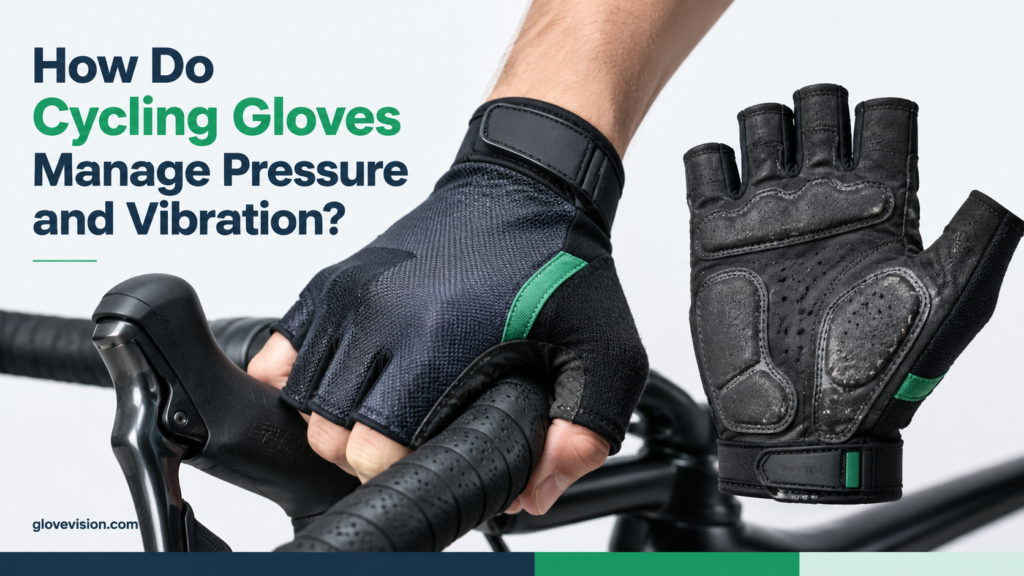
How Do Cycling Gloves Manage Pressure and Vibration?
Cycling Gloves manage handlebar pressure by cushioning and redistributing contact loading across the palm, while their padding may also modify how selected impacts or vibration frequencies reach the hand. The result depends on where the palm actually contacts the bar, how the pad is placed and compressed, and whether grip and control remain stable.
Pressure redistribution and vibration attenuation are different outcomes. Actual performance depends on padding material, thickness, placement, hand position, grip force, glove fit, handlebar construction, surface conditions, bicycle setup, and remaining glove condition.
Educational and safety notice: Cycling Gloves may reduce some localized pressure and discomfort, but they cannot eliminate handlebar loading, guarantee vibration attenuation, or prevent every nerve or hand problem. Follow the exact glove manufacturer’s sizing, use, care, inspection, and replacement instructions. Persistent numbness, tingling, pain, weakness, reduced coordination, or loss of hand function requires appropriate assessment rather than merely adding thicker padding.
What Types of Hand Loading Must Cycling Gloves Manage?
Cycling Gloves must manage several distinct hand loads: sustained handlebar pressure, brief surface impacts, repeated rough-surface shocks, equipment-transmitted vibration, palm shear, and the rider’s own grip force.
How Does Sustained Handlebar Pressure Load the Hands?
Sustained pressure is prolonged contact loading produced when body weight and grip force are supported through the hands. The load can concentrate over the thenar or hypothenar side depending on hand position, wrist posture, bar shape, and time in that position. Slane and colleagues found that glove type and hand position changed hypothenar pressure under their tested cycling conditions, supporting contact-zone-specific evaluation rather than a universal padding rule. [Slane]
How Do Road and Trail Impacts Reach the Hands?
A pothole, curb, road joint, rock, or root creates a brief impact. Repeated rough features create recurring larger shocks. These events differ from the smaller, faster oscillations usually described as higher-frequency vibration, so a pad that feels helpful for one load should not automatically be credited with controlling the others.
How Does Repeated Vibration Reach the Hand-Arm System?
The transmission pathway is surface → tire and wheel → fork and frame → handlebar and tape or grip → Cycling Gloves → hand and arm. Cycling vibration measurement research shows why posture, measurement location, technical configuration, and test method matter when vibration is evaluated. [Cycling HAV]
The broader distinction around equipment-transmitted vibration exposure is useful only for classifying vibration by the actual sport, equipment interface, frequencies, grip conditions, and tested construction; batting-glove results are not evidence for Cycling Gloves.
How Do Hand Position and Wrist Posture Change Loading?
Tops, hoods, drops, flat grips, and bar ends change which palm region bears load, how the wrist is positioned, how hard the rider squeezes, and where a pad actually contacts the bar. There is no single hand position that should be prescribed for every rider or bicycle.
The broader framework for sports glove pressure and impact management shows why sustained loading, isolated impacts, vibration, pad placement, fit, and movement must remain separate selection variables.
| Load Type | Typical Source | Intended Glove Response | Important Limitation |
|---|---|---|---|
| Sustained pressure | Body weight and grip force supported through the hands | Redistribute localized loading across padded palm contact zones | Padding changes distribution; it does not make total hand loading disappear |
| Discrete impact | Pothole, curb, rock, root, road joint | Compress locally and spread a brief load when the pad is aligned | Response depends on available compression and contact position |
| Repeated low-frequency shock | Recurring rough-surface events | Provide repeatable cushioning if material recovers between events | Pre-compression or bottoming out can reduce remaining deformation |
| Higher-frequency vibration | Equipment-transmitted oscillation from the surface and bicycle | Potentially modify selected frequency bands | Visible padding does not prove broad vibration attenuation |
| Shear and friction | Palm movement against tape or grips | Maintain stable contact and reduce unwanted sliding | Too little or too much friction can change control and skin loading |
| Grip force | Rider squeezing the handlebar | Stabilize the hand while padding conforms to contact | Higher grip force can pre-compress padding and change its later response |
How Do Cycling Gloves Redistribute Pressure and Affect Vibration?
Cycling Gloves redistribute handlebar pressure when correctly positioned padding increases effective contact area and changes how localized loading is shared across the palm, but their effect on vibration remains frequency- and construction-dependent.
How Does Padding Spread Pressure Across the Palm?
Padding can reduce a localized pressure peak by increasing contact area and transferring some load toward adjacent regions. A lower pressure reading at one palm region does not prove that total hand loading disappeared. Slane et al. reported condition-specific reductions in hypothenar pressure with padded gloves, with results varying by glove and hand position. [Slane]
Why Does Padding Placement Matter More Than Coverage Alone?
A broad pad that misses the real handlebar contact zone may do little for the rider’s actual pressure point, while an abrupt edge can create a new pressure ridge. Thenar and hypothenar contact, hand position, grip shape, seams, brake access, and shift access all matter more than the visual amount of padding.
How Do Foam and Gel Behave Under Handlebar Pressure?
Foam and gel should be compared by initial compliance, compression behavior, recovery, edge stability, long-duration deformation, and their placement within the finished glove. Giro documents finished Cycling Gloves using layered gel and rebound foam or molded multi-density palm construction, showing that real products combine material and placement rather than relying on one material label. [Giro]
The deeper evaluation of cycling gel padding explains why gel quantity or softness cannot establish pressure redistribution, vibration attenuation, control, or suitability without placement and complete-glove evidence.
Why Is Cycling Gloves Vibration Response Frequency-Dependent?
Padding response changes with frequency band, material behavior, compression state, grip force, placement, and the rest of the bicycle system. In one laboratory study, the Cycling Gloves tested did not significantly reduce hand-arm vibration, which is useful evidence against assuming that visible padding guarantees attenuation. It does not prove that every Cycling Gloves construction performs identically. [Cycling Vibration]
Why Can Excessive Padding Reduce Cycling Control?
Extra material can alter effective grip geometry, increase bunching, reduce palm feedback, demand more stabilization, interfere with braking or shifting, or create a pad-edge pressure point. Similar padding and grip-interface trade-offs illustrate the general principle that additional interface material can change grip geometry and feedback; barbell conclusions should not be transferred directly to cycling.
Why Must Cycling Gloves Be Evaluated as Part of the Bicycle System?
Bar tape or grips, handlebar construction, fork or suspension, tires, fit, weight distribution, grip force, and surface conditions all affect what arrives at the glove. Controlled handlebar and suspension-stem research supports the broader point that bicycle components can change transmitted vibration, so the glove should not be treated as an isolated filter. [Handlebar Study] [Suspension Stem]
Which Cycling Gloves Match Different Riding Conditions?
Cycling Gloves should be selected by identifying the rider’s dominant hand load, real handlebar-contact zones, required control feedback, riding conditions, and typical duration before comparing padding material or thickness. The broader system for glove construction and selection likewise starts with the real contact interface and task before material names or appearance are compared.
Which Cycling Gloves Suit Long Road Rides?
Evaluate sustained pressure across tops, hoods, and drops; long-duration compression; moisture; seam placement; and brake or shift feedback. Longer rides do not automatically justify thicker padding because added bulk can move pressure, mute feedback, or miss a changing contact zone.
Which Cycling Gloves Suit Gravel Riding?
Prioritize stable padding, palm friction, moisture behavior, and control feedback across repeated shocks and surface vibration. The glove should stay aligned as roughness changes rather than relying on soft or visibly thick padding alone.
Which Cycling Gloves Suit Mountain Biking?
Evaluate full-finger coverage if the riding context requires it, palm durability, brake-lever feel, impact frequency, grip stability, and padding bulk. Full-finger construction does not automatically mean heavier padding or better control.
Which Cycling Gloves Suit Urban Commuting?
Frequent braking, weather exposure, ride duration, practical maintenance, visibility features, and touchscreen features may all matter, but they remain secondary to stable grip, normal control access, and correct pressure-zone alignment.
Which Cycling Gloves Suit Riders Who Prioritize Tactile Feedback?
Lower-bulk construction, strategic padding, flexible palms, minimal seam interference, and a close stable fit can preserve bar and lever information. Fingerless construction should not be assumed to provide superior control without checking the whole glove.
Which Cycling Gloves Suit Riders With Previous Hand Symptoms?
Map the symptom location, identify the hand position in which it appears, check padding alignment and wrist posture, and reassess the bicycle contact system. A clinical review of cycling-related median and ulnar nerve problems reinforces that symptoms can have multiple contributors; persistent or progressive numbness, tingling, weakness, or coordination loss needs appropriate assessment rather than glove-only self-diagnosis. [Clinical Review]
| Riding Context | Dominant Hand Demand | Features to Evaluate | Main Trade-Off |
|---|---|---|---|
| Long road riding | Sustained pressure across changing hand positions | Pad-zone alignment, long-duration compression, seams, moisture, lever feel | Pressure redistribution versus bulk and feedback |
| Gravel | Repeated shocks plus surface vibration | Stable padding, palm friction, moisture behavior, feedback | Cushioning versus control precision |
| Mountain biking | Grip stability, brake feel, repeated impacts | Full-finger fit if needed, durable palm, stable friction, controlled padding bulk | Coverage and durability versus lever sensitivity |
| Urban commuting | Frequent braking, changing weather, shorter repeated rides | Brake access, grip, weather handling, practical maintenance | Convenience features versus palm simplicity |
| Feedback-oriented road riding | High tactile requirement | Lower-bulk or strategic padding, flexible palm, close fit | Feedback versus localized cushioning |
| Previous symptoms | Pressure or position sensitivity that needs reassessment | Contact-zone mapping, wrist posture, pad placement, fit, setup review | Do not rely on thicker padding alone when symptoms persist |
How Should Cycling Gloves Be Fitted and Function-Checked?
Cycling Gloves fit correctly when the fingers, thumb, palm, padding zones, and wrist closure remain anatomically aligned without bunching, rotation, painful pressure, internal slipping, or interference with braking and shifting.
How Should Cycling Gloves Fit the Fingers, Palm, and Wrist?
Use the exact manufacturer sizing guide, then check finger length, thumb alignment, fingertip material, palm smoothness, seam pressure, pad stability, glove rotation, and wrist closure. A size label alone cannot prove anatomical fit.
How Should Padding Align With the Handlebar?
Check each position that the rider actually uses—tops, hoods, drops, flat grips, or bar ends. A pad that aligns on one position may sit beside the contact zone or form an edge in another.
How Should Cycling Gloves Be Checked for Handlebar Control?
Verify secure grip, brake access, shift access, thumb movement, adequate feedback, no palm bunching, no pad-edge pressure, and no internal slipping. The glove should not require a compensating grip or wrist posture to reach controls.
How Should Cycling Gloves Be Evaluated During a Familiar Ride?
Use a gradual sequence: stationary check → short familiar ride → multiple required hand positions → controlled rougher section → pressure, symptom, and control reassessment. Stop if control deteriorates or new neurological symptoms appear.
Which Function-Check Problems Require Rejection?
Reassess or reject misaligned padding, pad-edge pressure, rotation, internal slipping, impaired brake or shift access, restricted wrist movement, inadequate feedback, or new numbness, tingling, weakness, or coordination loss.
| Check | Acceptable Sign | Reject or Reassess Sign |
|---|---|---|
| Manufacturer sizing | Size follows the exact maker guide and hand measurements | Copied sizing from another brand without checking |
| Finger and thumb alignment | Digits sit naturally without twisting or excess material | Finger pull, thumb distortion, or restricted motion |
| Smooth palm | Palm lies flat around the handlebar | Bunching, folds, or pressure ridges |
| Padding-contact alignment | Pads sit under real contact zones in each hand position | Pads miss contact zones or create abrupt edges |
| Wrist closure | Secure without painful constriction or movement restriction | Loose rotation or excessive tightness |
| Handlebar grip | Palm remains stable on tape or grips | Unexpected external slip or internal hand movement |
| Brake access | Lever can be reached normally in required positions | Padding or finger fit delays or blocks access |
| Shift access | Controls remain reachable and predictable | Glove bulk interferes with normal shifting |
| Tactile feedback | Useful bar and lever cues remain clear enough | Feedback is too muted for confident control |
| Internal stability | Hand and glove move as one unit | Palm or liner slides inside the glove |
| Symptom response | No new numbness, tingling, weakness, or coordination loss | New or progressive neurological symptoms |
What Problems, Wear, and Care Issues Reduce Cycling Gloves Performance?
Cycling Gloves lose reliable pressure and control performance when padding becomes misaligned or permanently compressed, palm friction deteriorates, fit becomes unstable, seams create pressure, moisture changes the interface, or the glove no longer matches the rider’s actual contact zones.
Why Do Cycling Gloves Fail to Relieve Palm Pressure?
Incorrect pad location, permanent compression, abrupt edges, unsuitable size, an unpadded riding position, or excessive weight through the hands can leave the original pressure problem unchanged or shift it elsewhere. The symptom location and hand position should be identified before adding more padding.
Why Do Hands Still Feel Vibration Through Cycling Gloves?
The relevant frequency band may not be attenuated, the pad may miss the contact zone, grip force may pre-compress the material, or another bicycle component may dominate transmission. The rider may also be interpreting sustained pressure or rough impacts as “vibration,” so the load type should be separated first.
Why Can Cycling Gloves Contribute to Numbness or Tingling?
Pad pressure, an overly tight wrist closure, seams, bunching, hand position, wrist posture, sustained loading, or sizing may all contribute to symptoms. These are screening checks, not a diagnosis; persistent or progressive symptoms require appropriate assessment. [Clinical Review]
Why Do Cycling Gloves Reduce Handlebar Control?
Excessive bulk, low palm friction, saturation, loose fit, bunching, thick seams, worn palms, or lever interference can make the handlebar and controls less predictable even when the glove initially feels cushioned.
How Can Care and Moisture Change Cycling Gloves Performance?
Moisture retention, contamination, liner movement, padding deformation, delamination, and closure deterioration can change grip and fit. Care instructions are construction-specific; one cycling-glove manufacturer’s cleaning sequence demonstrates why washing and drying guidance should remain product-specific rather than being copied across materials or brands. [Care Example]
How Should Cycling Gloves Be Inspected and Replaced?
Inspect palm wear, padding position, permanent compression, separation, seams, lining, grip prints, closures, stiffness, contamination, and fit stability. Replace or reassess when pressure distribution, grip, fit, or control can no longer be restored reliably.
Which Cycling Gloves Buying Mistakes Should Be Avoided?
Avoid selecting by thickness alone, assuming gel or foam is universally superior, ignoring pad placement or riding position, oversizing, overlooking brake and shift access, confusing pressure relief with vibration attenuation, expecting gloves to correct bicycle fit, or continuing through persistent neurological symptoms.
| Symptom | Possible Cause | What to Check | Corrective Action |
|---|---|---|---|
| Localized palm pressure | Pad misses contact zone, abrupt edge, compressed pad, unsuitable size | Exact pressure location, hand position, pad alignment, seams | Resize, change pad layout, or reassess bicycle interface |
| Pad-edge discomfort | Abrupt transition, bunching, migration | Palm flatness, seam position, compression pattern | Change construction or fit; do not add thickness blindly |
| Persistent vibration | Relevant frequencies not attenuated, pad pre-compressed, other bicycle component dominates | Surface, grip force, hand position, glove, bar and bicycle system | Reassess the full contact system rather than assuming glove failure alone |
| Internal slipping | Loose fit, sweat, liner movement | Palm stability, closure, damp behavior | Resize, improve fit match, or replace unstable glove |
| Reduced lever feel | Excess bulk, thick seams, loose palm | Brake and shift access, tactile feedback | Choose a lower-interference construction |
| Numbness or tingling | Localized pressure, posture, closure, bunching, sustained loading, or other causes | Pressure location, wrist posture, size, duration, progression | Stop and seek appropriate assessment if persistent or progressive |
| Unstable grip | Low friction, saturation, worn palm, bunching | Palm surface, moisture, fit, control check | Clean per product guidance, resize, or replace as needed |
| Permanently compressed padding | Material wear or repeated loading | Recovery, hard spots, separation, pressure distribution | Replace or reassess when cushioning and control become unreliable |
Conclusion
Cycling Gloves should be evaluated by how well their padding location, compression, palm friction, anatomical fit, and control access match the rider’s real hand positions, loading pattern, riding conditions, and current glove condition.
Choose Cycling Gloves that redistribute pressure without creating unstable padding, poor grip, reduced braking or shifting control, or excessive loss of feedback. Pressure relief does not guarantee vibration attenuation, and persistent or progressive hand symptoms require appropriate assessment.
Frequently Asked Questions
Do Padded Cycling Gloves Reduce Hand Pressure?
Padded Cycling Gloves can reduce some localized palm pressure when padding aligns with the loaded region and compresses appropriately, but pressure may be redistributed to adjacent areas rather than eliminated from the hand.
Do Cycling Gloves Absorb Handlebar Vibration?
Cycling Gloves do not reliably attenuate every handlebar vibration. Their response depends on vibration frequency, padding material, thickness, compression, placement, grip force, hand position, and the complete bicycle-contact system.
Are Gel Cycling Gloves Better Than Foam Cycling Gloves?
Gel Cycling Gloves are not universally better than foam Cycling Gloves. Suitability depends on the exact material, thickness, placement, compression behavior, durability, riding position, contact zones, and required control feedback.
Can Excessive Cycling Gloves Padding Contribute to Numbness?
Excessive Cycling Gloves padding may contribute to numbness when thick, misaligned, bunched, or compressed material creates localized pressure, but numbness has multiple possible causes and cannot be diagnosed from glove construction alone.
When Should Cycling Gloves Be Replaced?
Cycling Gloves should be replaced or reassessed when padding becomes permanently compressed or displaced, palms lose reliable friction, seams fail, closures become unstable, fit changes, or pressure distribution and handlebar control become unpredictable.