
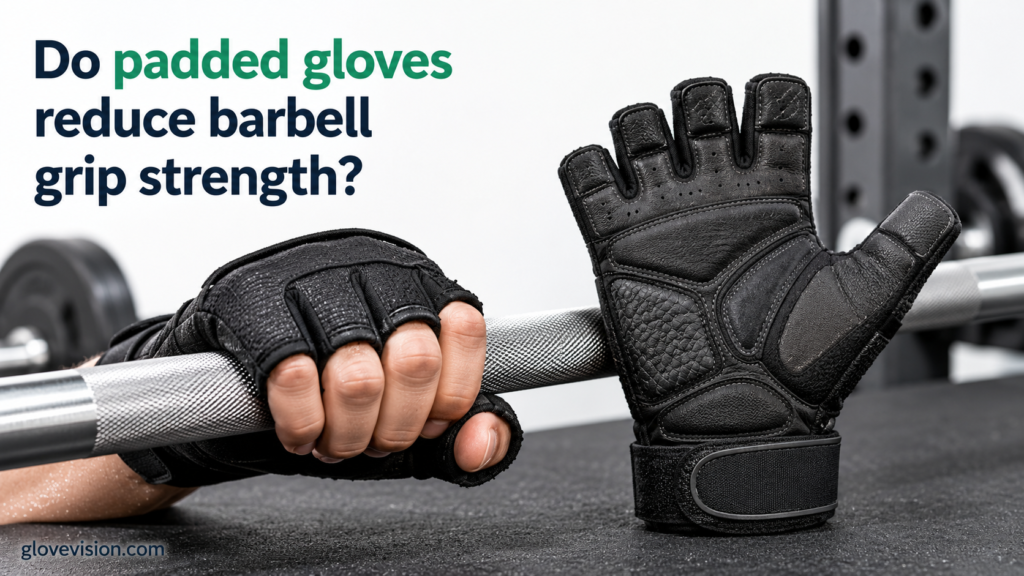
Do padded gloves reduce barbell grip strength?
Padded Gloves can reduce barbell grip strength when their added material increases effective grip diameter, limits finger closure, separates or repositions the fingers, interferes with thumb opposition, resists flexion, or deforms unpredictably between the hand and bar.
The result depends on the complete interface. Suitable friction, stable padding, correct fit, and reduced grip-disrupting palm discomfort may improve functional bar security even when the gloves do not increase—and may sometimes reduce—the hand’s maximum force-producing capability.
Educational and safety notice: Padded Gloves can change effective grip diameter, finger closure, palm pressure, friction, and bar stability, but they cannot guarantee retention of a loaded bar or prevent every hand or wrist injury. Stop using a glove that causes unpredictable bar movement, persistent pain, numbness, tingling, weakness, swelling, or restricted hand movement, and follow the exact manufacturer’s sizing, use, care, inspection, and replacement guidance.
Which Grip Variables Can Padded Gloves Change Through Added Padding?
Padded Gloves primarily change barbell grip mechanics by altering the physical thickness and mechanical behavior of the hand-to-bar interface, which can affect effective diameter, finger closure, thumb opposition, palm pressure, feedback, and stability.
How Do Padded Gloves Change Effective Bar Diameter?
Padding adds interface thickness, and some remains after compression. The fingers therefore close around a larger effective interface whose practical diameter depends on the bar, loaded padding thickness, placement, compression, and hand geometry. Handhold research supports diameter as an important retention variable, but its tested dimensions should not be converted into barbell prescriptions. [Young]
How Do Padded Gloves Change Finger Closure?
Added material can alter finger flexion, distal finger wrap, fingertip position, interdigital spacing, thumb opposition, and palm contact. Controlled glove research supports the mechanism that thickness, flexibility, tactile loss, and finger geometry can influence power grip, but its exact laboratory results do not establish finished lifting-glove performance. [Willms]
How Do Padded Gloves Change Palm Pressure?
Padding may spread local pressure, cushion knurling, or reduce direct skin contact, but pad edges, uneven compression, or seams can concentrate pressure elsewhere. The padding and handle-pressure trade-offs sibling is used only as a pressure-placement analogy; cycling performance does not transfer to barbell lifting.
How Do Padded Gloves Change Tactile Feedback?
Padding may reduce knurling detail, bar-rotation perception, and pressure detail while increasing physical separation and comfort. Comfort and feedback are separate outcomes. The close glove fit and handle feedback page supports only the general relationship among close fit, material bulk, and handle feedback.
For the broader framework covering internal versus external friction, complete glove construction, seams, finger coverage, closures, and multiple handle types, see how Weightlifting Gloves change bar grip mechanics; this page stays focused specifically on padding.
| Padding Variable | Mechanical Change | Possible Benefit | Possible Grip Cost | Verification |
|---|---|---|---|---|
| Thickness | Adds material between palm and bar | More cushioning | Larger effective diameter; less finger wrap | Check loaded thickness and full closure |
| Compression | Changes thickness under force | Conformity and pressure spreading | Uneven deformation can shift bar position | Check loaded alignment and recovery |
| Firmness | Changes resistance to deformation | Predictable pad shape | Can resist flexion | Check closure and bend resistance |
| Placement | Moves cushion into selected zones | Targets local pressure | Edges can create ridges | Confirm pad alignment |
| Stability | Controls whether pads stay positioned | Predictable geometry | Migration or bunching | Check repeated gripping |
| Friction surface | Changes external sliding resistance | May reduce slip | Poor match or wear increases squeezing | Check on actual clean bar |
| Wear | Changes thickness and texture | — | Flattening, delamination, friction loss | Inspect and replace unreliable construction |
How Can Padded Gloves Reduce Barbell Grip Strength?
Padded Gloves can reduce barbell grip strength when added bulk or glove resistance prevents the hand from reaching an efficient gripping geometry or requires additional muscular effort simply to close the fingers around the handle.
Why Can Thick Padded Gloves Reduce Finger Wrap?
A larger effective diameter can shorten distal finger wrap, change fingertip position, alter thumb opposition, limit complete closure, and change leverage. There is no universal thickness cutoff because starting bar diameter and hand geometry matter.
Why Can Stiff Padded Gloves Increase Grip Effort?
Bending resistance, reduced conformity, restricted finger flexion, altered finger spacing, and extra squeezing effort can make a padded interface more demanding. This is consistent with controlled glove power-grip findings, but it remains a transfer-limited mechanism. [Willms]
How Can Compressible Padded Gloves Destabilize the Bar?
As load rises, padding can deform. If loaded thickness changes unevenly, pressure distribution and bar position may change too; local collapse, migration, bunching, or asymmetric compression can make contact less predictable.
How Can Padded Gloves Friction Become a Grip Disadvantage?
A smooth or worn palm, moisture, contamination, or poor bar-surface match can reduce retention and increase squeezing or resets. Separate pulling research confirms that friction conditions can change force transfer in its tested task, but it does not prove that tackier Padded Gloves make muscles stronger. [Pulling Friction]
Which Signs Suggest Padded Gloves Are Reducing Grip?
Shorter finger wrap, incomplete closure, earlier fatigue, greater squeezing effort, repeated resets, unexpected rotation, padding movement, and weaker feedback are practical warning signs.
How Can Padded Gloves Improve Functional Grip Security Without Increasing Grip Strength?
Padded Gloves can improve functional grip security without increasing maximum grip strength when friction, padding stability, pressure management, or reduced palm discomfort decreases slipping and repeated grip correction enough to create a more consistent practical hold.
How Can Padded Gloves Friction Support Bar Security?
Suitable friction can resist sliding, stabilize palm contact, reduce repositioning, and reduce extra squeezing caused by instability. Handhold research supports friction as a meaningful retention variable, but also shows that glove effects depend on the interface rather than being universally beneficial. [Young]
How Can Padded Gloves Reduce Grip-Disrupting Palm Discomfort?
Stable padding can cushion knurling and spread concentrated palm pressure. If that reduces repeated hand repositioning, practical bar retention may become steadier, but reduced discomfort is not injury prevention or an increase in maximum strength.
How Can Padded Gloves Help When Sweat Disrupts Grip?
Where the exact product supports it, the outer surface may maintain useful friction and the glove may reduce direct skin-to-bar moisture interaction. The same construction can also trap moisture or increase internal hand movement.
Why Can Security Improve While Maximum Grip Strength Falls?
Maximum grip strength is force-producing capability; functional grip security is resistance to unwanted bar movement. Better friction or stable pressure can improve retention even when added glove material slightly worsens force geometry. Broader sports glove padding, pressure, and grip explains the sport-glove padding and pressure context.
Which Factors Determine Whether Padded Gloves Help or Hurt Barbell Grip Strength?
Whether Padded Gloves help or hurt barbell grip depends on how loaded thickness and friction interact with hand dimensions, bar diameter, finger geometry, padding stability, task, moisture, and existing grip capacity.
How Does Hand Size Change the Effect of Padded Gloves?
The same added thickness may use more or less of a person’s available wrap depending on hand length, finger length, and palm dimensions. Grip-force research supports an interaction between handle diameter and hand size, but not a universal rule that smaller hands should avoid padding. [Grip/Hand Size]
How Does Bar Diameter Change the Effect of Padded Gloves?
Bar diameter establishes the starting geometry; loaded glove layers then increase the effective interface. The combined geometry, not either variable alone, determines whether closure remains functional. [Young]
How Does Padding Thickness Change the Effect of Padded Gloves?
Unloaded thickness, loaded thickness, placement, closure, and feedback should be assessed together. A visually thick pad may compress substantially, while a thinner but firm pad may retain more thickness under load.
How Does Padding Firmness Change the Effect of Padded Gloves?
Firmness affects initial resistance, compression, stability, flexion interference, and recovery. Softer is not automatically better, and firmer is not automatically worse.
How Does Fit Change the Effect of Padded Gloves?
Fit matters here only insofar as it keeps padding aligned and the hand stable. Palm bunching, internal slip, rotation, or distorted pad geometry can change the outcome.
How Does Moisture Change the Effect of Padded Gloves?
Moisture can alter external friction, internal friction, pad feel, liner movement, and fit stability, shifting the balance between diameter cost and friction benefit.
| Determinant | Potential Benefit | Potential Cost | Critical Check |
|---|---|---|---|
| Hand size | Adequate wrap may remain | Less wrap reserve for some hands | Can fingers and thumb still close naturally? |
| Bar diameter | Smaller starting geometry may leave more reserve | Larger start + padding may restrict closure | Judge combined geometry |
| Loaded thickness | Cushion remains under pressure | Excess thickness enlarges grip | Evaluate under compression |
| Padding stability | Predictable pressure | Migration changes bar position | Does padding stay aligned? |
| Friction | May support retention | Low friction requires more squeezing | Separate external from internal slip |
| Fit | Keeps pads aligned | Oversizing permits bunching | Check palm flatness |
| Moisture | May be manageable by some surfaces | Can increase internal slip | Recheck when damp |
| Wear | Predictable when maintained | Flattening and delamination change outcome | Inspect recovery and surface |
When Do Padded Gloves Match Different Barbell Grip Demands?
Padded Gloves should be matched to the barbell task by checking whether the required cushioning can be achieved without unacceptable loss of finger closure, thumb opposition, friction, bar feedback, or interface stability.
When Do Padded Gloves Match Heavy Pulling Demands?
Prioritize natural finger closure, minimal unnecessary bulk, stable palm contact, stable padding, suitable friction, and predictable bar position. Reassess when padding opens the hand excessively, the bar rotates unexpectedly, or fatigue rises markedly. This is interface analysis, not deadlift coaching.
When Do Padded Gloves Match Pressing Demands?
Evaluate palm-pressure distribution, pad position, bar feedback, friction, hand closure, and seam pressure. Handle-shape research supports the general principle that geometry can change grip-force distribution and finger posture, but it does not supply a pressing technique prescription. [Handle Shape]
When Do Padded Gloves Match High-Repetition Demands?
Grip endurance, sweat, repeated palm pressure, compression, friction, and recovery become more important as contacts repeat. Permanent compression or increasing internal movement suggests the original pad behavior is no longer stable.
When Are Low-Bulk Padded Gloves More Compatible?
They may be more compatible where the priority is maximum available finger wrap, lower effective diameter, strong tactile feedback, and less pad movement. Low-bulk should not be described as universally stronger.
When Can More Cushioning Be Worth the Diameter Trade-Off?
More cushioning may be worthwhile when palm discomfort is disrupting retention, padding remains aligned, finger closure stays functional, and practical security becomes more predictable.
Harbinger’s current Pro Wristwrap Gloves 3.0 are a finished-product example of lightly padded leather palms with textured PU upper-palm zones and half-finger construction. That example shows one way manufacturers balance padding, friction, and coverage; it does not establish an optimal grip-strength design. [Harbinger]
| Barbell Demand | Padding Priority | Required Check | Main Failure Sign |
|---|---|---|---|
| Heavy pulling | Minimal unnecessary bulk + stable cushion | Finger wrap, friction, bar position | Early fatigue or rotation |
| Pressing | Pressure distribution without migration | Pad position, seam pressure, feedback | Pressure ridge |
| High repetitions | Stable compression + moisture control | Recovery, sweat, friction | Progressive collapse or slip |
| Smaller hand / diameter concern | Preserve closure reserve | Hand-to-bar geometry | Loss of distal wrap |
| Rough knurling | Enough cushion for pressure control | Pad position, feedback, wear | Repeated adjustments |
| Mixed training | Balanced cushioning | Recheck across tasks | One task exposes bulk or instability |
How Should Padded Gloves Be Function-Checked for Barbell Grip Strength?
Padded Gloves should be function-checked by confirming that padding remains correctly positioned and stable while the hand can close naturally around the intended bar with manageable effective diameter, usable thumb opposition, predictable friction, and no unexpected rotation.
How Should Padded Gloves Fit Around the Padding Zones?
Verify that padding covers the intended palm zones, the palm remains substantially flat, pads do not fold, the hand does not slide internally, the glove does not rotate, and edges or seams do not create concentrated pressure.
How Should Finger Closure Be Checked with Padded Gloves?
Before loading, open the hand naturally, close around the bar far enough for the intended task, check distal finger wrap, check thumb opposition, and note any pad interference. Stop for pain, tingling, numbness, or clear movement restriction.
How Should Padded Gloves Be Checked on an Unloaded Barbell?
Assess effective grip diameter, finger wrap, thumb position, palm and pad stability, external friction, bar rotation, and feedback. The palm friction and fit stability page provides only general palm-friction and fit-stability principles.
How Should Padded Gloves Be Progressively Function-Checked?
Progress from an unloaded bar to light familiar resistance, then to moderate familiar resistance and task-specific reassessment only while closure remains natural, padding stays aligned, grip remains predictable, and bar control does not deteriorate. Do not use this as a maximum-strength testing protocol.
Can Unloaded Testing Prove Heavy-Load Suitability?
No. Padding compression, rotation, friction demand, and grip fatigue can change as loading rises, so unloaded fit is only an initial interface check.
Which Problems Require Rejection?
Reject or reassess padding shift, internal hand sliding, unpredictable rotation, materially restricted closure, unexpectedly early fatigue, palm folds, concentrated pressure, or pain, numbness, and tingling.
| Check | Acceptable Sign | Reject / Reassess Sign |
|---|---|---|
| Exact model | Known construction and intended use | Unknown assumptions |
| Manufacturer size | Measured with exact guide | Copied size from another brand |
| Padding placement | Under intended contact zones | Off-center or folded |
| Palm flatness | Substantially flat | Bunching |
| Finger closure | Natural enough for task | Material restriction |
| Finger wrap | Usable distal wrap | Too little wrap |
| Thumb opposition | Natural position | Twist or pressure |
| Effective diameter | Manageable | Unmanageable bulk |
| Friction | Predictable contact | Unexpected slip |
| Internal stability | Hand and glove move together | Hand slides inside |
| Bar rotation | Predictable position | Unexpected rotation |
| Feedback | Useful cues remain | Too vague for task |
What Problems Show That Padded Gloves Are Reducing Bar Control?
Padded Gloves are likely mismatched or degraded when their padding, friction, fit, or compression behavior creates more bar movement, earlier grip fatigue, weaker closure, pressure concentration, or less predictable contact than the lifter can tolerate.
Why Does the Bar Slip with Padded Gloves?
Check external friction, moisture, contamination, palm wear, padding movement, and internal hand slipping. External bar slip and internal hand movement are different failure modes.
Why Do Padded Gloves Cause Earlier Grip Fatigue?
Increased effective diameter, reduced finger wrap, glove bending resistance, poor friction, repeated resetting, and excess squeezing can all raise the effort required to maintain the hold.
Why Does Padding Move Inside Padded Gloves?
Delamination, oversizing, palm bunching, worn structure, seam failure, and liner movement can let padding shift away from intended contact zones.
Why Do Padded Gloves Create Uneven Pressure?
Padding edges, uneven compression, permanent flattening, displacement, seam transitions, and bar location can create ridges or concentrated zones.
Why Do Padded Gloves Reduce Bar Feedback?
Excess thickness, broad padding, bunching, layer movement, and fit instability can mute information about knurling, pressure change, rotation, and early slip.
How Can Wear Change the Grip Effect of Padded Gloves?
Wear can cause permanent compression, reduced recovery, uneven thickness, lower surface friction, delamination, and fit instability, producing a different effective diameter and pressure map than when new.
When Should Padded Gloves Be Replaced?
Replace or reassess when padding repeatedly shifts, remains permanently deformed, becomes uneven, loses reliable friction, delaminates, develops failed seams, becomes unstable on the hand, or no longer allows predictable closure and bar interaction.
| Problem | Possible Padding-Specific Cause | What to Inspect | Likely Decision |
|---|---|---|---|
| Bar slipping | Low friction, wear, pad movement | Palm surface, moisture, pad position | Clean / change surface / replace |
| Early fatigue | Excess diameter, reduced wrap | Loaded thickness and closure | Reduce bulk / resize |
| Reduced closure | Thick or stiff padding | Flexion and thumb opposition | Change pad layout or size |
| Bar rotation | Uneven compression or migration | Pad stability and palm folds | Reassess / replace |
| Palm bunching | Oversizing or liner movement | Palm flatness | Resize / change model |
| Pressure ridge | Pad edge or seam | Exact pressure location | Change layout / replace |
| Weak feedback | Excess thickness or layer movement | Loaded thickness and stability | Lower-bulk / more stable construction |
| Permanent compression | Aged padding | Recovery, evenness, delamination | Replace |
How Should Padded Gloves Be Finally Evaluated for Barbell Grip Strength?
Padded Gloves should be finally evaluated by comparing the cushioning they provide against the mechanical cost they introduce through effective diameter, finger geometry, compression, friction, feedback, and stability for the lifter’s actual hand and barbell task.
Which Final Questions Should Be Answered?
Identify the task, whether maximum force or functional security matters more, hand-to-bar geometry, padding amount and loaded thickness, finger closure, distal wrap, thumb opposition, compression evenness, pad alignment, friction, internal stability, bar rotation, fatigue, feedback, whether palm discomfort improves enough to justify the interface cost, glove condition, and whether the glove has been checked progressively in familiar conditions.
Which Final Rule Should Guide Padded Gloves Selection?
Choose Padded Gloves only when the cushioning benefit is worth the added-interface cost: the best construction preserves functional finger closure, thumb opposition, friction, padding stability, and predictable bar contact without unnecessary bulk.
Under Armour’s current Weightlifting glove documents a leather palm, perforation, adjustable wrist strap, and product-specific care instructions. That construction contrast does not establish a universal padding thickness or grip-strength effect. [Under Armour]
Conclusion
Padded Gloves can reduce barbell grip when added padding makes the effective grip too large, restricts finger closure, shifts under load, or provides poor friction.
The best choice keeps cushioning useful while preserving finger wrap, thumb opposition, stable padding, and predictable bar contact.
Frequently Asked Questions
Do Thicker Padded Gloves Reduce Grip Strength?
They can if loaded padding increases effective grip diameter enough to reduce finger wrap or hand closure.
Can Padded Gloves Improve Barbell Grip?
Yes, they may improve functional grip security when friction, stable padding, or pressure relief creates a more predictable hold.
Are Padded Gloves Suitable for Heavy Deadlifts?
They can be if the exact glove preserves natural closure, stable padding, usable friction, and predictable bar control.
Should Padded Gloves Fit Tightly?
They should fit securely without internal sliding, but not so tightly that they restrict finger closure or thumb movement.
When Should Padded Gloves Not Be Used?
Stop or reassess them when padding shifts, bar control becomes unpredictable, closure is restricted, or pain, numbness, tingling, or weakness develops.