
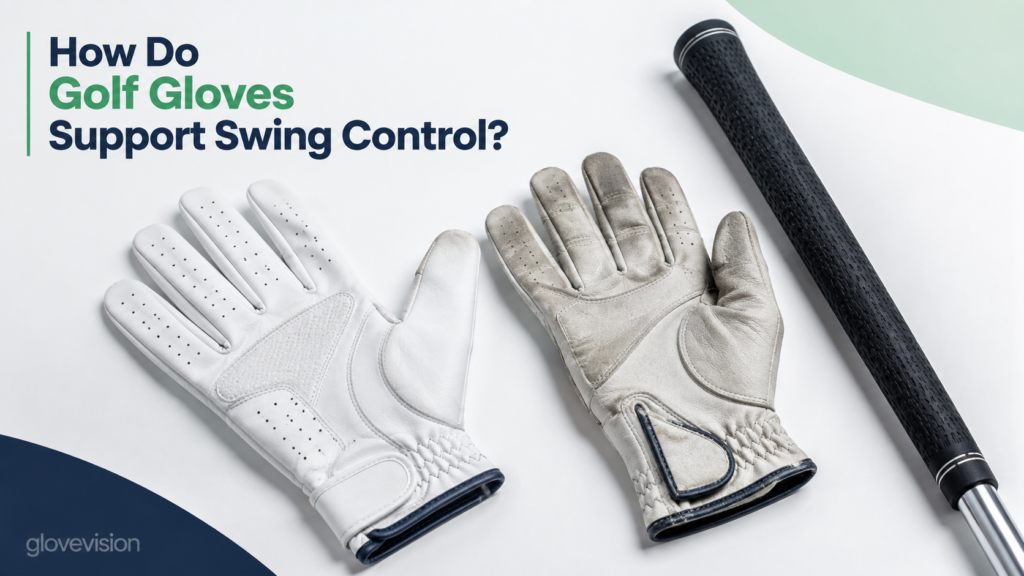
How Do Golf Gloves Support Swing Control?
Golf Gloves sit directly between the hand and club grip, where useful surface friction, close palm conformity, finger contact, secure retention, pressure consistency, and tactile feedback can make the hand-to-club interface more stable.
That contribution is supportive rather than corrective. Golf Gloves cannot independently determine swing path, clubface orientation, timing, tempo, body movement, or shot accuracy, and their usefulness depends on the playing hand, exact material and construction, anatomical fit, seams, closure, club-grip condition, weather, moisture, movement, and remaining glove condition.
Educational and use notice: Golf Gloves can support grip stability, palm contact, and club feel, but they cannot correct swing mechanics, guarantee shot accuracy, prevent every blister or hand injury, or compensate fully for an unsuitable club grip. Follow the exact manufacturer’s sizing, use, care, inspection, and replacement guidance, and verify current competition rules where glove construction may be regulated. Persistent pain, numbness, swelling, weakness, or restricted hand movement should receive appropriate assessment rather than being managed through glove selection alone.
What Role Do Golf Gloves Play in Swing Control?
Golf Gloves support swing control by helping stabilize the hand-to-club interface, reducing some unwanted slipping and material movement while preserving the golfer’s ability to feel and retain the club.
Current USGA Equipment Rules allow a glove to assist gripping when it meets the applicable “plain glove” requirements, while Rule 4.3 restricts equipment use that creates an artificial advantage with hand position or grip pressure. Commercial availability therefore does not automatically establish competition conformity. [USGA Gloves] [USGA 4.3]
Which Hand-to-Club Functions Do Golf Gloves Support?
The functional interface includes club retention, palm contact, finger and thumb contact, useful friction, pressure distribution, moisture response, and tactile feedback. These are glove-interface functions rather than swing-mechanics controls.
How Can Golf Gloves Reduce Unwanted Slipping?
A suitable palm surface, close conformity, stable material position, and weather-appropriate construction can reduce some glove-to-club or hand-to-glove movement. No glove should be described as slip-proof.
How Can Golf Gloves Support More Consistent Grip Pressure?
Greater interface security may reduce unnecessary squeezing or repeated adjustment for some players, but a glove should not be used to prescribe grip pressure or assign a universal reduction. Related equipment-contact pressure and feedback illustrates why equipment-contact pressure and feedback must be interpreted at the real contact surface rather than from padding or material names alone.
How Do Golf Gloves Preserve Feedback?
Tactile feedback helps the golfer sense club position, palm movement, contact pressure, and surface movement. Excess bulk, bunching, or poor fit can filter or distort that information even when external friction remains high.
Why Can Golf Gloves Not Correct Swing Mechanics?
Golf Gloves do not independently control path, clubface orientation, tempo, timing, body rotation, or strike quality. The broader framework for sports glove grip, fit, and equipment control helps separate golf’s close club-grip interface from other sports with different contact, padding, vibration, and support demands.
| Interface Stage | Golf Gloves Function | Possible Control Contribution | Limitation |
|---|---|---|---|
| Initial grip contact | Palm and finger surfaces conform around the club grip | May create more consistent contact and useful friction | Does not prescribe grip technique or pressure |
| Swing movement | Close fit and stable closure reduce unwanted glove rotation or bunching | May help retain a predictable hand-to-club interface | Does not control swing path, timing or clubface |
| Grip-pressure change | Stable surface contact may reduce repeated readjustment for some players | May support more consistent interface pressure | No universal pressure reduction can be assigned |
| Moisture exposure | Material and weather-specific construction affect friction and internal stability | May preserve interface reliability under intended conditions | Dry-glove behavior cannot be assumed in rain |
| Internal glove movement | Correct sizing, palm conformity and closure resist hand-to-glove slip | May reduce delayed movement and material folds | High external friction cannot compensate for poor internal fit |
| Tactile feedback | Palm thickness, material and fit transmit club position and pressure information | May preserve useful equipment feel | Maximum thinness or maximum friction is not automatically better |
How Do Golf Gloves Stabilize the Hand-to-Club Interface?
Golf Gloves stabilize the hand-to-club interface only when useful friction against the club is paired with equally stable fit against the hand.
How Does Surface Friction Matter?
Glove-to-club friction depends on the palm surface, grip texture, contact pressure, moisture, contamination, and wear. Maximum friction is not automatically the goal; the interface also needs natural movement and useful feedback.
How Does Palm Conformity Matter?
A conforming palm follows the hand and club grip with fewer disruptive wrinkles, preserves finger wrap, and maintains broad contact. Related bar and handle grip mechanics illustrates the general hand-to-equipment principle that palm thickness, folds, overlays, closure position, and surface texture can alter the interface without transferring weightlifting performance claims to golf.
Why Does Internal Stability Matter?
A glove can have high friction against the club and still fit poorly against the hand. Internal slipping, palm bunching, excess fingertip space, rotation, or loose closure can delay movement and change pressure even when the palm itself is grippy.
How Does Closure Stability Matter?
Closure location, adjustment, backhand tension, wrist pressure, and retention all affect whether the glove stays aligned as the hand closes. Secure should not mean restrictive.
How Does Club-Grip Condition Matter?
Grip wear, dirt, moisture, diameter, and surface condition can change glove-to-club contact. Golf Gloves cannot fully compensate for an unsuitable, heavily worn, contaminated, or damaged club grip. The broader palm grip and fit stability principle reinforces the need to evaluate palm alignment, bunching, moisture, and contact stability together.
Which Construction Features Help Golf Gloves Preserve Grip and Feedback?
Golf Gloves should be evaluated as complete constructions because palm material, thickness, seams, reinforcement, stretch zones, perforations, backhand design, and closure all influence the club interface.
Manufacturer examples illustrate why product-level evidence matters. FootJoy’s current StaSof documentation describes a performance-leather construction with grip, moisture resistance, feel, and a positioned closure, while Callaway’s Weather Spann uses a hybrid approach combining synthetic material, leather palm/thumb zones, reinforcement, and micro-ventilation. These claims apply to the exact products, not to leather, synthetic, or hybrid categories universally. [StaSof] [Weather Spann]
How Does Leather Affect Golf Gloves?
Exact leather constructions may offer close conformity, direct feel, and useful grip, but moisture, finish, stretching, drying, wear, and care can change performance. Leather should not be ranked universally above other materials.
How Do Synthetic Materials Affect Golf Gloves?
Synthetic materials can support repeatable patterning, ventilation zones, shape retention, and reinforcement, but flexibility, moisture behavior, durability, and club feel vary by finished construction.
How Do Hybrid Constructions Affect Golf Gloves?
Hybrid gloves can place different materials at the palm, thumb, backhand, fingers, or stretch zones to balance grip, wear, ventilation, and fit. “Hybrid” does not mean automatically better overall.
How Do Palm Thickness and Reinforcement Matter?
Thickness and reinforcement can change feedback, wear reserve, bulk, contact pressure, and finger wrap. Thin does not automatically mean more control, and reinforced does not automatically mean more durable in every construction.
How Do Seams Affect Contact?
Palm, finger, thumb, and transition seams can create pressure ridges, change folding, or influence how the glove wraps around a narrow club grip.
How Do Stretch Panels and Perforations Matter?
Stretch panels and perforations can support knuckle movement, finger flexion, ventilation, and fit adaptation, while also introducing trade-offs in shape retention, stretch, durability, and local wear.
| Construction | Interface Benefit | Trade-Off | Weather Consideration | Verification |
|---|---|---|---|---|
| Leather | Can conform closely and provide direct club feel where the exact product is designed for it | Can stretch, wear, stiffen or change with moisture and care | Moisture response varies by leather and finish | Exact finished-product documentation |
| Synthetic | Can support repeatable patterning, shape retention and ventilation zones | Feel, stretch, grip and wear vary by construction | Moisture handling is product-specific | Exact material and manufacturer claim |
| Hybrid | Allows leather, synthetic, stretch and reinforcement to be zoned by function | More interfaces, seams and materials can add complexity | Weather response varies by zone | Exact layer and zone documentation |
| Thin palm | Can preserve close feel and reduce unnecessary bulk | May offer less wear reserve or change durability depending on material | Wet behavior cannot be inferred from thickness | Exact palm thickness only where documented |
| Reinforcement | Can support wear areas and maintain local shape | Can add stiffness, seams or bulk | May affect drying and moisture retention | Verify exact reinforced area |
| Stretch panel | Can support knuckle movement and fit adaptation | Can permanently stretch or change tension over time | Perspiration and drying may affect fit | Exact panel location and condition |
| Perforation | Can support ventilation and moisture release | Can change structure or local wear pattern | Benefit depends on actual climate and material | Exact perforated zones |
How Do Golf Gloves Balance Grip Stability with Hand Mobility?
Golf Gloves should remain secure enough to prevent unwanted palm rotation or bunching while preserving natural finger closure, thumb movement, tactile feedback, and wrist freedom.
How Does Finger Fit Affect Control?
Good finger fit leaves minimal excess material at the fingertips, supports natural flexion, keeps material stable, and avoids painful compression.
How Does Thumb Construction Matter?
Thumb length, angle, seam position, palm transition, and twisting can influence both contact and movement. A rotated or oversized thumb can destabilize an otherwise well-fitting palm.
How Does Backhand Flexibility Matter?
The backhand must balance knuckle movement, shape stability, ventilation, and retention so the glove stays close without turning rigid.
How Does Wrist Closure Matter?
Closure security should stabilize the glove without excessive tension, pressure, or restriction of intended wrist movement. USGA equipment rules also restrict glove features that bind digits, adhere to the grip, or restrict joints in ways that provide artificial assistance. [USGA Gloves]
Can Golf Gloves Be Too Tight?
Yes. Excessively tight fit can restrict movement, increase seam stress or pressure, cause numbness, or overstretch the construction.
Can Golf Gloves Be Too Loose?
Yes. Excess material can bunch, rotate, fold at the fingertips, reduce feedback, and force repeated adjustment. Related hand-to-handle grip and feedback trade-offs shows the same broad interface trade-off between secure hand-to-handle contact and preserving useful equipment feedback.
How Do Playing Conditions Change Golf Gloves Performance?
Golf Gloves can behave differently as moisture, rain, heat, humidity, cold, repeated use, and drying change palm friction, material conformity, internal stability, flexibility, and tactile feedback.
How Do Golf Gloves Perform in Dry Conditions?
Check palm feel, useful friction, close fit, hand perspiration, feedback, and club-grip condition rather than assuming a dry-weather material category always behaves the same.
How Do Rain Golf Gloves Support Wet Conditions?
Use exact rain-specific evidence. FootJoy’s current RainGrip documentation describes a wet/humid-condition autosuede knit palm, quick-drying back-of-finger material, secure closure, and a paired configuration. Those claims apply to RainGrip rather than ordinary dry-weather golf gloves. [RainGrip]
How Do Golf Gloves Perform in Heat and Humidity?
Sweat can change internal stability, saturation, ventilation demand, closure feel, and drying burden. Rotation can be useful when the golfer needs another glove while a damp one dries, but it is not mandatory.
How Do Cold-Weather Golf Gloves Affect Control?
Cold-weather constructions can add warmth, cuff coverage, and material bulk, which must be balanced against finger mobility, feedback, and grip. FootJoy’s WinterSof is currently sold as a pair and documents a Sure-Grip palm, extended cuff, and insulated/wind-resistant back-of-hand construction. [WinterSof]
How Does Repeated Use Change Golf Gloves?
Repeated use can create stretch, thinning, smoothing, stiffness, seam wear, thumb distortion, and closure wear. There is no universal number of rounds at which every glove should be replaced.
| Condition | Main Interface Challenge | Golf Gloves Priority | Verification |
|---|---|---|---|
| Dry | Useful friction without excessive tack or bulk | Close palm conformity, feedback and stable closure | Check glove and actual club-grip condition |
| Rain | Wet grip, saturation and internal movement | Explicit rain-specific palm and secure pair/closure if designed | Use exact rain product evidence |
| Hot / humid | Sweat, internal slip and material saturation | Ventilation, moisture response, rotation and fit retention | Check product construction and drying guidance |
| Cold | Bulk, reduced finger mobility and lower tactile feel | Exact cold-weather construction, grip, cuff and mobility | Do not invent a temperature limit |
| Frequent use | Stretch, smoothing, seam and closure wear | Durability, rotation, care and condition checks | No universal round-count lifespan |
| Mixed weather | Changing friction, fit and drying demands | Versatile construction or planned glove rotation | Verify each product’s intended conditions |
Which Golf Gloves Best Match Different Players and Conditions?
Golf Gloves should be matched to the player’s hand proportions, desired feedback, expected moisture and weather, playing frequency, club-grip interface, and durability requirements rather than ranked by material name alone.
Which Golf Gloves Suit Feedback Priority?
Prioritize close fit, smooth contact, flexible fingers, low bunching, and only as much material as the golfer needs for the intended conditions.
Which Golf Gloves Suit Durability Priority?
Look at exact reinforcement, seam construction, stretch behavior, fit retention, and palm wear rather than assuming synthetic or thick automatically means durable.
Which Golf Gloves Suit Sweaty Hands?
Consider interior stability, ventilation, moisture response, closure retention, and practical rotation between gloves if drying time becomes a problem.
Which Golf Gloves Suit Rain?
Require explicit wet-condition construction and evidence rather than extending a general “all-weather” label beyond the exact product. Paired rain systems may be appropriate where that is the maker’s intended configuration. [RainGrip]
Which Golf Gloves Suit Cold?
Use exact cold-weather constructions and assess added bulk, finger mobility, grip, cuff coverage, and feedback. Do not assign a universal temperature rating. [WinterSof]
Which Golf Gloves Suit Frequent Players?
Fit retention, material wear, rotation practicality, care burden, and replacement cost become more important as use frequency increases.
Which Evidence Should Support Selection?
Prefer the exact model, documented material and weather intent, manufacturer sizing, hand orientation, current competition requirements, care instructions, return/fit options, and current condition. Product-level construction should outrank material prestige or generic “tour” claims.
| Player / Condition Priority | Prioritize | Trade-Off to Check | Decision Cue |
|---|---|---|---|
| Maximum feedback priority | Low unnecessary bulk, close fit, smooth palm and flexible fingers | Wear reserve and moisture performance | Club position remains easy to sense without slipping |
| Durability priority | Reinforcement, stable construction and strong seam condition | Added stiffness or bulk | Palm remains flat and fingers still close naturally |
| Sweaty hands | Internal stability, ventilation, moisture response and rotation | Material stretch or saturation | Hand does not move inside the glove |
| Rain | Explicit wet-condition product design and secure fit | Dry-condition feel may differ | Grip remains stable in the manufacturer’s intended wet context |
| Cold | Paired or insulated construction where documented, mobility and secure palm | Added bulk and reduced feedback | Hand remains warm enough without losing functional closure |
| Frequent play | Fit retention, rotation, inspectability and care burden | Cost and replacement frequency | Condition remains stable between uses |
| Mixed conditions | Balanced construction and practical rotation options | No single glove maximizes every condition | Selection matches the expected weather rather than marketing category alone |
How Should Golf Gloves Be Fitted and Function-Checked?
Golf Gloves should fit closely enough for the palm to remain flat and stable without uncomfortable compression, while fingers, thumb, closure, and wrist retain the movement needed to grip the club naturally.
FootJoy’s current fitting guidance describes a close “second skin” fit, minimal excess fingertip material, manufacturer-specific measurements, and distinct Regular versus Cadet proportions; Cadet uses a wider palm with shorter fingers. Those proportions are FootJoy-specific and should not be transferred automatically to other brands. [FJ Fit]
Which Hand Should Wear Golf Gloves?
Many golfers use a glove on the lead hand, while rain, cold, preference, or specific product configurations may involve a pair. Follow the player’s actual use and manufacturer configuration rather than an absolute one-glove rule.
How Should Golf Gloves Size Be Checked?
Use the exact manufacturer chart and check the measurements and proportions it specifies, including finger length and hand circumference; where offered, compare Regular and Cadet sizing. [FJ Fit] Then function-check thumb alignment, closure position, and wrist freedom on the actual glove.
How Should the Palm and Fingers Fit?
Look for a flat palm, minimal fingertip excess, no disruptive wrinkles, natural thumb alignment, and full functional closure without painful compression.
How Should Closure Be Adjusted?
The closure should hold the glove securely without excessive pressure, maintain a stable backhand, and leave intended wrist movement free.
How Should Golf Gloves Be Checked with the Club?
Using an unloaded club in a controlled setting, wrap the fingers naturally and check palm stability, thumb alignment, bunching, pressure, tactile feedback, and wrist movement. This is an interface check, not grip-style coaching.
Which Problems Require Rejection?
Palm bunching, internal slipping, excess fingertip slack, painful seams, twisted thumb position, restricted closure, numbness, wrist restriction, or unstable closure indicate a poor functional fit.
| Check | What to Verify | Why It Matters | Reject / Reassess If |
|---|---|---|---|
| Playing hand | Lead-hand convention or product-specific pair use matches the golfer’s actual configuration | Prevents buying the wrong hand or assuming one-glove use is mandatory | Glove orientation does not match intended use |
| Exact model | Material, weather intent and competition suitability are known | Prevents category-level assumptions | Product construction or intended conditions are unclear |
| Manufacturer size | Use exact brand guidance; compare Regular/Cadet only where offered | Proportions vary between brands and cuts | Fit requires extreme closure tension or excess material |
| Palm flatness | Palm lies smooth without disruptive folds | Wrinkles can alter friction, pressure and feedback | Palm bunches when the hand closes |
| Fingertip seating | Little excess material without painful compression | Controls finger wrap and tactile consistency | Fingertip folds or crushing pressure appear |
| Thumb alignment | Thumb length, angle and seam sit naturally | Twisting changes palm transition and club contact | Thumb rotates or seam becomes painful |
| Closure | Secure retention without excessive pressure | Stabilizes the glove while preserving movement | Closure migrates or restricts the wrist |
| Finger movement | Natural flexion and full closure remain available | Secure fit should not become restriction | Finger closure is blocked |
| Wrist freedom | Wrist moves normally within intended glove design | Closure should not immobilize the joint | Glove or tab restricts movement |
| Club-grip interaction | Use an unloaded club to check palm stability, finger wrap and feedback | Tests the real hand-to-club interface | Glove slips, bunches, or makes the grip unmanageable |
How Should Golf Gloves Be Maintained and Troubleshot?
Golf Gloves should be maintained according to the exact manufacturer’s instructions because leather, synthetic materials, rain-specific knits, insulation, stretch components, seams, and closures can respond differently to moisture, cleaning, drying, heat, and storage.
How Should Golf Gloves Be Cleaned?
Follow the exact product instructions. Do not universally prescribe washing, detergent, soaking, leather conditioner, or machine washing across different Golf Gloves.
How Should Golf Gloves Be Dried and Stored?
Use exact manufacturer guidance and avoid invented universal drying times, heat limits, or sunlight rules.
When Should Golf Gloves Be Rotated?
Rotation may be practical for frequent play, high perspiration, wet conditions, drying time, or fit consistency. FootJoy’s fitting guidance specifically recommends rotation as a way to give gloves more time to dry, but that does not make rotation mandatory for every golfer. [FJ Fit]
How Should Golf Gloves Be Inspected?
Check palm thinning and smoothing, holes, seam opening, permanent stretching, stiffness, thumb distortion, closure failure, and internal movement.
Why Do Golf Gloves Slip on the Club?
Possible causes include palm wear, moisture, contamination, poor fit, internal slipping, closure movement, or club-grip condition.
Why Do Golf Gloves Become Stiff?
Moisture cycles, drying, contamination, aging, and product-care mismatch can all contribute. Use the maker’s instructions rather than a universal softening treatment.
Why Does Palm Bunching Develop?
Oversizing, permanent stretch, mismatched hand proportions, liner movement, or closure instability can leave material folding between the palm and grip.
When Should Golf Gloves Be Replaced?
Reassess or replace when holes, unreliable grip, permanent stretch, persistent bunching, separated seams, thumb misalignment, closure failure, uncomfortable stiffness, or failed weather performance prevents the glove from maintaining the intended interface.
| Problem | Possible Cause | What to Inspect | Next Decision |
|---|---|---|---|
| Club slip | Palm wear, moisture, contamination, unsuitable glove or worn club grip | Palm surface, weather, fit and grip condition | Clean/care only as directed; replace glove or address grip condition as appropriate |
| Internal slip | Oversizing, permanent stretch, perspiration or weak closure | Hand movement inside glove and closure position | Resize or replace if stability cannot be restored |
| Palm bunching | Excess material, permanent stretch or wrong proportions | Palm flatness during full closure | Try a better size/cut or replace stretched glove |
| Restricted fingers | Excessively tight fit, stiffened material or seam tension | Finger flexion, fingertips and backhand panels | Reject if functional closure is restricted |
| Weak feedback | Excess bulk, bunching, poor fit or unsuitable construction | Palm thickness, folds and club feel | Choose a better feedback/fit balance |
| Stiff palm | Moisture cycles, aging, contamination or care mismatch | Palm flex and surface condition | Follow exact care guidance or replace if flexibility stays poor |
| Closure movement | Worn closure, wrong adjustment or stretched backhand | Tab retention and glove rotation | Reassess size/condition; replace if unstable |
| Wet instability | Non-rain glove, saturation, internal slip or unsuitable grip surface | Intended weather claim, palm and closure | Use a product documented for the wet conditions |
| Area | Check | Rule | Replacement / Reassessment Trigger |
|---|---|---|---|
| Manufacturer care | Exact cleaning, drying and storage guidance | Do not universalize washing, detergent, soaking or conditioning | Care requirements cannot be followed or construction is uncertain |
| Palm | Thinning, smoothing, holes or loss of reliable surface contact | Inspect the real club-contact zone | Grip or palm integrity becomes unreliable |
| Seams | Opening, fraying or pressure ridges | Seams affect club contact and fit | Seam failure or painful ridge develops |
| Thumb | Twisting, stretching and seam alignment | Thumb transition should remain natural | Thumb alignment no longer holds |
| Stretch | Permanent looseness in palm, fingers or backhand | Close fit should remain stable | Material no longer conforms to the hand |
| Closure | Fastener retention and adjustment range | Closure should secure without excessive pressure | Tab no longer holds or glove rotates |
| Flexibility | Natural finger closure and wrist freedom | Condition should not block movement | Palm/backhand remains uncomfortably stiff |
| Fit | Palm flatness, fingertips and internal stability | Recheck after repeated wear and moisture cycles | Bunching or internal slip persists |
| Grip | External glove-to-club stability | Glove cannot fully compensate for a damaged club grip | Reliable contact cannot be restored |
How Should Golf Gloves Be Chosen to Support Swing Control?
Golf Gloves should be chosen by defining the correct playing hand, expected weather, desired club feedback, friction requirement, playing frequency, and durability need before evaluating the exact glove construction and functional fit.
Which Final Questions Should Be Answered?
Confirm the playing hand, one- or two-glove configuration, expected weather, playing frequency, desired feedback, durability requirement, documented construction, hand proportions, palm flatness, fingertip seating, thumb alignment, closure pressure, internal stability, natural finger wrap, wrist freedom, club-grip condition, practical care requirements, current glove condition, and relevant competition requirements.
Which Final Rule Should Guide Golf Gloves Selection?
Choose Golf Gloves that provide the best complete balance of useful friction, close anatomical fit, low bunching, finger mobility, wrist freedom, club feedback, weather suitability, durability, and remaining condition—not simply the thinnest, tightest, tackiest, or most expensive glove.
Conclusion
Golf Gloves support swing control by helping stabilize the hand-to-club interface through useful friction, close palm fit, controlled internal movement, flexible fingers, and secure closure, but they cannot correct swing mechanics or guarantee shot accuracy.
External friction is not the same as internal stability; maximum friction is not automatically best; tight is not the same as correct fit; thin is not universally better; leather, synthetic, and hybrid constructions each require product-level evidence; weather, club-grip condition, care, competition rules, and current glove condition all influence whether the interface remains reliable.
Frequently Asked Questions
Do Golf Gloves Improve Swing Control?
They can support it. Golf Gloves may create a more stable hand-to-club interface and reduce some unwanted slipping, but they cannot correct swing path, clubface orientation, timing, tempo, or other swing mechanics.
Should Golf Gloves Fit Tightly?
They should fit closely without excessive pressure or movement restriction. A glove that is too loose can bunch or rotate, while an excessively tight glove may restrict motion, increase seam pressure, or overstretch the construction.
Are Leather Golf Gloves Better Than Synthetic Golf Gloves?
Not universally. Suitability depends on the exact leather or synthetic construction, hand fit, expected weather, desired feedback, durability, care requirements, and current condition.
Should Golf Gloves Be Worn on Both Hands?
Not necessarily. Many golfers use a lead-hand glove, while paired Golf Gloves may be chosen for rain, cold, preference, or another product-specific use.
When Should Golf Gloves Be Replaced?
Replace or reassess Golf Gloves when holes, permanent stretching, seam failure, stiffened material, unstable fit, closure failure, or unreliable grip prevents the glove from maintaining the required hand-to-club interface.