
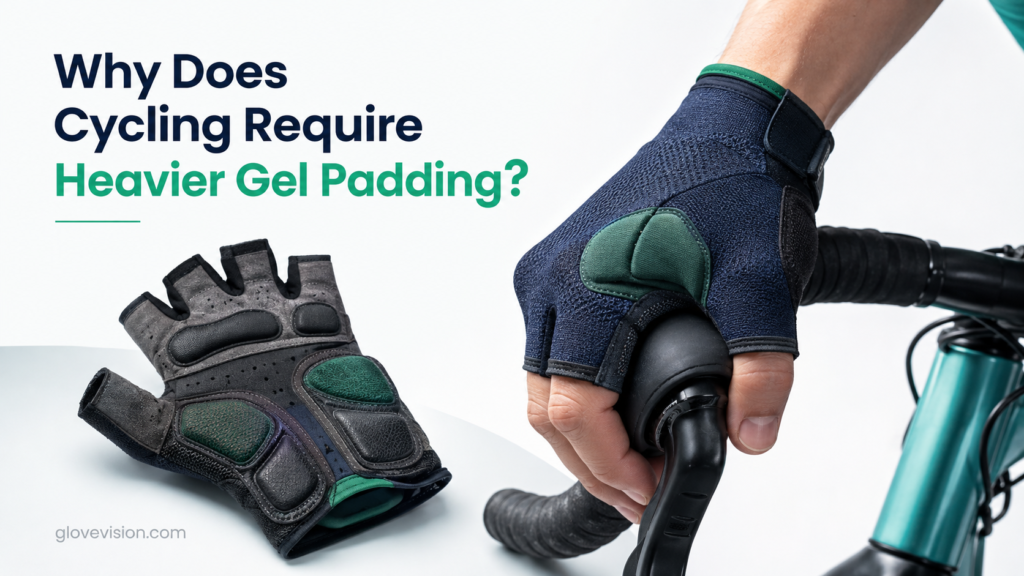
Why Does Cycling Require Heavier Gel Padding?
Cycling does not universally require heavier gel padding. More Gel Padding in Cycling Gloves may be useful when sustained palm loading, rough-surface impacts, or a specific handlebar-contact zone requires additional cushioning.
Additional gel is useful only when its placement, stiffness, loaded compression, and fit match the rider’s actual contact pattern. Excessive or poorly positioned gel may create pressure edges, increase grip bulk, reduce tactile feedback, destabilize palm contact, or provide little meaningful vibration attenuation.
Educational and safety notice: Gel Padding in Cycling Gloves may reduce some localized palm pressure or discomfort, but it cannot eliminate hand loading, guarantee vibration attenuation, or prevent every hand or nerve problem. Follow the exact glove manufacturer’s sizing, use, care, inspection, and replacement instructions. Persistent numbness, tingling, weakness, pain, loss of coordination, or reduced hand function requires appropriate assessment rather than simply adding more gel.
What Does “Heavier” Mean for Gel Padding in Cycling Gloves?
“Heavier” Gel Padding in Cycling Gloves is not a standardized category; it may describe greater thickness, volume, coverage, number of zones, stiffness, layering, or retained depth under load.
How Do Thickness and Stiffness Differ?
Thickness is material depth; stiffness is resistance to deformation. A thick gel pad can be soft, and a thinner pad can be firm, so neither variable alone predicts how the finished glove will cushion or control the handlebar.
How Do Volume and Coverage Differ?
Volume is the total amount of gel, while coverage is the area of palm occupied by gel. Broader coverage can add material outside the loaded region, whereas a smaller targeted zone may solve a localized contact problem with less bulk.
How Do Compression and Recovery Change the Meaning of “More”?
Useful gel behavior depends on initial deformation, retained loaded thickness, pre-compression, available deformation before bottoming-out, recovery after unloading, and whether permanent flattening develops. Unloaded appearance cannot substitute for loaded behavior.
Why Must the Complete Glove Be Evaluated?
Gel quantity alone does not establish contact-zone alignment, edge behavior, palm friction, grip diameter, anatomical fit, control access, or durability. The complete glove determines whether the gel remains useful in the actual riding position.
| Variable | What It Describes | Possible Benefit | Main Limitation |
|---|---|---|---|
| Thickness | Unloaded depth of the gel component | May provide more deformation space | Does not establish stiffness, loaded depth, or useful placement |
| Stiffness | Resistance to deformation under a given load | May support predictable shape under contact | Can feel firm or interfere with conformity if mismatched |
| Volume | Total amount of gel in the glove | May increase available cushioning material | More material can add bulk outside the loaded zone |
| Coverage | Palm area occupied by gel | Can spread cushioning across a broader region | Wide coverage is not automatically useful coverage |
| Compression | How gel deforms under load | Can increase contact area and redistribute local pressure | Excessive or uneven compression can bottom out or shift |
| Recovery | Return toward unloaded shape after load removal | Supports repeatable behavior when maintained | Visible rebound does not prove full performance recovery |
| Placement | Where gel sits relative to real palm contact | Targets cushioning where loading actually occurs | Misalignment can create missed zones or edge pressure |
When Is More Gel Padding in Cycling Gloves Mechanically Justified?
More Gel Padding in Cycling Gloves is mechanically justified only when a repeatable palm-contact zone experiences sustained loading or impacts that the existing construction does not manage adequately, and the added gel remains aligned and stable under load.
Which Loads May Create a Need for More Gel?
Separate sustained handlebar pressure, discrete impacts, repeated rough-surface shocks, and higher-frequency vibration. The broader cycling glove pressure and vibration management page explains why these load types should not be treated as interchangeable.
How Does Gel Redistribute Localized Palm Pressure?
Gel deformation can increase contact area and reduce some localized pressure peaks, while shifting part of the load toward adjacent palm regions. A controlled cycling study supports the principle that glove type and hand position can change hypothenar pressure, but its tested reductions should not be generalized to every glove or rider. [Slane] The wider sports glove padding and contact demands framework reinforces that padding must match the sport-specific contact zone and control task.
Which Palm Zones May Need Targeted Gel?
Potential contact regions include the hypothenar side, thenar side, central palm, palm heel, and the base of the fingers. The correct zone depends on the rider’s own handlebar position and contact pattern; there is no universal gel map.
How Do Ride Duration and Surface Change the Decision?
Longer exposure and rougher surfaces can increase cumulative loading, but they do not create a universal rule that more duration or roughness requires thicker gel. The decision still depends on the actual loaded zone and how the current construction behaves.
How Do Hand Position and Weight Distribution Change the Decision?
Tops, hoods, drops, flat grips, and bar ends can shift palm contact, wrist posture, and pad alignment. Gel cannot correct every bicycle-fit or weight-distribution problem, so a persistent mismatch may require reassessing the broader interface rather than simply adding material.
When Is More Gel Unnecessary?
More gel may be unnecessary when existing padding already covers the loaded zone, the real problem is misalignment, a targeted layout could solve the issue with less bulk, control or feedback worsens, the bicycle interface is the dominant contributor, or symptoms require assessment beyond glove selection.
| Riding Load or Context | Contact Problem | Possible Reason for Added Gel | Required Control Check | Lower-Bulk or System Alternative |
|---|---|---|---|---|
| Long road riding | Sustained localized palm pressure | Extra cushioning at a repeatable loaded zone | Grip bulk, hand-position changes, brake/shift access | More targeted gel; reassess hand position or bicycle interface |
| Rough gravel | Repeated impacts and rough-surface shocks | Stable cushioning at repeatedly loaded zones | Pad migration, moisture, feedback, bar control | Strategic zones; bar/grip/interface reassessment |
| Mountain-bike braking/control | Frequent control inputs with impact exposure | Localized cushioning without lever interference | Brake feel, grip diameter, palm stability | Lower-bulk or more targeted gel |
| Performance road riding | High feedback priority with sustained contact | Only if a clear pressure problem remains | Tactile feedback, hoods/drops transition, bar feel | Strategic low-bulk layout |
| Mixed hand positions | Contact zone changes across tops/hoods/drops | Additional gel only if it covers the recurring loaded areas | Alignment in every required position | Different pad layout rather than more total gel |
| Previous or current symptoms | Pressure or discomfort may have multiple contributors | Gel only when contact mapping identifies a glove-relevant problem | Symptoms, fit, posture, control, progression | Assessment beyond glove selection when persistent or progressive |
Why Doesn’t More Gel Padding in Cycling Gloves Guarantee Less Vibration?
More Gel Padding in Cycling Gloves does not guarantee less vibration because transmission depends on frequency, amplitude, material behavior, pre-compression, pad placement, hand position, grip force, and the complete bicycle-contact system.
How Does Vibration Differ From Sustained Pressure and Impact?
Sustained pressure is prolonged contact loading, a discrete impact is a brief transient event, and repeated vibration contains oscillatory components over time. A pad can behave differently under each type of input.
Why Is Gel Response Frequency-Dependent?
The same gel construction can respond differently across vibration bands. A cycling laboratory study comparing no glove, a non-padded glove, and a gel-padded glove did not find a significant overall glove effect on vibration transmissibility in its tested setup, which is evidence against assuming that visible gel automatically attenuates all vibration. [Vibration]
How Does Pre-Compression Change Vibration Response?
Grip force, fit, and sustained handlebar contact can use part of a pad’s available deformation before later vibration or impact arrives. The remaining response therefore depends on the loaded state rather than only on the pad’s unloaded softness or thickness.
How Can Contact-Zone Mismatch Bypass the Gel?
Changing hand position, glove rotation, individual anatomy, or gel placed outside the actual bar-contact patch can reduce the amount of relevant input that passes through the intended pad. Cycling-glove design research specifically highlights the conflict between added thickness and actual handlebar contact, and the risk that pad layouts miss the real contact zone. [Design]
What Does the Cycling Evidence Actually Show?
Evidence is setup-dependent. One cycling vibration experiment found no significant overall glove effect in its tested conditions, while a separate single-participant shock-input study reported a small tested glove effect and a larger handlebar-tape effect. [Vibration] [Shock] The broader principle of sport-specific vibration exposure is useful only to reinforce that vibration claims must remain specific to the sport, equipment interface, and tested frequency conditions.
When Is More Gel Padding in Cycling Gloves Worth the Control Trade-Off?
More Gel Padding in Cycling Gloves is worth the trade-off only when the added cushioning addresses the rider’s actual loaded zone and the glove still preserves stable palm contact, useful feedback, natural movement, and full brake and shift access.
When Can Long Road or Gravel Riding Support More Gel?
Additional gel may be reasonable when sustained localized pressure or repeated impacts remain a clear problem and the gel stays stable through long-duration compression, moisture exposure, and multiple hand positions. That does not create a universal maximum-padding rule.
When Can Mountain-Bike or Performance Riding Favor Less Gel?
Lower-bulk or strategically zoned gel may be preferable when brake feel is critical, the grip is already large, the hands reposition frequently, added gel destabilizes palm coupling, or precise feedback is a priority. This should be evaluated rather than assumed from riding category alone.
When Is Zoned Gel Better Than Broader Gel?
Targeted gel is often worth evaluating when the pressure problem is localized and broader padding adds material outside the contact patch. The benefit comes from alignment and loaded behavior, not from a smaller or larger gel quantity by itself.
Which Trade-Offs Must Be Accepted or Rejected?
Compare cushioning against grip bulk, coverage against edge transitions, conformity against migration, stability against tactile feedback, and padding against control access. The cross-sport principle behind padded glove and bar-grip trade-offs supports the same general caution: added material can cushion contact while also changing grip geometry and useful feedback.
What Evidence Should Support the Choice?
Prioritize exact finished-glove documentation when available, actual pad/contact alignment, controlled function checks, cycling-specific research, and current glove condition. Gel terminology or appearance alone is not enough to establish performance.
How Should Gel Padding in Cycling Gloves Be Fitted, Checked, and Finally Evaluated?
Gel Padding in Cycling Gloves should be accepted only when it stays aligned with the rider’s real contact zones, compresses predictably, avoids disruptive edges or migration, and preserves grip stability, feedback, braking, and shifting in every required hand position.
How Should Gel Align With the Palm and Handlebar?
Check that gel overlaps the intended contact zone, pad edges avoid concentrated pressure points, the palm stays substantially smooth, the glove does not rotate, and gel does not migrate or bunch.
How Should Gel Be Checked Across Hand Positions?
For every relevant position, compare contact-zone overlap, pad-edge location, wrist posture, palm stability, brake and shift access, and tactile feedback. A pad that works on one position may be poorly aligned in another.
How Should Loaded Compression Be Checked?
Assess even deformation, remaining cushioning depth, hard or abrupt transitions, migration, apparent bottoming-out, and recovery after unloading. No universal millimeter or pressure threshold should be invented.
How Should Control Be Function-Checked?
Using a stationary bicycle or another safe controlled setup, verify secure grip, manageable grip diameter, natural thumb movement, adequate feedback, full brake and shift access, and no internal slipping or bunching. The general cross-sport principle of glove fit and control stability supports checking bunching, rotation, internal slip, and excess material; cycling acceptance still depends on handlebar and control testing.
How Should the Glove Be Evaluated on a Familiar Ride?
Use a short familiar ride, the required hand positions, and a controlled uneven section, then reassess pressure, gel stability, symptoms, and control. Persistent or progressive neurological or functional symptoms have multiple possible contributors and require appropriate assessment rather than a padding-only decision. [Review] [Symptoms]
Which Problems Identify Excessive, Misplaced, or Worn Gel?
Persistent pressure may indicate a missed zone or bottomed-out pad; pad-edge discomfort can indicate abrupt transitions or migration; weak feedback can reflect excess depth or bunching; remaining vibration can reflect frequency or contact mismatch; permanent flattening suggests deterioration; and control interference points to excess bulk or poor layout.
How Should Gel Condition and Care Be Assessed?
Inspect permanent flattening, uneven thickness, hard or soft zones, migration, layer separation, contamination, seams, and closures. Follow the exact manufacturer’s care instructions for the specific glove rather than applying a universal washing, drying, or repair procedure.
Which Final Questions Determine Suitability?
Identify the load, real contact zone, whether more gel is truly required, whether a targeted layout could solve the problem with less bulk, whether loaded compression and recovery remain predictable, whether palm stability and feedback are adequate, whether braking and shifting remain normal, whether the gel is structurally reliable, and whether symptoms require assessment beyond glove selection.
What Is the Final Rule for Gel Padding in Cycling Gloves?
Choose correctly placed and appropriately responsive Gel Padding in Cycling Gloves—not automatically heavier gel. Add gel only when a verified palm-loading problem needs more cushioning and the extra material preserves grip stability, tactile feedback, and control access.
| Check | Acceptable Sign | Reassess / Reject Sign |
|---|---|---|
| Contact-zone alignment | Gel overlaps the real loaded palm area | Pad misses the bar-contact patch |
| Pad-edge location | Edges sit away from sensitive concentrated contact | Abrupt edge pressure or seam overlap |
| Compression behavior | Even deformation under handlebar contact | Local collapse, hard spots, or rapid bottoming-out |
| Recovery | Pad returns predictably after unloading | Permanent flattening or uneven rebound |
| Migration | Gel remains where designed | Pad shifts, bunches, or separates |
| Palm stability | Palm stays smooth and coupled to glove | Rotation or internal slipping |
| Grip diameter | Handle remains manageable | Added bulk makes the grip feel oversized |
| Tactile feedback | Useful bar and lever feel remains | Feedback becomes too vague for control |
| Brake and shift access | Full access in every required position | Padding or fit interferes with controls |
| Symptom response | No new/worsening symptoms during controlled checking | Numbness, tingling, pain, weakness, or coordination loss |
| Symptom | Possible Gel-Specific Cause | Verification | Decision |
|---|---|---|---|
| Pressure remains | Gel misses the loaded zone or has bottomed out | Map contact location and loaded pad behavior | Change placement/layout rather than automatically adding more gel |
| Pad-edge discomfort | Abrupt transition, excess depth, migration, seam overlap | Identify the exact pressure ridge | Reduce bulk, change layout, or replace |
| Palm instability | Excess bulk, gel movement, moisture, poor fit | Check rotation, bunching, and internal slip | Resize/change construction/reassess gel amount |
| Weak feedback | Excess depth, layering, bunching | Compare lever/bar feel in a stationary setup | Use lower-bulk or more stable layout |
| Vibration remains | Frequency or contact mismatch | Separate vibration from pressure and check contact overlap | Do not simply add more gel; reassess the bicycle-contact system |
| Gel remains flattened | Compression set or deterioration | Inspect recovery and evenness | Replace when loaded behavior is no longer reliable |
| Control interference | Excess bulk or poor layout | Check grip diameter, braking and shifting | Reduce gel or change construction |
Conclusion
Cycling does not universally require heavier Gel Padding in Cycling Gloves. Additional gel is justified only when its placement and loaded behavior improve localized pressure management enough to outweigh added bulk, edge-pressure, feedback, and control trade-offs.
Thickness, stiffness, volume, coverage, compression, and recovery are different variables. Choose gel by actual contact-zone alignment, loaded stability, grip and control performance, and current condition—not by selecting the thickest or broadest padded glove.
Frequently Asked Questions
Does Every Cyclist Need More Gel Padding in Cycling Gloves?
No. More gel is useful only when a defined palm-loading problem needs additional cushioning and the added material remains compatible with fit and control.
Does Thicker Gel Padding in Cycling Gloves Reduce More Palm Pressure?
Not automatically. Useful pressure redistribution depends on placement, stiffness, loaded compression, edge transitions, hand position, and complete-glove fit.
Does More Gel Padding in Cycling Gloves Reduce More Road Vibration?
Not reliably. Vibration response depends on frequency, material behavior, pre-compression, placement, grip force, and the complete bicycle-contact system.
Is Gel Padding in Cycling Gloves Better Than Foam Padding?
Not universally. Compare the finished padding system by contact-zone alignment, loaded behavior, pressure distribution, control, durability, and applicable evidence.
When Should a Rider Choose Less Gel Padding in Cycling Gloves?
Choose lower-bulk or more targeted gel when added material increases grip diameter, reduces feedback, moves beneath the palm, creates pressure edges, interferes with controls, or does not improve the loaded zone.