
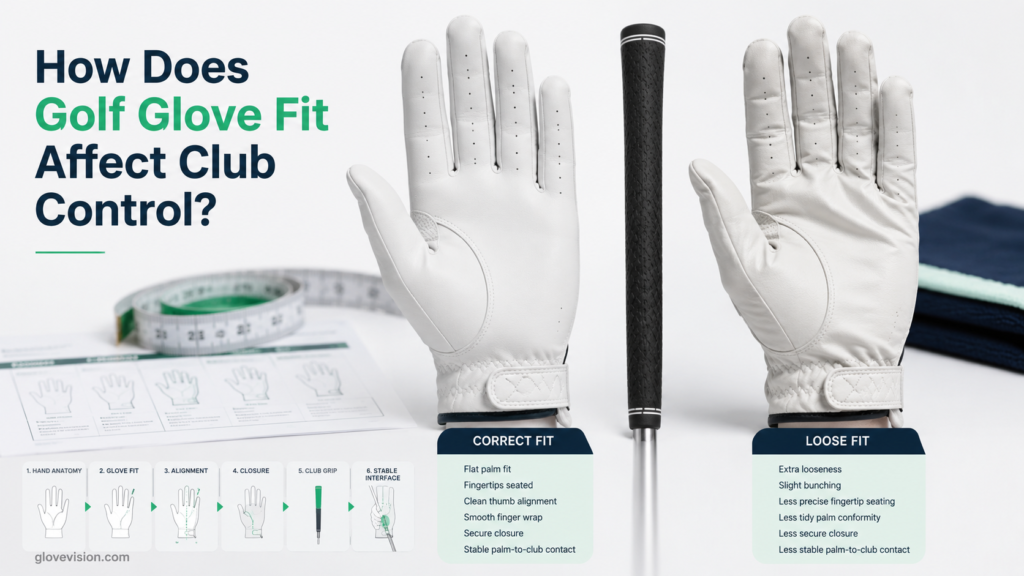
How Does Golf Glove Fit Affect Club Control?
Golf Glove Fit is the anatomical and functional relationship between the golfer’s hand, the finished glove pattern, and the club interface. Palm alignment, fingertip seating, thumb position, backhand tension, seams, closure security, and internal stability all influence whether the glove moves with the hand rather than against it.
Correct fit supports club control by reducing disruptive internal movement while preserving natural finger wrap, tactile feedback, and wrist freedom. Tightness alone is not fit, Golf Glove Fit cannot correct swing mechanics, manufacturer sizing remains product-specific, and material, weather, moisture, wear, and club-grip condition can change the final interface.
Educational and fit notice: Golf Glove Fit can support palm stability, finger control, tactile feedback, and a consistent hand-to-club interface, but it cannot correct swing mechanics, guarantee shot accuracy, or compensate fully for an unsuitable club grip. Follow the exact manufacturer’s sizing, fitting, care, inspection, and replacement guidance. A glove should not create persistent pain, numbness, swelling, weakness, circulation changes, or restricted hand movement; significant or ongoing symptoms should receive appropriate assessment rather than being managed by sizing changes alone.
What Does Correct Golf Glove Fit Mean for Club Control?
Golf Glove Fit is correct when the glove follows the palm, fingers, thumb, backhand, and wrist closely enough to minimize disruptive movement without creating painful compression or interfering with natural hand closure and wrist motion.
FootJoy’s current fitting guide treats fit as a multi-factor check: close palm/finger contact, no excess fingertip material, usable closure adjustment, manufacturer-specific sizing, and final try-on. That guidance is FootJoy-specific and should not be converted into a universal numerical fit rule. [FJ Fit]
How Should a Golf Glove Follow the Shape of the Hand?
Look for palm conformity, correctly seated fingers, natural thumb alignment, stable backhand tension, secure closure, and enough freedom for the hand to open and close normally.
How Should the Palm Sit?
The palm should remain substantially flat with minimal disruptive folds, no severe compression, low internal movement, and comfortable closure tension. Minor contouring is not automatically a failure.
How Should the Fingers Sit?
Finger stalls should seat the fingertips with minimal disruptive excess, enough width for comfortable movement, and no painful end or seam compression. FootJoy specifically flags extra material at the fingertips as a fit problem in its own system. [FJ Fit]
How Should the Thumb Sit?
The thumb should follow a natural angle and length, remain stable at its base, avoid twisting or pulling the palm, and move without pressure from seams or the closure.
How Should the Closure Sit?
The closure should retain the glove with adjustment still available, keep the backhand stable, avoid excessive wrist pressure, and preserve wrist mobility. Closure position is one fit indicator, not proof that the glove proportions are correct. [FJ Fit]
The broader sports glove fit and equipment-interface principles reinforce that sports gloves should be judged through actual contact surfaces, required movement, closure security, and functional fit rather than by size labels alone.
| Fit Area | Correct-Fit Function | Possible Club-Control Contribution | Poor-Fit Consequence |
|---|---|---|---|
| Palm | Close alignment with minimal disruptive folds | Keeps the gripping surface predictably positioned | Bunching, rotation, shifting pressure, weaker feedback |
| Fingers | Correct length/width with natural flexion | Supports consistent finger wrap and fingertip contact | Loose tips fold; short/narrow stalls compress |
| Thumb | Length, base and angle align naturally | Maintains palm-to-thumb transition during closure | Twisting, pulling, seam displacement or restriction |
| Backhand | Stable tension with knuckle movement | Helps retain overall glove alignment | Migration, overstretch or restricted opening |
| Closure | Retains an already well-proportioned glove | Reduces glove migration | Overtightening distorts fit; weak closure allows movement |
| Seams | Avoid disruptive pressure points | Keeps transitions predictable around the club | Pressure ridges, pulling or altered contact |
How Does Golf Glove Fit Stabilize the Hand-to-Club Interface?
Golf Glove Fit stabilizes the hand-to-club interface by reducing unwanted movement between the hand and glove while keeping the glove’s palm and fingers consistently positioned against the club grip.
How Does Internal Stability Affect Golf Glove Fit?
A correct fit can reduce internal sliding, palm rotation, material shifting, repeated adjustment, and thumb displacement. Internal stability is separate from the friction between the glove’s outer palm and the club grip.
How Does Palm Fit Support Club Contact?
A stable palm surface with fewer disruptive folds can maintain a more consistent contact layer and make changes in pressure or movement easier to sense.
How Does Finger Fit Support Natural Wrap?
Suitable finger length and width allow natural closure without empty fingertips, compressive seams, or folds that sit between the fingers and the grip.
How Does Golf Glove Fit Affect Grip-Pressure Consistency?
A stable hand-to-glove interface may reduce unnecessary readjustment or pressure changes caused by slipping or bunching, but the glove does not prescribe an ideal grip pressure.
How Does Golf Glove Fit Preserve Tactile Feedback?
Correct alignment helps the golfer detect club position, material movement, contact pressure, slipping, and interface changes without implying that the glove corrects swing mechanics. For the broader role of palm friction, construction, weather, and performance, see how Golf Gloves support swing control.
How Does Incorrect Golf Glove Fit Reduce Club Control?
Incorrect Golf Glove Fit can disrupt the hand-to-club interface in two opposite ways: excess glove volume can move and bunch, while excessive compression can restrict hand movement, distort material alignment, or create pressure.
How Does Loose Golf Glove Fit Affect Club Control?
Loose fit can create palm bunching, internal movement, fingertip folds, thumb rotation, closure instability, and less predictable feedback.
How Does Excessively Tight Golf Glove Fit Affect Club Control?
Excessive tightness can compress fingers, restrict closure, pull the thumb, increase seam pressure, overstretch material, create numbness, or add wrist discomfort. A tighter glove is not automatically more stable.
How Does Incorrect Finger Length Affect Golf Glove Fit?
Finger stalls that are too long can leave empty tips or folding material; stalls that are too short can compress the fingertips, increase seam pressure, restrict flexion, or stress the construction. Related fingertip fit and control trade-offs is used only for the general fit/dexterity relationship.
How Does Incorrect Palm Width Affect Golf Glove Fit?
A narrow palm can overstretch the glove, increase closure tension and seam strain, and restrict opening or closure. A wide or overly deep palm can leave excess volume that bunches or rotates.
How Does Incorrect Thumb Geometry Affect Golf Glove Fit?
Wrong thumb length, angle, base position, or seam transition can create twisting, excess material, pressure, or restricted movement even when palm and finger fit appear acceptable.
Why Can Closure Position Not Fix Incorrect Golf Glove Fit?
Tightening a closure cannot correct an oversized palm, incorrect finger length, mismatched thumb geometry, or the wrong palm-to-finger proportions. Closure stabilizes a correctly proportioned glove; it does not manufacture correct proportions.
| Fit Problem | Fit Sign | Interface Effect | Verification | Corrective Action |
|---|---|---|---|---|
| Loose palm | Large folds, rotation or interior movement | Material shifts between hand and club | Close/open hand and inspect palm on unloaded grip | Try smaller/different proportion or model |
| Long fingers | Empty tips or folding material | Less stable fingertip contact | Seat each finger and flex naturally | Compare adjacent size or alternate proportion |
| Tight palm | Painful lateral tension or overstretch | Restricted opening/closure | Open hand fully and check closure without over-pulling | Try larger/different palm proportion |
| Short/compressed fingers | Pressure at tips or seams | Reduced flexion and discomfort | Close fingers individually and on unloaded grip | Reject restrictive size |
| Thumb mismatch | Pulling, twisting or excess length | Distorts palm transition | Check at rest and during natural wrap | Try another size/model |
| Closure mismatch | Tab barely reaches, over-crosses or migrates | Masks wrong volume or fails retention | Check with relaxed wrist and movement | Do not use closure to repair proportions |
| Seam mismatch | Localized ridge or pulling | Changes pressure/material alignment | Inspect during hand closure | Change construction/model |
Which Anatomical Zones Determine Golf Glove Fit?
Golf Glove Fit is determined by several anatomical zones working together; a glove can fit the palm correctly while still failing at the fingers, thumb, backhand, seams, or wrist.
How Does Palm Length Affect Golf Glove Fit?
Palm length influences palm-heel position, finger-base alignment, cuff location, closure geometry, and how material is distributed through the hand.
How Does Palm Width Affect Golf Glove Fit?
Palm width influences lateral tension, side seams, knuckle spread, closure reach, and interior volume. Width should be assessed together with finger length rather than in isolation.
How Do Individual Finger Proportions Affect Golf Glove Fit?
Length, width, individual finger proportions, gussets, seam placement, and fingertip shape can create local fit differences even when the overall size label appears correct.
How Does Thumb Position Affect Golf Glove Fit?
Thumb base position, length, angle, seam transition, palm tension, and mobility must be checked separately from the fingers.
How Does Backhand Construction Affect Golf Glove Fit?
Elastic, stretch panels, perforations, knuckle accommodation, shape retention, and closure geometry can change how securely the glove follows the hand. Titleist’s current Players glove combines Cabretta leather with precisely placed seams, elastic, cuff/thumb reinforcement, perforations, and closure construction, illustrating why fit belongs to the finished pattern rather than the leather name alone. [Titleist]
How Does Cuff and Wrist Position Affect Golf Glove Fit?
Cuff height and closure pressure should support retention without interfering with wrist bending, clothing, or a watch, while the wrist remains naturally mobile.
How Do Materials and Playing Conditions Change Golf Glove Fit?
Golf Glove Fit can change after the initial fitting because leather, synthetic materials, hybrid panels, moisture, rain, insulation, drying, and repeated use can alter material tension, flexibility, internal stability, and glove volume.
Exact product construction matters. FootJoy StaSof currently combines performance leather with positioned elastics/mesh, perforations, and an adjustable closure, while Callaway Weather Spann uses proprietary synthetic material, leather palm/thumb zones, reinforcement, and micro-ventilation. These are product examples, not universal material rules. [StaSof] [Weather Spann]
How Does Leather Change Golf Glove Fit?
Leather may soften, conform, stretch, or stiffen depending on the exact construction, moisture exposure, care, and wear. Expected conformity should never be used to justify painful initial tightness.
How Do Synthetic Materials Change Golf Glove Fit?
Synthetic materials can differ in shape retention, flexibility, moisture response, and zoned movement. Callaway’s current Weather Spann demonstrates one hybrid/synthetic construction, but its behavior should not be generalized to every synthetic golf glove. [Weather Spann]
How Do Hybrid Constructions Change Golf Glove Fit?
Different stretch and material zones can move at different rates, affecting seam tension, palm stability, finger mobility, and the transition between the palm and backhand.
How Does Sweat Affect Golf Glove Fit?
Sweat can change interior friction, soften materials, alter closure feel, and contribute to temporary slipping or stretch, so in-use fit may differ from a dry try-on.
How Does Rain Affect Golf Glove Fit?
Rain-specific Golf Gloves can use a different palm/backhand system and paired configuration. FootJoy RainGrip currently uses a wet-weather autosuede knit palm, quick-dry back-of-finger material, an adjustable closure, and is sold in pairs. [RainGrip]
How Does Cold-Weather Construction Affect Golf Glove Fit?
Insulation and longer cuffs can add volume that changes finger mobility, effective grip diameter, feedback, and wrist fit. FootJoy WinterSof currently uses a paired construction with a Sure-Grip palm, extended cuff, and insulated/wind-resistant backhand. [WinterSof]
How Does Repeated Use Change Golf Glove Fit?
Permanent stretch, palm thinning, seam stress, thumb distortion, stiffness, and closure wear can make the original labeled size function differently over time.
| Material / Condition | Possible Fit Change | Functional Effect | Verification Requirement |
|---|---|---|---|
| Leather | May soften, conform, stretch or stiffen by construction/moisture/care | Can change tension and palm/finger feel | Use exact guidance; never rely on painful tightness |
| Synthetic | Shape retention/flexibility vary by zone and textile | Can alter backhand tension and internal stability | Verify finished product, not material name |
| Hybrid | Different zones may move differently | Transitions affect seam tension and fit retention | Check each zone in the actual glove |
| Sweat | Can soften material or increase interior movement | Fit may loosen during play | Recheck palm movement and closure |
| Rain | Wet-specific materials can change saturation/volume | Ordinary single-glove assumptions may not transfer | Use rain-specific product guidance |
| Cold construction | Insulation/cuff can add volume | May change finger mobility, grip diameter, wrist feel | Function-check exact cold pair |
| Repeated wear | Stretch, thinning, seam/closure wear accumulate | Original size may no longer function the same | Inspect current condition |
How Should Golf Glove Fit Be Measured and Selected?
Golf Glove Fit should be selected from the exact manufacturer’s measurement and size system, then verified through physical fit rather than assumed from a generic S, M, L, or numerical label.
FootJoy’s current fitting method uses its own specified measurements and sizing logic, then instructs golfers to try the glove on for final confirmation. The exact measurements and comparison rules belong to FootJoy and should not be treated as an industry-wide procedure. [FJ Fit]
Which Hand Should Be Measured for Golf Glove Fit?
Measure the hand that will wear the glove. Many golfers wear a glove on the lead hand, while rain or cold products may be sold as pairs. Callaway’s current Weather Spann guidance tells buyers to use its size chart and select by the hand on which the glove is worn. [Weather Spann]
Which Measurements Support Golf Glove Fit?
Follow the exact manufacturer instructions for the dimensions it requires, such as hand length, palm width or circumference, and finger length. Do not create one universal measuring procedure or one universal fingertip allowance.
How Should Manufacturer Charts Be Used?
Identify the manufacturer and exact model, confirm the glove hand, follow the maker’s measurement method, find the likely size, compare an adjacent size if borderline, consider an alternate proportion only if offered, then try on and function-check the glove.
When Should Cadet Sizing Be Considered for Golf Glove Fit?
Consider Cadet proportions when Regular sizing repeatedly creates a palm-versus-finger mismatch—for example, acceptable palm room with excess fingertip material while sizing down compresses the palm. FootJoy defines its own Cadet cut as wider through the palm and shorter through the fingers than its Regular cut. [FJ Fit]
How Should Borderline Golf Glove Fit Be Handled?
Do not automatically size up or down. Compare palm pressure, fingertip seating, finger width, thumb alignment, closure range, hand movement, and the way the exact material behaves.
Why Should Golf Glove Fit Be Rechecked Across Brands?
Size labels do not define universal physical dimensions. Finished patterns, size ranges, hand configurations, seams, closures, and materials vary by manufacturer and model, so the fit must be reassessed when the product changes. [Titleist] [Weather Spann]
| Check | What to Verify | Why It Matters | Boundary |
|---|---|---|---|
| Playing hand | Measure the hand that will wear the glove | Prevents wrong-hand assumptions | Some rain/cold systems use a pair |
| Manufacturer | Use the exact brand chart | Size labels are not universal | Do not copy another brand’s dimensions |
| Model | Confirm the exact finished glove | Patterns/materials vary within brands | Same label can fit differently |
| Measurement method | Use the maker’s landmarks and technique | Systems differ | No universal measuring procedure |
| Hand / palm measurement | Use requested length, width or circumference | Defines the shortlist | No universal palm number |
| Finger measurement | Use the finger dimension actually requested | Reveals length/proportion mismatch | Do not assume every brand measures every finger |
| Regular / Cadet | Compare only if offered and proportions justify it | Can solve palm-versus-finger mismatch | Cadet is not simply smaller |
| Adjacent size | Compare when borderline | Prevents automatic size-up/down logic | Fit decides the compromise |
| Try-on | Verify palm, fingers, thumb and closure | Measurements shortlist; try-on confirms | Label alone never proves fit |
| Function check | Open/close hand and use unloaded club | Confirms fit under real interface geometry | Not swing coaching |
How Should Golf Glove Fit Be Function-Checked on a Club Grip?
Golf Glove Fit should be function-checked with the actual club because a glove that looks acceptable at rest can still bunch, rotate, compress the fingers, distort the thumb, or restrict wrist movement when the hand wraps around the grip.
How Should Golf Glove Fit Be Checked Before Holding the Club?
Inspect the palm, fingertips, finger seams, thumb, backhand, closure, and cuff before adding the club-grip geometry.
How Should Hand Movement Be Checked?
Confirm full opening, functional closure, individual finger flexion, thumb movement, wrist movement, comfortable pressure, and material stability.
How Should Golf Glove Fit Be Checked on the Club Grip?
Using an unloaded club in a controlled setting, wrap the fingers naturally and check palm stability, thumb alignment, internal movement, fingertip folding, pressure, feedback, and wrist freedom. Related hand-to-handle grip mechanics is used only for broad hand-to-equipment interface reasoning.
How Should Closure Stability Be Checked?
The closure should remain in position as the hand opens and closes, backhand tension should stay stable, the wrist should not be compressed, and the glove should not migrate or require repeated readjustment.
Which Golf Glove Fit Warning Signs Should End the Test?
Stop and reassess for pain, numbness, tingling, severe pressure, restricted closure, thumb restriction, significant palm movement, or wrist restriction. Related palm fit and grip stability is used only for broader palm-alignment, bunching, and fit-stability logic.
| Check | Good Sign | Failure Sign | Decision |
|---|---|---|---|
| Palm flatness | Substantially flat through closure | Large folds/shifting | Reassess size/proportion |
| Fingertips | Minimal disruptive excess | Loose tips or painful end pressure | Compare size/proportion |
| Finger compression | Natural flexion | Restricted flexion/seam pressure | Reject |
| Thumb | Natural length, angle and movement | Twisting, pull or pressure | Try another size/model |
| Seams | No disruptive pressure ridge | Painful ridge/pulling | Change model/construction |
| Closure | Secure with adjustment available | Over-pulled, weak or migrating | Reassess volume/size |
| Hand opening | Full comfortable opening | Backhand/palm blocks opening | Reject |
| Hand closure | Natural wrap | Binding/bunching | Reassess |
| Wrist | Moves naturally | Restriction/compression | Reject or change model |
| Club-grip contact | Stays aligned on unloaded grip | Rotation/bunching | Change fit before play |
| Internal movement | Hand and glove move together | Sliding inside glove | Resize/reassess condition |
| Feedback | Club position/pressure remain perceptible | Bulk/folds obscure feel | Choose better functional fit |
What Problems Show That Golf Glove Fit Needs Correction?
Golf Glove Fit needs correction when the glove’s size, proportions, material condition, closure, or interaction with the club causes repeated movement, bunching, compression, pressure, misalignment, or loss of functional hand motion.
Why Does Golf Glove Fit Produce Palm Bunching?
Oversizing, excess palm depth, stretch, liner movement, closure instability, the wrong pattern, or wear can leave material folding across the palm.
Why Does Golf Glove Fit Leave Excess Fingertip Material?
The size may be too large, the finger stalls may be too long, the wearer may have shorter finger proportions, or the glove may have stretched. Compare another size or proportion where appropriate.
Why Does Golf Glove Fit Compress the Palm or Fingers?
Undersizing, a narrow palm pattern, short finger stalls, an overtight closure, stiff material, seam placement, or temporary swelling can all create compression. Do not keep a fit that causes numbness or persistent pressure.
Why Does Golf Glove Fit Cause Thumb Twisting?
Wrong thumb length or angle, palm mismatch, seam tension, or closure distortion can rotate the thumb stall or pull the palm out of alignment.
Why Does Golf Glove Fit Become Loose During Play?
Sweat, moisture, heat, material stretch, closure movement, wear, or an incorrect initial size can increase interior movement during use.
Why Does Golf Glove Fit Feel Different Across Clubs?
Club-grip diameter, taper, texture, material, wear, and contamination can change the overall interface even when the glove still fits the hand correctly. Golf Glove Fit cannot fully compensate for a worn, contaminated, damaged, or unsuitable grip.
Which Buying Mistakes Should Be Avoided?
Avoid choosing by label only, assuming tight means secure, ignoring thumb or finger width, relying on leather stretch, overtightening the closure to correct oversizing, copying size labels across brands, or ignoring worn club grips.
When Should Golf Glove Fit Trigger Replacement?
Replace or reassess when permanent stretch creates movement, bunching remains, holes disrupt contact, seams fail, thumb geometry distorts, the closure fails, material becomes unusably stiff, or stable fit cannot be restored.
| Problem | Possible Cause | What to Inspect | Next Action |
|---|---|---|---|
| Palm bunching | Oversizing, excess depth, stretch, closure instability or wrong pattern | Palm during closure and club contact | Try smaller/different proportion or replace |
| Fingertip excess | Size too large, stalls too long, short-finger proportions or stretch | Fingers and palm together | Compare adjacent size or Cadet where appropriate |
| Palm compression | Undersizing, narrow palm, overtight closure or stiff material | Palm tension, seams, opening/closure | Change size/proportion |
| Thumb twisting | Wrong length/angle, palm mismatch or seam tension | Thumb base, seam, closure | Try another size/model |
| Internal slipping | Too much volume, moisture, stretch or closure wear | Hand movement inside glove | Resize, care/dry as directed, or replace |
| Closure mismatch | Wrong volume/proportion or worn closure | Tab reach and movement | Do not overtighten; change size/model |
| Loose during play | Sweat, heat, stretch, wear or poor initial size | Dry fit vs in-use fit | Rotate/dry as directed or replace/re-size |
| Glove fits but club slips | Grip wear, contamination, diameter/material mismatch or moisture | Inspect club grip separately | Address club interface; do not force glove tightness |
How Should Golf Glove Fit Be Chosen for Reliable Club Control?
Golf Glove Fit should be chosen by matching the golfer’s actual hand dimensions and proportions to an exact manufacturer/model, then confirming palm, finger, thumb, closure, movement, and club-grip compatibility before accepting the fit.
Which Final Questions Should Be Answered?
Confirm the glove hand, exact manufacturer/model, required measurements, palm flatness and pressure, fingertip seating and finger width, whether an alternate proportion is relevant, thumb alignment, seam comfort, closure security, full hand opening and closure, wrist freedom, stability on the actual club, usable feedback, material/weather suitability, and current condition.
Which Final Rule Should Guide Golf Glove Fit?
Choose the Golf Glove Fit that keeps the palm, fingers, thumb, seams, and closure securely aligned with minimal disruptive excess while preserving natural hand closure, wrist movement, tactile feedback, and stable interaction with the actual club grip—not simply the tightest glove that can be worn.
Conclusion
Golf Glove Fit supports club control when the glove stays closely aligned with the palm, fingers, and thumb without disruptive bunching, internal slipping, painful compression, or restriction of natural hand and wrist movement.
Fit is not maximum tightness. Palm alignment, finger length and width, thumb geometry, backhand tension, seams, closure, material behavior, moisture, current glove condition, and the actual club grip all contribute to the final interface. Manufacturer charts create the shortlist; functional testing confirms whether the exact glove remains stable and usable.
Frequently Asked Questions
Should Golf Glove Fit Feel Tight?
It should feel close and secure without painful compression or movement restriction. The glove should stay aligned while allowing functional hand closure, natural thumb movement, comfortable circulation, and wrist mobility.
How Much Fingertip Space Should Golf Glove Fit Allow?
Do not use one universal numerical allowance. The finger stalls should seat the fingertips without disruptive loose material while also avoiding painful compression against the ends or seams.
Does Palm Wrinkling Mean Golf Glove Fit Is Wrong?
Not automatically. Minor material contouring may occur, but significant folds, bunching, or shifting that alter palm contact or internal stability indicate that size, proportions, material condition, or construction should be reassessed.
When Should Cadet Sizing Be Considered for Golf Glove Fit?
Cadet sizing is worth comparing when Regular sizing repeatedly leaves excess fingertip material while sizing down makes the palm too tight.
When Should Golf Glove Fit Be Replaced Rather Than Readjusted?
Replace or reassess the glove when permanent stretching, holes, failed seams, distorted thumb construction, closure failure, stiffness, or repeated palm bunching prevents stable functional fit.