
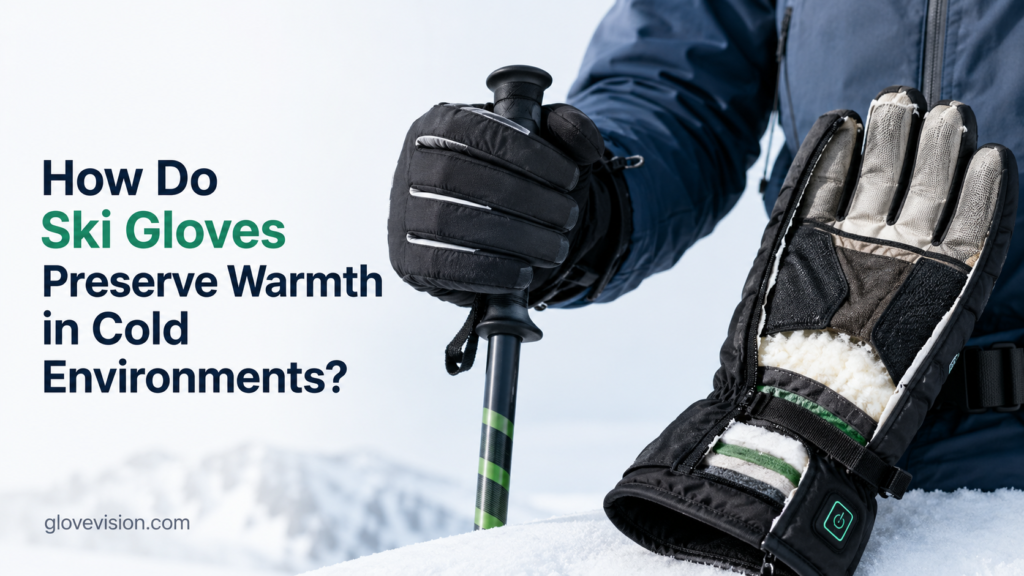
How Do Ski Gloves Preserve Warmth in Cold Environments?
Ski Gloves preserve warmth by slowing heat transfer from the hands through insulation, wind-resistant shells, moisture barriers, liners, cuffs, and closures that maintain protective coverage.
Warmth depends on more than insulation thickness. Wet materials, compressed loft, cuff gaps, restricted circulation, excessive perspiration, poor fit, and repeated glove removal can make heavily insulated Ski Gloves perform poorly.
Educational and safety notice: Ski Gloves reduce heat loss but cannot guarantee protection from frostbite or other cold injuries. Persistent numbness, pale or waxy skin, severe pain, loss of coordination, blistering, or hard or frozen-feeling tissue requires immediate removal from the cold and appropriate medical attention.
What Heat-Loss Pathways Must Ski Gloves Limit?
Ski Gloves must slow several simultaneous heat-loss pathways because cold equipment, moving air, colder surroundings, moisture, and reduced peripheral circulation can all lower hand and finger temperature.
How Does Conductive Heat Loss Reach the Hands?
Cold poles, metal components, snow, ice, and wet equipment can pull heat from the hand through direct contact. Dry insulation and palm layers slow this transfer, but they do not eliminate it.
How Does Moving Air Increase Convective Heat Loss?
Wind and skiing speed increase air movement around the glove. A wind-resistant shell and well-integrated cuff reduce that exchange, while open cuffs, damaged shells, or closure gaps allow warm internal air to escape.
The wider framework for sports glove insulation and control demands helps explain why warmth must remain compatible with movement and sport-specific control.
How Much Does Radiative Heat Loss Matter?
Hands also exchange thermal energy with colder surroundings. Insulation slows heat reaching the exterior, but radiation is only one part of the total heat-loss system and reflective layers do not return all lost heat.
How Does Moisture Increase Heat Loss?
Snow entry, wet cuffs, perspiration, and damp liners can reduce usable loft and increase cooling. NIOSH guidance also emphasizes keeping insulation dry and managing perspiration because wetness can undermine cold-weather protection. [NIOSH]
Why Does Circulation Affect Ski Gloves Warmth?
Blood flow supplies heat to the fingers, and cold exposure can reduce peripheral circulation. Excessively tight gloves may add compression, while Ski Gloves cannot fully compensate for inadequate whole-body warmth or an underlying circulation problem. Controlled research also links hand warmth and blood flow with manual performance. [Blood Flow]
| Heat-Loss Pathway | Typical Skiing Exposure | Ski Gloves Response | Main Limitation |
|---|---|---|---|
| Conduction | Cold poles, snow, equipment | Dry insulation and palm layers | Wet or compressed material |
| Convection | Wind and skiing speed | Wind-resistant shell and sealed cuff | Open cuff or permeable shell |
| Radiation | Colder surroundings | Insulating layers slow heat reaching the exterior | Inadequate or compressed loft |
| Evaporation | Perspiration and damp liners | Moisture movement and drying capability | Trapped internal moisture |
| Circulatory limitation | Cold response or excessive tightness | Secure, non-restrictive fit | Gloves cannot correct physiology |
How Do Insulated Ski Gloves Control Heat, Wind, and Moisture?
Insulated Ski Gloves preserve warmth through a layered system: loft retains relatively still air, the shell reduces airflow and external wetting, moisture-control components manage limited vapor transfer, and cuffs maintain coverage at the wrist.
How Do Loft and Trapped Air Slow Heat Transfer?
Insulation works partly by maintaining small spaces of relatively still air. Useful warmth depends on that loft remaining dry, distributed, and resilient rather than collapsed or shifted. General cold-PPE evidence supports the principle, but it does not establish performance for a specific Ski Gloves model. [Dexterity]
Why Does Compression Change Ski Gloves Insulation?
Pole-grip pressure, finger flexion, tight sizing, repeated packing, and long-term deformation can reduce the air space within insulation. Shelf thickness therefore does not equal the loft that remains around the hand while skiing.
How Do Shells and Membranes Perform Different Jobs?
Wind resistance, liquid-water resistance, abrasion resistance, and vapor transfer are different functions. Seam construction, coatings, contamination, and wear also affect the finished glove, so waterproofing should not be treated as insulation or guaranteed breathability.
Other glove thermal-protection demands illustrate how insulation, coverage and dexterity interact, but occupational ratings must not be transferred to Ski Gloves.
How Do Ski Glove Liners Manage Warmth and Perspiration?
Liners can add comfort, moisture movement, and insulation, but bunching, twisting, retained moisture, or excess bulk can create cold spots and reduce control. Removable liners may simplify drying only when the exact product is designed for removal.
How Do Palms, Cuffs, and Closures Affect Warmth?
Palms are repeatedly compressed during pole use, while cuffs and closures protect the wrist interface from wind and snow entry. Gauntlet and under-jacket cuffs can both work when they integrate correctly with the jacket and remain secure without restricting circulation.
The broader principles of glove moisture exposure support checking wetness, liner condition and drying requirements, while ski performance still depends on the exact finished glove.
Why Can Waterproof Ski Gloves Still Feel Cold?
Water-resistant construction does not prevent perspiration. High activity can create internal moisture; when activity falls on a lift or during a pause, that dampness can reduce insulation performance and increase evaporative cooling.
Which Ski Gloves Match Different Cold Environments?
Ski Gloves should be selected by the actual combination of cold, wind, moisture, activity, exposure duration, hand sensitivity, and required control rather than by insulation thickness alone.
Which Ski Gloves Suit Cold, Dry, and Windy Conditions?
Prioritize usable insulation loft, wind resistance, dry-interior management, continuous cuff coverage, and enough dexterity for the required ski controls. More bulk is not automatically better if it compromises grip or compresses insulation during use.
Which Ski Gloves Suit Wet Snow or Mixed Precipitation?
Evaluate shell water resistance, seams, membrane construction, cuff integration, wet-grip behavior, and the practicality of complete drying. A dry replacement pair can be useful operationally, but there is no universal waterproof-duration rule.
Which Ski Gloves Suit High Activity or Long Inactivity?
High-output skiing may place more emphasis on moisture management, while long lift exposure can increase the importance of insulation and wind protection. The useful balance changes with the rider, weather, duration, and how much perspiration accumulates.
Which Ski Gloves Suit Cold-Sensitive Hands?
Evaluate complete fit, fingertip insulation, moisture control, whole-body warmth, compatible liners, and whether a powered design is appropriate. Cold-related loss of dexterity is well documented in general research, but study thresholds should not be converted into skiing limits. [Cold Stress]
When Are Heated Ski Gloves Appropriate?
Heated Ski Gloves differ from passive models because their powered system actively adds heat. Research on electrically heated gloves supports that mechanism, while also showing that airflow and complete-system behavior still matter. Battery condition, charging, heat settings, washing, drying, storage, and fault handling must follow the exact product instructions. [Heated]
How Should Five-Finger, Lobster, and Mitten Configurations Be Compared?
Compare finger separation, shared air space, pole grip, dexterity, bulk, and task requirements rather than assuming one configuration is universally warmer or better. Extreme-cold research can inform the configuration principle but should not create a universal skiing ranking. [Extreme Cold]
For a focused configuration comparison, see mittens versus fingered gloves.
| Skiing Context | Dominant Challenge | Features to Evaluate | Main Trade-Off |
|---|---|---|---|
| Cold and dry | Air and contact cooling | Loft, wind resistance, cuff coverage | Bulk versus dexterity |
| Wet snow | External moisture | Shell, seams, membrane, cuffs | Moisture protection versus vapor transfer |
| High activity | Perspiration | Moisture management and suitable insulation | Less reserve warmth when inactive |
| Long lift exposure | Wind and low heat production | Insulation and sealed coverage | Control loss if too bulky |
| Very cold conditions | Rapid heat loss | Complete thermal system; powered heat if appropriate | Dexterity and power dependence |
| Cold-sensitive hands | Individual response | Fit, dryness, distribution, whole-body warmth | Gloves may not solve an underlying issue |
How Should Properly Fitted Ski Gloves Preserve Warmth and Dexterity?
Properly fitted Ski Gloves should retain usable insulation loft and continuous coverage without compressing the fingers or wrist, restricting circulation, bunching internally, or preventing required skiing controls.
How Should Ski Gloves Fit the Fingers, Thumb, Palm, and Wrist?
Use the manufacturer’s sizing system, then verify natural finger and thumb alignment, smooth liners, stable palms, non-restrictive closures, natural flexion, and no painful seam pressure. Avoid inventing one universal fingertip-space rule.
How Can Tight Ski Gloves Make Hands Colder?
Excess tightness can flatten insulation, reduce finger movement, create fingertip pressure, and potentially restrict circulation. NIOSH cold-weather guidance specifically warns against excessively tight gloves as part of cold protection. [NIOSH]
How Can Oversized Ski Gloves Reduce Warmth or Control?
Oversizing can allow the hand to move inside the glove, bunch liners, create fingertip folds, destabilize the cuff, and reduce pole grip or dexterity. Loose fit is therefore not an automatic warmth advantage.
How Should Ski Gloves Interface With Jacket Sleeves?
Move the wrist and forearm through the positions used on snow. The glove and jacket should maintain continuous coverage without an exposed gap, while the overlap and closure stay secure and non-restrictive.
When Can a Ski Glove Liner Be Added?
Add a liner only when it is compatible with the exact glove, leaves enough space for insulation loft and circulation, does not bunch or interfere with heating components, and still preserves the required dexterity.
How Should Ski Gloves Be Function-Tested?
Before exposure, verify stable pole grip, natural hand opening and closing, thumb movement, cuff stability, and access to the controls or emergency equipment you actually use. Occupational research shows that cold and glove construction can affect dexterity, but it should be used only as a general principle rather than a Ski Gloves performance rating. [Dexterity]
What Problems Show Ski Gloves Are Wet, Mismatched, or Worn?
Ski Gloves may become thermally or functionally unsuitable when moisture, compressed insulation, poor fit, cuff leakage, activity mismatch, failed components, or structural wear makes warmth or control unreliable.
Why Do Fingertips or Wrists Stay Cold?
Check tight finger stalls, compressed insulation, damp liners, thin or displaced fingertip insulation, reduced circulation, low activity, wet sleeves, and gaps at the cuff. The cold spot often identifies where fit, loft, moisture, or coverage needs reassessment.
Why Do Warm or Sweaty Hands Become Cold Later?
Excess insulation during high activity can increase perspiration. When activity drops, retained moisture may reduce insulation performance and increase evaporative cooling, so the better correction may be activity-matched insulation and moisture control rather than simply adding more insulation.
Why Do Wet Ski Gloves Lose Warmth?
Moisture can displace insulating air, collapse or clump insulation, increase heat transfer, and create evaporative cooling. Identify whether the source is external leakage or internal perspiration before deciding whether the glove needs drying, approved repair, different construction, or replacement.
Which Ski Gloves Care and Drying Errors Should Be Avoided?
Do not transfer one universal washing, soaking, detergent, water-temperature, dryer, direct-heating, waterproofing-treatment, charging, or storage method to every Ski Gloves product. Follow the exact manufacturer instructions for the materials and powered components actually present.
How Should Heated Ski Gloves Be Fault-Checked?
Stop using a powered glove if the battery is damaged or swollen, wiring or connectors are compromised, heating becomes uneven or excessive, water intrusion is suspected, or charging/control behavior is abnormal. Do not improvise electrical repairs; use the manufacturer’s fault procedure.
How Should Ski Gloves Be Inspected and Replaced?
Inspect shells, seams, liners, insulation distribution, palm grip, cuffs, closures, fit stability, and heating components where present. Reassess or replace the glove when reliable dryness, warmth, fit, grip, closure, coverage, or powered-system safety cannot be restored or verified. The general logic of reusable glove condition and replacement supports condition-based reassessment without transferring household performance claims to Ski Gloves.
Which Cold-Safety Signs Require More Than a Glove Adjustment?
Frostbite warning signs include numbness and skin that becomes unusually firm or waxy; current CDC guidance advises getting out of the cold and seeking medical care when signs are present. Ski Gloves should never be used to mask a possible cold injury. [CDC]
| Symptom | Possible Cause | What to Check | Decision |
|---|---|---|---|
| Cold fingertips | Tight fit or compressed insulation | Finger fit, liner and loft | Resize or change construction |
| Warm then cold hands | Perspiration accumulation | Interior moisture and activity | Dry or choose more suitable insulation |
| Cold wrist | Coverage gap or wet cuff | Jacket-glove interface | Adjust cuff configuration |
| Wet interior | Leakage or perspiration | Identify moisture source | Dry, repair only as approved, or replace |
| Poor pole control | Excess bulk or poor fit | Grip and closure test | Select another construction |
| Persistent numbness | Possible cold injury or other concern | Stop exposure and assess symptoms | Seek appropriate assessment |
| Uneven heating | Powered-system fault | Exact manufacturer procedure | Stop use and inspect as directed |
Conclusion
Ski Gloves preserve body-produced warmth by slowing heat loss through dry, usable insulation, wind protection, moisture control, secure cuff coverage, and circulation-safe fit. Ordinary Ski Gloves retain heat rather than generate it; powered Heated Ski Gloves are the exception because they actively add heat.
Select the complete glove for the actual environment, activity, duration, moisture exposure, fit, dexterity, and condition—not by thickness alone. Warmth becomes unreliable when loft is wet or compressed, cuffs leak, fit restricts circulation, or bulk prevents safe and precise control.
Frequently Asked Questions
Do Thicker Ski Gloves Always Keep Hands Warmer?
No. Warmth also depends on insulation loft, dryness, fit, circulation, wind protection, cuff coverage, activity, and glove condition.
Should Ski Gloves Fit Tightly to Preserve Warmth?
No. Ski Gloves should fit securely without compressing insulation, restricting circulation, or limiting natural hand movement and control.
Are Waterproof Ski Gloves Automatically Warm?
No. Waterproofing manages external moisture; warmth also depends on insulation, dryness, fit, circulation, wind protection, activity, and exposure.
Do Ski Glove Liners Make Hands Warmer?
They may, but only when the liner is compatible with the glove and does not create tightness, bunching, moisture retention, or reduced dexterity.
When Should Heated Ski Gloves Be Considered?
Consider properly specified Heated Ski Gloves when passive insulation is insufficient for the real environment or cold sensitivity, provided fit and control remain acceptable and the product is used exactly as directed.