
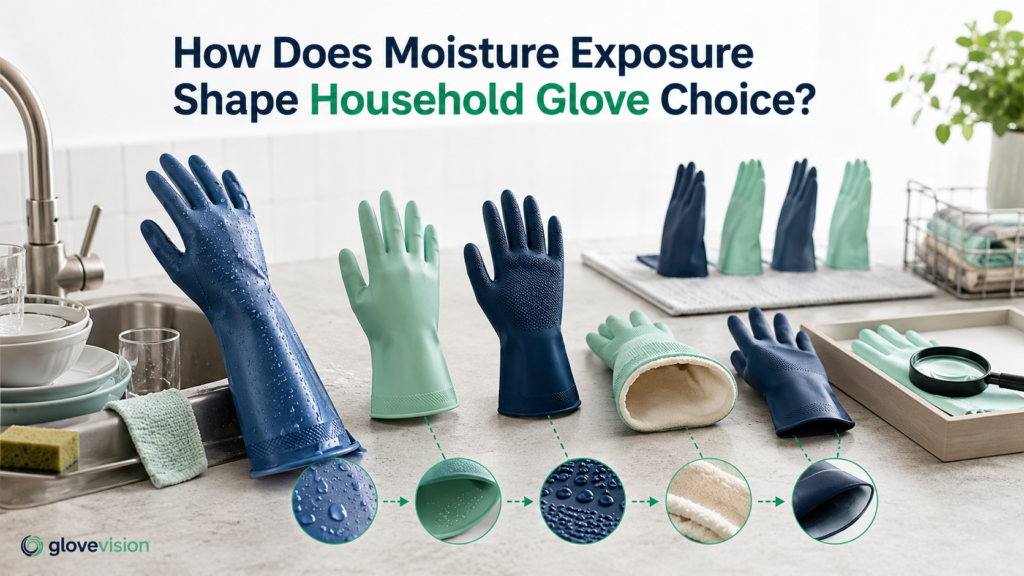
How Does Moisture Exposure Shape Household Glove Choice?
Moisture exposure shapes Household gloves choice because wet household tasks can involve both external liquid contact and moisture accumulating inside the glove. Exposure pattern, duration, coverage, cuff design, wet grip, fit, lining, cleaner compatibility, and post-use drying can all change what the task requires.
No material, lining, cuff style, or thickness is automatically best for every wet task. Selection should be based on the exact Household gloves product, the exact task, manufacturer documentation, cleaner-specific compatibility where relevant, and the conditions in which the glove will actually be used.
Educational and household-safety notice: This article provides general Household gloves education. Follow the exact cleaner label, SDS where relevant, and glove-manufacturer instructions. Do not infer chemical, temperature, immersion, or other protective performance solely from glove material, thickness, lining, cuff length, or appearance.
Why Does Moisture Exposure Matter When Choosing Household gloves?
Moisture exposure matters when choosing Household gloves because light dampness, repeated wet work, splashing, partial immersion, cuff exposure, and interior moisture create different coverage, grip, comfort, care, and condition requirements.
Household gloves should be selected according to the task, conditions present, expected duration, and relevant hazards rather than by material name or household-glove category alone. [OSHA]
Which external moisture conditions matter?
Light damp wiping, repeated wet contact, splashing, partial immersion, runoff toward the cuff, and handling wet tools or surfaces create different exposure directions and coverage needs. A glove that is adequate for brief surface dampness is not automatically suitable for repeated immersion or high-splash work.
Which internal moisture conditions matter?
Perspiration, interior humidity, previous incomplete drying, cuff entry, suspected leakage, lining saturation, and residue can all contribute to interior dampness. The source should be investigated rather than diagnosed from moisture location alone.
Why does duration matter?
Longer tasks may increase interior humidity, moisture accumulation, grip demands, cuff exposure, comfort challenges, and the amount of drying required before reuse. Duration is a selection variable, not a universal safe-use countdown.
Why must Household gloves be matched to the entire task?
Wetness may occur alongside detergents, cleaners, mechanical friction, repeated flexing, temperature, and hygiene requirements. Repeated wet household exposure therefore requires a broader decision than simply asking whether a glove can contact water.
Table 1. Match the moisture scenario to the primary concern, required features, verification need, and decision.
| Moisture Scenario | Primary Concern | Required Glove Features | What Must Be Verified | Decision |
|---|---|---|---|---|
| Light damp wiping | Short water contact plus cleaner residue | Task-appropriate coverage, fit, dexterity, usable grip | Exact cleaner, intended use, current condition | Use only if task and product match |
| Repeated dishwashing | Splash, interior humidity, detergent, repeated flexing | Coverage, cuff stability, wet grip, fit, drying readiness | Detergent compatibility, duration, care instructions | Use, then clean/dry as permitted |
| Partial immersion | Liquid level may approach cuff or structural openings | Sufficient coverage, stable cuff, intact construction | Immersion depth, product suitability, cleaner compatibility | Select another glove if coverage is insufficient |
| Splash cleaning | Directional liquid entry and cleaner contact | Coverage matched to splash direction, secure fit, wet grip | Cleaner, cuff/sleeve interface, exact product | Proceed only after compatibility is verified |
| Long-duration wet work | Moisture accumulation, comfort, grip, care burden | Functional fit, grip, interior-moisture plan, reusable design where intended | Duration, drying process, previous exposure history | Reassess if control or interior readiness declines |
| Warm-water work | Temperature plus moisture and cleaner exposure | Only product-documented temperature suitability | Manufacturer temperature information and cleaner compatibility | Do not infer thermal protection from lining |
| Cool wet work | Comfort, stiffness, dexterity, wet grip | Fit, flexibility and grip appropriate to conditions | Product use conditions and current function | Select another model if control is inadequate |
The matrix is a selection screen, not proof that a glove is suitable without exact-product documentation.
How Do Internal Perspiration and External Water Affect Household gloves?
Interior moisture in Household gloves does not automatically indicate leakage because perspiration, incomplete drying, cuff entry, saturated lining, residue, and structural defects can all contribute to a wet-feeling interior.
How can perspiration affect Household gloves?
Warm conditions, physical activity, and occlusive glove wear may contribute to interior humidity, perspiration, skin softening, discomfort, and reduced wear tolerance. Wearing wet PPE and prolonged wet conditions can also contribute to irritation and skin-barrier disruption, but this page does not diagnose dermatitis or infection. [NIOSH]
How can external water enter Household gloves?
External liquid can enter through the cuff opening, runoff, splash, holes, tears, failed seams, or other structural damage. Cuff entry is an exposure pathway and should not be confused with material penetration or chemical permeation.
Why should moisture location not be used as a diagnosis?
Even dampness may involve perspiration or incomplete drying; wrist dampness may involve runoff, splash, or previous moisture; localized fingertip moisture may involve lining saturation, residual moisture, or a possible structural breach. Use a controlled sequence: stop, inspect, review previous drying, inspect the cuff, inspect construction, and reassess.
Why are visible liquid entry and chemical permeation different?
Permeation describes chemical movement through protective material under defined test conditions and is different from visible liquid entry through a hole, seam, or cuff. ISO 6529:2026 describes laboratory permeation methods for protective materials, including gloves, and cautions that test conditions do not necessarily reproduce practical exposure. [ISO 6529]
Moisture observations guide inspection; they do not prove whether the source is perspiration, cuff entry, residual dampness, penetration, or permeation.
Which Construction Features Should Be Compared in Household gloves for Wet Work?
Household gloves for wet work should be compared as complete products because cuff design, lining, surface texture, palm and finger construction, seams, coverage, fit, material formulation, and care requirements can all influence task suitability.
ISO 21420:2020 addresses general glove design and construction, comfort, efficiency, marking, and manufacturer information, while also making clear that hazard-specific protective properties require the relevant specific standards. [ISO 21420]
How does cuff design affect Household gloves?
Compare cuff length, opening, forearm coverage, sleeve interface, exposure direction, and task movement. A longer cuff may add coverage, but it does not guarantee prevention of runoff or liquid entry.
How does lining affect Household gloves?
Linings may influence comfort, donning, perspiration management, warmth, drying time, and inspection. They do not automatically establish chemical resistance, thermal protection, or superior wet-work performance. A deeper comparison of glove lining and comfort belongs on the dedicated lining page.
How does surface texture affect Household gloves?
Texture may support wet grip, dish control, cleaner-bottle control, or tool control, but function can decline through wear, residue, contamination, or surface deterioration. Texture alone is not proof of safe grip for the exact task.
How does material affect Household gloves?
Material matters, but the exact formulation, thickness, intended use, cleaner compatibility, construction, wet-work suitability, and manufacturer documentation matter with it. Natural rubber, nitrile, neoprene, PVC, and other polymers should not be ranked universally.
How does construction affect repeated wet use?
For gloves moving through repeated cleaning sessions, repeated wet reuse should be evaluated through the complete shell, cuff, lining, seams, grip texture, drying requirements, inspection access, exposure history, and current condition rather than polymer alone.
Table 2. Construction features can offer useful functions, but every feature has limits that require product-specific verification.
| Feature | Possible Benefit | Important Limitation | Verification |
|---|---|---|---|
| Extended cuff | May increase wrist/forearm coverage | Does not prevent all runoff or cuff entry | Exposure direction, sleeve interface, manufacturer design |
| Textured palm | May support wet object control | Grip can decline with wear or residue | Exact task and current surface condition |
| Flock lining | May improve comfort and donning | May retain moisture; not thermal protection | Product instructions and drying requirements |
| Knit lining | May change comfort and insulation feel | Can increase bulk and drying burden | Fit, grip, intended use, care |
| Unlined construction | May simplify interior inspection and drying | Not automatically safer or more protective | Exact product performance and task |
| Full polymer shell | May provide continuous liquid-contact surface where designed | Does not prove chemical compatibility | Material formulation, construction, specific evidence |
| Seamless construction | May reduce some seam-related pathways | Does not eliminate cuff entry, wear, or permeation | Complete glove integrity and intended use |
A construction feature is an input to selection, not a stand-alone guarantee.
How Should Household gloves Be Selected for Different Moisture Conditions?
Household gloves should be selected for moisture exposure by matching the exact task, water-contact pattern, cleaner, duration, required coverage, cuff exposure, wet grip, dexterity, and documented product performance.
What should be checked for light damp wiping?
Check task duration, cleaner, required dexterity, wet grip, and coverage. Brief surface dampness does not automatically justify the thickest or longest construction.
What should be checked for repeated dishwashing?
Review wet-work duration, detergent, splash direction, cuff exposure, wet grip, interior humidity, fit, and whether the glove can be dried adequately between uses.
What should be checked for partial immersion?
Define immersion depth, duration, cuff height, exposure direction, exact cleaner, glove integrity, and whether the selected glove is documented for that contact.
What should be checked for splash cleaning?
Match coverage and cuff position to liquid direction, then verify fit, grip, cleaner compatibility, and the complete glove construction.
What should be checked for warm-water tasks?
Verify intended use, product-specific temperature information, grip, comfort, and duration. Lining, thickness, or polymer name alone does not establish thermal protection.
What should be checked for cleaner contact?
Identify the exact cleaner and review its label; use the SDS where relevant, including exposure-control and PPE information, together with the exact glove manufacturer’s compatibility information. [OSHA SDS]
Liquid resistance, wet grip, cuff length, or material name does not by itself establish chemical protection. ISO 374-1:2024 addresses protective gloves intended for dangerous chemical risks and separates that performance from other protection features requiring their own specific evidence. [ISO 374-1]
When wet work includes cleaners or stronger formulations, dedicated household chemical glove selection should verify the exact product, exact formulation, contact pattern, duration, coverage, and condition.
Should specific polymers automatically be assigned to wet tasks?
No. Natural rubber, nitrile, neoprene, PVC, and other polymer families can differ by formulation, thickness, construction, intended use, and chemical data. Use exact-product evidence instead of a universal polymer hierarchy.
The broader differences between Household gloves and disposable gloves involve lifecycle, construction, coverage, dexterity, hygiene workflow, care, reuse, and disposal—not moisture performance alone.
How Should Interior Dampness in Household gloves Be Troubleshot?
Interior dampness in Household gloves should be treated as a finding that requires inspection rather than as proof of perspiration, runoff, or leakage.
What should users do when Household gloves feel evenly damp inside?
Stop, remove the glove safely, inspect the interior, review drying history, dry according to instructions, and reassess before use. Perspiration, previous incomplete drying, and interior residue are all possible contributors.
What should users do when Household gloves are wet near the cuff?
Review cuff position, sleeve interface, exposure direction, task movement, splash, runoff, and previous moisture. Wrist dampness alone does not prove cuff runoff.
What should users do when Household gloves have localized fingertip moisture?
Stop and inspect the fingertip, adjacent seams, lining, and previous moisture history. Localized wetness can indicate a possible structural pathway, but it should not automatically be labeled a pinhole.
ISO 374-2:2019 treats penetration resistance as a distinct protective-glove test concept, supporting the need to examine structural pathways separately from chemical permeation. [ISO 374-2]
What should users do when Household gloves remain damp after drying?
Review the approved drying method, ventilation, lining saturation, storage, cuff-entry history, and possible structural leakage. Do not return the glove to wet work until reuse readiness can be established.
What should users do when Household gloves develop persistent odor?
Moisture, residue, contamination, or inadequate drying may contribute to persistent odor. Odor alone does not diagnose bacterial, fungal, or mold growth. Clean only as permitted and replace when hygienic reuse cannot be established.
Table 3. Treat the moisture pattern as an observation, then inspect and reassess without assigning a cause too early.
| Finding | Possible Contributors | What Not to Assume | Next Action |
|---|---|---|---|
| Even interior dampness | Perspiration, residual moisture, residue | That it is definitely sweat | Inspect, review drying, dry as instructed, reassess |
| Wrist/cuff dampness | Splash, runoff, cuff entry, previous moisture | That runoff is proven | Review cuff, sleeves, direction, movement |
| Local fingertip wetness | Residual moisture, lining saturation, possible breach | That a pinhole is proven | Stop, inspect fingertip/seams, use approved integrity method |
| Persistent dampness | Incomplete drying, lining saturation, storage, leakage | That extra drying alone restores integrity | Dry correctly, inspect, reassess before reuse |
| Persistent odor | Moisture, residue, contamination, drying failure | That microbial growth is diagnosed | Clean as permitted; replace if hygiene cannot be restored |
| Wet-grip loss | Surface wear, residue, contamination, fit shift | That visible texture guarantees control | Stop if control is unsafe; clean/inspect/select another glove |
| Swelling | Material change after exposure | One exact chemical mechanism | Stop use and review product/exposure documentation |
| Tackiness | Material change, residue, contamination | That washing will restore performance | Stop, inspect, follow replacement criteria |
Observation → stop if necessary → inspect → review previous drying and cuff exposure → inspect construction → reassess.
Table 4. Record prior exposure before deciding whether the same glove is ready for the next wet task.
| Field | What to Record | Why It Matters |
|---|---|---|
| Exact glove | Model / identifiable product | Connects care and performance to the correct product |
| Previous task | Dishwashing, wiping, scrubbing, other | Defines prior exposure context |
| External wetness | Light, splash, repeated, partial immersion | Shows water-contact pattern |
| Interior wetness | None, localized, widespread, unresolved | Flags drying or integrity concerns |
| Cleaner | Exact product/formulation where known | Supports compatibility review |
| Duration | Approximate task duration | Supports exposure and care review |
| Cuff entry | Observed / suspected / none | Separates cuff pathway from material assumptions |
| Suspected leakage | Location and whether resolved | Determines whether reuse can be considered |
| Cleaning | Method used and whether permitted | Identifies care history |
| Drying | Method and completion status | Confirms interior readiness |
| Storage | Dry/ventilated or damp/closed/unknown | Explains residual-moisture risk |
| Current condition | Damage, residue, lining, grip, fit | Supports serviceability decision |
| Next task | Exact new moisture/cleaner pattern | Prevents automatic reuse across different tasks |
| Final decision | Use / clean / dry / reassess / replace / stop | Creates a clear action boundary |
How Should Household gloves Be Cleaned, Dried, and Stored After Wet Work?
Household gloves should be cleaned, dried, inspected, and stored according to exact product instructions because moisture management can support approved reuse but cannot restore damaged or degraded glove material.
Should Household gloves always be rinsed while worn?
No. Exterior cleaning before removal should occur only when the glove manufacturer permits it, the cleaner instructions allow it, runoff can be controlled, skin contact is avoided, and the method does not create another exposure.
Can the interior of Household gloves be washed?
Only when permitted for the exact product. Interior cleaning can affect linings, adhesives, drying, fit, and material condition.
How should Household gloves be dried?
Follow exact product instructions for interior ventilation, exterior moisture, lining saturation, drying time, heat restrictions, and inspection before reuse. The full reusable Household gloves drying process should be treated as a dedicated care decision rather than a universal inside-out or direct-heat rule.
Should Household gloves be turned inside out?
Only where inversion is compatible with the exact construction, lining, and manufacturer instructions. Do not prescribe universal inversion.
Can removable liners be used with Household gloves?
Only when the liner does not interfere with fit, wet grip, cuff function, required protection, hygiene, or manufacturer instructions. Cotton liners should not be prescribed universally.
How should Household gloves be stored?
Follow manufacturer instructions and control residual moisture, excessive heat, prolonged sunlight, sharp objects, compression, and contact with contaminated equipment. Damp closed storage should be avoided.
Proof Asset 5. Use this checklist only within the exact glove manufacturer’s care instructions.
- Exact glove and wet task known
- Cleaner/detergent known
- Splash, immersion and cuff entry recorded
- Suspected leakage status recorded
- Duration known
- Manufacturer instructions available
- Exterior-cleaning method known
- Interior-cleaning permission known
- Drying and storage requirements known
- No universal rinse/powder/sanitizer rule used
- Residue managed as permitted
- Runoff controlled
- Cuff protected
- Contamination not transferred inside
- Cleaner compatibility remains acceptable
- Interior and lining inspected
- Cuff-entry moisture considered
- Residue checked
- Interior cleaning only if permitted
- Removable liner handled as instructed
- Approved method followed
- Interior ventilated and exterior dried
- Unapproved heat and open flame avoided
- Damp closed storage avoided
- Required drying condition reached
- No hole, tear, confirmed leak or seam failure
- No cracking, swelling, tackiness or coating separation
- Lining usable
- Grip acceptable
- Fit acceptable
- Stored dry per manufacturer guidance
- Excessive heat and prolonged sunlight avoided
- Sharp objects avoided
- Contaminated equipment separated where required
- Gloves remain accessible for inspection
When Should Moisture-Exposed Household gloves Be Replaced?
Moisture-exposed Household gloves should be replaced when structural damage, significant material change, unresolved interior contamination, persistent drying failure, or loss of fit, grip, or required coverage makes continued wet-work use unreliable.
Which structural findings require Household gloves replacement?
Holes, tears, confirmed leaks, failed seams, worn-through areas, coating separation, or cuff damage that reduces required protection are replacement or removal-from-use triggers.
Which material changes require Household gloves replacement?
Significant swelling, tackiness, permanent softening, severe hardening, deep cracking, or distortion indicate a material-condition problem that should not be corrected by improvised cleaning or extra drying. ISO 374-4:2019 addresses degradation of protective glove materials after chemical exposure and emphasizes that degradation is only one part of chemical-resistance evaluation. [ISO 374-4]
When does lining damage require Household gloves replacement?
Replace when lining deterioration causes unresolved contamination, persistent drying problems, unsafe fit, excessive friction, bunching, inability to inspect adequately, or unacceptable hygiene.
When does interior contamination require Household gloves replacement?
Replacement is appropriate when cleaner residue cannot be removed safely, contamination remains unresolved, visible mold exists, interior hygiene cannot be restored, or the manufacturer does not permit an adequate cleaning process.
Which functional failures require Household gloves replacement?
Replace or select another model when wet grip is unreliable, fit is unsafe, dexterity is inadequate, the glove twists during use, or the cuff no longer provides required coverage. The broader Household gloves replacement decision also considers exposure history and whether continued use can be verified.
Proof Asset 6. Replacement is driven by integrity, material condition, hygiene, function, and exposure history—not age or appearance alone.
- No hole or tear
- No confirmed leak or seam failure
- No worn-through area
- Cuff intact
- No coating separation
- No significant swelling or tackiness
- No permanent softening
- No severe hardening
- No deep cracking or distortion
- No severe thinning
- Can be adequately cleaned and dried
- No unremovable residue
- No unresolved contamination or visible mold
- Lining remains functional
- Lining does not prevent proper fit/drying
- Wet grip controlled
- Fit secure
- Dexterity adequate
- Glove does not twist
- Cuff remains functional
- Previous wet task and cleaner known
- Cuff entry history known
- Suspected leakage resolved
- Cleaning/drying history acceptable
- Reuse is permitted
- Use: all checks pass.
- Clean as permitted: approved cleaning remains necessary.
- Dry further: integrity passes but drying is incomplete.
- Reassess: moisture source or condition remains uncertain.
- Select another glove: construction does not match the task.
- Replace: structural, material, hygiene, or functional integrity fails.
- Do not proceed: suitable wet-work protection cannot be verified.
Which Mistakes Reduce Moisture Control in Household gloves?
Moisture-control problems in Household gloves often result from selecting by material or thickness alone, misdiagnosing interior moisture, ignoring cuff pathways, using unsafe care methods, or continuing after grip or structural condition deteriorates.
Which selection mistakes affect Household gloves?
Avoid polymer-only or thickness-only selection, assuming lining equals better wet protection, assuming flock lining equals thermal protection, and ignoring cuff length, exposure direction, wet grip, or cleaner compatibility.
Which moisture-diagnosis mistakes affect Household gloves?
Avoid treating even dampness as proven perspiration, wrist moisture as proven runoff, fingertip moisture as a proven pinhole, dampness as infection, or odor as proof of microbial growth.
Which use mistakes affect Household gloves?
Do not continue after suspected leakage without inspection, ignore cuff entry, continue after wet grip becomes unsafe, use the glove outside its documented task, or infer warm-water suitability from lining or thickness.
Which care mistakes affect Household gloves?
Avoid universal rinse-while-worn instructions, universal soap cleaning, universal cuff inversion, universal inside-out drying, unapproved direct heat, damp storage, unapproved powders, or the assumption that drying restores degraded material.
Which inspection mistakes affect Household gloves?
Avoid improvised bubble, balloon, air-trap, or inflation testing unless the exact manufacturer has an approved procedure that specifically calls for it. Inspect the full glove—including palm, fingertips, thumb web, finger sides, back, seams, cuff, lining, texture, and exposure history.
What Should Users Check Before Wearing Household gloves for Wet Work?
Before Household gloves are used for wet work, the exact moisture pattern, cleaner, duration, required coverage, cuff exposure, wet grip, product documentation, previous moisture history, current condition, interior readiness, and fit should all be checked.
Proof Asset 7. Complete the selection, history, condition, interior, and function checks before the glove returns to wet work.
- Exact task identified
- Surface dampness, splash and partial immersion considered
- Cuff-entry risk and duration considered
- Cleaner identified
- Temperature, grip and dexterity considered where relevant
- Exact model and manufacturer known
- Intended use matches
- Material/thickness known where relevant
- Coverage, cuff and lining appropriate
- Cleaner/temperature suitability verified where relevant
- Previous task and cleaner known
- Splash, immersion and cuff entry history known
- Suspected leak history known
- Cleaning/drying method known
- Storage history acceptable
- Palm and fingertips inspected
- Thumb web and finger sides inspected
- Back of hand and seams inspected
- Cuff and lining inspected
- Texture inspected
- No holes, tears or confirmed leaks
- No severe thinning or cracking
- No swelling or tackiness
- No permanent softening or severe hardening
- No coating separation
- Interior appropriately clean and dry
- No cleaner residue
- No unresolved contamination or visible mold
- Persistent unexplained odor resolved or glove rejected
- Lining correctly positioned
- Correct size selected
- Not excessively loose or tight
- Finger movement appropriate
- Wet grip and dexterity adequate
- Glove and cuff remain stable
- Use: task, product, moisture, compatibility, condition, and fit checks pass.
- Dry further: interior drying is incomplete.
- Clean as permitted: approved cleaning remains necessary.
- Reassess: moisture source or condition remains uncertain.
- Select another glove: coverage, grip, lining, compatibility, or construction is unsuitable.
- Replace: structural, material, hygiene, or functional failure exists.
- Do not proceed: suitable Household gloves cannot be verified.
Sources & Evidence Boundaries
This page uses eight public technical sources for task selection, SDS/PPE information, glove construction, chemical-risk distinctions, penetration, degradation, permeation, and wet-condition skin principles. Exact glove-model approval and exact cleaner compatibility still require product-specific manufacturer information.
- OSHA 29 CFR 1910.138 supports task-, condition-, duration-, and hazard-based hand-protection selection.
- OSHA Hazard Communication Appendix D supports use of SDS information, including Section 8 exposure controls and PPE.
- ISO 21420:2020 supports general glove design, construction, comfort, efficiency, marking, and manufacturer-information context; it does not establish hazard-specific protection by itself.
- ISO 374-1:2024 supports chemical-risk glove performance terminology and the need for relevant specific standards for other protection features.
- ISO 374-2:2019 supports penetration resistance as a distinct protective-glove test concept.
- ISO 374-4:2019 supports chemical-degradation testing and the need to consider degradation with other chemical-resistance information.
- ISO 6529:2026 supports laboratory permeation concepts and the boundary between test conditions and practical exposure.
- CDC/NIOSH wet-condition guidance supports the limited principle that wet PPE and prolonged wet conditions can contribute to skin irritation and skin-barrier compromise; it does not establish Household gloves product performance.
What Should Users Remember About Household gloves and Moisture Exposure?
Household gloves should be selected according to the exact pattern of moisture exposure, task duration, required coverage, cleaner compatibility, grip, fit, construction, and post-use drying requirements rather than by polymer or lining alone.
External water and interior perspiration are separate concerns, and moisture distribution does not prove its source. Material, thickness, cuff length, lining, and texture can influence the decision, but each must be interpreted within the complete glove product, exact cleaner and task, current condition, wet-grip needs, previous exposure history, and manufacturer instructions. Drying supports care but does not restore a damaged barrier; unresolved leakage, degradation, contamination, poor fit, or loss of control should lead to reassessment, another glove, replacement, or a decision not to proceed.
Frequently Asked Questions
Why do Household gloves feel wet inside even when no leak is visible?
Possible contributors include perspiration, residual moisture from incomplete drying, cuff entry, saturated lining, residue, or an undetected leak. Stop, inspect, review drying history, and reassess rather than assuming one cause.
Are flock-lined Household gloves always better for wet work?
No. Flock lining may improve comfort for some users, but it may also retain moisture or increase drying requirements. Suitability depends on the exact glove and task.
Do lined Household gloves protect against hot water?
Not automatically. Lining does not establish thermal protection. Use exact manufacturer temperature or thermal-performance information where the task requires it.
Should users fold the cuffs of Household gloves outward?
Not universally. Cuff arrangement should match exposure direction, clothing interface, glove construction, task movement, and manufacturer instructions.
How can Household gloves be checked for leaks?
Use visual and tactile inspection plus any manufacturer-approved integrity procedure. Do not rely on improvised inflation, air-trap, or sink-bubble testing.
When should moisture-exposed Household gloves be replaced?
Replace after holes, tears, confirmed leaks, seam failure, severe thinning, significant swelling, tackiness, deep cracking, coating separation, unresolved interior contamination, visible mold, unsafe fit, lost wet grip, or when suitability for the next task cannot be verified.