
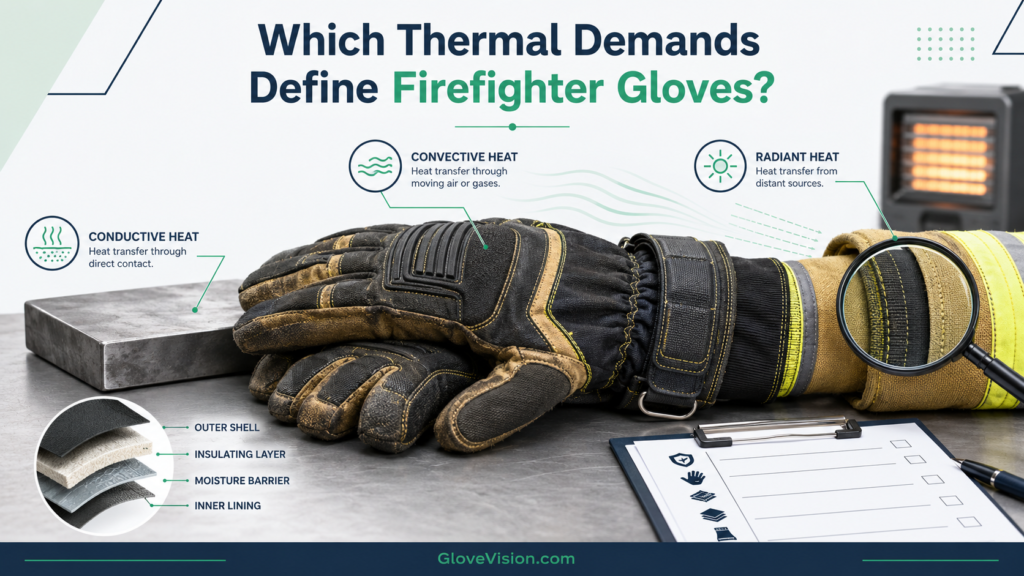
Which Thermal Demands Define Firefighter Gloves?
Structural Firefighter Gloves are defined by the need to delay conductive, convective, and radiant heat transfer while maintaining physical protection and usable hand control within documented limits. Their performance depends on complete glove construction, glove condition, moisture status, compression, functional fit, and the glove–turnout interface.
This article explains how those heat pathways affect Firefighter Gloves, how layered systems and certification data should be interpreted, and which pre-use and damage-response checks protect against unsafe assumptions. It covers layered protection, standards context, specialty-task boundaries, moisture and compression, cuff interface, control checks, damage, and replacement triggers.
This article provides educational guidance about structural Firefighter Glove thermal demands and does not replace manufacturer instructions, current applicable standards, department SOPs, incident command, hazard assessment, training, inspection requirements, or professional safety evaluation. Verify the exact glove system, certification, condition, moisture status, task category, turnout interface, and department requirements before use.
Why Do Firefighter Gloves Use Layered Systems to Address Structural Heat Transfer?
Structural Firefighter Gloves use documented layered systems because direct contact, hot gases, and thermal radiation transfer heat through different pathways that one material or feature cannot be assumed to control by itself.
Layered glove research treats thermal performance as a system problem involving construction, material layers, thickness, placement, and exposure conditions rather than a single material name. [NIOSH glove research]
Which Heat-Transfer Pathways Affect Structural Firefighter Gloves?
Structural Firefighter Gloves may face conductive heat from hot objects, convective heat from heated gases, and radiant heat from flames and hot surroundings. A hose coupling, heated debris, or tool contact can create localized conductive demand; hot gases can heat exposed glove surfaces; flames and heated surroundings can add radiant energy without direct contact.
These pathways can occur together, and the outcome depends on exposure intensity, duration, contact pressure, glove condition, moisture status, and construction. The glove should not be deliberately tested against heat in the field.
How Do Glove Layers Delay Heat Transfer?
Glove layers delay heat transfer by combining outer protection, insulation, liquid-resistance functions where present, and controlled spaces between components. A product can include an outer shell, thermal or insulating layer, moisture barrier where documented, inner lining, reinforcements, seams, cuff, wristlet, and interface components.
Layer order, attachment, internal air spaces, and fit can influence how the system behaves. More layers, thicker material, or a moisture barrier should not be treated as automatic proof of greater protection.
How Do Moisture, Compression, and Damage Change Thermal Behavior?
Moisture, layer compression, and physical damage can change how quickly heat moves through a Firefighter Glove and how much thermal energy its materials retain. NIOSH-linked thermal-capacity work supports careful, condition-specific wording rather than a universal wet-glove rule. [NIOSH thermal capacity]
Cuts, holes, charring, liner displacement, suspected barrier damage, or severe compression make thermal performance uncertain. Damaged or suspected-compromised gloves should be removed from structural service according to manufacturer and department procedure.
Table 1. Heat-transfer pathways and condition variables matched to glove components, limits, and verification needs.
| Heat Pathway or Condition | Relevant Glove Component | Possible Protective Function | What It Does Not Prove | Verification Needed |
|---|---|---|---|---|
| Conductive heat | Complete glove body composite | May delay heat transfer during incidental contact within tested limits | Safe prolonged contact with hot surfaces | Standard data, manufacturer data, task review |
| Convective heat | Shell and insulating layers | May reduce heat penetration from hot gases | Safety in every interior thermal environment | Certification, condition, department procedure |
| Radiant heat | Outer shell and complete composite | May reduce transmitted radiant energy | Flashover or direct-flame safety | Applicable certification and product data |
| Layer compression | Liner, barrier, air space | Uncompressed layers may retain more insulating structure | A loose or thick glove is automatically safer | Fit trial, task control, manufacturer design |
| Moisture | Barrier, liner, shell | May resist or manage liquid where documented | Chemical protection or unchanged thermal behavior | Product construction, moisture condition, procedure |
| Shell abrasion or cut | Outer shell and reinforcements | Reinforcements may support durability | Continued thermal protection after damage | Pre-use inspection and removal criteria |
| Liner separation | Inner layers and attachment system | Attached layers help maintain intended alignment | Safe use with detached or inverted liners | Manufacturer and department inspection |
| Cuff interface | Cuff, wristlet, coat sleeve | May reduce exposed wrist gaps | Protection if the ensemble separates during movement | Complete ensemble movement check |
Connect heat pathways to glove components without turning any feature into a guarantee.
Material-family comparison belongs to glove-material content. Exact turnout-interface engineering belongs to Firefighter Turnout Gear Integration because cuff, wristlet, and turnout-sleeve behavior require a dedicated ensemble-interface page.
How Should NFPA 1970, Legacy NFPA 1971, EN 659, and Thermal Test Data Be Interpreted?
NFPA 1970, legacy NFPA 1971 references, EN 659, certification labels, and thermal test data help verify defined product requirements, but none guarantees protection in every structural firefighting condition.
What Does NFPA 1970 Establish for Structural Firefighter Gloves?
NFPA 1970 establishes current minimum design, performance, testing, and certification context for protective ensembles and emergency-services equipment, including protective ensemble elements such as gloves where applicable. Its 2025 edition should be read through the exact product label, certification documentation, and department-adopted requirements. [NFPA 1970]
When Does NFPA 1971 Still Matter?
NFPA 1971 remains relevant when a glove label, legacy certification, procurement record, department policy, or jurisdictional rule specifically references that edition. USFA explains that NFPA 1970 consolidated prior standards including NFPA 1971, NFPA 1975, NFPA 1981, and NFPA 1982 into one document. [USFA]
A legacy NFPA 1971 reference should trigger review, not automatic disposal or automatic continued use. The exact label, manufacture date, service status, inspection outcome, and department policy control the next step.
What Does EN 659 Verify?
EN 659 provides a performance framework for protective gloves used by firefighters, incorporating thermal, mechanical, water-related, and other testing references. SATRA describes EN 659 as a specialist standard for firefighting gloves that references procedures from EN 420, EN 388, EN 407, and additional tests such as water and chemical penetration properties. [EN 659]
EN 659 marking does not approve deliberate hazardous-material handling, electrical work, chainsaw work, or unlimited structural heat exposure. Product marking, jurisdiction, manufacturer instructions, and department policy still control use.
Why Are Laboratory Ratings Not Field-Safety Guarantees?
Laboratory ratings describe performance under controlled methods, while real structural fires introduce changing heat flux, contact pressure, moisture, contamination, movement, damage, and exposure duration. NIOSH test-method review work supports the distinction between repeatable testing and the complexity of field conditions. [NIOSH test methods]
Certification remains valuable and may be required, but it should not be converted into a safe field duration, flashover guarantee, or permission for prolonged hot-surface contact.
Table 2. NFPA, EN, label, department, and inspection records interpreted as boundaries rather than field guarantees.
| Standard, Label, or Document | What It Helps Verify | What It Does Not Prove | Task Boundary | Documentation Needed |
|---|---|---|---|---|
| NFPA 1970, 2025 edition | Current NFPA design, performance, test, and certification framework | Safe time in a fire or department approval by itself | Structural and proximity PPE scope as documented | Exact label, certification, product data |
| Legacy NFPA 1971 reference | Historical or jurisdictional structural firefighting certification context | Current compliance or automatic retirement | Use only with product and department review | Label, manufacture date, policy, inspection |
| EN 659 | Firefighter protective-glove performance framework | Deliberate chemical-handling suitability | Product and jurisdiction dependent | Marking, declaration, manufacturer instructions |
| TPP or other thermal data | Laboratory thermal-performance result under a defined method | A real-world countdown to injury | Use only within exact test context | Standard method, result, product documentation |
| Manufacturer label | Model, standard, size, certification, warnings | Suitability after damage or contamination | Exact product only | Legible original label |
| Department PPE policy | Local approval and operational requirements | Universal approval elsewhere | Department-specific | Current adopted policy |
| Inspection record | Condition history where required | Hidden integrity without proper testing | Serviceability decision support | Department inspection procedure |
Separate standards context from product-specific and department-specific approval.
This section explains standards only as much as needed to interpret structural Firefighter Glove thermal claims safely. Broader task-family sorting belongs to Glove Types Explained, not this thermal-demands page.
How Do Structural Firefighter Glove Systems Balance Thermal Protection and Hand Mobility?
Structural Firefighter Glove systems balance thermal protection and hand mobility by combining documented protective components with a fit and pattern that still permits hose, coupling, valve, radio, and tool control.
Structural gloves should be separated from general Work Gloves, because broad work-glove categories cover different abrasion, grip, cut, and handling tasks and are not automatically structural firefighting PPE.
Which Components Form a Structural Firefighter Glove System?
A structural Firefighter Glove system can include an outer shell, insulating components, a moisture barrier, an inner lining, reinforcements, seams, and a cuff or wristlet, depending on the certified product design. Each component should be interpreted through product documentation, not a universal material recipe.
The outer shell faces heat, flame, debris, abrasion, and physical wear. Insulating components may reduce heat transfer where documented; a moisture barrier may resist certain liquid penetration under defined conditions; the inner lining can support comfort and liner stability; and reinforcements may support selected wear zones.
Why Are Structural Gloves Different From Wildland and Rescue Gloves?
Structural Firefighter Gloves are built around structural heat and physical hazards, while wildland, extrication, rope-rescue, chainsaw, medical, and technical-rescue gloves address different hazard combinations. Structural firefighting gloves occupy one controlled branch within the broader classification of glove types by task, construction, and protective purpose.
Crossover use requires exact product documentation and department approval. A structural label should not be treated as automatic approval for every rescue, medical, chemical, electrical, or powered-tool task.
What Trade-Off Exists Between Insulation and Dexterity?
Increased insulation and reinforcement may reduce fine finger feedback, while designs emphasizing mobility must still meet the thermal and physical demands of the structural task. NIOSH hand-anthropometry research links firefighter glove sizing and fit to task performance and dexterity concerns, which supports treating fit as an operational readiness variable rather than a cosmetic preference. [NIOSH fit]
Fit, pattern, stiffness, liner alignment, glove condition, moisture, and cuff interface all influence hose, coupling, valve, radio, and tool control. A thin glove should not be selected merely for dexterity, and a thick glove should not be selected merely for perceived protection.
Exact side-by-side material comparison belongs to glove-material content. Task-first glove selection belongs to a recommendation workflow, not this page.
How Should Firefighter Gloves Be Checked for Fit, Cuff Interface, Moisture, and Tool Control?
Firefighter Gloves should be checked for functional fit, intact layers, a stable cuff–sleeve interface, acceptable moisture condition, and adequate task control before structural use.
Step 1 — Verify Functional Fit
Functional fit allows the fingers and thumb to seat correctly without severe tightness, excessive fingertip bulk, palm bunching, liner distortion, or loss of basic control. Tightness, excess material, or liner misalignment may alter compression, movement, comfort, and control.
Step 2 — Inspect the Shell, Liner, Barrier, Seams, and Reinforcements
The shell, liner, barrier, seams, and reinforcement zones must remain intact and correctly positioned before the glove enters structural service. Check for cuts, holes, charring, missing stitches, exposed layers, liner separation, liner inversion, suspected barrier damage, stiffening, cracking, hard spots, thin zones, and damaged cuff or wristlet.
Step 3 — Confirm the Cuff and Sleeve Interface
The glove cuff or wristlet and turnout-coat sleeve must maintain the intended interface through realistic arm and hand movement. Wrist protection depends on the complete ensemble because Firefighter Glove and turnout-gear integration must remain effective during reaching, crawling, hose handling, and tool movement.
Step 4 — Check Moisture and Contamination Status
Wet, waterlogged, heavily soiled, or contaminated gloves require department-directed evaluation before structural use because their thermal and physical behavior may no longer match documented clean-and-dry test conditions. Light hand perspiration is different from visibly wet or waterlogged gear, but the decision still belongs to product and department procedure.
Fuel, solvent, hydraulic fluid, foam concentrate, or unknown contamination requires contaminant-specific procedures. A moisture barrier should not be treated as chemical protection.
Step 5 — Confirm Task Control and Specialty-Tool Requirements
A firefighter must be able to maintain basic hose, coupling, valve, radio, and tool control without assuming that structural certification covers every powered or specialty tool. Powered tools may require separate PPE, training, guarding, shutoff procedures, and department SOPs.
Table 3. Pre-use workflow for fit, construction, cuff interface, moisture, contamination, control, and replacement routing.
| Step | What to Check | Safe Action | Route or Boundary | Target Outcome |
|---|---|---|---|---|
| Verify fit | Severe tightness, excess slack, bunching, liner distortion | Select an approved better-fitting glove or route to fit assessment | Exact sizing belongs to the sizing tool | Functional movement without forced compression |
| Inspect construction | Cuts, charring, holes, missing stitches, liner separation | Remove questionable gloves from service | Follow manufacturer and department inspection | Intact glove system |
| Check cuff interface | Wrist gaps during movement | Reassess glove–coat compatibility | Detailed interface belongs to turnout-integration page | Stable ensemble coverage |
| Check moisture | Wetness, waterlogging, heavy internal moisture | Follow department evaluation and drying procedure | Do not invent drying time | Known moisture condition |
| Check contamination | Fuel, solvent, hydraulic fluid, foam, unknown substance | Isolate and follow contaminant procedure | Requires SDS/manufacturer/department guidance | No unauthorized return to service |
| Check control | Coupling, valve, radio, hose, and basic tool handling | Replace or reassess if control is inadequate | Specialty tools require separate approval | Usable task control |
| Start or replace | All checks passed under procedure | Begin task or replace glove | Department decision controls | Verified pre-use readiness |
Convert normal pre-use concerns into observable checks without becoming an exact sizing tool.
What Should Firefighters Do When Gloves Heat Rapidly, Become Wet, or Show Damage or Contamination?
Rapid heat increase, waterlogging, structural damage, contamination, or sudden control loss requires the firefighter to communicate, follow crew and incident procedures, move away from the hazard when directed and feasible, and remove the glove from service for evaluation.
OSHA fire-brigade requirements provide a regulatory hand-protection boundary for hazards such as cuts, punctures, and heat penetration, but they do not certify a specific glove model or guarantee field performance. [OSHA]
What Should Happen After a Rapid Increase in Hand Heat?
A rapid increase in hand heat is a warning condition that should be communicated immediately and managed through crew, incident-command, and department emergency procedures. PPE coverage should not be removed in an active thermal zone unless an emergency procedure directs otherwise.
The glove and hand should be evaluated in a safer area, and medical or exposure evaluation should follow when indicated by procedure.
What Should Happen When a Glove Becomes Wet or Waterlogged?
A wet or waterlogged Firefighter Glove should be removed from structural service and evaluated under manufacturer and department procedures before reuse. Removal should occur when conditions safely permit, followed by inspection of shell, liner, barrier, fit, and control.
Feeling dry is not enough to authorize return to service, and this page does not approve a field drying timeline or method.
What Should Happen After Shell, Seam, Liner, or Barrier Damage?
Cuts, holes, charring, seam failure, liner separation, inversion, stiffening, or suspected barrier damage make the glove’s protective condition uncertain and require removal from service. Reporting, documentation, matching-glove inspection, and any repair or replacement decision should follow department policy.
What Should Happen After Fuel, Solvent, Hydraulic Fluid, Foam, or Unknown Contamination?
Fuel, solvent, hydraulic-fluid, foam-concentrate, or unknown contamination requires isolation of the glove and contaminant-specific evaluation before cleaning, disposal, or return to service. Department exposure procedures, manufacturer guidance, and Safety Data Sheet or incident chemical information control the response.
What Should Happen When Grip or Dexterity Suddenly Declines?
Sudden grip or dexterity loss requires the task to be stabilized according to procedure and the glove to be checked for fit shift, liner movement, moisture, contamination, heat damage, or structural failure. Reduced task control is itself a reason to reassess the glove.
Table 4. Protocol-aligned response logic for rapid heat, waterlogging, shell damage, seam failure, barrier concerns, contamination, and control loss.
| Problem | Immediate Concern | Protocol-Aligned Action | Verification Needed | Return-to-Service Rule |
|---|---|---|---|---|
| Rapid heat increase | Possible rising thermal exposure or glove compromise | Communicate and follow crew/incident procedure; evaluate in safer area | Glove and hand evaluation | No return until authorized |
| Wet or waterlogged glove | Altered thermal behavior, weight, control, and liner condition | Remove when conditions safely permit | Manufacturer and department inspection | Feeling dry alone is insufficient |
| Charred or holed shell | Loss of outer integrity | Remove from service | Product inspection criteria | Repair or replacement only if authorized |
| Seam failure | Structural opening or exposed layers | Remove and document | Manufacturer and department procedure | Do not improvise field repair |
| Liner separation or inversion | Uncertain alignment and control | Remove from service | Approved liner inspection | Return only after approved disposition |
| Suspected barrier damage | Uncertain liquid and system performance | Isolate and evaluate | Product-specific inspection | No visual-only approval |
| Fuel or solvent contamination | Flammability, chemical, and skin-exposure concerns | Isolate and follow contaminant procedure | SDS, manufacturer, department guidance | No unauthorized cleaning or reuse |
| Foam or unknown contamination | Uncertain compatibility and exposure | Isolate and report | Incident and product information | Department decision required |
| Sudden control loss | Tool, hose, or movement control may be impaired | Stabilize task and reassess | Fit, liner, moisture, damage, contamination | Replace if control remains inadequate |
Use this matrix for abnormal-event response, not independent tactics or medical diagnosis.
This section does not replace emergency tactics, incident command, department exposure procedures, or medical care.
Which Pre-Shift Checks Confirm That Firefighter Gloves Are Ready for Structural Use?
Pre-shift verification confirms structural-task documentation, glove condition, moisture status, cuff compatibility, functional control, contamination status, and department approval before the gloves enter service.
Table 5. Concise pre-shift screen for structural-task identity, certification context, construction, moisture, cuff interface, control, contamination, specialty tools, and replacement triggers.
| Check | Core Verification | Required Action if Not Met | Evidence or Procedure |
|---|---|---|---|
| Structural-task identity | Glove is documented for structural firefighting | Do not substitute a specialty or general work glove | Label, product data, department policy |
| Current certification context | Applicable NFPA 1970, legacy NFPA 1971, EN 659, or jurisdictional documentation is understood | Route uncertain labels for departmental review | Certification label and records |
| Shell integrity | No disqualifying cuts, holes, charring, severe abrasion, cracking, or hard zones | Remove from service | Inspection procedure |
| Seams and reinforcements | No disqualifying missing stitches, openings, or reinforcement failure | Remove and report | Manufacturer and department criteria |
| Liner condition | Liner remains attached, positioned, and serviceable | Remove from service | Product inspection |
| Barrier condition | No known or suspected barrier compromise | Route for approved evaluation | Manufacturer procedure |
| Moisture status | Glove is not wet or waterlogged beyond approved use condition | Remove and follow drying/evaluation procedure | Department and manufacturer guidance |
| Cuff and coat interface | Wrist coverage remains functional through movement | Reassess glove–coat combination | Ensemble movement check |
| Functional fit | No severe tightness, excess slack, bunching, or liner distortion | Route to approved fit assessment | Fit trial and department process |
| Dexterity and control | Basic hose, coupling, valve, radio, and permitted tool control remains adequate | Replace or reassess | Functional check |
| Contamination status | No fuel, solvent, hydraulic fluid, foam, unknown chemical, or disqualifying soil | Isolate and follow contamination procedure | SDS, manufacturer, department guidance |
| Specialty-tool boundary | Separate PPE requirements have been checked | Do not assume structural certification covers the tool | Tool instructions and department SOP |
| Replacement triggers | No condition requiring repair, retirement, or replacement | Remove from service | Care, inspection, and retirement procedure |
This checklist is a screening tool; product instructions and department procedures control the final decision.
This checklist is a screening tool. It does not override product instructions, certification conditions, department policy, or competent inspection.
Sources & Evidence Boundaries
This page uses 8 public sources. Manufacturer labels, technical data, user instructions, department SOP/SOG, care and maintenance procedure, and contaminant information remain verification requirements inside the article logic.
- NFPA — NFPA 1970, Standard on Protective Ensembles, Work Apparel, Open-Circuit SCBA, and PASS for Emergency Services, 2025 Edition supports current NFPA protective-ensemble standards context; it does not prove safe field duration or department approval.
- U.S. Fire Administration — New Standard for Firefighter Personal Protective Equipment supports NFPA 1970 consolidation context; it does not reproduce detailed glove test requirements.
- SATRA — EN 659: 2003+A1:2008 Protective Gloves for Firefighters supports EN 659 firefighter-glove scope and related test context; it does not prove chemical-task suitability.
- OSHA — 29 CFR 1910.156 Fire Brigades supports U.S. fire-brigade hand-protection boundaries; it does not certify a glove model.
- CDC/NIOSH Stacks — Firefighter Hand Anthropometry and Structural Glove Sizing supports fit, hand-dimension, task-performance, and dexterity research context; it does not approve an individual size.
- CDC/NIOSH Stacks — Modeling and Analyzing Thermal Protection of Firefighters’ Gloves supports glove layer architecture and thermal-performance research context; it does not prove universal glove construction.
- CDC/NIOSH Stacks — Thermal Capacity of Fire Fighter Protective Clothing supports moisture-conditioned, radiant, stored-energy, and compression-related thermal nuance; it does not create one universal wet-glove rule.
- CDC/NIOSH Stacks — Review of Gaps and Limitations in Test Methods for First Responder Protective Clothing and Equipment supports laboratory-test limitations and field-complexity boundaries; it does not reject certification.
Frequently Asked Questions
Do Structural Firefighter Gloves Prevent Burns?
No. Structural Firefighter Gloves may delay heat transfer within documented limits, but they cannot prevent every thermal injury or make direct flame, extreme heat, or prolonged hot-surface contact safe. Complete-system condition, exposure intensity, moisture, fit, and department procedure still matter.
Does NFPA 1970 Replace NFPA 1971?
NFPA 1970 is the current consolidated NFPA standard, while NFPA 1971 can remain relevant in legacy product labels, departmental documents, procurement records, or jurisdictional requirements. Exact labels and policies must be verified before service decisions.
Does EN 659 Mean a Firefighter Glove Is Chemical-Protective?
No. EN 659 addresses firefighters’ protective gloves, but its marking does not approve the glove for deliberate handling of fuels, solvents, hazardous chemicals, or unknown liquids. Chemical contact needs product, Safety Data Sheet, and department procedures.
Are Thicker Firefighter Gloves Always More Protective?
No. Thickness alone does not establish complete thermal performance because material properties, layer order, compression, moisture, construction, testing, condition, and fit also affect the glove system. Added bulk can also reduce dexterity or task control.
Can Wet Firefighter Gloves Be Used Again After They Feel Dry?
A glove that feels dry should not automatically return to structural service because waterlogging, liner displacement, barrier damage, contamination, or hidden deterioration may still require inspection. Manufacturer and department return-to-service procedure controls the decision.
When Should Firefighter Gloves Be Removed From Service?
Firefighter Gloves should be removed from service when damage, contamination, moisture condition, liner problems, failed seams, poor fit, or reduced control meets the manufacturer’s or department’s removal criteria. Observable triggers include cuts, holes, charring, stiffening, liner separation, wetness, unknown contamination, or control loss.
Conclusion
Structural Firefighter Gloves are defined by the combined conductive, convective, and radiant heat demands they must address while preserving physical integrity, interface coverage, and usable hand control. Their performance depends on the complete layered system, moisture and compression conditions, current NFPA 1970 or legacy NFPA 1971 context where applicable, EN 659 boundaries, laboratory-test interpretation, fit, cuff interface, damage, contamination, and department procedure.
Certification, layer count, material names, thickness, moisture barriers, or laboratory ratings do not guarantee field protection. Structural use should remain tied to manufacturer documentation, serviceable condition, department approval, and removal from service when wetness, damage, contamination, liner problems, poor fit, or reduced control makes the glove’s condition uncertain.