
How Do Firefighter Gloves Integrate with Turnout Gear?
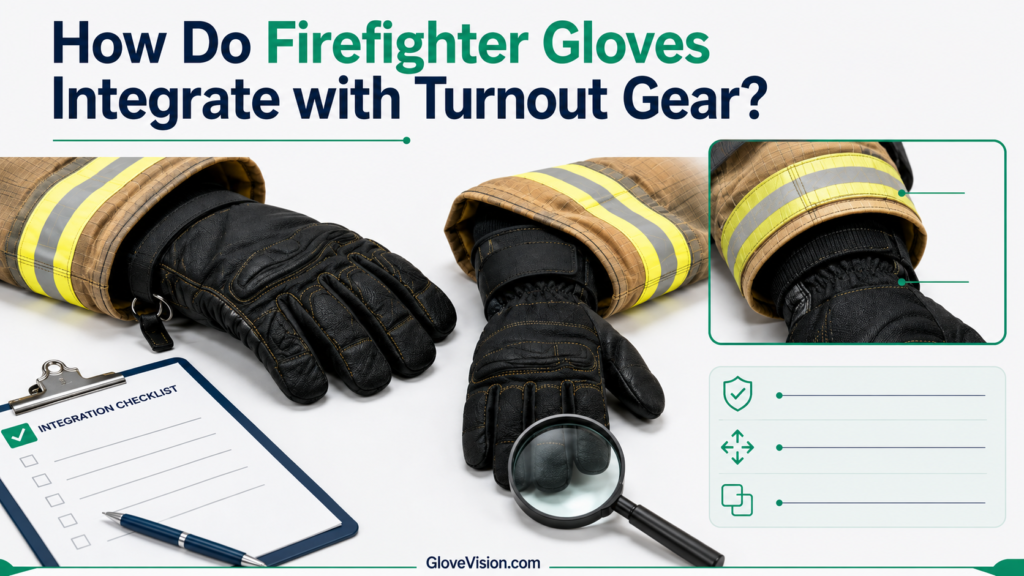
Firefighter Gloves integrate with turnout gear through a cuff or wristlet interface that should maintain practical wrist coverage during movement without restricting hand control. The result depends on glove design, turnout-coat design, approved ensemble configuration, donning, fit, movement, moisture, contamination, and equipment condition.
This article explains why the glove–sleeve interface matters, how gauntlet and wristlet designs differ, what standards and documentation can establish, and how to verify coverage before and during use. It covers interface vulnerability, cuff-style compatibility, donning, movement checks, abnormal response, and shift-start verification.
This article provides educational guidance about structural Firefighter Glove and turnout-gear interface coverage. It does not replace manufacturer instructions, current applicable standards, department SOPs, incident command, hazard assessment, approved ensemble configurations, inspection requirements, or professional safety evaluation. Verify the exact glove, turnout coat, cuff or wristlet design, condition, movement coverage, moisture status, contamination status, and department requirements before use.
Why Do Firefighter Gloves Need Turnout-Sleeve Interface Coverage?
Structural Firefighter Gloves need a stable turnout-sleeve interface because arm and hand movement can reduce overlap and create exposed wrist gaps between otherwise protective ensemble components.
Interface coverage supports the larger glove system, but Firefighter Thermal Demands covers the broader conductive, convective, and radiant heat pathways beyond the wrist area alone.
Why Is the Glove-to-Sleeve Interface Important?
The glove-to-sleeve interface is important because it connects two protective components across a highly mobile wrist and lower-forearm area. Overhead reach, elbow flexion, crawling posture, hose advancement, coupling operation, radio access, valve manipulation, and permitted tool use can all change how the cuff and sleeve sit together.
Which Conditions Can Create Exposed Wrist Gaps?
Exposed wrist gaps can develop when the sleeve retracts, the glove cuff migrates, interface components twist or bunch, or the glove–coat combination is not functionally compatible. Poor donning, excessive glove bulk, severe tightness, excess slack, liner displacement, coat wristlet interference, cuff damage, wet components, stiffness, or an incorrect ensemble combination can contribute.
What Does Interface Coverage Not Guarantee?
Interface coverage reduces exposed gaps but does not create a heat-proof, liquid-tight, contamination-proof, or movement-proof seal. It does not prove thermal immunity, complete spark exclusion, complete liquid exclusion, chemical protection, compatibility in every posture, continued suitability after damage, or tool-specific approval.
The complete heat-transfer discussion belongs to the firefighter thermal-demands page, while this page owns glove-to-turnout interface behavior.
How Should NFPA 1970, Legacy NFPA 1971, EN 659, and Interface Documentation Be Used?
NFPA 1970, legacy NFPA 1971 references, EN 659, product labels, manufacturer instructions, and department policies help verify the glove system, but they do not independently prove perfect turnout-sleeve compatibility.
What Does NFPA 1970 Help Verify?
NFPA 1970 helps verify defined design, performance, testing, and certification requirements for structural firefighting ensemble elements, including gloves. The 2025 edition is the current consolidated product-performance framework where applicable, but exact product labeling and department adoption still matter. [NFPA 1970]
When Do NFPA 1971 References Still Matter?
NFPA 1971 references still matter when they appear on legacy labels, certification documents, procurement records, department policies, or jurisdictional requirements. NFPA describes NFPA 1970 as a consolidation of previous documents including NFPA 1971, so a legacy reference should trigger department and serviceability review rather than automatic approval or automatic retirement. [NFPA issued]
What Does EN 659 Establish?
EN 659 establishes defined requirements and test references for firefighters’ protective gloves but does not guarantee a perfect glove–sleeve interface with every turnout coat. SATRA describes EN 659 as a specialist firefighting-glove standard referencing EN 420, EN 388, EN 407, and additional tests for water and chemical penetration properties. [EN 659]
Which Documents Control the Exact Interface?
The exact interface should be determined from the glove label, glove instructions, turnout-coat instructions, approved ensemble configuration, and department procedure. Glove model, coat model, cuff type, coat wristlet, donning instructions, compatibility information, movement check, inspection result, and department policy all matter.
Table 1. Standards, labels, manufacturer instructions, department policy, movement checks, and inspection records interpreted as interface boundaries.
| Standard or Source | What It Helps Verify | What It Does Not Prove | Interface Question | Documentation Needed |
|---|---|---|---|---|
| NFPA 1970, 2025 edition | Current product design, performance, testing, and certification framework | Perfect coverage in every movement posture | Is the glove documented for the intended structural ensemble? | Label, certification, manufacturer data |
| Legacy NFPA 1971 reference | Historical or jurisdictional certification context | Current adoption, automatic retirement, or exact compatibility | Is the legacy product still approved and serviceable? | Label, records, department policy |
| EN 659 | Firefighter protective-glove performance framework | Liquid-tight overlap or every-coat compatibility | Is EN 659 applicable to the product and jurisdiction? | Marking, declaration, instructions |
| Glove manufacturer instructions | Cuff, wristlet, donning, care, and limitations | Compatibility with an undocumented coat | How should the cuff be positioned? | Exact model instructions |
| Coat manufacturer instructions | Sleeve and coat-wristlet design | Compatibility with every glove | Which glove interfaces are intended? | Exact coat instructions |
| Department PPE policy | Approved local ensemble setup | Universal approval elsewhere | Is this glove–coat combination accepted? | Current department policy |
| Movement check | Practical interface behavior during selected motions | Certification or hidden-integrity proof | Does coverage remain functional during expected movement? | Department check procedure |
| Inspection record | Observable condition and service history | Perfect internal integrity | Is the cuff or wristlet serviceable? | Approved inspection process |
Use this table to prevent unsupported claims that certification, one visible overlap arrangement, or one label proves perfect glove–sleeve compatibility.
This section is not a complete standards article. It explains only what the reader needs to avoid unsupported interface claims.
How Do Gauntlet and Wristlet Firefighter Gloves Differ in Turnout-Gear Compatibility?
Gauntlet and wristlet Firefighter Gloves use different interface configurations, and neither design is universally superior without the exact turnout-coat design, approved ensemble setup, movement needs, and department procedure.
Structural firefighting gloves represent one task-specific branch within Glove Types Explained, where glove categories are organized by protective purpose and working environment.
How Should Gauntlet-Style Firefighter Gloves Be Described?
Gauntlet-style Firefighter Gloves use an extended cuff that can support interface coverage and donning in compatible turnout systems. Possible benefits include extended coverage, easier handling during donning in some systems, and space for some sleeve configurations; possible limitations include bulk, cuff migration, sleeve interference, poor compatibility with some coat wristlets, and unstable overlap when improperly fitted.
How Should Wristlet-Style Firefighter Gloves Be Described?
Wristlet-style Firefighter Gloves use a closer-fitting wrist component that can maintain localized coverage when correctly aligned with a compatible coat system. It may reduce loose cuff bulk in some systems, but it can twist, bunch, retain moisture, complicate donning, interact poorly with coat wristlets, or shift with liner displacement.
What Determines Glove–Coat Compatibility?
Glove–coat compatibility depends on product design, functional fit, donning instructions, approved ensemble configuration, movement coverage, condition, moisture, and task control. Exact glove model, coat configuration, cuff geometry, sleeve opening, liner position, department approval, manufacturer guidance, contamination status, and tool-control needs all shape the decision.
What Are the Main Trade-Offs?
The main trade-offs involve coverage stability, bulk, donning, mobility, moisture retention, sleeve interaction, and task control. The complete ensemble must be checked through approved movement steps rather than a preference for gauntlet or wristlet style alone.
Table 2. Gauntlet, wristlet, coat, movement, liner, moisture, and tool-control variables matched to documentation needs and limitations.
| Interface Feature | Possible Benefit | Possible Limitation | Movement Check | Documentation Needed | What It Does Not Prove |
|---|---|---|---|---|---|
| Extended gauntlet cuff | May increase overlap in compatible systems | Can add bulk or migrate | Reach, flex, crawl, hose handling | Glove and coat instructions | Universal over-sleeve placement |
| Fitted wristlet cuff | May maintain close wrist conformity | Can twist, retain moisture, or bunch | Flexion, reach, radio and tool checks | Product and department instructions | Liquid-tight sealing |
| Coat wristlet | May support interface continuity | May interfere with some glove cuffs | Full movement check | Coat instructions | Compatibility with every glove |
| Longer overlap | May reduce exposed gaps | Can increase bulk or restrict movement | Overhead and crawling check | Approved ensemble configuration | Complete thermal protection |
| Closer cuff fit | May reduce migration | Can increase tightness or compression | Hand flexion and control check | Fit assessment | Better protection in every design |
| Loose cuff fit | May simplify donning | Can shift or separate | Repeated movement check | Product and department guidance | Safer thermal performance |
| Correct liner alignment | Supports intended glove shape and control | Misalignment can alter cuff position | Donning and flexion check | Manufacturer instructions | Hidden component integrity |
| Dry interface | Supports expected fit and control | Surface dryness does not prove internal condition | Internal and external inspection | Care and inspection procedure | Unlimited safe use |
| Tool-control compatibility | Supports task performance | Varies by tool and glove system | Permitted control check | Tool and department procedure | Tool-specific PPE approval |
This matrix compares interface features without ranking one cuff design as universally safer.
How Should Firefighter Gloves Be Donned and Movement-Checked with Turnout Gear?
Firefighter Gloves should be donned according to the approved glove–coat configuration and then checked through realistic movement to confirm that the cuff, wristlet, sleeve, liner, and hand position remain functional.
General work gloves address different grip, abrasion, cut, and handling demands and should not be substituted for a documented structural firefighting ensemble element.
Step 1 — Don According to the Approved Ensemble Configuration
The glove and coat should be donned in the arrangement specified by their manufacturers and the department-approved ensemble procedure. Fingers, thumb, palm, liner, cuff, wristlet, coat wristlet, sleeve, tightness, slack, and basic grip should all be checked before use.
Step 2 — Verify Interface Coverage During Movement
Interface coverage should remain functional during selected arm, hand, and task movements rather than appearing adequate only while the wearer is standing still. Practical screening can include arm extension, elbow flexion, overhead reach, crawling posture, hose handling, coupling operation, radio access, valve movement, and permitted tool handling.
Step 3 — Check Moisture and Contamination Status
Wet, waterlogged, heavily soiled, or contaminated interface components require evaluation before structural use because moisture and contaminants can alter fit, control, comfort, and thermal behavior. Normal perspiration is different from visible wetness or waterlogging, but unresolved moisture or chemical contact requires product and department procedures.
Step 4 — Verify Permitted Task Control
The glove–coat interface should permit basic hose, coupling, valve, radio, and approved tool control without bunching, slipping, or restricted access. General work gloves address different grip, abrasion, cut, and handling demands, while powered and specialty tools may require separate PPE and procedures.
Step 5 — Recheck After Meaningful Task or Condition Changes
The interface should be rechecked after movements or conditions that may shift the glove, sleeve, liner, moisture level, or control. Recheck triggers include crawling, repeated overhead reach, hose advancement, tool changes, glove removal and redonning, rehab, moisture exposure, contamination exposure, recurring cuff migration, or control loss.
Table 3. Normal pre-use workflow for approved setup, hand seating, cuff alignment, movement coverage, moisture, contamination, control, and recheck triggers.
| Step | Core Check | Practical Action | Failure Response | Target Outcome |
|---|---|---|---|---|
| Review approved setup | Exact glove, coat, and department configuration | Follow product and department donning instructions | Stop if configuration is uncertain | Known ensemble arrangement |
| Seat hand and liner | Fingers, thumb, palm, liner position | Reseat without twisting or force | Route persistent fit problems | Stable glove position |
| Align cuff and sleeve | Gauntlet or wristlet follows approved arrangement | Correct folds, twists, or trapped material | Do not improvise modifications | Functional static coverage |
| Perform movement check | Reach, flex, crawl, hose, coupling, radio | Observe migration or exposed gaps | Re-don or reassess compatibility | Functional moving coverage |
| Check moisture | Wetness or waterlogging | Follow evaluation procedure | Remove from service when required | Known moisture condition |
| Check contamination | Fuel, solvent, hydraulic fluid, foam, unknown material | Isolate and report | No unauthorized reuse | Controlled contamination response |
| Check control | Hose, valve, coupling, radio, permitted tool | Replace or reassess if control is poor | Route tool-specific decisions | Functional task control |
| Recheck after change | Task, moisture, redonning, or movement shift | Repeat relevant checks in a safe setting | Remove if recurring separation persists | Continued interface stability |
This workflow turns interface concepts into observable checks without creating universal cuff-direction rules.
What Should Firefighters Do When the Glove–Sleeve Interface Separates or Becomes Compromised?
Interface separation, rapid heat near the wrist, wet or contaminated cuffs, recurring slippage, or reduced control requires communication, movement to a safer setting according to operational procedure, and evaluation of the glove–coat system before continued use.
OSHA fire-brigade requirements provide regulatory PPE context for fire brigades, but they are not product-specific interface certification. [OSHA]
What Should Happen After Cuff Slippage or an Exposed Wrist Gap?
Cuff slippage or an exposed wrist gap should be communicated and corrected only in a safer setting under department procedure. PPE coverage should be maintained in a hazard zone unless an emergency procedure directs otherwise, and recurring separation should trigger review of glove size, cuff position, coat sleeve, liner alignment, and ensemble compatibility.
What Should Happen After Rapid Heat or Moisture Concerns Near the Wrist?
Rapid heat, wet-liner discomfort, or moisture-related concerns near the wrist require immediate communication and evaluation in a safer area when operational conditions permit. Wet or waterlogged gloves should be removed from service under procedure, and feeling dry should not authorize return by itself.
What Should Happen After Fuel, Hydraulic Fluid, Foam, Solvent, or Unknown Contamination?
Fuel, hydraulic fluid, foam concentrate, solvent, contaminated runoff, or unknown chemical contact requires isolation and contaminant-specific evaluation before cleaning, disposal, or return to service. NFPA 1850 provides current care-and-maintenance context where adopted and applicable, while NFPA 1851 remains relevant only where legacy or department documentation controls. [NFPA 1850] [NFPA 1851]
What Should Happen When Grip or Tool Control Declines?
Reduced grip, trigger or shutoff access, valve control, coupling control, or hose control requires the task to be stabilized according to procedure and the glove system to be reassessed. Bulk, fit, moisture, contamination, liner movement, stiffening, seam damage, and tool access should be checked without approving a specialty tool from a simple grip screen.
Table 4. Response logic for exposed wrist gaps, cuff migration, bunched wristlets, waterlogging, damage, contamination, and tool-control loss.
| Problem | Immediate Concern | Protocol-Aligned Action | Documentation Check | Return-to-Service Rule |
|---|---|---|---|---|
| Exposed wrist gap | Reduced interface coverage | Communicate and correct in a safer setting | Glove, coat, and department instructions | No return if coverage cannot be maintained |
| Recurring cuff migration | Possible compatibility or fit problem | Re-don and reassess ensemble | Product and fit documentation | Remove if recurrence remains unresolved |
| Twisted or bunched wristlet | Uneven coverage and reduced control | Correct alignment in a safe setting | Manufacturer instructions | Return only after stable movement check |
| Wet or waterlogged wristlet | Altered fit, control, comfort, and thermal behavior | Remove when conditions safely permit | Care and inspection procedure | Surface dryness alone is insufficient |
| Charred or damaged cuff | Loss of structural integrity | Remove from service | Manufacturer and department inspection | Repair or replace only if authorized |
| Seam separation | Interface component may open or shift | Remove and report | Product inspection criteria | No improvised field repair |
| Fuel or solvent contamination | Flammability, chemical, and skin-exposure concern | Isolate and follow contaminant procedure | SDS, manufacturer, department guidance | No unauthorized reuse |
| Foam or unknown contamination | Uncertain material compatibility | Isolate and report | Incident information and care procedure | Department decision required |
| Tool-control loss | Reduced operational control | Stabilize task and reassess | Tool, fit, and PPE requirements | Replace if adequate control is not restored |
This matrix handles abnormal conditions without replacing incident command, medical evaluation, or department exposure procedures.
This section does not replace incident command, emergency procedures, department exposure programs, or medical care.
Which Shift-Start Checks Confirm Firefighter Glove and Turnout-Gear Interface Readiness?
Shift-start verification confirms that the structural Firefighter Gloves, turnout coat, interface arrangement, condition, movement coverage, moisture status, and department approval remain suitable for the intended structural task.
NFPA 1970 technical documentation recognizes structural glove component areas such as glove body, gauntlet, wristlet, thread, and hardware in testing discussion, but that does not prove perfect field pairing with every turnout coat. [NFPA technical]
Fit and hand dimension research supports treating interface control as a functional performance issue, not just a static visual check. [NIOSH fit]
Table 5. Shift-start screening for documentation, approved ensemble setup, cuff arrangement, coverage, condition, moisture, contamination, fit, control, tool boundaries, and replacement triggers.
| Check | Core Verification | Required Action if Not Met | Evidence or Procedure |
|---|---|---|---|
| Structural-task documentation | Glove is documented for structural firefighting | Do not substitute a general or specialty glove | Label, product data, department policy |
| Standard context | Current NFPA 1970, legacy NFPA 1971, EN 659, or applicable local documentation is understood | Route uncertain labeling for review | Certification and department records |
| Approved ensemble | Glove and coat combination is approved or documented | Do not assume cross-model compatibility | Manufacturer and department information |
| Cuff arrangement | Gauntlet or wristlet follows the approved donning arrangement | Re-don according to instructions | Product and department procedure |
| Static coverage | No obvious misalignment, trapped material, or exposed wrist at rest | Correct before movement check | Visual inspection |
| Movement coverage | Interface remains functional during selected movement | Re-don or reassess compatibility | Department movement-check procedure |
| Cuff and wristlet condition | No disqualifying charring, tears, seam damage, stiffening, or stretching | Remove and report | Inspection criteria |
| Liner position | Liner remains correctly seated and attached | Remove or route for inspection | Manufacturer instructions |
| Moisture condition | Interface is not wet or waterlogged beyond approved condition | Follow evaluation and drying procedure | Current NFPA 1850 or applicable department program |
| Contamination status | No disqualifying fuel, solvent, hydraulic fluid, foam, unknown chemical, or contaminated runoff | Isolate and follow exposure procedure | SDS, manufacturer, department guidance |
| Functional fit | No severe tightness, excess slack, bunching, or cuff migration | Route to approved fit assessment | Fit and department procedure |
| Task control | Hose, coupling, valve, radio, and permitted tool control remain adequate | Replace or reassess | Functional task check |
| Specialty-tool boundary | Separate PPE requirements have been verified | Do not assume structural glove approval | Tool instructions and department SOP |
| Replacement triggers | No recurring gap, failed seam, damaged cuff, persistent slippage, contamination, or control loss | Remove from service | Inspection, repair, and retirement procedure |
This checklist is a screening tool; manufacturer instructions, certification conditions, department approval, competent inspection, and tool-specific PPE rules still control the final decision.
This checklist is a screening tool. It does not replace certification, manufacturer instructions, department approval, competent inspection, or task-specific PPE requirements.
Sources & Evidence Boundaries
This page uses 8 public sources. Product labels, manufacturer instructions, turnout-coat instructions, department policy, department SOP/SOG, care program, SDS, and contaminant information remain verification requirements inside the article logic.
- NFPA — NFPA 1970, Standard on Protective Ensembles, Work Apparel, Open-Circuit SCBA, and PASS for Emergency Services, 2025 Edition supports current product-performance and certification context; it does not prove perfect interface coverage or department approval.
- NFPA — NFPA 1970 Has Been Issued supports NFPA 1970 consolidation context; it does not provide detailed glove-interface instructions.
- SATRA — EN 659: 2003+A1:2008 Protective Gloves for Firefighters supports EN 659 firefighter-glove scope and test context; it does not prove liquid-tight overlap, chemical-task approval, or exact coat compatibility.
- OSHA — 29 CFR 1910.156 Fire Brigades supports U.S. fire-brigade PPE regulatory boundaries; it does not certify a glove model or interface performance.
- NFPA — NFPA 1850, Standard on Selection, Care, and Maintenance of Protective Ensembles and SCBA for Emergency Services supports current selection, care, and maintenance context where adopted; it does not certify product performance or approve cleaning by itself.
- NFPA — NFPA 1851 Standard Development supports legacy care-and-maintenance context; it does not make NFPA 1851 the universal current default.
- NFPA 1970 Technical Documentation — Structural Firefighting Glove Component Testing supports recognition of glove body, gauntlet, wristlet, thread, and hardware components in NFPA 1970 technical discussion; it does not prove perfect field fit with every coat.
- CDC/NIOSH — Firefighter Hand Anthropometry and Structural Glove Sizing supports fit, hand-dimension, task performance, and dexterity context; it does not approve an individual size or glove–coat pairing.
Frequently Asked Questions
Should Gauntlet Firefighter Gloves Always Be Worn Over Turnout Sleeves?
No. Gauntlet placement depends on the exact glove design, turnout-coat sleeve, manufacturer instructions, approved ensemble configuration, and department procedure. A universal over-sleeve or under-sleeve rule can create unsafe assumptions.
Should Wristlet Firefighter Gloves Always Be Worn Inside the Coat Sleeve?
No. Wristlet positioning must follow the documented glove and coat design rather than a universal inside-sleeve rule. A close-fitting wristlet can support local coverage in some systems, but it does not create a seal.
Does NFPA 1970 Guarantee Glove and Coat Compatibility?
No. NFPA 1970 establishes defined product requirements, but exact glove–coat compatibility still depends on labels, manufacturer instructions, approved ensemble configurations, movement checks, condition, and department policy.
Is a Visible Wrist Gap Always a Complete PPE Failure?
A visible wrist gap signals reduced interface coverage and requires reassessment, but its meaning must be judged through the approved ensemble procedure rather than an invented universal gap threshold. Recurring gaps require removal or compatibility review.
Can Wet Firefighter Glove Wristlets Return to Service After Drying?
A wristlet that feels dry should not automatically return to service because internal moisture, liner movement, contamination, damage, or care requirements may still require approved inspection. Current NFPA 1850 where adopted, or department procedure, controls the care context.
When Should the Glove–Turnout Interface Be Rechecked?
The interface should be rechecked after donning, major movement, glove removal and redonning, moisture exposure, contamination, task changes, recurring cuff movement, or any reduction in hand control.
Conclusion
Firefighter Gloves integrate with turnout gear through an ensemble-specific cuff or wristlet interface that should maintain practical wrist coverage during movement without being treated as a perfect seal. The glove and turnout coat must be considered as connected PPE elements because sleeve retraction, cuff migration, twisting, moisture, contamination, damage, and control demands can all change interface behavior.
Cuff length, wristlet style, overlap direction, certification, or visual fit does not independently guarantee interface protection. The safer interpretation is product-specific and department-specific: verify NFPA 1970 or legacy NFPA 1971 context, EN 659 boundaries where applicable, current NFPA 1850 or legacy NFPA 1851 care context where controlling, manufacturer instructions, approved ensemble configuration, movement coverage, moisture and contamination status, condition, control, and replacement triggers.