
Why Do Mittens Retain Heat Better Than Fingered Gloves?
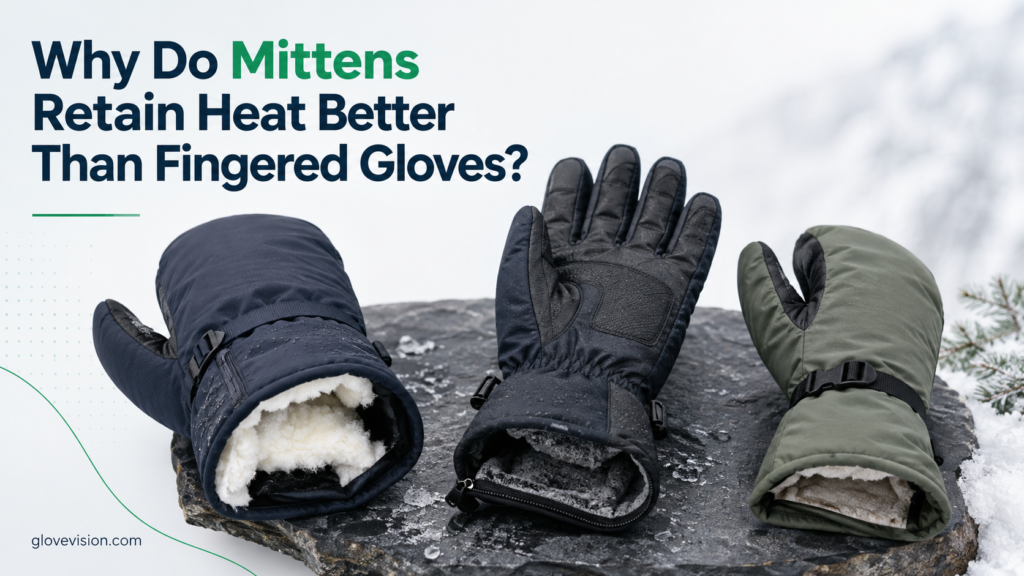
Mittens generally retain heat better than comparable fingered gloves because grouped fingers share one insulated compartment with fewer separate finger envelopes and potentially more continuous insulation around the grouped digits.
Their warmth advantage depends on insulation, wind protection, moisture control, loft, cuff coverage, fit, circulation, and condition. Mittens that are wet, compressed, excessively tight, poorly sealed, or unsuitable for the task may still leave the hands cold.
Educational and safety notice: Mittens reduce heat loss but cannot guarantee protection from frostbite or other cold injuries. Persistent numbness, white, grayish, or waxy skin, severe pain, loss of coordination, blistering, or unusually firm or frozen-feeling tissue requires immediate removal from the cold and appropriate medical attention.
What Structural and Thermal Features Help Mittens Retain Heat?
Mittens can retain more heat than comparable fingered gloves because grouped fingers share one insulated compartment instead of occupying several narrow, individually enclosed channels.
How Does the Shared Finger Chamber in Mittens Retain Heat?
Four fingers share one internal environment surrounded by the same insulation. Body heat still arrives through circulation; the advantage comes from reduced separation, not from the fingers creating extra heat by touching.
How Do Fingered Gloves Create Greater Isolated Finger Exposure?
Each finger requires a separate material envelope. That adds external and inter-finger surfaces and creates narrow finger channels that can cool more independently. Comparable Mitten geometry can reduce this isolated construction area, but there is no universal surface-area percentage.
Why Can Fewer Inter-Finger Zones Support Insulation Continuity?
Fewer narrow partitions may allow more continuous insulation around grouped fingers and reduce some compressed inter-finger regions. Seam count alone does not determine warmth; shell integrity, insulation quality, fit, and weather protection remain decisive.
How Do Mittens Slow Different Heat-Loss Pathways?
Mittens slow conduction through insulated palm layers, convection through wind-resistant shells and cuffs, radiative loss through surrounding insulation, and evaporative cooling by helping manage moisture. They reduce these pathways rather than eliminate them.
Why Does Circulation Remain Essential to Mittens Warmth?
Circulation supplies heat to the fingers, and whole-body thermal state can influence finger comfort. Tight Mittens may add compression, so the shared chamber cannot compensate for inadequate body warmth or an underlying circulation problem. [Heat]
The wider framework for sports glove warmth and control demands shows why insulation must remain compatible with movement, grip, and the actual hand task.
| Mitten Feature | Thermal Effect | Possible Warmth Benefit | Limitation |
|---|---|---|---|
| Shared finger chamber | Reduces finger separation | Shared insulated microclimate | Less independent movement |
| Fewer finger envelopes | Reduces isolated construction area | Slower potential finger cooling | No universal numerical advantage |
| Fewer inter-finger zones | Supports insulation continuity | Fewer narrow compressed areas | Poor construction can still leak |
| Continuous insulation | Covers grouped fingers | More consistent loft | Compression reduces performance |
| Shared interior volume | Preserves insulated space | Supports thermal resistance | Excess volume reduces control |
| Split-finger grouping | Retains partial grouping | Warmth-dexterity compromise | Less grouping than full Mittens |
How Do Insulated Mittens Preserve Their Warmth Advantage?
Insulated Mittens preserve their warmth advantage only when the insulation retains usable loft, the shell controls wind and external moisture, the interior manages perspiration, and the fit avoids compressing the hand or insulation.
How Does Insulation Loft Affect Mittens?
Insulation retains relatively still air only when usable loft survives gripping, packing, moisture, and repeated wear. Visible thickness does not reveal how much loft remains around the hand under load. NIOSH guidance also emphasizes keeping cold-weather insulation dry and avoiding excessive tightness. [NIOSH]
How Do Shells Protect Mittens From Wind and Moisture?
Wind resistance, water resistance, waterproof construction, abrasion resistance, and breathability are separate functions. Seam design, coatings, wear, and contamination can change protection, so waterproofing is not a substitute for insulation.
How Do Mitten Liners Support Warmth?
Liners can add next-to-skin insulation, comfort, moisture movement, and easier drying when removable by design. Bunching, twisting, dampness, or excess bulk can instead compress the system and reduce control.
How Does Palm Construction Affect Mittens Warmth and Grip?
Palm insulation, reinforcements, grip overlays, seams, and contact with cold equipment all matter. A high-friction palm is not automatically thermally efficient because sustained gripping can compress the insulation.
How Do Cuffs and Closures Preserve Mittens Coverage?
Gauntlet and under-sleeve cuffs can both work when they integrate with clothing and stay secure without excessive wrist pressure. Wind leakage, snow entry, closure wear, and poor sleeve overlap can weaken the thermal advantage.
Why Can Perspiration Weaken Mittens Warmth?
High activity can create perspiration that dampens the liner or insulation. When activity later drops, retained moisture can reduce thermal performance and increase evaporative cooling.
How Does Fit Preserve Insulation and Circulation?
Fit should leave useful insulation loft, natural finger movement, stable palm positioning, and non-restrictive closures. Cold-work comparisons also show that configuration and liners can matter under specific conditions, but occupational results should not be converted into universal consumer rankings. [Work]
The broader explanation of how ski gloves preserve warmth provides additional context for insulation loft, moisture, cuffs, and circulation-safe fit.
Other glove thermal-protection demands reinforce that insulation, coverage, exposure, and dexterity must be evaluated together, although occupational ratings must never be transferred to Mittens.
Which Mittens Match Different Warmth and Dexterity Requirements?
Mittens should be selected by balancing the required warmth against the independent-finger movement, grip, and equipment control demanded by the activity.
When Are Full Mittens the Strongest Configuration?
Full Mittens can be useful in severe cold, passive exposure, walking, carrying, and simple gripping tasks that do not demand independent finger movement. Field evidence comparing gloves and mittens supports configuration effects under tested cold conditions, but it does not establish a universal winner. [Extreme Cold]
When Are Split-Finger Mittens More Appropriate?
Split-finger or lobster Mittens preserve partial grouping while improving equipment interaction and grip control. They are an intermediate configuration, not a universal ideal compromise.
When Are Fingered Gloves More Appropriate Than Mittens?
Fingered gloves may be preferable for fine fastening, tool manipulation, braking, buckle adjustment, zippers, touchscreen use, and detailed equipment handling. Greater dexterity does not automatically outweigh thermal requirements during severe cold.
How Large Is the Warmth-versus-Performance Trade-Off?
Cold-work testing found meaningful differences in finger temperature and task performance among tested handwear systems, reinforcing that warmth and useful work must be assessed together rather than inferred from configuration alone. [Performance]
When Should Heated Mittens Be Considered?
Heated Mittens actively add heat and should be treated as complete powered products. Evaluate passive insulation, heat distribution, battery placement, fit, dexterity, charging requirements, and a backup plan if heating stops; do not invent universal runtime or heat-setting rules.
| Configuration | Warmth Potential | Dexterity | Best-Fit Context | Main Limitation |
|---|---|---|---|---|
| Full Mittens | Generally highest when construction is comparable | Lowest | Severe cold and simple tasks | Limited finger independence |
| Split-finger Mittens | Intermediate to high | Moderate | Tasks needing partial control | Construction-specific compromise |
| Heavily insulated fingered gloves | Moderate to high | Moderate | Cold tasks needing separate fingers | Greater isolated finger exposure |
| Low-bulk fingered gloves | Lower | High | Precision tasks and milder cold | Lower thermal protection |
| Heated Mittens | Potentially high while operating | Construction-dependent | Selected severe-cold use | Powered-system dependence |
How Should Properly Fitted Mittens Be Sized and Function-Tested?
Properly fitted Mittens should preserve usable insulation loft and circulation while keeping the hand stable enough to grip and operate every required item safely.
How Should Mittens Fit Around the Fingers?
Use the manufacturer’s sizing system, then check that fingers are not compressed, fingertips do not press tightly into the shell, insulation remains lofted, and the fingers can flex naturally. Avoid a universal fingertip-gap rule.
How Should Mittens Fit the Thumb and Palm?
The thumb should align naturally and move fully, while the palm remains stable without painful seam pressure or excessive internal movement. Grip security matters because a thermally warm Mitten can still be unsuitable if the hand rotates inside it.
How Can Tight or Oversized Mittens Fail?
Tightness can compress insulation, reduce movement, and potentially restrict circulation; oversizing can allow the hand and liner to move, weaken grip, destabilize the cuff, and interfere with equipment.
How Should Mitten Liners Be Fitted?
Use only compatible liners that do not make the Mitten restrictive, bunch inside the chamber, reduce thumb movement, destabilize grip, or interfere with powered components.
How Should Mittens Be Function-Tested?
Test the actual required actions: gripping, carrying, pole handling, levers where relevant, buckles, zippers, emergency equipment, communication devices, and cuff adjustment. Research on protective gloves in cold environments confirms that thermal protection and manual dexterity must be evaluated together. [Dexterity]
What Problems Show Mittens Are Wet, Mismatched, or Worn?
Mittens may lose their warmth advantage when moisture, compression, poor fit, activity mismatch, cuff leakage, construction damage, or inadequate task control makes the complete product unsuitable.
Why Do Fingers Stay Cold Inside Mittens?
Check insulation amount and distribution, permanent compression, tight fit, damp liners, shell wetness, wind leakage, cuff gaps, activity level, whole-body warmth, and individual cold sensitivity before assuming the configuration itself has failed.
Why Do Sweaty Hands Become Cold in Mittens?
Excess insulation during high activity can increase perspiration. If the interior becomes damp and activity later drops, reduced loft and evaporative cooling can make the hands feel colder. Correct the insulation-and-moisture mismatch instead of automatically adding more insulation.
Why Do Mittens Lose Warmth While Gripping Equipment?
Gripping can compress palm insulation against cold poles, tools, or equipment. Wet surfaces, sustained gripping, thin palm construction, and moisture accumulation can further increase local cooling.
Which Mitten Layering and Care Mistakes Should Be Avoided?
Avoid incompatible liners, overcrowded layers, damp liners, improvised powered-component changes, and universal washing or drying instructions. Follow exact finished-product guidance for cleaning, drying, charging, waterproofing treatments, and storage.
The broader principles of glove moisture exposure help separate external wetting from internal dampness, while cold-weather performance still depends on the exact Mitten.
How Should Mittens Be Inspected and Replaced?
Inspect insulation loft, liner position, shell tears, seam separation, persistent moisture, palm grip, cuff and closure function, fit stability, and powered components where present. The general logic of reusable glove condition and replacement supports condition-based reassessment without transferring household performance claims to Mittens.
Which Cold-Safety Signs Require More Than a Mitten Adjustment?
Current CDC guidance lists numbness and white, grayish-yellow, firm, or waxy skin among frostbite warning signs. Leave the cold and seek medical attention when warning signs are present rather than relying on thicker Mittens. [CDC]
| Symptom | Possible Cause | What to Check | Decision |
|---|---|---|---|
| Cold fingertips | Tight fit or compressed insulation | Finger space and loft | Resize or change construction |
| Warm then cold hands | Perspiration accumulation | Interior moisture and activity | Dry or change insulation level |
| Cold wrist | Cuff or sleeve gap | Wrist interface | Change cuff configuration |
| Wet interior | Leakage or perspiration | Identify moisture source | Dry, repair only as approved, or replace |
| Poor grip | Excess size or bulk | Complete task test | Resize or change configuration |
| Persistent numbness | Possible cold injury or other concern | Stop exposure | Seek appropriate assessment |
Conclusion
Mittens generally retain more heat than reasonably comparable fingered gloves because grouped fingers share one insulated compartment with fewer separate finger channels and potentially more continuous insulation. The fingers do not create extra heat by touching; the configuration simply helps preserve body-produced warmth.
The advantage weakens when insulation is wet or compressed, fit restricts circulation, cuffs leak, or the task requires more finger independence than the Mitten can provide. Choose the configuration by balancing cold exposure, warmth, grip, dexterity, moisture, fit, and current condition.
Frequently Asked Questions
Are Mittens Always Warmer Than Fingered Gloves?
No. Mittens generally have a structural warmth advantage when products are reasonably comparable, but insulation, shell protection, moisture, fit, circulation, wind exposure, activity, and condition determine actual performance.
Do Fingers Warm Each Other Inside Mittens?
Not in a simple direct-heating sense. Grouped fingers share a common insulated environment, while their heat still comes from body metabolism and circulation.
Are Thicker Mittens Always Warmer?
No. Useful warmth also depends on retained insulation loft, compression, dryness, wind protection, fit, circulation, and the complete product.
Are Split-Finger Mittens as Warm as Full Mittens?
Not automatically. Split-finger Mittens retain some grouping while adding finger independence, but warmth still depends on insulation, shell, moisture, fit, and exposure.
When Are Fingered Gloves Better Than Mittens?
Fingered gloves may be more suitable when precise grip, control operation, fasteners, or other independent-finger tasks matter more than the additional warmth potential of Mittens.