
How Do Finger Spines Prevent Hyperextension?
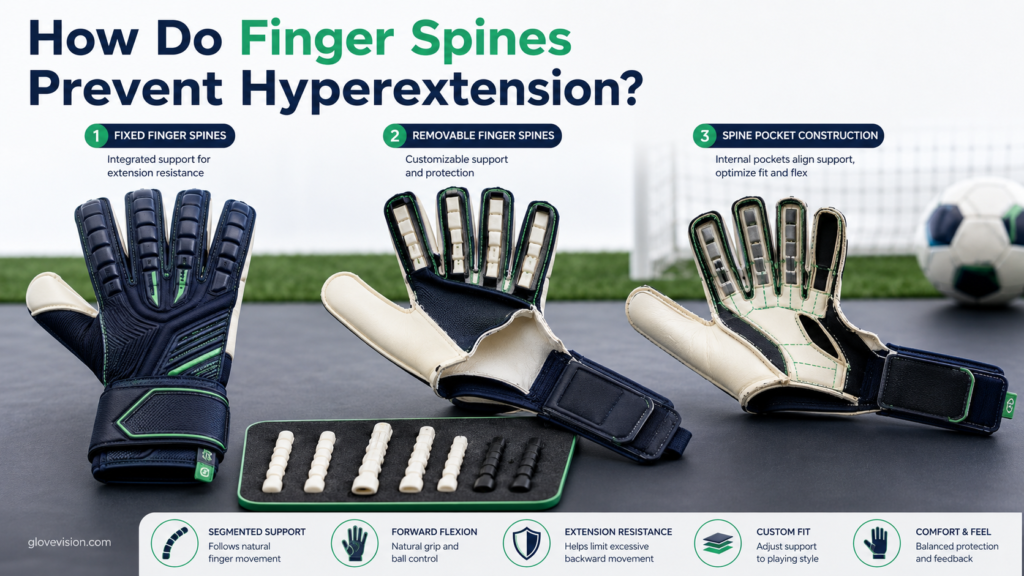
Goalkeeper Glove Finger Spines are structural support components designed to resist excessive backward finger movement while preserving enough forward flexion for hand opening, closure, and ordinary ball handling. Their job is directional support, not impact cushioning.
How much support they provide depends on the exact spine or frame architecture, stiffness, segmentation, coverage, alignment, glove fit, force direction, hand position, surrounding materials, support configuration, use history, and current condition. Fixed and removable systems should therefore be evaluated as parts of the complete goalkeeper glove rather than as standalone injury-prevention devices.
Educational and safety notice: Goalkeeper Glove Finger Spines may resist excessive backward finger movement, but they cannot guarantee prevention of hyperextension, fractures, sprains, dislocations, or other hand injuries. Follow the exact glove manufacturer’s sizing, support-configuration, use, care, inspection, and replacement instructions. Persistent or worsening pain, swelling, weakness, deformity, numbness, instability, or reduced finger movement should receive appropriate professional assessment rather than being managed through glove selection alone.
How Do Goalkeeper Glove Finger Spines Resist Hyperextension?
Goalkeeper Glove Finger Spines resist hyperextension by adding structural resistance when a supported finger is forced backward while allowing more useful flexion toward normal hand closure according to the exact support design.
Reusch describes its Ortho-Tec system as five individually removable, lightweight, highly bendable protection spines that follow natural finger movement and resist the fingers being pushed backward. [Ortho-Tec] Its separate Finger Support system uses five protection spines and is described by Reusch as reducing hyperextension risk while keeping the glove soft and flexible. [Finger Support]
What is finger hyperextension in goalkeeper-glove use?
For this page, hyperextension is the movement problem in which a finger is forced backward beyond its intended functional range. Ball contact can create a backward-extension event, but direction, contact point, loading severity, hand position, and support alignment can all differ.
How do back-bending supports respond?
A useful mechanism model is: backward movement → support engagement → increased structural resistance where designed → residual loading continues through the glove and hand. The support should not be described as completely stopping all backward movement.
How does segmentation permit forward flexion?
Articulated, hinged, flexible, or segmented structures can allow movement between sections so the fingers can still flex toward the palm. uhlsport, for example, describes FLEX FRAME as balancing digit stabilization with catching mobility and lists multiple frame architectures. [uhlsport]
Can spines distribute extension loading?
Correctly aligned supports may engage along a longer dorsal portion of the finger instead of leaving all resistance to one local point, but the exact distribution should not be assumed unless the finished system documents it.
How are spines different from padding?
Finger spines provide structural extension resistance. Foam or padding instead provides compressive cushioning and contact management. The broader framework for sports glove finger support and fit reinforces that support, fit, finger-box volume, and sport-specific movement must be evaluated together.
| Movement Stage | Support Response | Possible Contribution | Limitation |
|---|---|---|---|
| Normal finger position | Spine remains aligned along the intended dorsal finger zone | Adds structural support without needing to engage maximum resistance | Fit and architecture determine alignment |
| Forward flexion | Articulated or bendable structure allows palmward movement where designed | Preserves useful hand closure and finger mobility | Flexion effort varies by system |
| Backward extension begins | Support architecture engages against the reverse movement | Adds directional resistance to excessive extension | Residual loading still reaches the glove-hand system |
| Greater backward demand | Segments/frame resist further extension according to the exact design | May reduce excessive backward travel under some conditions | Cannot guarantee prevention of injury |
| Return to neutral | Support returns toward its normal shape if structurally sound | Restores intended configuration for later use | Damage or permanent deformation can change response |
Which Design Properties Control Goalkeeper Glove Finger Spines?
Goalkeeper Glove Finger Spines should be evaluated through their complete architecture because stiffness, segmentation, directionality, coverage, attachment, and glove fit interact to determine both resistance and mobility.
Manufacturer systems demonstrate that there is no single universal architecture. Reusch documents removable Ortho-Tec and a separate built-in Finger Support design, while uhlsport lists FLEX FRAME, FLEX FRAME CARBON, SUPPORTFRAME, and SUPPORTFRAME+. [Reusch] [uhlsport]
How does stiffness matter?
Greater stiffness may add more resistance to backward movement, but it can also increase flexion effort, pressure, bulk, and changes in tactile feedback. There is no universal stiffness recommendation.
How does segmentation matter?
Segment count, segment length, articulation, flexion zones, and backward engagement all influence how the support moves. More segments or hinges do not automatically establish better protection.
How does directionality matter?
Where the exact product documents it, a support may be easier to bend palmward than backward. That asymmetric behavior is central to preserving closure while resisting unwanted extension.
How does spine length matter?
Coverage can extend across distal, middle, or proximal finger zones and may interact with the knuckle or fingertip. Longer coverage is not automatically safer if it creates pressure or restricts needed movement.
How do fixed and removable systems differ?
Fixed supports remain integrated into the glove. Removable supports can be configured only where the manufacturer permits it, which adds pocket, orientation, insertion, and re-fit requirements. Configuration type is not a performance ranking.
How does spine material matter?
Material can affect flexibility, weight, recovery, fatigue, and environmental response, but polymer or composite composition should be named only when the manufacturer documents it. For example, uhlsport describes a plastic compound for FLEX FRAME and carbon-reinforced fibers for FLEX FRAME CARBON. [uhlsport]
| Design Variable | Possible Support Effect | Handling Effect | Verification Need |
|---|---|---|---|
| Stiffness | May increase backward resistance | May increase flexion effort or pressure | Do not assume rigid = safer |
| Flexibility | May improve natural finger movement | Too little resistance may not meet the intended support need | Verify exact system behavior |
| Segmentation | Can permit movement between support sections | More joints do not automatically mean better protection | Check exact architecture |
| Directionality | May allow easier palmward flexion than backward extension | Can influence closure and feel | Use only where documented |
| Spine length | Changes how much of the finger is structurally supported | Can affect fingertip freedom and knuckle interaction | Check coverage and alignment |
| Fixed construction | Maintains a stable integrated configuration | Less user configurability | Do not remove unless manufacturer intends removal |
| Removable construction | Allows approved support configuration changes | Orientation and pocket integrity become critical | Follow exact removal/reinstallation instructions |
How Do Goalkeeper Glove Finger Spines Affect Fit and Ball Handling?
Goalkeeper Glove Finger Spines affect handling because their physical volume, alignment, stiffness, surrounding padding, finger-stall geometry, and backhand integration can change hand closure, fingertip seating, ball feedback, and pressure.
How do finger stalls position supports?
Finger-stall length, width, fingertip position, spine pocket, backhand attachment, and seam placement determine whether the support stays centered over the intended finger.
How do glove cuts affect support fit?
Negative, roll, flat/classic, and hybrid cuts create different finger-box volumes and seam relationships. The cut should be judged by actual fit, palm tension, and support alignment rather than ranked universally.
How can spines affect closure?
Support stiffness and bulk can increase flexion resistance, reduce fingertip curl, or create dorsal pressure. The glove should still allow functional closure without forcing the hand against the support.
How can spines affect ball feedback?
Support stiffness, padding, finger sensitivity, internal stability, and overall glove weight can change how directly ball contact is felt. Support decisions should also be balanced against goalkeeper glove grip and durability because the complete glove still has to preserve useful grip, closure, and handling.
How does complete construction interact?
Palm latex, backhand material, padding, gussets, liner, cuff, seams, and wrist closure all affect where the support sits and how the hand moves. Reusch documents finger support alongside glove cuts, palms, backhand and wrist systems within the finished glove. [Reusch]
Why does poor fit reduce support quality?
Excess fingertip space, sliding, palm bunching, pressure, or whole-glove rotation can move the spine away from its intended centerline or make natural movement harder.
Where Does Goalkeeper Glove Finger Spines Protection End?
Goalkeeper Glove Finger Spines are directional support components, not complete injury-prevention systems, and they should not be represented as guaranteeing protection against hyperextension, fracture, dislocation, direct impact, abrasion, cuts, or wrist injury.
A prospective study of professional male soccer players found hand, wrist, and forearm injuries were more common in goalkeepers than outfield players and that fractures were a major injury category. The study did not test finger-spine effectiveness, so it supports injury relevance only—not a prevention claim. [Study]
Do spines prevent every hyperextension event?
No. Outcome can vary with force, direction, contact point, finger position, alignment, support architecture, fit, and pre-existing condition.
Do spines prevent fractures or dislocations?
No guarantee. Structural resistance to one movement direction should not be converted into a claim that fractures, dislocations, or sprains are prevented.
Do spines cushion impact?
Not by structural support alone. Cushioning belongs to foam, padding, and the surrounding glove construction.
Do spines provide cut or abrasion protection?
Not automatically. Those hazards require separate material or finished-product evidence.
Can spines compensate for poor fit?
No. A misaligned, oversized, overly tight, or rotating glove can undermine the support architecture.
Is maximum rigidity safer?
Not universally. Greater rigidity can create pressure, restricted closure, reduced feedback, poor fit, or reduced mobility. Other forms of protective glove structure and finger control belong to different hazard contexts and should not be transferred to goalkeeper finger spines without exact product evidence.
| Exposure / Concern | What Spines May Contribute | What They Do Not Prove | Separate Requirement |
|---|---|---|---|
| Excessive extension | Directional resistance to backward movement | Guaranteed hyperextension prevention | Exact support architecture and fit |
| Direct impact | Structural support may be present during contact | Impact cushioning | Padding/foam evidence |
| Fracture | May limit some backward movement | Fracture prevention | No guaranteed injury protection |
| Dislocation | May resist selected extension motion | Dislocation prevention | Medical assessment if injury occurs |
| Cut / abrasion | No automatic role | Cut or abrasion resistance | Separate material/rating evidence |
| Wrist injury | Finger spines do not stabilize the wrist by themselves | Wrist-injury prevention | Closure/support evaluation |
| Existing symptoms | Glove selection may change support feel | Diagnosis or treatment | Appropriate professional assessment |
Which Goalkeeper Glove Finger Spines Match Different Support Needs?
Goalkeeper Glove Finger Spines should be selected by balancing the actual need for backward-extension resistance against required finger flexion, anatomical fit, ball feedback, training volume, support configuration, and current hand condition.
adidas provides another manufacturer-specific example: its current Predator Match Fingersave product describes Fingersave technology in which the finger spines stiffen and resist pressure, integrated with the palm, backhand, and wrist construction of the finished glove. [adidas]
What if mobility is the priority?
Look for adequate directional resistance with articulation and natural closure, but do not automatically choose the most flexible system. Support still has to match the actual need.
What if extension resistance is the priority?
Evaluate architecture, coverage, engagement behavior, pressure, alignment, and closure rather than simply selecting the most rigid option.
What matters for developing goalkeepers?
Prioritize current anatomical fit, functional movement, and regular size reassessment. Do not oversize a support-equipped glove simply to allow for growth.
What matters for frequent practice?
Repeated flexion, pocket wear, structural fatigue, removable-component handling, and routine inspection become more important as use volume increases.
What if there has been a previous finger problem?
Do not use glove support as medical treatment. Persistent or recurrent symptoms require appropriate assessment.
Which evidence should be verified?
Confirm the exact glove, support technology, fixed or removable configuration, number of supported fingers, manufacturer sizing, removal instructions, care requirements, and replacement components. The broader principle behind protection and fingertip control trade-offs is also relevant: added protection should not be evaluated without checking whether required fingertip movement and control remain usable.
| Support Need | Prioritize | Trade-Off to Check | Decision Cue |
|---|---|---|---|
| Mobility priority | Adequate directional support with usable articulation | Too much stiffness or pressure | Natural opening/closure remains usable |
| Extension-resistance priority | Architecture, coverage, engagement and alignment | Reduced flexion or feedback | Resistance is useful without abnormal restriction |
| Developing goalkeeper | Exact current fit and regular size reassessment | Oversizing for growth | Finger/support alignment remains correct |
| Frequent practice | Durable pockets, consistent alignment and inspectable components | Repeated flexion and material fatigue | Inspect spines and pockets regularly |
| Previous finger problem | Professional assessment plus exact support need | Using a glove as treatment | Symptoms are not managed by glove choice alone |
| Adjustable support preference | Manufacturer-approved removable system | Wrong orientation or pocket damage | Removal/reinstallation is explicitly permitted |
How Should Goalkeeper Glove Finger Spines Be Fitted and Function-Checked?
Goalkeeper Glove Finger Spines should remain centered over their intended fingers while the complete glove fits securely enough to prevent migration yet allows comfortable hand opening, functional closure, finger flexion, thumb movement, and controlled ball interaction.
How should each spine align?
Check the finger centerline, intended coverage, fingertip relationship, knuckle relationship, pocket stability, and absence of sideways migration.
How should size be checked?
Use the exact manufacturer chart and consider hand length, palm width, finger length, finger width, fingertip seating, and wrist position.
How should movement be checked?
Confirm full hand opening, functional closure, individual finger flexion, thumb movement, and comfortable wrist motion without painful pressure.
How should ball interaction be checked?
Use ordinary controlled ball interaction only. The glove should remain stable, close naturally, avoid internal slipping, preserve acceptable feedback, and create no painful pressure. This is a function check, not goalkeeper coaching.
How should removable supports be checked?
Only where removal is manufacturer-approved, verify the correct spine, correct pocket, correct orientation, full insertion, secure pocket closure, no twisting, and repeat the complete fit test after reinstallation.
What fit problems require rejection?
Pain, numbness, excessive pressure, spine migration, unstable hand position, restricted closure, excess fingertip slack, or persistent misalignment require reassessment. The broader relationship between palm fit and grip stability reinforces why support cannot compensate for bunching, unstable internal movement, or an incorrectly fitted glove.
| Check | What to Verify | Why It Matters | Reject / Reassess If |
|---|---|---|---|
| Exact model | Named support technology and intended configuration | Prevents guessing how the system works | Support type cannot be verified |
| Manufacturer size | Use exact sizing guidance | Finger-box volume changes alignment | Glove is too tight or too loose |
| Finger alignment | Each spine follows its intended finger centerline | Misalignment can create pressure or weak support | Spine drifts sideways |
| Fingertip space | Finger seats correctly without excessive slack | Too much space can shift support position | Excess slack or fingertip compression |
| Hand opening | Full natural opening remains possible | Support should not block usable extension | Opening is restricted |
| Hand closure | Functional closure remains comfortable | Rigid structures can resist flexion | Closure is painful or incomplete |
| Ball feedback | Contact remains predictable for intended use | Added structure can alter feel | Feedback is unacceptable |
| Pressure | No painful dorsal or side pressure | Concentrated pressure is a fit failure | Pain or numbness appears |
| Wrist position | Glove remains secure without rotating | Whole-glove shift changes spine alignment | Glove migrates during movement |
How Should Goalkeeper Glove Finger Spines Be Maintained and Troubleshot?
Goalkeeper Glove Finger Spines should be maintained according to the exact finished-glove instructions because removable-support handling, washing, drying, storage, pocket construction, palm materials, and support components differ between products.
Reusch’s goalkeeper care instructions give brand-specific cleaning, air-drying, and storage guidance, which illustrates why care should remain tied to the exact glove rather than generalized across all support systems. [Care]
How should cleaning be handled?
Verify whether supports remain installed or may be removed, along with the exact water, cleaning-agent, washing, palm, and liner instructions. Never prescribe universal spine removal.
How should drying and storage be handled?
Follow the manufacturer’s guidance for ventilation, heat restrictions, pocket drying, shape preservation, and storage. Do not heat-reshape, permanently bend, or crush supports unless the product expressly allows a process.
What should inspection look for?
Check cracks, breaks, missing pieces, permanent deformation, sharp edges, segment separation, unusual flexibility, pocket tears, migration, and closure failure.
Why can support become too flexible?
Possible causes include fatigue, breakage, material degradation, incorrect installation, or pocket damage. Do not diagnose material failure from feel alone.
Why can closure become restricted?
Check size, orientation, alignment, spine architecture, glove cut, current finger condition, and support damage.
Can damaged spines be repaired?
Only through a manufacturer-approved component or process. Do not glue, tape, heat-reshape, cut shorter, add improvised inserts, or mix incompatible supports.
When should support be replaced?
Reassess or replace when a segment breaks, a spine permanently deforms, resistance becomes unreliable, a sharp edge develops, migration persists, a pocket tears, closure fails, fit becomes unstable, or movement becomes painful or abnormally restricted.
| Symptom | Possible Cause | What to Inspect | Next Decision |
|---|---|---|---|
| Weak support | Fatigue, breakage, wrong orientation or pocket damage | Each spine, segment and pocket | Replace approved component or glove if unreliable |
| Restricted closure | Wrong size, excessive stiffness, misalignment or damaged support | Finger flexion and glove cut | Resize or choose another system |
| Spine migration | Loose pocket, wrong insertion or poor fit | Pocket closure and support seating | Reinstall only if approved; replace if migration persists |
| Concentrated pressure | Misalignment, wrong size or sharp/damaged segment | Dorsal finger contact and edges | Stop use and reassess |
| Uneven support | Different spine conditions or pocket positions | All fingers side by side | Replace damaged components as approved |
| Sharp contact | Crack, break or exposed edge | Spine surface and pocket integrity | Do not continue use |
| Unstable handling | Whole-glove fit, palm shift or support conflict | Palm, finger box and wrist closure | Choose a better-fitting complete glove |
| Area | Check | Rule | Replacement / Reassessment Trigger |
|---|---|---|---|
| Exact instructions | Product-specific cleaning and care | Do not universalize one brand routine | Instructions cannot be followed or support is uncertain |
| Removal permission | Whether supports may be removed | Never remove fixed systems | Removal is not explicitly approved |
| Reinstallation | Correct spine, pocket, orientation and full insertion | Re-test fit after installation | Twisting or migration persists |
| Drying | Manufacturer-approved method and heat limits | Avoid unsupported heat reshaping | Material or pocket damage develops |
| Storage | Shape and support position | Avoid unapproved crushing/bending | Permanent deformation appears |
| Spine condition | Cracks, breaks, sharp edges or excessive flexibility | Inspect every support | Directional resistance becomes unreliable |
| Pocket condition | Tears, opening or support movement | Pocket must retain the spine correctly | Support cannot stay centered |
| Alignment / fit | Finger seating, pressure and closure | Whole-glove fit controls support position | Pain, numbness or unstable fit |
| Unauthorized repair | No glue, tape, cutting, heating or improvised inserts | Use approved components/process only | Replace rather than improvise |
How Should Goalkeeper Glove Finger Spines Be Chosen to Reduce Hyperextension Risk?
Goalkeeper Glove Finger Spines should be chosen by defining the actual support requirement first and then verifying the support architecture, backward resistance, forward flexion, complete-glove fit, spine alignment, ball handling, maintenance requirements, and current condition.
Which final questions should be answered?
Identify whether extra support is wanted, which fingers need it, the exact support system, fixed or removable architecture, remaining flexion, alignment, complete-glove fit, hand opening and closure, ball feedback, pressure, removal instructions, care practicality, structural inspectability, approved replacement options, and whether symptoms need professional assessment.
Which final rule should guide selection?
Choose the complete goalkeeper glove whose Goalkeeper Glove Finger Spines provide the required extension resistance without creating unacceptable loss of anatomical fit, finger flexion, hand closure, ball feedback, comfort, or structural reliability.
Conclusion
Goalkeeper Glove Finger Spines can reduce excessive backward finger movement when their directional support architecture remains correctly aligned and compatible with the goalkeeper’s complete glove fit, finger flexion, hand closure, ball handling, maintenance requirements, and current structural condition.
Spines resist movement; foam cushions contact; palm latex supports ball contact; and wrist closures stabilize the glove. No system guarantees injury prevention, rigid is not universally safer, flexible is not universally better, fixed and removable systems are not performance rankings, and damaged or poorly aligned support should be reassessed rather than modified with improvised repairs.
Frequently Asked Questions
Do Goalkeeper Glove Finger Spines Prevent Hyperextension Completely?
No. They can provide resistance against excessive backward movement, but severe, concentrated, misdirected, or poorly aligned loading can still result in injury.
Are Rigid Goalkeeper Glove Finger Spines More Protective?
Not automatically. Greater stiffness may increase backward resistance while also increasing flexion effort, pressure, bulk, or loss of natural closure.
Are Removable Goalkeeper Glove Finger Spines Better Than Fixed Spines?
Not universally. Removable supports offer configuration flexibility where permitted, while fixed supports remain integrated into the glove. Suitability depends on design, fit, support requirement, movement, care, and condition.
Can Goalkeeper Glove Finger Spines Be Removed for More Flexibility?
Only when the exact glove is designed for removable supports and the manufacturer permits their removal. Removing a support changes the glove’s structural configuration and may change fit.
When Should Goalkeeper Glove Finger Spines Be Replaced?
Replace an approved removable support or the complete glove when a spine cracks, breaks, permanently deforms, shifts repeatedly, develops sharp edges, loses reliable directional resistance, causes abnormal restriction, or can no longer remain correctly aligned.